Token Budgeting as a First-Class Design Constraint in Agentic and RAG Workflows
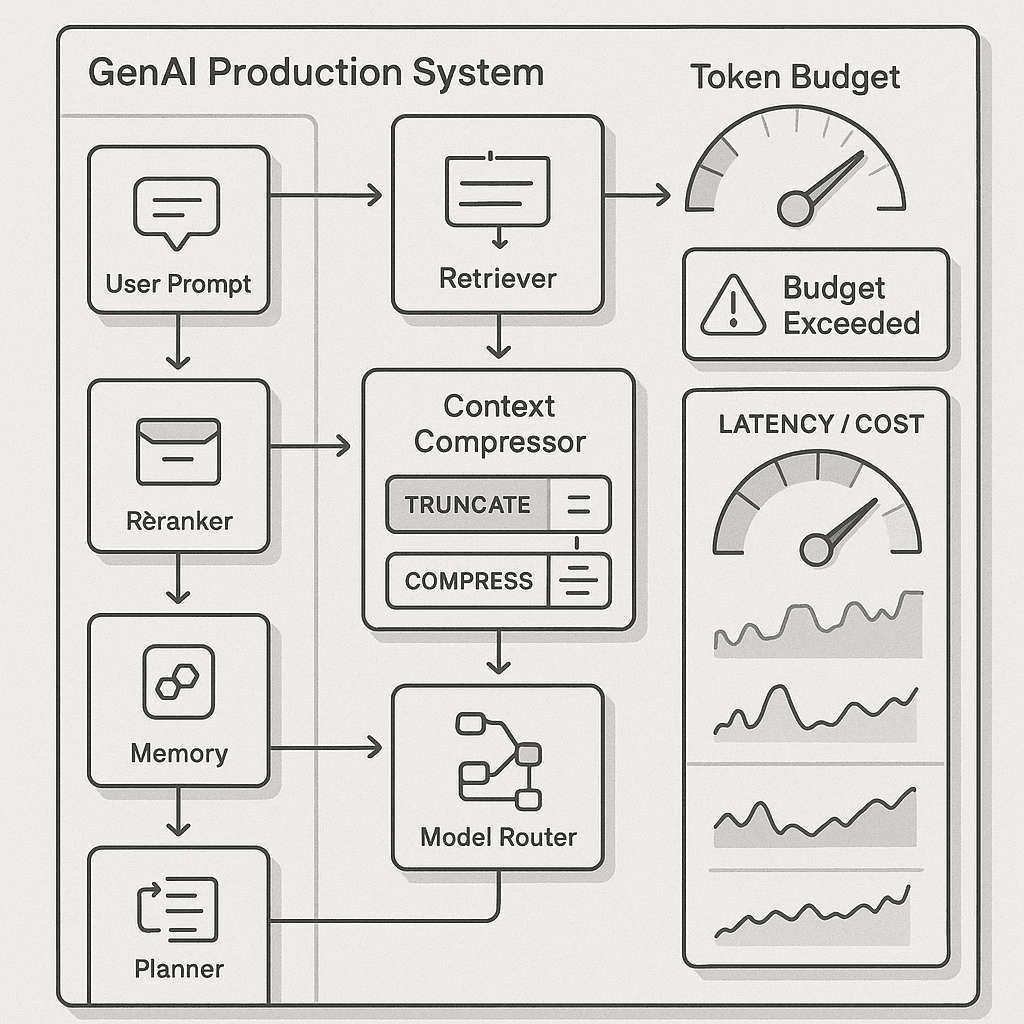
Most teams discover token budgeting the hard way: not in a design review, but in production, after an apparently healthy assistant starts getting slower, more expensive, and less reliable as usage grows.
A common pattern looks like this. The first version of the system works in staging with short prompts and a handful of documents. Then product adds conversation memory. Retrieval starts returning more chunks “to improve recall.” Tool use is added, along with chain-of-thought-like planning scaffolds, verbose tool schemas, and multi-step retries. A second model is inserted for reranking or critique. Everything still works in demos because test cases are moderate in size.
Then real traffic arrives.
A customer pastes a 4,000-token incident report. The retriever returns 12 chunky passages because the top-k was tuned for benchmark accuracy rather than context efficiency. The planner model emits a long action trace. A SQL tool returns 300 rows. The agent retries twice because the first tool call was malformed. Conversation history is appended “just in case.” The final answer step now receives a swollen prompt assembled from partially duplicated context, irrelevant retrieval, stale memory, and too much tool output. Latency spikes. Cost per task jumps. The model starts ignoring critical instructions in the middle of the prompt. On bad days, requests exceed the context window and fail; on worse days, they fit, but quality collapses in a way that is harder to detect.
That failure mode is not really about prompting. It is an architecture problem.
If you are building agentic or retrieval-augmented systems, token consumption is not a secondary optimization. It is a first-class design constraint, on the same level as latency, availability, and correctness. Tokens determine whether your workflow fits at all, how much context can be carried across steps, whether a cheaper model can be used, how much retrieval evidence can be shown, how many retries are safe, and how much margin exists for pathological inputs.
The practical shift is to stop asking, “What is the best prompt?” and start asking, “What is the token budget envelope for this workflow, stage by stage, in the worst plausible case?”
Once you do that, many design decisions become clearer:
- How much of the user input can be passed raw versus summarized.
- How many retrieved chunks are allowed into generation.
- Whether tool results should be schema-constrained summaries instead of raw payloads.
- When to switch to a larger-context model versus compress context.
- When to terminate an agent loop because there is not enough budget left to finish well.
- What telemetry must be emitted so token creep is visible before spend and quality blow up.
The rest of this article is a production-focused guide to designing with token budgets explicitly across prompts, retrieval, memory, tools, and multi-step agent loops.
The pattern behind runaway token usage
Most runaway token incidents share the same underlying shape: each subsystem is locally rational and globally reckless.
The retrieval team increases top-k because recall improved in offline tests. The prompt engineer adds more examples because answer quality improved on a benchmark. The agent framework logs every intermediate thought and tool result because debugging became easier. The memory subsystem keeps more turns because personalization got better. Each change helps in isolation. Together they create a context assembly process with no global budget discipline.
That is why naive token control often fails. Teams try one or more of these tactics:
- Set a model with a large context window and hope it absorbs growth.
- Add a truncation step at the very end.
- Cap output tokens only.
- Reduce top-k globally.
- Use a cheaper model without changing prompt shape.
These are partial controls, not architecture.
A bigger context window delays the problem but usually worsens cost and often hides poor retrieval hygiene. Last-minute truncation is especially dangerous because it cuts whatever happened to come last in the assembly order rather than what matters least. Output caps prevent only one class of overrun; they do not protect input cost or prompt quality. Global top-k reductions often trade away accuracy because they ignore query difficulty. Cheaper models are more sensitive to prompt clutter and may degrade faster under the same token load.
The right mental model is closer to resource planning in distributed systems. You do not let every service use arbitrary CPU, memory, and retries just because each service can justify its own behavior. You define budgets, backpressure, routing, and observability. Token budgeting should work the same way.
Treat the workflow as a tokenized pipeline
The most useful design move is to define token accounting per stage, not just per request.
For a typical agentic RAG workflow, the stages often look like this:
- User input intake
- Instruction scaffold and system prompt
- Conversation memory inclusion
- Query rewriting or decomposition
- Retrieval candidates
- Reranking or filtering
- Context compression or citation packing
- Planner / action selection
- Tool schema injection
- Tool outputs
- Final synthesis response
- Retry or repair loop allowance
For each stage, define:
- Expected tokens: median/typical
- P95 tokens: heavy but normal
- Worst-case cap: hard upper bound
- Whether the stage is elastic or fixed
- What degrades if the stage is compressed or removed
- Which fallback policies apply
A simple budget table for a support copilot might look like this:
| Stage | Typical | P95 | Hard cap | Notes |
|---|---|---|---|---|
| System instructions | 600 | 600 | 700 | Mostly fixed |
| User message | 300 | 2,500 | 4,000 | Highly variable |
| Conversation summary | 200 | 500 | 700 | Replace raw history |
| Query rewrite | 100 | 150 | 200 | Separate model step |
| Retrieval payload | 1,200 | 2,500 | 3,000 | Post-compression |
| Tool schema | 400 | 700 | 900 | Depends on enabled tools |
| Tool outputs | 500 | 2,000 | 2,500 | Summarize raw outputs |
| Final response allowance | 500 | 900 | 1,200 | User-visible output |
| Retry reserve | 0 | 500 | 1,000 | For repair loop |
| Total | 3,800 | 10,350 | 14,200 | Against model context cap |
This kind of table immediately exposes what usually remains hidden:
- User input variability dominates many workflows.
- Retrieval payload is often the biggest controllable contributor.
- Tool outputs are the most underestimated source of prompt bloat.
- Retry reserve needs to be budgeted in advance rather than “borrowed” from the final answer step.
If your model has a 16k context window, a 14.2k worst-case input budget may still be unsafe because you need output headroom and some margin for tokenization variance. In practice, many teams should target 70–85% of the hard context limit for planned input+output combined, depending on reliability requirements.
Budget envelopes beat single-number caps
A single max token setting is too blunt. What you want is a budget envelope: a policy that defines how much each stage may consume and in what order tradeoffs occur when pressure rises.
A budget envelope should answer questions like:
- If the user input is unusually large, which stage shrinks first?
- If retrieval evidence is abundant, do we cut the number of chunks, compress each chunk, or switch models?
- If a tool returns too much data, do we summarize it, sample it, or request a narrower tool query?
- If a plan requires multiple agent turns, how much budget must remain before starting the next turn?
A good envelope usually distinguishes between fixed, elastic, and reserve budgets.
Fixed budget
These are the tokens you intentionally keep stable because quality depends on them.
Examples:
- Core system instructions
- Safety and formatting requirements
- Output schema definition
- Minimal tool usage guidelines
Fixed budget should be aggressively edited for clarity and compactness. Long prompts with duplicated rules often look “safe” but are actually fragile because critical instructions get diluted.
Elastic budget
These tokens can grow or shrink based on request complexity.
Examples:
- Retrieved evidence
- Memory summary detail
- Few-shot examples
- Tool output excerpts
Elastic budget should be managed by ranking and compression policies, not raw truncation.
Reserve budget
This is the margin you intentionally leave unused at the start so the system can handle uncertainty.
Examples:
- Output allowance
- Repair turn budget for malformed tool calls
- Extra retrieval pass allowance
- Escalation to a larger model if the small model fails
Reserve budgets are the difference between a system that works in the median case and one that survives the tail.
Why naive truncation fails
When systems finally hit token limits, the first patch is usually to truncate the assembled prompt to fit. This is one of the worst habits in production LLM design.
Naive truncation fails for three reasons.
First, prompt order is not importance order. Many systems append the newest retrieval items or tool outputs last, which means a hard cut may remove the exact evidence needed for the answer.
Second, truncation preserves redundancy. If the prompt contains duplicated instructions, near-duplicate chunks, and verbose tool traces, truncation removes some suffix but leaves waste elsewhere untouched.
Third, truncation breaks hidden dependencies. A final generation step may contain references like “based on the previous tool result” or “using the following citations,” and truncation may sever that supporting context without producing a hard error.
Better systems do hierarchical reduction instead:
- Remove low-value redundancy first.
- Compress verbose sections into structured summaries.
- Drop low-ranked evidence.
- Reduce example count.
- Replace raw history with summary.
- Only as a last resort, truncate within a section that has its own semantic boundaries.
Think in terms of semantic compaction, not character cutting.
Retrieval is usually the highest-leverage token control point
In RAG systems, retrieval payloads are often where token discipline has the biggest payoff. Teams spend a lot of time tweaking answer prompts while shipping retrievers that dump too much text into generation.
There are four common anti-patterns.
1. Top-k tuned for benchmark recall, not generation efficiency
A retriever might perform best at top-10 for document relevance, but generation may perform better with the best 3 compressed passages than 10 mediocre ones. Offline retrieval metrics do not automatically translate to answer quality under context constraints.
2. Chunking for indexing, not for downstream prompting
Large chunks can improve recall but often waste tokens because only a few sentences matter. Tiny chunks can force inclusion of too many fragments and lose coherence. Chunking should be co-designed with what the generator can actually use.
3. No deduplication or overlap control
Adjacent chunks from the same source frequently repeat context. If you include multiple overlapping chunks, token waste rises fast.
4. Raw passage injection without compression
Many teams retrieve relevant text and paste it directly into the final prompt. This is easy but expensive. A better pattern is retrieve broadly, then compress narrowly.
A stronger retrieval architecture often looks like this:
- Retriever returns candidate chunks with metadata.
- Reranker scores them for answer usefulness, not just lexical/semantic similarity.
- Deduper removes high-overlap chunks.
- Context packer assembles a bounded evidence set.
- Optional compressor rewrites each chunk into a citation-preserving summary.
- Generator receives only the packed evidence budget.
This design adds one extra step but usually lowers both cost and quality variance.
Practical retrieval budget policies
A few patterns work well in production:
- Per-source caps: Avoid letting one long document consume the whole budget.
- Diversity constraints: Keep evidence from multiple sources when tasks require cross-document synthesis.
- Adaptive top-k: Increase candidate count only for hard or ambiguous queries.
- Sentence extraction before passage inclusion: Include only relevant spans instead of whole chunks when your stack supports it.
- Compression with citation anchors: Summarize retrieved content into fewer tokens while preserving source references.
An example policy:
- Retrieve top 20 candidates.
- Rerank to top 8.
- Remove overlaps above a similarity threshold.
- Cap to 2 chunks per source.
- Compress into at most 1,800 tokens total.
- If user input is over 2,000 tokens, retrieval budget drops to 1,200.
That last line is important: context stages should compete for a shared budget. User input growth should force retrieval discipline rather than simply inflating total request size.
Memory is useful, but raw history is a token trap
Conversation history is one of the fastest ways to destroy token efficiency. Teams often append the last N turns or, worse, the full thread. This feels safe because maybe something in prior turns will matter. In practice, most raw history is low-value clutter.
The better pattern is memory stratification:
- Working memory: short-lived details relevant to the current task
- Session summary: compact running summary of the conversation
- Durable memory: user/profile facts stored outside the prompt and retrieved selectively
Only a small amount of working memory should be passed raw. Session memory should usually be summarized, not replayed. Durable memory should be fetched by relevance, not appended by default.
A common production policy is:
- Keep the last 1–2 turns raw.
- Maintain a session summary capped at a fixed budget, say 200–500 tokens.
- Store extracted durable facts separately with confidence and recency metadata.
- Inject only durable facts relevant to the current task.
The important architectural idea is that memory should be treated like retrieval: it needs its own retrieval, ranking, and compression discipline.
Tool traces and tool outputs are where agent systems quietly bleed tokens
Agent systems often look affordable in simple demos because tool calls are mocked or small. In production, tools return real payloads: JSON blobs, search results, log excerpts, SQL rows, API responses, stack traces.
Passing these raw outputs back into the model is one of the biggest hidden token multipliers.
Three rules help a lot.
1. Models should rarely see raw tool payloads
Instead, insert a tool adapter layer that converts raw tool responses into compact, schema-constrained summaries tailored to what the model needs next.
For example, instead of showing 300 order records, provide:
- Count of matching records
- Top anomalies
- Aggregates
- Representative examples
- IDs available for drill-down
2. Tool schemas should be minimal
Verbose natural-language tool descriptions and giant JSON schemas consume context every turn. Split tools by purpose, reduce optional parameters, and avoid injecting tools irrelevant to the current route.
Dynamic tool availability is a direct token optimization. If a request only needs retrieval and summarization, do not include CRM, SQL, and web-browsing tools in the action prompt.
3. Agent traces need different representations for execution and observability
You may want detailed traces for debugging, but the model does not need all of them in-context. Store full traces externally. Feed the model only the minimum state required to continue.
This distinction is critical. Many frameworks blur “what the system records” with “what the model sees.” Those should be separate channels.
Budget-aware routing should decide model, workflow, and context policy
Token budgeting is not just about making one prompt smaller. It should influence routing decisions.
A budget-aware router can make choices such as:
- Use a cheaper small-context model if the request fits comfortably.
- Switch to a larger-context model only when compression would likely hurt answer quality.
- Skip agent planning and use direct RAG for simple factual queries.
- Disable expensive critique or self-repair loops when remaining budget is insufficient.
- Route to extractive answers when evidence volume is high but synthesis requirements are low.
A simple decision policy might use:
- Estimated input tokens from user content
- Predicted retrieval volume
- Need for tools
- Required output length
- SLA tier
- Remaining account or session spend budget
For example:
- If estimated full workflow token use < 6k, use Model A with direct RAG.
- If 6k–18k and synthesis complexity high, use Model B with compression.
- If >18k and user asked for broad analysis, require pre-summarization stage or chunked processing.
- If tool output predicted >3k, execute tool summarizer before final generation.
This is where cost and latency tradeoffs become explicit.
Larger-context models reduce orchestration complexity but often cost more and can still underperform if prompts are bloated. Smaller models with compression/reranking stages add engineering complexity but can materially reduce spend and improve predictability. There is no universal winner. The correct choice depends on traffic shape, SLA, and tolerance for implementation complexity.
A concrete reference architecture
A practical production architecture for token-aware agentic RAG often includes the following components:
-
Token estimator
- Estimates token load before each model call.
- Uses model-specific tokenization estimates.
- Computes both current total and remaining reserve.
-
Budget policy engine
- Stores per-workflow envelopes.
- Applies stage caps and fallback rules.
- Makes routing decisions when pressure rises.
-
Retriever + reranker
- Fetches broad candidates.
- Produces a high-value shortlist.
-
Context packer
- Deduplicates, diversity-balances, and orders context.
- Enforces retrieval token cap.
-
Context compressor
- Summarizes or extracts the salient parts of long evidence.
- Preserves citations and metadata.
-
Memory manager
- Maintains raw recent turns, running summary, and durable memory store.
- Injects only policy-approved memory slices.
-
Tool adapter layer
- Transforms tool schemas into compact forms.
- Converts raw tool outputs into bounded summaries.
-
Agent loop controller
- Tracks cumulative spend and remaining context budget.
- Refuses another iteration if there is not enough budget left for a credible finish.
-
Model router
- Chooses model and workflow path based on budget, complexity, and SLA.
-
Observability pipeline
- Emits token metrics per stage, per request, per customer, per workflow version.
- Supports regression detection and budget drift alerts.
The key is that token management lives in dedicated components, not scattered across ad hoc prompt templates.
Implementation details that matter more than teams expect
Use model-specific token accounting
Character count is not sufficient. Different models tokenize differently, and multilingual or code-heavy inputs can skew estimates. Use the actual tokenizer when possible, and store estimated versus actual token usage so estimation error can be monitored.
Budget before every model call, not just the final one
Multi-step systems often estimate only the final synthesis prompt. That misses the cumulative effect of planner calls, rewrite calls, repair calls, and tool-result reinsertion. Every call should have a preflight estimate and post-call accounting.
Reserve output tokens explicitly
If a model call needs up to 800 output tokens, do not assemble inputs until the context window is 100% full and then hope the output fits. Reserve output space upfront.
Order context by utility under compression
When budget shrinks, the system should know which evidence survives first. Establish deterministic packing order based on utility scores, not assembly convenience.
Make compression task-specific
Compression should not be generic “summarize this text.” The compressor should know the downstream task: answer a question, extract entities, compare vendors, classify root cause, draft email response. Task-aware compression preserves the right details.
Prefer structured intermediate representations
Free-form text expands. Structured fields constrain token growth.
Examples:
- Replace narrative memory with key-value facts + short summary.
- Replace full tool outputs with typed result objects.
- Replace verbose reranker explanations with scores and evidence spans.
Enforce max tool payloads at the tool boundary
Do not rely on the LLM layer to clean up oversized tool responses. The tool interface itself should support pagination, field selection, row limits, and aggregation modes.
Stop agent loops based on finishability, not iteration count alone
A fixed max-steps policy is necessary but insufficient. An agent with two steps remaining but only 600 tokens left may be unable to complete successfully. Add a finishability check: “Do we have enough budget left for at least one tool use plus final synthesis?” If not, compress, hand off, or terminate gracefully.
Evaluation strategy: token-aware evals, not just answer-quality evals
One of the most common mistakes is evaluating only task accuracy or answer preference while ignoring token behavior. A workflow that scores slightly better offline but doubles prompt size can be a production regression.
Your eval suite should include token-aware metrics such as:
- Input tokens per stage
- Output tokens per stage
- Total tokens per completed task
- Tokens per successful answer
- Cost per successful answer
- Latency per token bucket
- Overflow/truncation rate
- Compression rate by stage
- Retrieval waste ratio: retrieved tokens versus cited/used tokens
- Tool payload inflation ratio: raw tool tokens versus summarized tool tokens
- Agent loop token burn by iteration
Segment these by:
- Workflow type
- Customer tier
- Query length bucket
- Complexity label
- Model version
- Prompt version
- Language
Build worst-case eval sets
Median-case testing is not enough. You need adversarial or tail-heavy eval sets containing:
- Very long user inputs
- Retrieval-heavy queries with many near-duplicate documents
- Tools returning large payloads
- Long-running conversations
- Inputs mixing prose, tables, code, and logs
- Ambiguous tasks that trigger retries
For each scenario, define pass/fail thresholds not just for answer quality but for budget integrity:
- Must complete under cost cap X
- Must stay under latency SLO Y
- Must not exceed context envelope Z
- Must preserve required citation accuracy after compression
Compare architectures, not just models
A useful experiment matrix often looks like this:
- Direct RAG vs RAG + rerank + compression
- Raw memory vs summary memory
- Raw tool outputs vs summarized tool outputs
- Single large-context model vs smaller model + preprocessing
- Fixed top-k vs adaptive top-k
You will often find that architecture changes beat model changes on cost-quality balance.
Cost and latency tradeoffs: the honest version
There is no free lunch in token budgeting.
Compression, reranking, and query rewriting add extra model calls and orchestration latency. Sometimes they save money overall; sometimes they do not. The right answer depends on how often they prevent much larger downstream prompts.
A useful heuristic:
- If preprocessing removes a small amount of context only occasionally, it may not be worth the added complexity.
- If preprocessing consistently shrinks large retrieval/tool payloads before expensive synthesis calls, it often pays for itself quickly.
For example, imagine a final synthesis model is expensive and receives 5,000 retrieval/tool tokens per request. A lightweight compressor model that reduces that to 1,500 tokens may add 300 ms and a small cost, but if the system runs at scale, the net savings and latency stability can be substantial.
On the other hand, inserting three extra LLM stages into a workflow where prompts are already small can increase tail latency for little gain.
That is why token budgeting should be empirical. Instrument the actual token flows, then decide where intervention pays off.
Observability patterns that prevent silent budget drift
Budget failures are often gradual. Nobody notices the 8% increase from a bigger tool schema, the 12% increase from adding another few-shot example, and the 15% increase from retrieval overlap until monthly spend jumps or latency SLOs start failing.
You need observability that makes token drift obvious.
At minimum, log for every model call:
- Workflow ID and version
- Model name
- Input tokens total
- Output tokens total
- Token breakdown by stage
- Estimated versus actual token difference
- Number of retrieved chunks and packed chunks
- Tool count and tool payload sizes
- Memory tokens injected
- Retry count
- Cost estimate
- End-to-end latency
- Outcome label: success, fallback, overflow prevented, overflow occurred
Then build dashboards for:
- Total tokens per request over time
- Token composition by stage
- P50/P95/P99 token usage
- Cost per successful task
- Overflow prevention events
- Compression activation rate
- Budget policy fallback rates
- Token drift by prompt version
- Token drift by customer tenant
Alert on:
- Sudden step-up in average retrieval tokens
- Rising tool payload inflation ratio
- Increased frequency of near-limit requests
- Higher failure rate for long-input segments
- Drop in answer quality correlated with aggressive compression
This is the operational equivalent of memory and CPU dashboards in traditional systems. Without it, token problems remain anecdotal until they become expensive incidents.
A practical budget policy for an agentic support workflow
To make this concrete, here is a sample policy for a support assistant that can search knowledge base articles, inspect order history, and draft responses.
Context and goals
- SLA target: sub-6s P95
- Cost target: under a fixed per-resolution threshold
- Models: small model for rewrite/compression, medium model for synthesis, larger model only for escalation
- Tools: KB search, order API, ticket history
Budget envelope
- Hard total context target: 12k input + 800 output reserve
- Safety margin below model max: 15%
- Max agent iterations: 3
- Minimum remaining budget to start a new iteration: 2k
Stage allocations
- System prompt: 500 fixed
- User message: cap raw at 3k, summarize excess into 400-token issue abstract
- Session memory: last 1 turn raw up to 300, running summary up to 250
- Query rewrite: separate small-model step capped at 120
- Retrieval evidence: 1.5k normal, 2.2k max after compression
- Tool schemas: dynamic, max 500 based on route
- Tool outputs: each summarized to 400 max, aggregate cap 1.2k
- Final response: reserve 800
- Repair reserve: 700
Policies
- If user input > 3k, summarize before retrieval.
- If retrieval candidates exceed budget, compress and retain citations.
- If both retrieval and tool output are needed, retrieval budget shrinks by 20%.
- If remaining budget < 2k after a tool call, skip further planning and synthesize best-effort answer.
- If estimated full request > envelope after compression, escalate to larger-context model or return a narrowing question.
Why this works
The workflow protects the final synthesis stage, constrains tools, and treats summarization as a pressure-relief valve rather than a universal default. It also acknowledges that not every request should proceed to full agentic exploration if there is no budget left to finish responsibly.
What teams should do in the next two weeks
If your system already exists, you do not need a grand rewrite to get value from token budgeting. Start with these steps.
1. Instrument token usage by stage
If you only know total prompt tokens, you are flying blind. Add stage-level accounting first.
2. Build a worst-case budget table for each major workflow
Not just averages. Write down typical, P95, and hard caps.
3. Identify the top two elastic contributors
Usually retrieval payloads, memory, or tool outputs. Fix those before micro-optimizing prompt wording.
4. Add one compression layer where it has highest leverage
For many teams, this is either retrieval packing or tool output summarization.
5. Introduce a finishability check in agent loops
Do not let the agent spend the last of the budget on one more exploratory step when it cannot complete the task afterward.
6. Add dashboards and alerts for token drift
Treat budget regressions like latency regressions.
7. Update evals to include cost and token metrics
A better answer that is twice as expensive may still be the wrong production choice.
The real takeaway
Token limits are not just model constraints. They are system design constraints.
Once you treat tokens as a first-class resource, you start designing workflows differently. Retrieval becomes selective and compressed. Memory becomes layered and queryable. Tools become bounded and summarized. Agent loops become budget-aware instead of open-ended. Model routing becomes a policy decision, not a static configuration.
This shift does more than reduce spend. It prevents a subtler failure mode: quality collapse under context pressure. Many systems do not fail cleanly when prompts get too big. They simply become noisier, less grounded, slower, and more erratic. Those are harder incidents to debug than a hard context overflow.
The teams that ship reliable GenAI systems are usually not the ones with the fanciest prompts. They are the ones that know, at every stage of a request, how many tokens they are spending, why they are spending them, what the worst case looks like, and what policy kicks in when the budget gets tight.
In other words: they budget tokens the way mature teams budget every scarce production resource.
And that is exactly what tokens are.