Testing and Hardening Structured Output Pipelines for LLM Systems
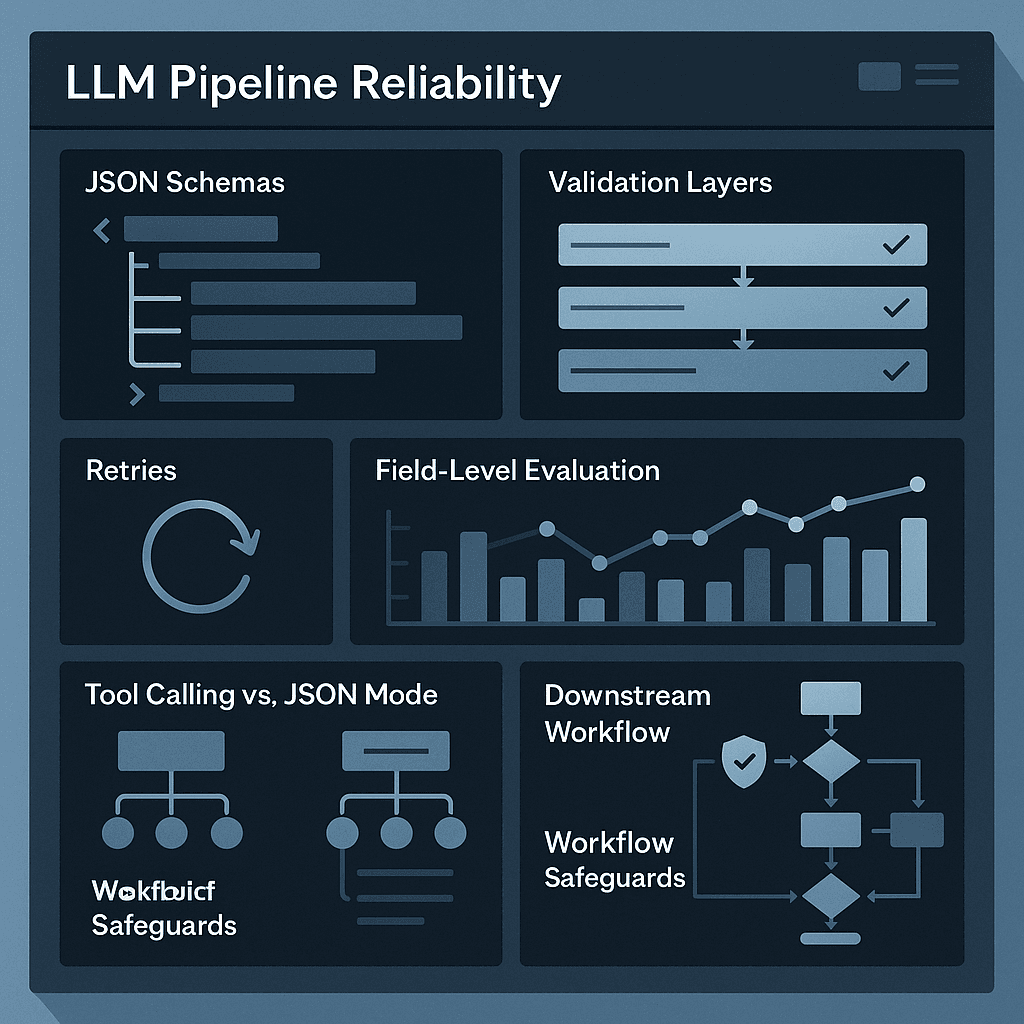
The incident usually starts small.
A support automation pipeline has been running fine for weeks. An LLM reads inbound tickets, extracts customer identity, issue category, priority, product line, refund eligibility, and a handful of routing tags. The system expects a clean JSON object, validates a few required fields, and forwards the result into CRM updates, queue routing, and in some cases immediate customer messaging.
Then one Friday evening, a model update, prompt change, or seemingly unrelated tool addition causes a subtle shift. The model still returns valid JSON. The parser is happy. But priority starts drifting from the allowed enum values of low | medium | high to strings like urgent or normal-high. The refund_eligible field flips from boolean to a sentence in 2% of cases. The customer_id field remains syntactically correct but occasionally contains an email address instead of the canonical internal ID because the model found a more salient identifier in the input.
No exception fires. No pager goes off. The workflow keeps moving.
Now tickets route to the wrong queues. High-value customers get delayed. Refund requests enter the wrong approval path. Dashboards look slightly noisier but not alarming enough to trigger immediate investigation. By the time someone notices, the bad outputs have already propagated into operational systems, analytics, and maybe customer-facing communications.
This is the real problem with structured output pipelines for LLM systems: the hardest failures are not the ones where the JSON is malformed. The hardest failures are the ones where the output is perfectly parseable and semantically wrong in ways your downstream systems cannot tolerate.
If you are building production LLM systems that emit schema-bound outputs, you should think of structured generation as a contract enforcement problem, not just a formatting problem. JSON mode, tool calling, schema validation, retries, and repair are all necessary, but none of them alone is sufficient. Reliability comes from a layered architecture that assumes the model will fail in multiple ways and designs for containment, measurement, and graceful degradation.
This article lays out a production-focused approach to testing and hardening structured output pipelines: when to use JSON mode versus tool/function calling, how to design the output contract, how to build validation and repair layers, how to handle partial failures, how to keep downstream systems safe, how to evaluate field-level correctness, and how to instrument observability so you catch breakage before it corrupts workflows.
The pattern: structured output is an interface, not a convenience
Teams often treat structured output as a prompt engineering trick: “Ask the model for JSON and parse it.” That can work in demos. In production, the structured output is effectively an API boundary between probabilistic generation and deterministic systems.
Once you frame it that way, the engineering priorities become clearer:
- The output schema is a contract.
- Contract violations must be detectable.
- Some violations are recoverable and some are not.
- Downstream systems need compatibility guarantees.
- You need test coverage at both syntax and semantics layers.
- Versioning and rollout discipline matter.
- Observability needs to focus on drift, not just crashes.
A useful mental model is to split failures into four classes:
- Syntactic failures: invalid JSON, invalid types, missing required fields.
- Schema-semantic failures: valid JSON that violates business constraints, enums, formatting rules, referential integrity, or confidence requirements.
- Task-semantic failures: the field is schema-valid but wrong for the input, such as extracting the wrong order number.
- Workflow failures: the output is locally acceptable but incompatible with downstream assumptions, causing hidden corruption or poor user outcomes.
Most teams only build for class 1. Mature teams build for all four.
Why the naive approach fails
The naive pipeline usually looks like this:
- Prompt the model: “Return JSON matching this schema.”
- Parse the response.
- If parsing fails, retry once.
- If parsing succeeds, send it downstream.
This breaks for a few predictable reasons.
1. JSON validity is not enough
You can get valid JSON with invalid business meaning. For example:
json{
  "priority": "urgent",
  "refund_eligible": "likely yes",
  "customer_id": "alice@example.com"
}
The parser succeeds. Your business logic may not.
2. Prompt-only contracts are weak contracts
If your only enforcement is a natural language instruction in the prompt, the contract is advisory. Even strong frontier models drift under context pressure, long inputs, ambiguous examples, or changes to system prompts and tool context.
3. Retries without diagnosis amplify cost and latency
Blindly retrying the same prompt against the same model often reproduces the same mistake. Worse, it can increase variance: one retry fixes syntax but introduces a semantic error in another field.
4. A single schema for all contexts becomes brittle
Teams often define one large output object to serve multiple downstream use cases. The result is a schema with too many optional fields, unclear nullability, overloaded enums, and hidden dependencies between fields. These schemas are hard for models to satisfy consistently and hard for downstream consumers to interpret safely.
5. Downstream systems assume stronger guarantees than the pipeline provides
CRMs, billing systems, routing queues, and compliance workflows often assume identifiers are canonical, enums are closed sets, dates are normalized, and missing fields are intentional. LLM outputs rarely deserve those assumptions without post-processing.
6. Aggregate accuracy masks dangerous field-level errors
A pipeline can report “92% extraction accuracy” and still be unusable if the critical fields—account ID, jurisdiction, medication dosage, payout amount—are wrong too often. Structured output quality must be measured at the field and workflow level.
A better approach: layered contract enforcement
A hardened structured output pipeline has multiple layers, each designed to catch different failure modes.
A practical reference architecture looks like this:
- Task-specific contract design
- Constrained generation layer using JSON mode or tool/function calling
- Structural validation layer for schema conformance
- Business-rule validation layer for semantic constraints
- Repair/normalization layer for recoverable issues
- Retry/escalation layer for unresolved failures
- Downstream compatibility layer that protects consumers
- Evaluation harness for field-level correctness and regression testing
- Observability stack for production drift detection and incident response
Think in terms of trust boundaries. The model is an untrusted component that produces candidate structured data. Every layer after generation either increases confidence, narrows ambiguity, or blocks propagation.
JSON mode vs tool/function calling
One of the first implementation choices is how to get structured data from the model. The common options are JSON mode and tool/function calling.
JSON mode
In JSON mode, the model is constrained or instructed to return JSON directly. Depending on the platform, this may enforce valid JSON syntax or support schema-aware decoding.
Strengths:
- Simpler integration when you just need a structured object.
- Lower orchestration overhead than tools in some stacks.
- Good fit for extraction, classification, and summarization outputs where no external action is required.
- Often lower latency because there is no tool-calling loop.
Weaknesses:
- Depending on provider, syntax may be constrained more strongly than semantics.
- Large or deeply nested schemas can degrade reliability.
- Enum adherence and nullable behavior may still require repair.
- You must still validate and normalize downstream.
Tool/function calling
With tool calling, the model emits a function invocation with structured arguments. The provider may strongly bias the model toward valid arguments.
Strengths:
- Often better adherence to argument structure and types.
- Natural fit when structured output is tied to actual actions or external lookups.
- Easier to separate “thinking about what to do” from “emitting action arguments.”
- Useful for multi-step flows where the model can call retrieval, ID resolution, or verification tools before finalizing arguments.
Weaknesses:
- More orchestration complexity.
- Can increase latency due to additional round trips.
- Models may choose not to call a tool when they should, unless the framework enforces it.
- Tool arguments can still be semantically wrong.
Practical selection guidance
Use JSON mode when:
- The task is single-shot extraction or classification.
- No external lookup is needed to fill or verify fields.
- You want lower latency and simpler implementation.
- The schema is relatively compact and stable.
Use tool/function calling when:
- The output triggers side effects.
- The model needs to resolve entities via external systems.
- You want explicit action boundaries and auditability.
- The workflow naturally benefits from a staged interaction.
In practice, many reliable systems use a hybrid:
- JSON mode for initial extraction.
- Deterministic validators and normalizers.
- Tool calls for referential verification, enrichment, or final action execution.
For example, extract customer_email, order_reference, and issue_type in JSON mode, then use deterministic services to resolve customer_id and order_id. Do not ask the model to hallucinate canonical internal IDs if an authoritative source exists.
Contract design: make the schema easy to satisfy and hard to misuse
A good schema is not just expressive. It is operationally safe.
Design principles
1. Prefer smaller, task-specific schemas
Avoid giant universal contracts. If one workflow needs routing labels and another needs refund decisions, split them into separate schemas or stages.
Bad:
- One 40-field schema with many loosely related optional fields.
Better:
- Stage 1: extract core entities.
- Stage 2: classify issue.
- Stage 3: decide workflow eligibility using deterministic rules plus narrow model inputs.
This reduces cognitive load on the model and improves testability.
2. Use enums aggressively
Closed sets are your friend. Free text should be rare and intentional.
Instead of:
priority: string
Prefer:
priority: enum[low, medium, high]
If the business may evolve, version the enum and map legacy values deterministically.
3. Separate raw evidence from normalized fields
A robust contract often includes both:
raw_customer_referencenormalized_customer_idevidence_spanconfidence
This allows downstream review, better debugging, and safer repair logic.
4. Encode uncertainty explicitly
Do not force the model to pretend certainty.
Include patterns like:
valueconfidencestatus: found | ambiguous | missingcandidate_values
This is especially important for extraction from messy documents, OCR, support threads, or multilingual inputs.
5. Be precise about nullability and missingness
There is a big difference between:
- field absent
- field null
- field empty string
- field unknown
- field not applicable
Your schema and consumers should distinguish them clearly.
6. Keep nesting shallow unless there is real structure
Deeply nested arrays of objects are harder for models to produce consistently and harder to repair automatically. Flatten where practical.
Example contract pattern
A support ticket extraction contract might look like:
json{
  "schema_version": "1.2",
  "ticket_language": "en",
  "customer": {
    "email": "alice@example.com",
    "internal_id": null,
    "status": "resolved_by_lookup"
  },
  "issue": {
    "category": "billing_dispute",
    "priority": "high",
    "summary": "Customer reports duplicate charge on annual plan renewal"
  },
  "order_reference": {
    "raw_value": "INV-10482",
    "normalized_id": null,
    "status": "extracted"
  },
  "refund_request": {
    "requested": true,
    "eligibility_prediction": "unknown"
  },
  "evidence": [
    {
      "field": "order_reference.raw_value",
      "quote": "I was charged twice for invoice INV-10482",
      "source_offset": [118, 154]
    }
  ]
}
Notice what this does:
- It avoids asking the model for authoritative IDs it cannot know.
- It separates extracted references from normalized IDs.
- It gives a place for ambiguity.
- It captures evidence for auditing and repair.
Validation layers: syntax, schema, and business rules
You need at least two validation stages and usually three.
1. Structural validation
This checks:
- valid JSON
- required fields present
- types match
- enums valid
- numeric/date formats valid
- array bounds and string lengths acceptable
Use standard schema validation libraries where possible. Keep this layer deterministic and fast.
2. Business-rule validation
This checks rules the schema alone cannot express well:
refund_eligiblecannot be true unlessissue.categoryis refund-relatedpriority=highrequires certain phrases, customer tier, or SLA conditions- if
status=resolved_by_lookup,internal_idmust be present - if currency is
JPY, amount must not include fractional values - if
country=US, state must be one of the valid postal abbreviations
This layer is usually custom code and should be explicit, versioned, and testable.
3. Referential validation
This checks values against authoritative systems:
- does
customer_emailmap to a real account? - does
order_reference.raw_valueresolve to exactly one order? - is
product_skuvalid in the catalog?
Do not skip this when downstream actions depend on internal identifiers or external state.
Repair and normalization strategies
Not every invalid output deserves a full retry. Many issues are cheap to repair deterministically.
Good candidates for deterministic repair
- Trim surrounding markdown fences.
- Coerce `