Speculative Retrieval for Production RAG: Hiding Search Latency Without Wasting Tokens or Fetching the Wrong Context
A team ships a polished internal assistant for support engineers. In staging, the retrieval-augmented generation stack looks solid: median search latency is acceptable, answer quality is high on curated eval sets, and the model usually cites the right runbooks. Then the system meets reality.
Users do not type one perfectly formed question and patiently wait. They paste half a stack trace, pause, add a product name, delete the first clause, then append “only for enterprise tenants.” They ask follow-up questions that are obviously heading toward a known incident, but the system waits until the final token of the final query before it starts retrieval. Search takes 250–600 ms, reranking adds another 80–150 ms, document fetching sometimes spikes on cold storage, and generation begins only after all of that settles. In aggregate, the assistant feels sluggish even though no single component looks catastrophic in isolation.
The natural reaction is to hide some of that latency. If the user has typed enough to suggest what they are asking, why not begin retrieval early? If the previous turn strongly implies the next question, why not prefetch likely documents before the user finishes? If telemetry shows common transitions like “error code -> troubleshooting runbook -> escalation policy,” why not speculate on those branches and have candidate context ready?
That instinct is correct, but the naive implementation usually creates a second, more subtle failure mode. The system gets faster in dashboards while becoming noisier, more expensive, and less trustworthy in production. It fetches documents that never get used, reranks results for abandoned intents, loads context from the wrong product surface because the user changed direction mid-query, and in the worst cases leaks timing or metadata about documents a user should not be able to access. Teams discover that retrieval latency is not the only thing they have hidden; they have also hidden token waste, infrastructure churn, ACL complexity, and quality regressions.
Speculative retrieval is the pattern for managing this tradeoff deliberately. The idea is simple: initiate retrieval work before the final query is fully resolved, based on predicted intent or partial query signals, then either promote, refine, or cancel that work once the query stabilizes. In practice, doing this well requires architecture discipline, explicit confidence thresholds, cancellation-aware infrastructure, strong access-control boundaries, and evals that measure wasted work alongside answer quality.
This article is a practitioner’s guide to deploying speculative retrieval in production RAG systems. The focus is not on a flashy demo where latency drops in a happy-path benchmark. The focus is on when speculative retrieval actually improves user experience, how to design it so relevance does not erode, and how to account for the hidden costs when it does not.
The pattern: retrieval starts before the query is “done”
In a conventional RAG flow, the request path is linear:
- User submits a query.
- Query rewriting or normalization runs.
- Retrieval executes.
- Reranking executes.
- Selected documents are fetched and packed.
- Generation starts.
Speculative retrieval changes the temporal boundary between steps 1 and 3. Retrieval may start when one of the following happens:
- The user has typed enough tokens to trigger a partial-query retriever.
- The conversation state predicts a likely next intent.
- The frontend detects a high-probability transition from a prior answer or cited doc.
- A structured action in the UI, like selecting a product or tenant, narrows the search space enough to prefetch.
The speculative work may include:
- Sparse retrieval on partial terms.
- Dense retrieval on an embedding of an incomplete query.
- Retrieval against a predicted canonical intent label.
- Prefetching document metadata only, not full content.
- Prefetching top-k IDs into cache for likely next-turn reuse.
- Running a cheap reranker so final assembly can begin faster.
The retrieval artifacts are provisional. They are not automatically inserted into context. They sit in a staging area until the final query resolution step decides whether to accept, refine, or discard them.
That distinction is critical. Speculative retrieval is not “stuff likely docs into the prompt early and hope.” It is “begin reversible work early, under explicit confidence and safety rules.”
Why the naive approach fails
Teams usually encounter speculative retrieval through one of three simplistic ideas.
1. Trigger retrieval on every keystroke
This looks attractive because it maximizes overlap between typing time and backend work. It also tends to explode retrieval QPS, saturate vector indexes, and create a blizzard of work on unstable prefixes. Early tokens are often ambiguous. “reset ent” might refer to enterprise password reset, entitlement service resets, tenant reset policy, or an error message prefix. You end up repeatedly fetching and reranking different neighborhoods of the corpus for a query that has not converged.
If the user pauses while thinking, the backend interprets the pause as stability and doubles down on the wrong branch. If the user then appends a disambiguator like “for SAML,” the prior speculative work becomes waste.
2. Reuse prior-turn retrieval as if follow-up intent were obvious
Conversation continuity is powerful, but many systems overfit to it. If the previous answer discussed incident 4512 and the user asks “what about the EU tenants?”, the right context may still be incident 4512. But “what about” can also pivot to compliance docs, rollout policy, or account segmentation. Blindly carrying over prior-turn docs often lowers latency while quietly increasing irrelevant context. The model then appears “helpful” because it says something plausible grounded in nearby-but-wrong documents.
3. Promote speculative results directly into the prompt
This is the most dangerous version. Retrieval hits are treated as if they were equivalent to final-query results, and prompt assembly starts before confirmation. The risk is not just wasted tokens. Wrong speculative context can anchor the generator, causing it to answer in the frame of the predicted intent rather than the actual one. If your LLM sees five enterprise troubleshooting docs because the prefix looked enterprise-related, it may ignore the later clause showing the user actually asked about a self-serve SKU.
Once wrong context is in the prompt, reranking quality no longer saves you.
A better approach: two-phase retrieval with promotion gates
The production-ready pattern is a two-phase design:
- Speculation phase: run cheap, reversible retrieval work on partial evidence.
- Resolution phase: once the query or intent stabilizes, decide whether to reuse, refine, or discard speculative artifacts.
A good architecture treats speculative retrieval like branch prediction in CPUs: useful when accurate, costly when wrong, and only worthwhile when the recovery path is cheap.
Core architecture
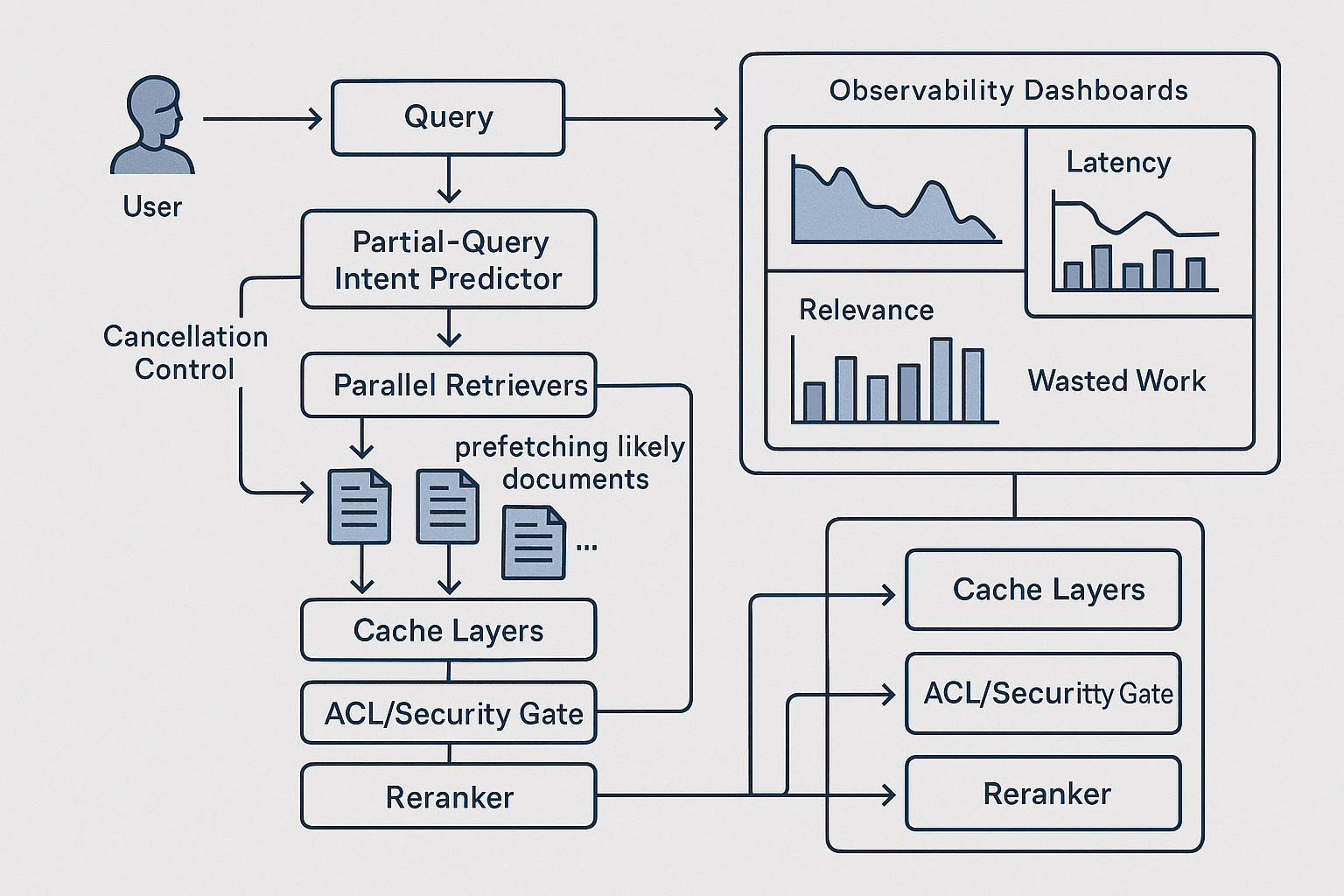
A practical speculative retrieval stack typically looks like this:
-
Signal collector
- User keystrokes or partial utterance stream
- Conversation state
- UI selections: product, tenant, environment, region
- Session history and recent clicked docs
- Access-control scope
-
Intent predictor / query stabilizer
- Predicts canonical intent or retrieval facets from partial evidence
- Produces confidence score and ambiguity score
- Detects when query is still drifting
-
Speculation planner
- Chooses whether to speculate
- Chooses retrieval mode: sparse, dense, hybrid, metadata prefetch only
- Sets budget caps: max concurrent branches, time budget, token budget
-
Speculative retrievers
- Run in parallel on predicted intent(s) or partial query
- Return candidate IDs, scores, and provenance
- Optionally precompute embeddings or reranker features
-
Staging cache
- Stores speculative artifacts keyed by session, user, ACL scope, predicted intent, and query prefix hash
- TTLs are short
- Results are not yet eligible for prompt assembly by default
-
Resolution gate
- Triggered on query submit, speech endpointing, or stabilized prefix
- Compares final query against speculative branches
- Promotes matching branch, refines it, or cancels all
-
Final retrieval / rerank / pack
- Can reuse staged IDs or metadata
- Verifies ACLs again
- Assembles prompt context from confirmed results only
-
Observability and accounting
- Tracks latency saved, wasted retrieval work, wasted fetches, stale promotions, and relevance impact
Promotion gate rules
Speculative artifacts should only be promoted when all of the following pass:
- Intent compatibility: final intent matches predicted intent above a threshold.
- Query similarity: final query embedding or rewrite is sufficiently close to speculative prefix or canonical form.
- Scope compatibility: same tenant, product, region, role, and ACL envelope.
- Freshness compatibility: document version and index snapshot are still valid.
- Quality floor: speculative top-k passes minimum relevance or reranker confidence thresholds.
If these checks fail, you fall back to a regular retrieval path. That fallback must be fast and normal, not treated as an error.
Deciding what to speculate on
Not every RAG workload benefits equally from speculative retrieval. The biggest wins tend to come from domains with one or more of these traits:
- Users type long, structured queries or paste logs incrementally.
- Multi-turn flows have predictable transitions.
- Retrieval latency is a meaningful share of total response time.
- Candidate corpora can be narrowed early using metadata like product, tenant, or region.
- The cost of a wrong speculative branch is controllable because context is only promoted after resolution.
Workloads that benefit less:
- Very short queries where typing time is negligible.
- Corpora with high lexical ambiguity and weak metadata filters.
- Flows where generation latency dominates and retrieval is already cheap.
- Highly sensitive domains where speculative prefetch complicates ACL guarantees.
A common mistake is to speculate at the full-document-content level. Often the right thing to speculate on is much cheaper:
- retrieve candidate IDs,
- prefetch only titles/snippets,
- compute embeddings,
- warm cache entries,
- pre-run a lightweight reranker.
The deeper you go before confirmation, the more recovery cost you incur when wrong.
Confidence thresholds: the real control surface
Speculative retrieval lives or dies on thresholding. If thresholds are too low, you save latency at the cost of waste and relevance regressions. If thresholds are too high, you rarely speculate and gain little.
In production, use multiple thresholds rather than one global confidence number.
1. Intent confidence threshold
How likely is the predicted intent class or retrieval facet correct? For example:
- “incident triage” vs “feature documentation”
- “billing issue” vs “authentication issue”
- “product=A, region=EU, enterprise=true”
Speculate only when confidence exceeds a threshold calibrated on live-like traffic, not just training data.
2. Ambiguity threshold
Even when top-1 confidence is decent, the margin over top-2 matters. If the predictor says 0.58 for billing and 0.34 for auth, you may want to wait or run a very cheap dual-branch speculation. If it says 0.58 and 0.56, that is effectively unstable.
3. Prefix stability threshold
The user may still be editing aggressively. Track whether the partial query has stabilized across a short window:
- no edits to earlier tokens,
- low semantic drift between prefix snapshots,
- pause duration exceeds a debounce value,
- added tokens narrow rather than invert meaning.
4. Budget threshold
Even a high-confidence branch may not be worth it if the system is under load. Introduce dynamic speculation throttles based on:
- current retrieval QPS,
- cache hit rates,
- index saturation,
- tail latency in rerankers,
- user segment or SLA tier.
5. Relevance floor for promotion
Speculation may run, but promotion should still require that speculative top-k resembles what final retrieval would likely return. If speculative top-k is weak, refine from scratch.
Retrieval strategies for speculation
There is no single best speculative retriever. The right choice depends on corpus shape, partial-query quality, and cost profile.
Sparse retrieval on partial queries
Advantages:
- cheap,
- easy to cancel,
- often strong when prefixes include product names, error codes, or nouns.
Weaknesses:
- poor on incomplete phrasing,
- brittle when key disambiguators appear late.
Best for:
- support corpora with identifiers, codes, config names, runbook titles.
Dense retrieval on partial queries
Advantages:
- more tolerant of incomplete language,
- can capture likely semantic direction before exact phrasing is complete.
Weaknesses:
- expensive at scale if run too frequently,
- partial-query embeddings can be noisy,
- may produce broad neighborhoods that need reranking.
Best for:
- conceptual or knowledge-heavy corpora where users ask natural-language questions.
Retrieval on predicted canonical intent
Instead of embedding a shaky prefix, map the partial input to a normalized intent representation such as:
reset_sso_for_enterprise_tenantincident_postmortem_lookupquota_limit_exceeded_troubleshooting
Then retrieve against documents associated with that intent cluster.
Advantages:
- stable,
- often lower variance than literal partial-query retrieval,
- can use curated mappings and metadata constraints.
Weaknesses:
- requires an intent taxonomy,
- misses long-tail questions outside known patterns.
Hybrid speculation
A common production design:
- cheap sparse retrieval on partial tokens,
- plus intent prediction,
- then a final hybrid retrieval at resolution time using speculative candidates as seeds.
This often gives the best latency-quality tradeoff because the early stage remains inexpensive while the final stage preserves precision.
Cancellation control: where most systems are weaker than they think
Speculative retrieval is only as good as your ability to stop wasting work once it becomes irrelevant. Many systems claim cancellation support because the frontend can ignore a stale response. That is not the same as backend cancellation.
You want cancellation to propagate through the stack:
- stop retriever tasks,
- stop reranker jobs,
- stop document fetches,
- stop cache fills,
- avoid prompt assembly,
- prevent LLM invocation on stale branches.
In practice, real cancellation is uneven. Vector search may not be cancellable once launched. Some rerankers run on GPU microbatches that cannot be interrupted cheaply. Object-store reads may already be in flight. That means you need cancellation-aware planning, not just cancellation signaling.
Design principles for cancellation
-
Prefer shallow speculation first Start with candidate ID retrieval before full document fetch.
-
Separate branch stages Do not fetch full content until a branch survives preliminary checks.
-
Use short deadlines Speculative tasks should have stricter deadlines than final retrieval.
-
Assign branch IDs Every speculative action carries a branch token so downstream services can drop stale work.
-
Exploit batch windows carefully Small batching windows reduce cost but can increase stale work if many speculative branches queue together.
-
Measure uncancellable waste Distinguish canceled-before-start, canceled-in-flight, and completed-but-unused work.
This accounting matters because speculative retrieval that “saves” 150 ms while creating 30–40% completed-but-unused retrieval load may still be a bad trade at scale.
Wasted-work accounting: if you do not measure it, you will fool yourself
Teams often celebrate lower median latency and miss that speculative retrieval is burning budget in the background. You need explicit waste metrics.
Track at least these:
- Speculation trigger rate: fraction of sessions/turns where speculation starts.
- Promotion rate: fraction of speculative branches ultimately used.
- Useful promotion rate: promoted branches that survive into final packed context.
- Wasted branch rate: branches completed but not promoted.
- Wasted fetch bytes: document content fetched but unused.
- Wasted reranker compute: rerank jobs run for discarded branches.
- Token waste: context tokens inserted from speculative results that were later superseded, if your system allows interim generation.
- Latency saved per useful promotion: wall-clock savings attributable to successful speculation.
- Cost per ms saved: additional infra cost divided by latency improvement.
A useful composite metric is:
net_speculation_value = UX_latency_gain - infra_cost_penalty - quality_regression_penalty
You do not need a perfect scalar objective in production, but you do need a shared framework that prevents “faster but sloppier” from masquerading as progress.
Cache interaction: speculative retrieval can help or hurt cache efficiency
Caching changes the economics substantially.
Ways speculation helps cache behavior
- Warm likely next-turn docs in a session-local cache.
- Precompute embeddings or retrieval features likely to be reused.
- Warm metadata filters for the selected product or tenant scope.
- Pre-stage top-k IDs so final retrieval needs only reranking or validation.
Ways speculation hurts cache behavior
- Pollutes shared caches with low-value branch artifacts.
- Evicts high-value hot keys under bursty typing traffic.
- Creates misleading hit-rate improvements where cached speculative junk is “hitting” but rarely used.
The fix is usually cache stratification.
Recommended cache design
- Session-local speculative cache: short TTL, branch-scoped, not shared broadly.
- ACL-scoped artifact cache: only reusable within the same access envelope.
- Global stable cache: only for confirmed, high-reuse artifacts like embeddings, frequent canonical intents, and public docs.
Do not put speculative full-document payloads into a globally shared cache unless your usage data proves it is worth the memory and security complexity.
Measure cache value with use-aware metrics, not hit rate alone:
- hit-and-promoted rate,
- bytes reused in final context,
- ms saved from cache hits that led to successful answers.
ACL safety and security: the non-negotiable boundary
Speculative retrieval becomes dangerous if it weakens authorization assumptions. The most common security failure is not direct content leakage in the prompt; it is allowing unauthorized documents to influence timing, ranking, metadata visibility, or shared caches.
Rules that should be treated as hard constraints:
-
Apply ACL filters before speculative results are stored in reusable caches Never prefetch into a cache visible across users or roles without access filtering.
-
Key speculative artifacts by user or ACL envelope A top-k set computed for one principal must not be reused for another unless the access scope is identical and proven equivalent.
-
Do not expose speculative metadata in UI Suggested docs, snippets, counts, or titles generated from speculative retrieval can leak existence information.
-
Re-check ACL at promotion time Indexes change, roles change, and edge cases happen.
-
Watch timing side channels If speculative retrieval behaves differently when protected documents exist, an attacker may infer corpus properties from latency deltas.
-
Audit cache invalidation for role changes Session-scoped speculative caches should be invalidated when impersonation, tenant switch, or role escalation changes the security envelope.
In regulated environments, the right answer may be to speculate only on public or coarse metadata until final authorization is confirmed.
Observability: debug the branches, not just the answer
Speculative systems are hard to reason about if your traces only show the final request path. You need branch-aware observability.
For each user turn, capture:
- query prefix snapshots,
- predictor outputs and confidences,
- branch creation time,
- branch retrieval mode,
- branch cancellation status,
- whether branch was promoted/refined/discarded,
- documents fetched and eventually used,
- latency overlap achieved,
- cost incurred per branch.
A good trace should let you answer:
- Why did we speculate here?
- Why this branch and not another?
- What work completed after it became stale?
- Did we promote speculative results directly or rerun final retrieval?
- Did the final answer use those docs?
- Was the answer better, same, or worse than the no-speculation baseline?
Dashboards should include both latency and quality views segmented by traffic type:
- short typed queries,
- long typed queries,
- pasted logs,
- follow-up turns,
- high-ambiguity prefixes,
- low-ambiguity enterprise flows,
- public vs ACL-heavy corpora.
Speculation usually helps some segments and hurts others. Global averages hide this.
Evaluation design: proving it improves UX without degrading relevance
Offline retrieval metrics are not enough. Speculative retrieval changes temporal behavior and error modes, so your eval stack must combine retrieval quality, answer quality, and systems metrics.
Offline evals
Build datasets that include partial-query evolution, not just final queries. For each session or turn, store:
- prefix sequence over time,
- pauses and edits,
- final submitted query,
- gold documents,
- gold answer,
- access-control scope.
Then evaluate:
- prefix-time recall@k,
- intent prediction accuracy by prefix length,
- promotion precision: when promoted, how often speculative docs overlap gold final docs,
- refinement efficacy: how often speculative candidates seed final retrieval successfully,
- wasted-work rate by trigger point.
Useful slices:
- prefixes that add disambiguators late,
- abrupt topic pivots,
- multi-turn follow-ups,
- corpora with similar document families,
- low-resource or tail intents.
Counterfactual simulation
Replay real traffic logs with a speculative controller and compare against the actual no-speculation baseline. Simulate:
- trigger timing,
- branch selection,
- retriever outputs,
- cancellation timing,
- cache state assumptions.
This helps estimate cost/latency effects before rollout. It will not perfectly capture user behavior changes, but it surfaces whether your thresholds are remotely sane.
Online experiments
A/B test with metrics beyond response time:
Primary metrics:
- time to first useful answer,
- time to final answer,
- user-perceived responsiveness,
- successful task completion rate.
Guardrails:
- answer correctness or acceptance,
- citation relevance,
- hallucination complaint rate,
- wasted infra cost per session,
- ACL anomaly counts,
- tail latency under load.
I would strongly recommend a “shadow speculation” phase first:
- run speculative planning and retrieval,
- do not use it in final context,
- measure would-have-saved latency, promotion rate, and wasted work.
This is often where teams discover their predictor confidence looks good offline but promotion precision is mediocre in production.
Model and tool choices: keep the predictor cheap and the final path strong
Speculative retrieval does not require a large model in the loop. In fact, using an expensive LLM to decide whether to speculate often defeats the point.
Intent prediction options
- Rules/heuristics: fastest and easiest for structured domains. Example: error code regex + selected product + prior-turn category.
- Small classifier model: good for canonical intent prediction with calibrated confidence.
- Embedding similarity to intent prototypes: useful when you have a clean intent taxonomy.
- LLM-based router: flexible, but usually too slow and variable for per-prefix decisions unless heavily constrained.
My bias in production: start with heuristics plus a small classifier, not an LLM router. You want stable calibration, low latency, and low cost.
Retrieval tool choices
- Use sparse retrieval for identifier-heavy domains.
- Use hybrid retrieval when natural language dominates.
- Use a lightweight reranker speculatively and a stronger reranker only on the resolved query if needed.
- Consider metadata-first retrieval when product, tenant, or region cuts the corpus significantly.
Cost/latency tradeoffs
A practical hierarchy:
- cheapest: metadata narrowing, cache warming, ID prefetch,
- low cost: sparse retrieval,
- medium cost: dense retrieval or small reranker,
- higher cost: full content fetch, heavy reranker,
- highest cost: generation with speculative context.
Push speculation as low in that hierarchy as possible. The earlier and cheaper the speculative stage, the safer the economics.
Implementation blueprint
Here is a concrete implementation pattern that works well for many support and internal knowledge assistants.
Step 1: Define stable trigger points
Do not trigger on every keystroke. Use events like:
- 300–500 ms typing pause,
- minimum token count reached,
- presence of a strong anchor token like product name, error code, or feature name,
- follow-up turn with high prior-intent continuity.
Step 2: Predict facets, not just intents
Instead of one monolithic label, predict:
- product,
- issue class,
- deployment type,
- tenant tier,
- region,
- likely doc family.
Facet prediction is often more robust than end-to-end intent prediction and maps naturally to metadata filters.
Step 3: Run shallow speculative retrieval
Example:
- sparse top-20 on partial query within predicted product + region,
- fetch only IDs, titles, snippets, and ACL-safe metadata,
- store in session speculative cache.
Optional:
- precompute dense embedding for final query refinement,
- warm document chunks only for top-5 if confidence is very high.
Step 4: Debounce and branch cap
Enforce:
- at most 1–2 active speculative branches per turn,
- supersede older branches when prefix drift exceeds threshold,
- do not launch a new branch if the prior branch is likely to be reusable with a metadata tweak.
Step 5: Resolve on submit or stabilization
At resolution:
- rewrite/normalize final query,
- compare against staged branch predictions,
- if compatible, reuse candidate IDs and rerank on final query,
- otherwise run normal retrieval and cancel staged fetches.
A powerful compromise is seed-and-refine:
- use speculative top-k IDs as seeds,
- add a small fresh retrieval around the final query,
- rerank combined candidates.
This often recovers from minor prediction errors while still saving time.
Step 6: Pack context conservatively
Even if speculative retrieval was promoted, final prompt packing should still obey standard context quality rules:
- diversity across sources,
- freshness weighting,
- deduplication,
- ACL verification,
- token budget discipline.
Never bypass your usual context assembly safeguards just because the docs arrived early.
Step 7: Log branch outcomes for calibration
Store enough data to recalibrate:
- trigger reason,
- confidence,
- branch family,
- promotion outcome,
- final answer quality proxy,
- cost consumed.
Then periodically retune thresholds by traffic segment.
Common failure modes and mitigations
Failure mode: faster answers, worse grounding
Cause: promoted speculative docs are topically adjacent but not final-query relevant.
Mitigation:
- require reranking on final query before promotion,
- increase ambiguity threshold,
- use seed-and-refine rather than direct promotion.
Failure mode: infrastructure cost spikes under heavy typing activity
Cause: trigger policy too eager.
Mitigation:
- stronger debounce,
- branch caps,
- load-aware throttling,
- speculate only on high-value user segments or long queries.
Failure mode: cache looks great, budget looks terrible
Cause: speculative artifacts inflate hit rate without useful reuse.
Mitigation:
- use promoted-hit rate instead of raw hit rate,
- isolate speculative cache tiers,
- shorten TTLs.
Failure mode: ACL incidents or security review blocks rollout
Cause: speculative artifacts are not keyed tightly enough to principal/scope.
Mitigation:
- principal-scoped caches,
- metadata-only prefetch before final authorization,
- explicit red-team review for timing and cache leakage.
Failure mode: no visible UX improvement despite significant engineering effort
Cause: generation latency dominates, or users submit short queries with little overlap window.
Mitigation:
- measure overlap opportunity before building,
- prioritize generation streaming, answer planning, or retrieval optimization instead.
When speculative retrieval is worth it
Speculative retrieval is worth serious investment when:
- retrieval + rerank contributes meaningfully to end-to-end latency,
- users naturally create overlap windows via typing, pauses, or predictable follow-ups,
- your domain has enough structure for early narrowing,
- your infrastructure supports branch accounting and safe cancellation,
- you can evaluate quality impact rigorously.
It is not worth it when the likely gain is cosmetic, when wrong context carries high risk, or when you cannot isolate speculative waste from core serving costs.
Practical takeaways
First, treat speculative retrieval as reversible precomputation, not early context injection. The goal is to move cheap retrieval work forward in time, not to let guessed context pollute generation.
Second, your main levers are not model cleverness but thresholding, cancellation, and accounting. A mediocre predictor with disciplined promotion gates can outperform a clever predictor glued to a sloppy pipeline.
Third, speculate as shallowly as possible. Candidate IDs, metadata, cache warming, and lightweight reranker features usually deliver better economics than aggressive full-content prefetch.
Fourth, evaluate with partial-query traces and branch-aware metrics. If your eval set contains only final queries, you are missing the core problem.
Fifth, segment your rollout. Speculative retrieval often shines for long support queries, pasted logs, and predictable follow-ups, while doing little for short factual questions.
Finally, insist on wasted-work visibility. The production question is not “did latency go down?” It is “did users get meaningfully faster, equally relevant answers at an acceptable incremental cost and risk?”
When teams answer that question honestly, speculative retrieval becomes a powerful optimization rather than an expensive illusion. Done right, it hides search latency in the moments users already spend thinking and typing. Done poorly, it silently burns budget and pushes the model toward the wrong context before the user has even finished asking the question.