Shadow Mode for GenAI Systems: Rehearsing Prompts, Retrieval, and Agent Policies on Live Traffic Before Cutover
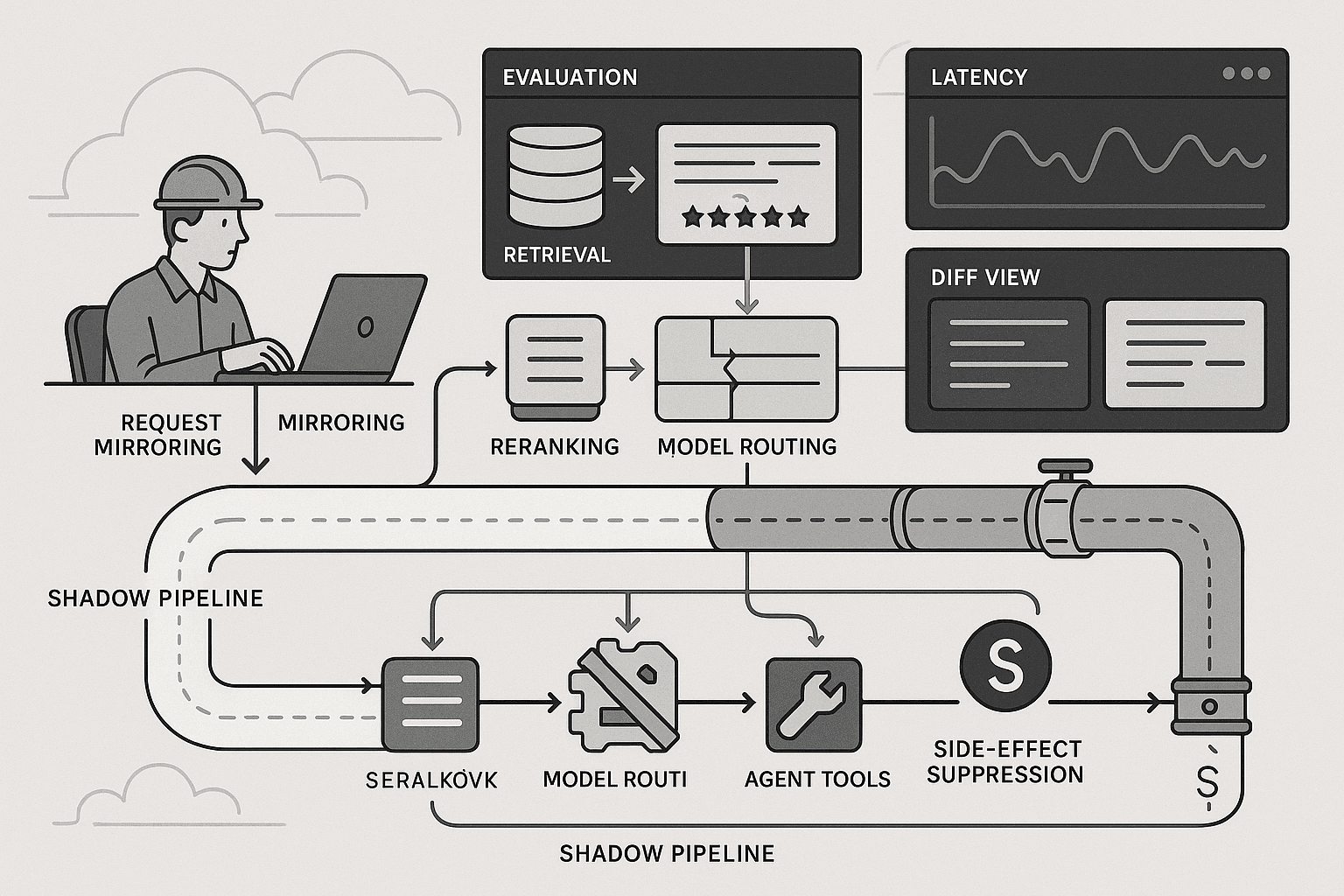
Most GenAI failures do not show up first in your benchmark spreadsheet. They show up at 2:13 p.m. on a Tuesday when a real customer asks a perfectly reasonable question that happens to combine three things your eval set underrepresented: stale entitlements, messy context, and an ambiguous follow-up. Your old system would have produced a cautious answer. The new one confidently calls the wrong tool, retrieves the wrong document family, and summarizes a policy that no longer applies. Nobody notices in staging. Canary barely notices because the traffic slice is too small and the visible metrics are too coarse. Then support tickets appear.
This is why shadow mode matters for GenAI systems.
Shadow mode is the practice of running a candidate system against real production traffic without exposing its outputs or side effects to users. It is not just for model swaps. In mature GenAI stacks, shadow mode is the safest way to rehearse changes to prompts, retrieval pipelines, chunking, embeddings, rerankers, model routes, guardrails, memory strategies, and agent policies before cutover. It lets you exercise the full system under real traffic distributions while keeping blast radius near zero.
For engineering teams shipping LLM features into production, shadow mode fills the gap between offline evals and user-visible canaries:
- Offline evals tell you whether your system performs on the examples you remembered to collect.
- Canaries tell you whether production users are visibly harmed at small scale.
- Shadow mode tells you how a proposed system behaves on the traffic patterns, edge cases, sequence dependencies, and hidden operational realities that rarely make it into static eval sets.
Done well, shadow mode catches regressions that both of those methods miss. Done poorly, it becomes an expensive duplicate of production that teaches you very little. The difference is in what you mirror, how you suppress side effects, how you diff outputs, how you adjudicate disagreements, and how you design the architecture so shadow experiments do not degrade the serving path.
This article is a production-focused guide to doing that well.
The failure pattern shadow mode is built for
Consider a support copilot used by internal agents. The current production path looks like this:
- User asks a question in chat.
- Query rewriting normalizes references to products and account plans.
- Retrieval fetches top-40 chunks from a hybrid BM25 + vector index.
- A cross-encoder reranker narrows to top-8.
- A router sends simple informational questions to a cheaper model and account-sensitive questions to a larger model.
- The assistant can optionally call tools for account lookups, refund policy checks, and order status.
- Final answer is returned with citations.
The team wants to improve answer quality and reduce cost. They make several changes:
- A new system prompt to encourage directness.
- A new embedding model and chunking policy.
- A lightweight reranker to cut latency.
- A modified router to send more traffic to the cheaper model.
- An updated agent policy that allows the model to check refunds before asking a clarifying question.
In offline testing, average judged quality improves. Retrieval recall on a document benchmark stays flat. Tool call rates look acceptable. Latency is better.
Then the team deploys to a 5% canary.
Visible error rate barely moves. CSAT is noisy. Cost looks good. So they ramp.
Three days later they discover a specific regression: for users with multiple orders and partial refunds, the new policy often calls the refund tool too early, before entity disambiguation. Because the cheaper model is now handling more borderline cases, it is worse at noticing ambiguity. The new chunking scheme also split refund exceptions away from the main policy section, so the reranker promoted incomplete snippets. The answers sound crisp, cite documents, and are wrong in exactly the scenarios that matter.
Every individual change looked safe in isolation. The system interaction was not.
This is a classic shadow mode problem. The failure did not come from one component being obviously broken. It came from composition under real traffic:
- Real users ask ambiguous multi-entity questions.
- Production data contains edge-case account states.
- Tool outputs are messy and schema drift happens.
- Retrieval quality depends on actual query distribution, not benchmark phrasing.
- Routers alter which prompt and policy combinations get exercised.
- Agent policies affect both latency and correctness through action sequencing.
A static eval set rarely captures enough of that. A small canary exposes users while still giving limited observability into the full error surface. Shadow mode lets you run the candidate system on exactly those messy cases, inspect where behavior diverges, and decide whether the differences are improvements, regressions, or just harmless stylistic variation.
What shadow mode means in GenAI, specifically
In conventional services, shadow mode often means duplicating requests to a new service version and comparing responses. In GenAI systems, that definition is too narrow.
A meaningful GenAI shadow run may need to mirror:
- Prompt templates and system instructions
- Retrieval query rewriting
- Index selection
- Embedding models
- Chunking and document segmentation
- Metadata filters
- Rerankers
- Model routing logic
- Safety policies
- Memory construction
- Tool selection policies
- Tool argument generation
- Multi-step agent plans
- Answer post-processing and citation formatting
It may also need to observe hidden intermediate artifacts, not just final text:
- Retrieved document IDs and scores
- Reranker feature outputs
- Router decisions
- Chosen model and fallback behavior
- Tool call traces and arguments
- Number of agent steps
- Structured outputs before rendering
- Safety classifier labels
- Token counts, cost, and latency per stage
If you only compare final responses, you miss most actionable insight. Two answers can look similar while one uses a much riskier reasoning and tool path. Conversely, two answers can look different while both are acceptable, and the real signal lies in retrieval quality or unnecessary tool usage.
The right mental model is this: shadow mode is a production rehearsal environment attached to live traffic, where the candidate stack executes in parallel, its side effects are suppressed, its behavior is recorded at each stage, and its outputs are adjudicated offline.
Why the naive approach fails
The naive version of shadow mode is easy to describe:
- Mirror a percentage of requests.
- Run the new prompt or pipeline in parallel.
- Store the output.
- Compare it to production.
This usually disappoints for five reasons.
1. Text diffing is a poor proxy for quality
LLM outputs are non-deterministic and semantically flexible. A literal diff between the control answer and the shadow answer overstates harmless variation and understates subtle regressions.
Examples:
- The shadow answer uses different wording but is more accurate.
- The shadow answer preserves the same text but cites different documents, one of which is stale.
- The shadow answer is shorter and clearer, but omitted a required disclaimer.
- The shadow answer took a different tool path that would have caused trouble if side effects were enabled.
You need multi-layer comparison, not raw string diffing.
2. Side effects are harder to suppress than teams expect
Agent systems do not just return text. They call search, update tickets, trigger workflows, write notes, send emails, issue refunds, and mutate memory. If you mirror traffic into a candidate agent naively, you can create duplicate writes, inconsistent state, vendor rate limit issues, or accidental customer communications.
Even “read-only” tools are not always read-only. Some analytics queries increment counters. Some external APIs trigger audit records. Some CRM lookups alter recent-viewed state.
If your shadow environment cannot guarantee side-effect suppression at the tool boundary, do not shadow agents yet.
3. Shared dependencies contaminate results
Suppose control and shadow both hit the same retrieval cluster, model quota, tool backends, or cache layer. Now your shadow experiment changes production latency and cache locality. Worse, control and shadow may affect each other’s outputs through shared freshness, request bursts, or cache pollution.
If the shadow run causes production timeouts, the experiment is invalid even if the candidate quality is great.
4. Cost explodes without prioritized sampling
Running a second full GenAI stack on all traffic can double inference spend instantly. If the shadow path includes large models, rerankers, and multi-step agents, the multiplier can be worse than 2x.
Teams often react by sampling too aggressively and then miss the rare, high-risk slices they most needed to test.
5. Offline adjudication becomes a data swamp
If you capture millions of shadow traces but have no strategy to bucket, score, and review disagreements, shadow mode degenerates into log accumulation. Engineers skim a few examples, feel vaguely reassured, and cut over on intuition.
The value of shadow mode comes from structured disagreement analysis, not from collecting outputs.
The better approach: shadow as a first-class release stage
The production pattern that works is to treat shadow mode as a formal release stage between offline evals and user-visible canary.
A practical lifecycle looks like this:
-
Offline development and evals
- Component benchmarks
- Task-level judged evals
- Tool-call and safety evals
- Cost and latency estimates
-
Shadow mode on live traffic
- Mirrored requests
- Full candidate execution with side effects disabled
- Stage-by-stage trace capture
- Automated diffing and stratified adjudication
- Operational validation under production load
-
Constrained canary
- Limited user-visible rollout
- Real user outcomes, complaint rates, and task completion
- Fast rollback path
-
Ramp and continuous post-cutover monitoring
- Ongoing drift checks
- Sampled shadow for future changes
The key is that shadow mode is not replacing evals or canaries. It is the missing bridge.
Reference architecture for GenAI shadow mode
Here is a practical architecture that works for most production GenAI systems.
Control plane
The control plane decides which requests get mirrored and what candidate configuration they should use.
Core responsibilities:
- Experiment configuration
- Sampling rules
- Traffic segmentation
- Version pinning for prompts, models, retrieval indexes, tool policies
- Kill switches
- Budget limits
- Data retention policy
Useful sampling dimensions:
- User segment
- Query intent
- Product area n- Language
- Conversation length
- High-risk workflows
- Presence of tools or structured outputs
- Known edge-case cohorts
Do not sample uniformly by default. Shadow budget should be concentrated on risky and uncertain slices.
Data plane request fan-out
At request ingress:
- The live request proceeds to the control system as usual.
- A lightweight mirror event is emitted asynchronously to a shadow queue or stream.
- The shadow executor consumes the mirrored request, fetches any required context snapshot, and runs the candidate stack.
- Results are stored in an evaluation warehouse for later comparison.
Important design point: the user-facing path should not wait on the shadow path. Ever.
Use asynchronous fan-out unless you have a very specific reason to test tightly synchronized behavior. Even then, isolate the latency path with hard budgets.
Context snapshotting
Many GenAI behaviors depend on mutable state:
- Conversation history
- User profile
- Entitlements
- Inventory
- Ticket state
- CRM notes
- Document corpus freshness
If the shadow run executes minutes later against current state instead of request-time state, your comparison becomes noisy or misleading. You need a request-scoped context snapshot.
At minimum, snapshot:
- Input message(s)
- Conversation state at request time
- User/account identifiers and non-sensitive derived features
- Relevant tool inputs if available
- Index version or document timestamp watermark
- Production system version used by control
For strict comparisons, make retrieval and tools read from versioned snapshots or a time-bounded replica.
Candidate executor
The candidate executor runs the full shadow configuration.
Design it to capture a stage graph, not just a final answer. For each stage, log:
- Inputs and normalized forms
- Selected config version
- Outputs and confidence scores
- Tokens, latency, cost
- Failures and retries
Typical stages:
- Preprocessing / classification
- Query rewrite
- Retrieval
- Rerank
- Route selection
- Prompt assembly
- LLM generation
- Tool planning
- Tool execution simulation
- Final answer rendering
- Safety checks
This stage graph becomes the backbone for analysis.
Tool sandbox / side-effect suppression layer
This is the part teams underestimate.
Every tool callable by the candidate system must declare an execution mode:
- Pure read: safe to execute against a read replica or shadow credentials
- Read with observable side effects: must use a stub, replay cache, or recorded response
- Write: must be blocked, simulated, or redirected to a sandbox
- External communication: must be replaced by a no-op or synthetic acknowledgment
Practical suppression techniques:
- Read replicas with credentials scoped to shadow
- Idempotency keys plus write-deny policies
- Tool virtualization where calls return recorded or synthetic responses
- Contract mocks generated from recent production traces
- “Plan-only” agent mode where the model decides actions but tools are not executed
For high-risk tools, a useful pattern is split shadowing:
- First shadow the planner only, comparing proposed tool sequences and arguments.
- Then shadow execution against sanitized replicas.
- Only later test end-to-end with sandboxed writes.
Evaluation warehouse and review UI
Store both control and shadow artifacts in a warehouse designed for slice-and-diff analysis.
Minimum schema:
- Request ID
- Shadow experiment ID
- Timestamps
- Input metadata and cohort labels
- Control final output and stage traces
- Shadow final output and stage traces
- Latency/cost by stage
- Diff features
- Auto-judgment labels
- Human adjudication status and notes
- Linked incidents or bug tags
Build a review UI that lets evaluators inspect:
- Final answer side by side
- Citations side by side
- Retrieved docs overlap and score changes
- Tool traces
- Prompt versions
- Router decisions
- Structured output diffs
- Token and latency deltas
Without this UI, shadow mode reviews become painfully slow.
What to mirror
The best shadow setups support multiple levels of candidate substitution.
Prompt-only shadow
Use when changing:
- System prompts
- Developer messages
- Output schemas
- Few-shot examples
- Formatting instructions
Benefits:
- Lowest implementation complexity
- Good for style, policy, and reasoning changes
- Cheap if retrieval and routing are reused
Limitations:
- Misses retrieval and tool policy interactions
- Overstates gains if context quality is the real bottleneck
Retrieval shadow
Use when changing:
- Embedding models
- Chunking
- Metadata filters
- Query rewriting
- Hybrid retrieval weights
- Index sharding
What to compare:
- Recall against known relevant docs where available
- Overlap with control results
- Citation stability
- Answer groundedness
- Latency and index cost
A strong pattern is to shadow retrieval independently before combining it with prompt changes. Retrieval regressions often masquerade as prompt failures.
Reranker shadow
Use when changing:
- Cross-encoder models
- Distilled rerankers
- Fusion heuristics
- Diversity constraints
What matters:
- Promotion of stale or contradictory chunks
- Long-tail latency under load
- Quality impact on answer grounding
Smaller rerankers often look attractive on average latency but degrade exactly the ambiguous cases where expensive disambiguation was valuable.
Model route shadow
Use when changing:
- Router thresholds
- Model portfolio
- Fallback logic
- Structured output model choice
You want to know not just whether the cheaper model can answer many requests, but where it fails after routing decisions compound with retrieval and prompt assumptions.
Agent policy shadow
Use when changing:
- Tool selection policies
- Clarification vs action thresholds
- Planning prompts
- Termination conditions
- Memory usage
- Error recovery logic
This is the most valuable and most dangerous category. Valuable because agent failures are often sequence-dependent and underrepresented in evals. Dangerous because tool execution is where shadow mistakes cause real-world side effects.
Diffing strategy: compare behavior, not just words
A good shadow analysis pipeline computes several layers of diff features.
1. Surface-form diffs
Useful but limited:
- Length delta
- Citation count delta
- Presence/absence of required disclaimers
- Structured field changes
- Refusal vs non-refusal
Good for quick triage, not final judgment.
2. Semantic answer diffs
Use model-based judges or task-specific validators to classify:
- Equivalent
- Shadow better
- Control better
- Both acceptable but stylistically different
- Both flawed
- Incomparable due to missing context
For factual tasks, ask judges to score dimensions separately:
- Correctness
- Completeness
- Groundedness to supplied context
- Policy compliance
- Actionability n- Concision
Treat model judges as prioritization aids, not unquestioned truth. Calibrate them against human adjudication.
3. Retrieval diffs
Compare:
- Document ID overlap
- Rank shifts for key documents
- Freshness of selected docs
- Metadata filter changes
- Coverage of required policy sections
- Contradiction risk within top-k context
In production, many answer regressions are retrieval regressions wearing a generation costume.
4. Tool-path diffs
For agents, capture:
- Tool sequence edit distance
- Additional or missing tool calls
- Argument correctness and completeness
- Clarify-before-act policy adherence
- Number of steps
- Retry loops
- Use of fallback tools
This often catches failures before they become visible answer defects.
5. Operational diffs
Track:
- End-to-end latency delta
- P95/P99 by cohort
- Token input/output delta
- Cost per request delta
- Tool call amplification
- Cache hit changes
- Error and timeout rates
A shadow configuration that improves quality by 1% but increases agent step count by 80% may be unacceptable.
Offline adjudication that scales
The goal is not to review every shadow trace. The goal is to review the right disagreements.
A practical adjudication pipeline:
Step 1: Auto-bucket all requests
Bucket by:
- No meaningful difference
- Likely harmless variation
- Quality win candidate
- Quality regression candidate
- Retrieval disagreement
- Tool policy disagreement
- Safety/policy disagreement
- Latency/cost regression candidate
Step 2: Stratified sampling
Sample more heavily from:
- High business impact intents
- High disagreement confidence
- Safety-sensitive outputs
- Large retrieval rank shifts
- Novel tool paths
- Expensive latency regressions
Sample lightly from obvious no-difference cases just to validate the bucketing.
Step 3: Human adjudication rubric
Provide reviewers with a concrete rubric:
- Which answer better solves the user’s task?
- Which answer is more correct based on available evidence?
- Did either answer violate policy or omit required guidance?
- Were citations appropriate and sufficient?
- If tool use differed, which path was safer or more efficient?
- Would either output likely cause user harm or support escalation?
Require reviewers to tag root cause where possible:
- Prompt regression
- Retrieval miss
- Reranker issue
- Router misallocation
- Tool argument issue
- Agent sequencing issue
- Safety filter mismatch
- Non-deterministic variation
Step 4: Feed findings back into eval sets
Every confirmed shadow regression should create one or more persistent test assets:
- A new offline eval example
- A retrieval benchmark entry
- A tool-path unit test
- A policy regression scenario
- A router threshold check
Shadow mode is not just a release gate. It is a factory for better evals.
Where shadow mode catches what canaries miss
Canaries are essential, but shadow mode sees different failure classes.
Silent correctness regressions
Users often do not immediately complain when an answer is plausible but wrong. In a canary, these errors hide in aggregate metrics. In shadow mode, you can inspect disagreements directly.
Rare but critical cohorts
A 1% canary may not include enough examples of:
- Multi-account customers
- Long conversations
- Non-English queries
- High-value workflows
- Sparse-document products
- Escalation scenarios
Shadow mode can oversample these cohorts without exposing them.
Agent side-effect risk
You cannot safely learn that an agent makes bad write decisions by letting it write at low volume. Shadow mode lets you examine intended actions before any side effects reach users or systems.
Operational coupling
A candidate reranker or route policy may look fine in low-volume canary but collapse at scale due to tail latency, quota pressure, or cache churn. Shadow traffic exercises realistic concurrency earlier.
Cost and latency tradeoffs
Shadow mode is not free. You are paying for confidence.
The right question is not “Can we afford shadow mode?” It is “What is the cheapest shadow design that reliably catches the regressions we care about?”
Cost levers
-
Selective sampling
- Shadow 5% of low-risk traffic, 50% of high-risk cohorts, 100% of rare safety-critical intents.
-
Stage-level shadowing
- Shadow retrieval alone before end-to-end shadow.
- Shadow planner without executing tools.
- Shadow route decisions without generating full answers.
-
Model substitution for analysis
- Use a cheaper judge model for broad bucketing, escalate ambiguous cases to a stronger judge or humans.
-
Token controls
- Cap shadow answer length.
- Disable chain-of-thought logging.
- Truncate low-value context fields in shadow where they do not affect behavior under test.
-
Short-lived experiments
- Run intense shadow tests for 48 hours on targeted cohorts rather than diffuse tests for weeks.
Latency isolation principles
- Never block the user path on shadow completion.
- Use separate queues and worker pools.
- Apply strict rate limits per experiment.
- Use separate model quotas if possible.
- Prefer separate retrieval replicas for heavy experiments.
- Disable cache writes from shadow unless intentionally testing cache behavior.
If shadow affects production latency, stop and fix the architecture before trusting the results.
Model and tool comparison considerations
Not all shadow experiments should be evaluated the same way.
Frontier model to smaller model swap
Look for:
- Increased ambiguity failures
- Lower tool argument precision
- More brittle citation grounding
- Higher variance across long conversations
Often the smaller model appears fine on straightforward Q&A but degrades sharply in workflows requiring careful clarification or schema adherence.
Embedding model replacement
Look for:
- Better average similarity but worse metadata sensitivity
- Reduced recall on rare terminology
- Increased stale document retrieval if freshness signals are weaker
Embedding changes can improve dashboard metrics while harming policy-heavy or long-tail domains.
Reranker downgrade for latency savings
Look for:
- Failure to keep exception clauses near top ranks
- More contradictory contexts in top-k
- Worse performance on verbose or multi-part queries
Agent policy changes
Look for:
- More aggressive action-taking
- Fewer clarification questions at the cost of correctness
- Longer loops due to optimistic retries
- Hidden cost growth through tool amplification
The key is to compare along the dimensions each component actually influences, not just final answer preference.
Implementation details that matter in practice
Determinism and reproducibility
For shadow experiments, pin everything you reasonably can:
- Prompt versions
- Model versions
- Temperature and decoding params
- Retrieval index versions
- Reranker versions
- Tool schemas
You do not need full determinism, but you do need enough reproducibility to debug disagreements.
PII and compliance
Shadow traces often contain the same sensitive data as production requests. Treat them as production data.
Requirements typically include:
- Encryption at rest
- Access controls on trace review
- Redaction of unnecessary sensitive fields
- Retention limits
- Audit logging for adjudication access
Do not create a “temporary” shadow datastore that bypasses your normal controls.
Schema evolution
When shadowing structured outputs or tool calls, schema changes can create false alarms. Version schemas explicitly and normalize compatible differences before diffing.
Timeouts and partial traces
Candidate systems will fail in new ways. Make partial traces first-class.
You should be able to answer:
- Did the shadow run fail before retrieval, during generation, or in tool simulation?
- Was the failure due to timeout, quota, malformed tool args, parser error, or sandbox denial?
- What fraction of failures are experiment-induced versus background noise?
Conversation-level analysis
Many GenAI regressions are not turn-level. A prompt change may make turn 1 cleaner and turn 4 much worse because the agent established the wrong assumptions. Preserve session linkage and review multi-turn trajectories.
Shadowing against recorded tool responses
For some workflows, replaying recorded production tool responses is better than hitting live replicas. It improves comparability and suppresses side effects. The downside is reduced realism when tools are highly stateful. Use it when action safety matters more than environment fidelity.
A rollout playbook
Here is a battle-tested sequence for a meaningful GenAI shadow release.
Phase 0: Define release hypotheses
Before any traffic is mirrored, write down:
- What should improve?
- What might regress?
- Which cohorts are highest risk?
- Which intermediate signals should move if the change is working?
- What are the no-go thresholds for cutover?
Example:
- Improve groundedness for refund questions
- Reduce average cost by 15%
- No increase in policy omission rate
- No increase in clarify-before-act violations
- P95 latency increase must remain under 200 ms for control path and under experiment budget for shadow path
Phase 1: Component shadow
If multiple subsystems changed, test them separately first:
- Retrieval shadow alone
- Reranker shadow alone
- Route shadow alone
- Planner-only shadow for agent policy
This narrows root cause quickly.
Phase 2: End-to-end shadow on targeted cohorts
Mirror traffic for cohorts most likely to surface risk:
- High ambiguity intents
- Long sessions
- Tool-heavy workflows
- High-value enterprise accounts
- Non-English traffic if applicable
Do not wait for a massive random sample if you already know where the danger is.
Phase 3: Adjudication and defect fixing
Review disagreement buckets daily. File bugs with trace links and root-cause tags. Re-run shadow after fixes.
Phase 4: Pre-cutover scorecard
Summarize:
- Human preference by cohort
- Regression counts by severity
- Safety/policy deltas
- Tool-path deltas
- Latency and cost deltas
- Known unresolved risks
Make the cutover decision from this scorecard, not from anecdotes.
Phase 5: Small visible canary
Only after shadow is clean enough do you expose users. At this stage, you are validating user outcomes and unknown unknowns, not doing first-pass correctness discovery.
Common anti-patterns
“We shadowed the final answer only”
Then you likely missed retrieval, routing, and tool-policy regressions.
“We used shadow data as ground truth because it matched control most of the time”
Agreement is not correctness. Both systems can be wrong.
“We let shadow tools hit production because they were mostly reads”
Mostly is not enough.
“We sampled uniformly to be statistically clean”
Uniform sampling under-tests the rare workflows that create incidents.
“We cut over because the average judge score improved”
Means and averages hide tail risk. Slice by cohort and failure mode.
“We never converted shadow findings into evals”
Then you will rediscover the same failures in future releases.
What good looks like
A strong shadow mode program for GenAI has the following properties:
- Mirrored execution is asynchronous and isolated from user latency.
- Candidate configs are versioned and reproducible.
- Tool side effects are provably suppressed.
- Retrieval, routing, and tool traces are stored alongside final outputs.
- Automated diffing buckets disagreements by likely root cause.
- Human adjudication focuses on high-risk slices, not random browsing.
- Findings are fed back into persistent eval suites.
- Cutover decisions combine quality, safety, latency, and cost.
Most importantly, the team trusts shadow mode enough to let it block releases.
That trust is earned through operational discipline. If your shadow environment is flaky, expensive, or hard to interpret, teams will bypass it. If it reliably catches real regressions before customers do, it becomes one of the highest-leverage parts of your GenAI delivery pipeline.
Final takeaways
Shadow mode is the safest way to learn how GenAI changes behave under the traffic patterns that matter, before users pay the price.
For GenAI systems, this means more than duplicating requests and comparing text. You need to shadow the real moving parts: prompts, retrieval, reranking, model routing, and especially agent policies. You need stage-level traces, side-effect suppression at the tool boundary, operational isolation from the serving path, and an adjudication process that turns messy disagreement into release decisions.
Offline evals remain necessary. Canaries remain necessary. But neither is enough on its own.
If you are shipping production GenAI systems, the practical release ladder is:
- Eval offline to catch obvious issues cheaply.
- Shadow on live traffic to uncover interaction failures and tail risks safely.
- Canary to validate real user outcomes at low exposure.
- Ramp with continuous monitoring and new regression tests.
The teams that do this well are not the ones with the prettiest benchmark dashboards. They are the ones that rehearse change against reality before cutover.
That is what shadow mode gives you: reality, without the blast radius.