Reranking in Production RAG: How to Improve Retrieval Precision Without Blowing Your Latency Budget
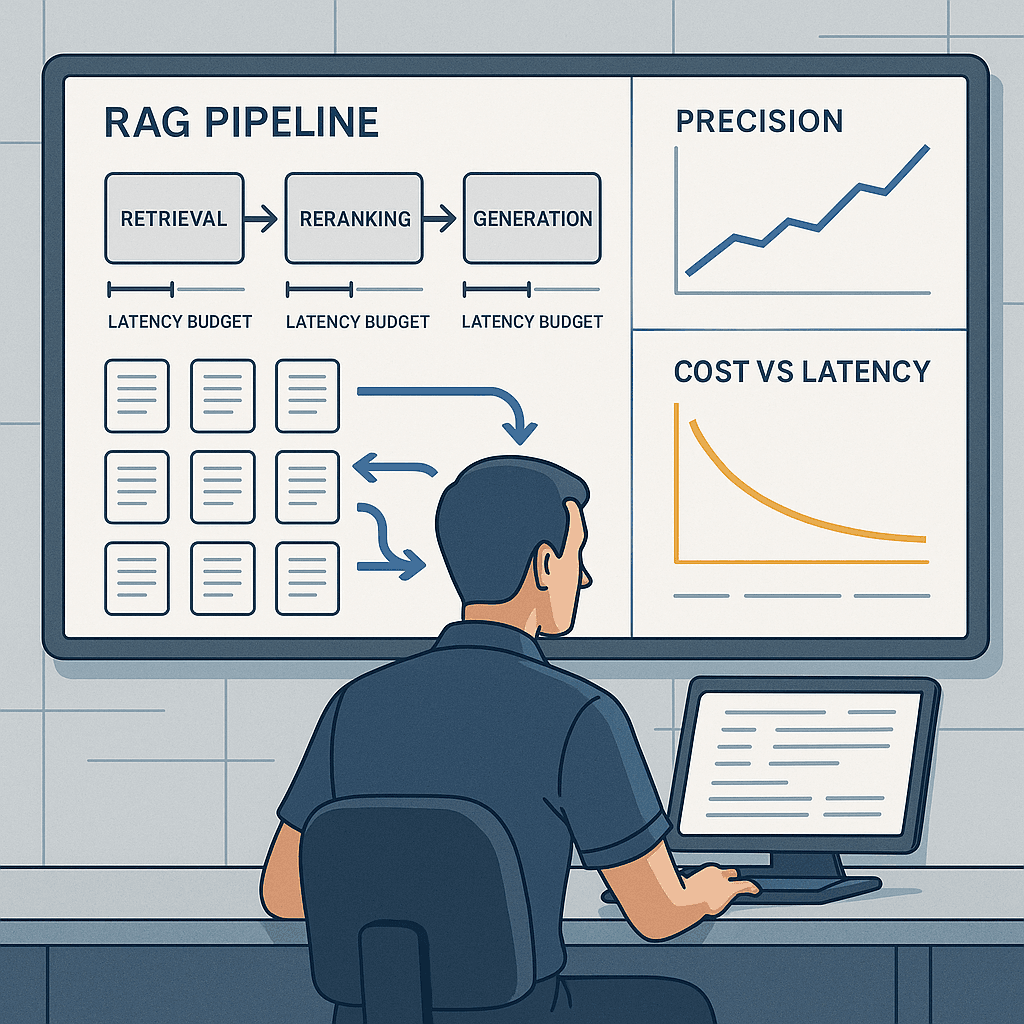
A team ships a RAG assistant for internal support. The first version looks good in demos: vector search over chunked docs, top-5 context into the generator, decent answers to common questions. Then production traffic arrives.
Users ask questions with overloaded terms, product nicknames, and half-remembered policy names. The retriever returns chunks that are individually “similar” but not actually the best evidence for the user’s intent. The generator does what generators do: it confidently weaves together whatever context it received. Precision drops exactly where trust matters most. The team responds the way many teams do at first:
- increase top-k from 5 to 20
- use a larger embedding model
- stuff more chunks into the prompt
- add another vector index
- ask the LLM to “be more careful”
Answer quality moves a bit, token costs jump, and latency gets worse. Worse, the retrieval failures become harder to diagnose because the pipeline now has more moving parts and more context in play.
This is the point where reranking usually enters the conversation.
A reranker sits between first-stage retrieval and generation. It takes a broader candidate set from fast retrieval and reorders it using a more precise relevance signal. In production RAG, reranking is one of the highest-leverage ways to improve answer quality because many failures are not “knowledge missing” failures. They are ordering failures. The right evidence was present in the candidate pool but was not placed high enough to make it into the final context window.
The challenge is that reranking is also where many teams accidentally blow their latency budget. A naive reranking layer can turn a 150 ms retrieval step into an 800 ms bottleneck, or make costs unpredictable at peak traffic. So the real problem is not “should we rerank?” It is “how do we improve precision enough to matter, with bounded latency and operational complexity?”
That is the production problem this article tackles.
The pattern: most retrieval problems in RAG are ranking problems before they are generation problems
In mature RAG systems, you can bucket bad answers into a few recurring categories:
- The system retrieved nothing relevant. This is a recall problem.
- The system retrieved relevant evidence, but too low in the list. This is a ranking problem.
- The system retrieved relevant evidence plus distracting near-matches. This is a precision problem.
- The system retrieved the right chunks, but chunk boundaries or formatting hid the answer. This is a document processing problem.
- The system had the evidence, but the generator ignored or misused it. This is a generation or orchestration problem.
Teams often over-attribute failures to embeddings or the generator because those components are more visible. But when you inspect retrieval traces, a lot of production misses look like this:
- the correct policy document is ranked #11, behind ten semantically similar but less authoritative FAQ chunks
- a chunk with the right product name but wrong version outranks the exact version-specific runbook
- a stale document outranks a fresh one because the text is more verbose and embedding similarity likes it
- a broad overview page outranks the narrow procedural step list that actually answers the query
In other words: first-stage retrieval found plausible candidates, but not in the order your final context assembly needed.
Reranking exists to fix exactly this class of problem.
Why the naive approach fails
The naive production pattern is straightforward: retrieve top-50 from vector search, send all 50 pairs (query, chunk) to a cross-encoder or an LLM, sort by score, keep top-5, then generate. This often works in a benchmark notebook. It often disappoints in production.
Here is why.
1. Latency grows in the worst possible part of the pipeline
First-stage retrieval is usually optimized for speed: ANN vector search, BM25, metadata filters, maybe hybrid search. Reranking is usually much more expensive per candidate because it evaluates query-document interaction directly.
If your reranker takes 8–20 ms per pair on CPU or batched GPU inference and you pass 50 candidates per query, reranking can dominate end-to-end latency. If you use an LLM reranker, the latency jump is even more dramatic and often highly variable.
The result is a pipeline where retrieval, which should be fast and boring, becomes the slowest step before generation.
2. Candidate set size is chosen by habit, not measurement
A lot of teams choose values like top-20, top-50, or top-100 because they have seen them in examples. But the useful candidate pool size depends on your corpus, chunking strategy, query distribution, and first-stage retriever quality.
If the relevant chunk is almost always in the top-12, reranking top-50 is waste. If the relevant chunk is often below top-30 for long-tail queries, reranking only top-10 cannot help.
Without recall-at-K analysis on your own data, candidate sizing is guesswork.
3. All queries do not need reranking equally
Some queries are easy:
- exact error code lookups
- unique SKU or feature names
- strong metadata filters
- navigational queries with one obvious document
On these, reranking adds cost with little gain. Other queries are ambiguous, multi-hop, or version-sensitive; reranking matters much more there.
Applying the same heavy reranking policy to every query is one of the fastest ways to overspend.
4. Teams treat reranker scores as truth instead of another noisy signal
Cross-encoder scores, LLM judgments, BM25 scores, embedding similarity, freshness signals, authority weights, click priors, and metadata matches all tell you something. None is perfect alone.
In production, blindly replacing your retrieval order with a single reranker score often creates new failure modes:
- highly similar but stale content dominates
- long chunks get inflated because they contain more lexical overlap
- boilerplate headers confuse the reranker
- duplicated content crowds out diversity
The more robust pattern is score fusion plus business constraints.
5. Teams evaluate reranking with the wrong metric
If you only measure answer correctness after generation, you can miss whether reranking improved evidence quality or just changed prompting behavior. If you only measure retrieval metrics like NDCG@10, you may miss whether better ordering actually improves final answers.
Reranking needs both retrieval-stage and answer-stage evaluation.
When to add a reranker
Do not add a reranker because “RAG systems should have one.” Add it when the evidence says your bottleneck is ranking precision.
Good signs you are ready:
- Your retrieval traces show relevant chunks frequently appearing in top-20 but not top-5.
- Hybrid search and metadata filtering have already captured the easy gains.
- Prompt tuning and larger context windows are producing diminishing returns.
- Generation quality is strongly correlated with whether the right chunk appears in the top few context slots.
- You have enough labeled or weakly labeled query-document pairs to evaluate changes.
Signs you should solve something else first:
- The right document rarely appears even in top-50. That is a recall problem.
- Chunking is poor, with answer spans split across tiny fragments or buried in huge chunks.
- Metadata filters are missing or incorrect.
- Your corpus has severe duplication or staleness issues.
- The generator routinely ignores clearly relevant retrieved evidence.
A reranker cannot rescue a broken corpus or nonexistent recall. It shines when the first-stage candidate pool is decent but noisy.
A better production architecture
The architecture I recommend for most production RAG systems is a staged retrieval pipeline with explicit budgets.
Reference architecture
-
Query preprocessing
- normalize identifiers and version strings
- classify query type if useful: navigational, procedural, factual, troubleshooting
- extract structured filters: product, region, version, time range, tenant
-
First-stage retrieval
- hybrid retrieval: ANN embeddings + BM25/keyword
- apply metadata filters early
- retrieve a relatively broad candidate pool, e.g. 20–100 depending on corpus behavior
- deduplicate near-identical chunks/documents
-
Candidate enrichment
- attach document-level features: title, recency, authority/source tier, doc type, product/version tags, popularity, prior click data if available
- optionally map chunk candidates back to parent document and sibling chunks
-
Reranking layer
- cross-encoder for most traffic, or a cheaper learned ranker with features in high-scale settings
- optional LLM reranker only for hard slices or asynchronous evaluation
- compute a fused score from semantic rank, lexical rank, reranker relevance, freshness, authority, and diversity penalties
-
Context assembly
- choose top-N chunks with diversity and document coverage constraints
- expand to adjacent chunks when needed
- compress or cite passages selectively rather than stuffing raw top-k blindly
-
Generation
- answer with grounding/citation requirements
- abstain or ask clarification if confidence is low
-
Observability and feedback loop
- log candidates, scores, chosen context, latency, costs, answer outcomes, user feedback, and downstream task success
The key idea is that reranking is not a single model call. It is a decision layer.
Choosing between cross-encoders and LLM rerankers
This is where a lot of teams get stuck. The short version:
- Cross-encoders are usually the default production choice.
- LLM rerankers are useful for specific hard cases, specialized domains, or as an upper-bound evaluator, but they are rarely the first thing I would put on the hot path.
Cross-encoders
A cross-encoder jointly processes the query and candidate text and outputs a relevance score. Because it attends across both inputs, it is usually much more precise than pure embedding similarity.
Pros
- strong relevance quality for query-document matching
- lower and more predictable latency than LLM calls
- easier batching
- typically much cheaper per candidate
- simpler scoring interface for production rank pipelines
Cons
- input length limits may force truncation
- less flexible for nuanced ranking criteria unless fine-tuned
- still expensive relative to ANN retrieval
- can struggle with long documents unless chunking is good
When I use them
- general enterprise search and support RAG
- documentation, policy, knowledge base, ticket, runbook corpora
- high-QPS systems where stable latency matters
LLM rerankers
An LLM reranker uses an instruction prompt to assess which candidates best answer the query, sometimes scoring each independently, sometimes ranking a set jointly.
Pros
- can incorporate nuanced criteria: version matching, policy authority, temporal reasoning, subtle intent matching
- easier to adapt behavior with prompts than with model retraining
- can act as a strong evaluator or adjudicator on difficult slices
Cons
- much higher latency and cost
- output variability unless tightly structured
- more operational complexity
- ranking large candidate sets is cumbersome
- prompt token costs can dominate retrieval economics quickly
When I use them
- low-volume high-value workflows
- hard-query fallback paths
- offline labeling and evaluation
- specialized domains where relevance requires richer reasoning than a cross-encoder captures
Practical decision rule
Start with a cross-encoder unless one of these is true:
- traffic is low enough that latency/cost are secondary to quality
- relevance depends heavily on domain reasoning or policy interpretation
- you already know simple pairwise relevance is not sufficient
- you need a judge-like signal for a narrow high-value slice
Even then, I would usually gate LLM reranking to a subset of traffic instead of making it universal.
Candidate set sizing: the most underappreciated reranking decision
If you only remember one operational lesson from this article, make it this: the effectiveness and cost of reranking are dominated by candidate set sizing.
You want the smallest candidate pool that still contains the relevant evidence often enough for reranking to recover it.
How to size candidate pools properly
Measure recall of your first-stage retrieval at multiple cutoffs:
- Recall@5
- Recall@10
- Recall@20
- Recall@50
- Recall@100
Do this on representative labeled queries, and segment by query type.
Example pattern:
- exact identifier queries: relevant doc in top-5 95% of the time
- troubleshooting queries: top-5 62%, top-20 86%
- policy comparison queries: top-5 48%, top-20 79%, top-50 88%
This tells you that one global K is probably suboptimal.
Adaptive candidate sizing
A better production pattern is adaptive K based on cheap signals:
- lexical exact-match confidence
- entropy/spread of top retrieval scores
- query classifier output
- metadata filter strength
- query length or presence of versions/codes
For example:
- easy navigational query with exact match: retrieve 10, rerank 0 or 5
- standard support query: retrieve 25, rerank 10–15
- ambiguous troubleshooting query: retrieve 50, rerank 20
This often captures most of the quality gain while controlling average latency.
Chunk-level vs document-level candidates
If your first stage retrieves chunks, think carefully about whether you rerank chunks directly, documents, or both.
Common production pattern:
- retrieve chunks
- collapse to top parent documents
- rerank documents or representative passages
- select best chunks from winning documents
Why? Because pure chunk-level reranking can overfavor duplicated or neighboring chunks from one document and reduce diversity. Document-aware reranking often produces better final context sets.
Score fusion: where production systems become robust
A production reranker should rarely rely on one score alone. The most robust systems combine multiple signals with explicit normalization and business logic.
Useful signals to fuse
- embedding similarity score
- BM25 or lexical score
- cross-encoder relevance score
- exact field/title match
- metadata matches: product, version, region, doc type
- authority score: canonical docs > community posts > tickets
- recency/freshness score
- engagement priors: clicks, successful resolutions, human curation
- diversity penalty for duplicates or same-document saturation
Why fusion matters
Suppose a stale migration guide is semantically very similar to the query, while a newer version-specific KB article is slightly less similar but authoritative and current. A cross-encoder alone may still pick the stale content. Fusion lets you encode organizational truth:
- freshness matters for release-sensitive content
- official runbooks outrank forum threads
- exact version match gets a boost
- duplicate siblings should not fill the whole top-5
How to fuse in practice
You do not need a complicated learning-to-rank system on day one. Start simple.
A practical baseline:
- normalize each score to a comparable range
- compute weighted sum
- add hard boosts/penalties for exact metadata match or forbidden sources
- enforce diversity rules after scoring
Example conceptual formula:
final_score = 0.50 * cross_encoder + 0.20 * bm25 + 0.15 * embedding + 0.10 * authority + 0.05 * freshness + metadata_boost - duplication_penalty
Then tune weights using offline evals. Over time, if you have enough data, move to a learned ranker.
Pairwise versus listwise concerns
Cross-encoders often score candidates independently. But your final context quality depends on the set, not just each item individually. Five very similar top chunks can be worse than three highly relevant chunks plus two complementary ones.
So after pairwise scoring, run a lightweight selection stage that encourages coverage and diversity:
- limit max chunks per document
- penalize near-duplicates
- include adjacent chunk expansion selectively
- ensure at least one highly authoritative source if available
This set-aware postprocessing often creates a larger answer-quality gain than another 2 points of reranker accuracy.
Latency and cost tradeoffs that actually matter
Teams often discuss reranking quality abstractly and forget the economics. In production, the architecture has to survive peak load.
Build a retrieval budget
Treat retrieval and reranking like any other service with an SLO. For example:
- p50 retrieval + reranking <= 120 ms
- p95 retrieval + reranking <= 250 ms
- mean cost per query within target
This forces discipline. If generation already consumes most of your latency budget, your reranker must be tightly bounded or conditional.
Tactics to control latency
-
Batch scoring
- especially for cross-encoders on GPU/optimized inference servers
- batch candidate pairs per query, or microbatch across requests if tail latency allows
-
Cap reranked candidates
- retrieve broad, rerank narrow
- e.g. retrieve 40, rerank top 12 from a fused first-pass shortlist
-
Use query gating
- skip reranking for high-confidence exact-match queries
-
Two-stage reranking
- cheap reranker or feature ranker over 30 candidates
- expensive cross-encoder over top 8–12
-
Cache aggressively where it helps
- query normalization + cache for repeated internal queries
- document-side preprocessing and feature extraction
- beware of low hit rates in consumer settings
-
Truncate intelligently
- feed title + salient passage window, not entire giant chunks if irrelevant text adds noise
-
Prefer deterministic local inference on hot paths
- external LLM API rerankers add variance and network latency
Cost heuristics
As a rough operational intuition:
- ANN retrieval is usually cheap enough to ignore relative to downstream generation.
- Cross-encoder reranking is often affordable if candidate counts stay disciplined.
- LLM reranking can easily exceed the cost of first-stage retrieval by orders of magnitude, sometimes rivaling generation itself.
That means the real question is not whether LLM reranking improves quality. It often does on some slices. The question is whether that improvement is worth paying for on every request.
Failure modes you should expect
Reranking improves precision, but it also introduces new ways to fail.
1. Near-duplicate crowding
The reranker loves five sibling chunks from the same document, leaving no room for corroborating sources or complementary details.
Mitigation: max-per-document caps, sibling collapse, marginal relevance/diversity penalties.
2. Overweighting surface form overlap
Lexically similar but substantively wrong chunks rise because they mention the same terms repeatedly.
Mitigation: hybrid signals, exact structured filters, authority and version features.
3. Stale authoritative content outranking newer exceptions
A canonical guide outranks the recently updated incident note or revised policy.
Mitigation: freshness-aware boosts, time-sensitive source policies, document lifecycle governance.
4. Truncation hiding the answer span
The reranker sees only the first part of a chunk or page and misses the relevant section.
Mitigation: better chunking, passage extraction windows, title/section headers, parent-child retrieval.
5. Latency blowups at peak load
Batching assumptions fail under bursty traffic; queues form; p95 explodes.
Mitigation: strict candidate caps, autoscaling, fallback modes, admission control, skip-rerank under load shedding policies.
6. Misleading offline gains
You improve NDCG@10 but final answer correctness does not improve because the generator needed diverse evidence, not just a better top-1.
Mitigation: evaluate context-set usefulness and final answer outcomes, not just ranking metrics.
7. Reranker overfits annotation style
If labels are weak or biased, the reranker learns the preferences of your annotation process rather than user utility.
Mitigation: mix human labels, real interaction data, slice reviews, and online validation.
Evaluation: the part that determines whether reranking is actually helping
A production reranking project lives or dies by evaluation quality.
Offline evaluation
You need at least three layers of offline measurement.
1. Retriever recall diagnostics
Before reranking, measure whether relevant evidence exists in the candidate pool.
Use metrics like:
- Recall@K
- MRR
- hit rate by query type
If recall@20 is weak, reranking top-20 will not save you.
2. Ranking quality metrics
Given a candidate pool, measure ordering improvements.
Useful metrics:
- NDCG@K
- MAP
- MRR
- Precision@K
For RAG, I care especially about metrics aligned to context budget, such as Precision@3 or NDCG@5, because only a few items typically make it into the prompt.
3. End-to-end answer metrics
The real target is answer quality. Measure:
- exactness/correctness
- groundedness/citation support
- abstention quality when evidence is weak
- task success or resolution rate
A good reranker should improve not only relevance metrics but final answers on the slices where ranking was the bottleneck.
Build a gold set the pragmatic way
You do not need a perfect handcrafted benchmark before starting.
Use a mix of:
- curated high-value queries from support, sales, ops, or compliance
- hard negatives from observed failures
- weak labels from clicks, solved tickets, linked docs, or accepted answers
- LLM-assisted labeling with human review on important slices
Label not just one “correct document” if possible. In RAG, multiple chunks can be valid evidence, and diversity matters.
Slice your evals
Always break results down by slices such as:
- exact identifier vs natural language queries
- new vs returning docs
- policy vs troubleshooting vs how-to
- short vs long queries
- filtered vs unfiltered queries
- head vs tail traffic
Rerankers often show strong average gains while harming a specific high-value slice.
Online evaluation
Offline metrics are necessary and insufficient.
What to watch in A/B tests or canaries
- answer acceptance or helpfulness rate
- citation clickthrough or trust signals
- deflection/resolution rate for support assistants
- user reformulation rate
- latency p50/p95/p99
- token usage and cost/query
- fallback or timeout rates
Good rollout pattern
- shadow traffic with full logging
- compare retrieved context sets before changing generation
- run offline replay on recent production queries
- canary to a small percentage of traffic
- gate by query type if needed
- expand gradually with rollback thresholds
Do not launch reranking globally in one shot if you lack robust observability.
Implementation details that matter more than people expect
Query-document formatting for rerankers
How you present the candidate text matters.
A practical input format often works better than raw chunk text alone:
- query
- document title
- section heading
- chunk text
- structured metadata summary: product/version/doc type/date
This gives the reranker more of the signals humans use to judge relevance.
Chunking strategy and reranking interact strongly
If chunks are too small, reranking loses context and may prefer snippets with keyword overlap over complete answers. If chunks are too large, irrelevant text dilutes relevance and increases latency.
Good production defaults are domain-specific, but in many corpora:
- chunk semantically by section boundaries when possible
- retain titles and headers
- preserve version and product metadata at chunk level
- use overlap carefully, then deduplicate siblings at ranking time
Parent-child and adjacency retrieval
Sometimes the best reranked unit is not the final prompt unit.
A useful pattern:
- rerank compact child passages
- once selected, expand to parent metadata and one adjacent sibling if needed
- assemble final context with compressed evidence spans
This often improves both precision and answer completeness.
Confidence-based fallbacks
A reranker should not be an all-or-nothing dependency. Define fallback behavior when:
- reranker times out
- score spread is too flat
- top candidate confidence is below threshold
- system is under load
Fallbacks might include:
- use hybrid retrieval order only
- lower candidate count
- ask a clarifying question
- abstain for high-risk domains
Logging schema
At minimum, log:
- query and normalized query
- retrieval candidates with raw scores
- reranker scores
- fused scores and selected context
- source metadata
- per-stage latency
- generation output and citations
- user feedback / task outcome
If you cannot reconstruct why a chunk was selected, you cannot improve the system reliably.
A pragmatic rollout plan
If I were introducing reranking into an existing production RAG system, I would usually do it in this order.
Phase 1: establish baselines
- instrument current retrieval traces
- measure first-stage recall@K and answer quality
- identify failure slices where relevant evidence is present but under-ranked
Phase 2: add a simple cross-encoder reranker offline
- rerank top-10 or top-20 only
- compare Precision@3, NDCG@5, and end-to-end answer metrics
- inspect query slices manually, especially regressions
Phase 3: add score fusion and diversity constraints
- blend reranker with lexical, authority, and freshness signals
- limit duplicate/sibling domination
- tune for context-set quality, not just best top-1
Phase 4: enforce latency budgets
- batch inference
- adaptive candidate sizing
- query gating for easy queries
- fallback when time budget is exceeded
Phase 5: canary rollout
- shadow first
- release to one team, region, or query class
- monitor quality and p95 jointly
Phase 6: consider advanced paths
Only after the above works should you consider:
- learned rankers with richer features
- domain fine-tuning of cross-encoders
- selective LLM reranking for difficult slices
- personalized ranking using user or tenant context
This sequence avoids the common mistake of using a sophisticated reranker to compensate for weak retrieval hygiene.
A concrete decision framework
If you need a practical checklist, use this.
Add a reranker if:
- relevant evidence is often in top-20 but not top-5
- answer quality is sensitive to context ordering
- you can afford some extra retrieval latency
- you can evaluate retrieval and answer quality separately
Prefer a cross-encoder if:
- you need predictable latency and cost
- query-document relevance is the main issue
- traffic volume is meaningful
- you want a default hot-path reranker
Use LLM reranking selectively if:
- traffic is low or value/query is high
- ranking requires nuanced reasoning
- you need adjudication on hard slices
- you can tolerate higher latency variance
Invest in score fusion if:
- corpus authority and freshness matter
- metadata is informative
- duplicates and stale docs are common
- a single similarity score keeps making obvious mistakes
Focus on candidate sizing if:
- reranking cost is high
- p95 latency is unstable
- gains flatten beyond a certain K
- query difficulty varies significantly
The honest tradeoff
Reranking is not magic. It is a precision tool. When used well, it often gives the cleanest quality lift available in production RAG because it upgrades the evidence ordering step without requiring you to retrain the generator or explode the context window.
But it only pays off when you treat it as an engineered ranking layer with budgets, constraints, and evaluation discipline.
The teams that get the most value out of reranking tend to do a few things consistently:
- they diagnose whether they have a recall problem or a ranking problem
- they use fast retrieval to cast a broad net, then apply a more precise scorer sparingly
- they size candidate pools with data, not habit
- they fuse multiple signals rather than worshipping one score
- they evaluate both ranking metrics and final answer outcomes
- they roll out gradually with strict latency guardrails
If you do that, reranking can materially improve answer trustworthiness without turning retrieval into a bottleneck.
If you do not, it becomes another expensive layer that makes dashboards busier and postmortems longer.
That is really the production lesson: reranking works best when it is treated less like an AI flourish and more like what it actually is—search engineering for the LLM era.