Prompt Cache Architecture for Production LLM Systems: Cutting Cost Without Serving Stale or Unsafe Context
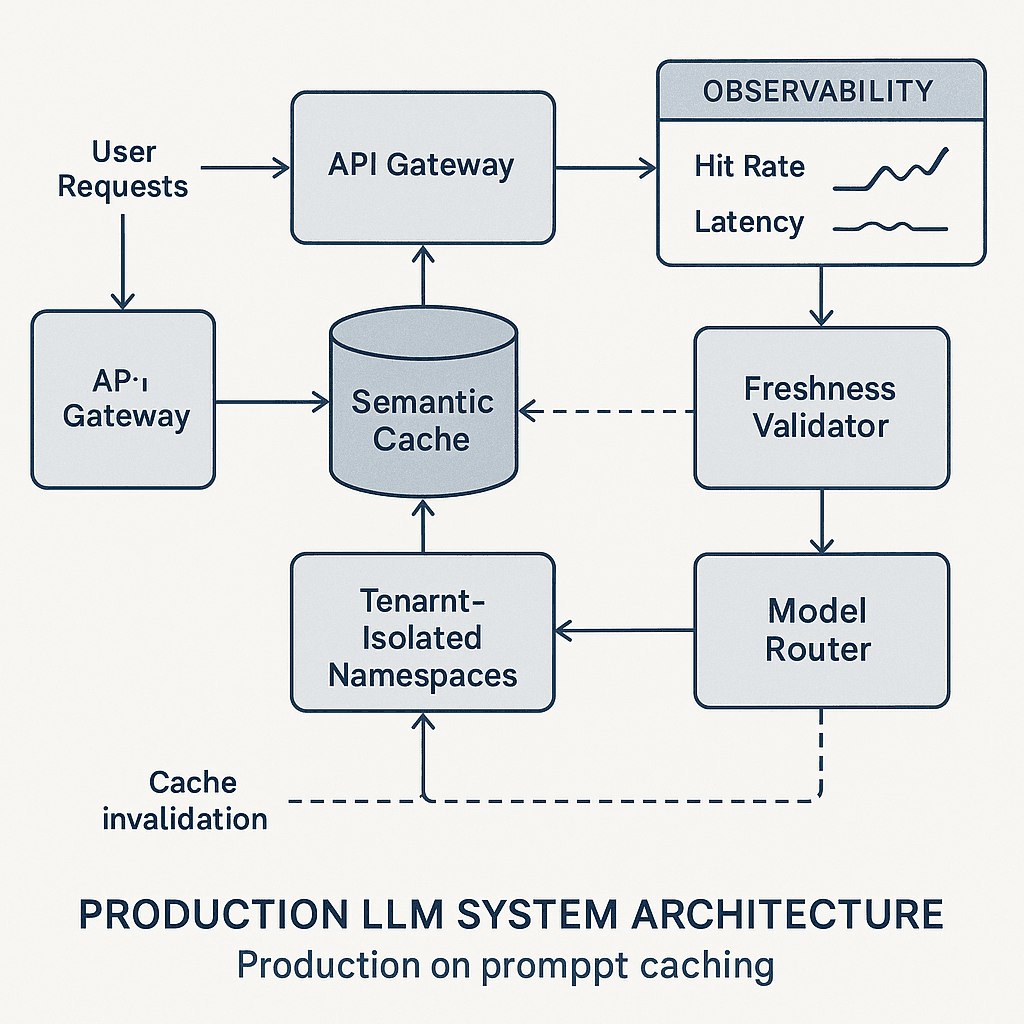
The team had done the obvious thing.
They had a retrieval-augmented support copilot serving internal agents. Traffic was climbing, model cost was ugly, and latency was drifting upward as prompt sizes grew. A senior engineer added a cache in front of the LLM call: hash the final prompt, store the response for 30 minutes, return the cached answer on a match.
At first, the graphs looked great. Token spend dropped. P95 latency improved. Product was happy.
Then the failures started.
One customer support agent asked about a refund policy for a specific enterprise contract. The system returned an answer generated earlier for a different tenant with similar wording. No raw data leaked, but the contractual logic was wrong. Another case involved a policy doc that had been updated an hour earlier; the cache kept serving a confidently phrased answer grounded in the old version. In a third incident, a harmful user message had triggered a refusal originally, but after prompt assembly changed, the cache replayed a previously allowed answer because the moderation and tool state were not part of the key. The engineering team had reduced inference cost by introducing a new reliability and safety surface they were not measuring.
This is how prompt caching usually enters production: as an optimization. In practice, it is a data consistency, multitenancy, retrieval freshness, and safety problem disguised as an optimization.
If you are building production LLM systems, caching can absolutely save money and shave latency. But a naive cache in front of a stochastic, retrieval-heavy, policy-constrained system will produce stale, ungrounded, or unsafe outputs unless you treat the cache as part of your serving architecture.
The useful pattern is not “cache the prompt.” It is “cache the right intermediate and final artifacts, under the right identity and freshness constraints, with explicit evaluation of when replay is safe.”
This article lays out a production architecture for prompt and response caching in LLM systems: semantic cache keys, invalidation strategies, tenant isolation, retrieval-aware freshness checks, safety implications, hit-rate instrumentation, and the cases where caching actually reduces cost and latency without corrupting grounded outputs.
The pattern: there is no single cache
Most teams start with one of two ideas:
- Cache the final model response keyed by the exact prompt string.
- Cache embeddings or retrieval results to avoid repeated upstream work.
Both are useful, neither is sufficient.
In production systems, “the prompt” is the output of many moving parts:
- user input normalization
- system instructions
- policy blocks
- tenant-specific configuration
- conversation summary or memory
- retrieved documents and snippets
- tool outputs
- model choice and decoding parameters
- safety classifier decisions
- response schema or tool contract
A cache that ignores these dimensions will create false hits. A cache that includes every byte literally will be so specific that hit rate collapses.
The architecture that works in practice is layered:
- L0 request deduplication: collapse duplicate in-flight requests.
- L1 exact response cache: replay only when effective inputs are truly equivalent.
- L2 semantic intent cache: for bounded classes of requests where semantically similar queries can safely reuse an answer or a generated intermediate.
- L3 retrieval/result cache: cache document retrieval, reranking, chunk assembly, and tool outputs with explicit freshness contracts.
- L4 prompt-prefix/provider cache: leverage provider-side prefix caching or reusable context windows where available.
These layers should not be treated equally. Some can tolerate approximation; some must be exact. The dangerous mistake is to apply semantic similarity at the final answer layer for grounded or tenant-sensitive tasks.
Why the naive approach fails
1. Exact prompt hashes ignore hidden state
Hashing the final prompt string sounds safe because it is exact. But in many systems the “same” output depends on more than the visible prompt text.
Examples:
- The safety policy version changed.
- The model changed from one release to another.
- Temperature, top_p, or max output tokens changed.
- The tool schema changed.
- A retrieval filter changed.
- The user’s authorization scope changed.
- The conversation memory summary changed upstream, even if the visible user turn did not.
If these are not part of the cache identity, you get silent inconsistencies.
2. Semantic keys over-answer grounded questions
Teams often notice that exact hashing gives low hit rate because users ask the same question in different words. So they embed the query, use nearest-neighbor lookup, and serve a prior answer if the semantic similarity is above a threshold.
This can work for FAQ-like tasks. It fails badly for grounded systems where tiny differences in retrieved evidence, user permissions, or temporal context matter.
Consider:
- “Can I cancel my subscription?”
- “Can I cancel my enterprise annual subscription signed in March?”
These are semantically close, but the answer may depend on contract clauses, account state, geography, or recently updated policy docs. A semantic hit at the final answer layer can convert a retrieval problem into a hallucination problem.
3. Retrieval changes more often than prompts
In RAG systems, many teams think the prompt is the expensive part. Often the real variability comes from retrieval.
- New documents are ingested.
- Chunking changes.
- Ranking features improve.
- ACL filters change.
- Source document metadata updates.
- External tools return fresh values.
A cache that keys only on user intent but not on retrieval state will happily serve answers grounded in obsolete evidence.
4. Multitenancy and security are easy to get wrong
Cross-tenant leakage does not require returning the wrong raw document. It is enough to reuse the wrong answer template, logic, or policy state.
Every cache needs an isolation model:
- tenant namespace
- user or role scope where needed
- data classification tags
- authorization context
If your cache is global by default, your incident review will eventually include the phrase “we assumed the prompt was generic.”
5. Safety decisions are part of the artifact
An LLM response is not just the generated text. It is the result of a policy decision pipeline.
You may have:
- input moderation
- jailbreak detection
- routing to safer or more capable models
- refusal templates
- output moderation
- policy post-processing
If you cache the generated text without caching or rechecking the safety context that allowed it, you can replay content into a context where it should now be blocked, or vice versa.
A better approach: cache architecture by artifact type
The production question is not “should we cache?” It is “what artifact can be safely reused, under what invariants?”
Here is a practical decomposition.
Layer 0: in-flight deduplication
Before you do anything sophisticated, deduplicate concurrent identical requests.
This is the lowest-risk, highest-ROI cache in many systems.
Use cases:
- chat clients retrying after timeouts
- multiple tabs issuing the same ask
- backend retries after transient failures
- bursty workflows where many jobs ask the same question simultaneously
Key design:
- exact request fingerprint
- short TTL, usually seconds
- promise/future sharing rather than durable storage
Benefits:
- reduces duplicate model calls
- reduces thundering herds on tools and vector DBs
- no stale data concerns because reuse window is tiny
Layer 1: exact response cache
This is your replay cache for deterministic-enough requests where all relevant state can be fingerprinted.
Good candidates:
- static prompt transformations
- classification tasks on unchanged content
- summarization of immutable artifacts
- structured extraction from versioned documents
- FAQ answers over controlled, low-churn corpora
Cache key should include more than the prompt string:
textcache_key = hash(
  tenant_id,
  auth_scope,
  normalized_user_input,
  system_prompt_version,
  policy_bundle_version,
  memory_state_id,
  retrieval_fingerprint,
  tool_output_fingerprint,
  model_id,
  model_release,
  decoding_params,
  response_schema_version
)
This looks heavy, but that is the point. Replay should be strict.
Layer 2: semantic cache for intermediates, not final answers
Semantic caching is most valuable when applied to stable intermediates instead of final user-visible grounded outputs.
Examples:
- intent classification
- query rewriting for retrieval
- route selection
- decomposition plans
- canonical search query generation
- synthetic SQL templates under schema versioning
Why intermediates are safer:
- they are narrower in scope
- they can be validated downstream
- they are less likely to encode stale source facts directly
- they can improve hit rate without replaying incorrect final prose
For final answers, use semantic caching only in constrained domains with explicit approval, such as low-risk support FAQs over versioned content where freshness is tightly controlled.
Layer 3: retrieval and tool caches
This is often the most underused layer.
For RAG systems, the expensive work may include:
- embedding the query
- vector search
- metadata filtering
- reranking
- fetching chunk payloads
- formatting citations
- calling external tools
Cache these artifacts independently.
Examples:
- query embedding cache keyed by normalized text + embedding model version
- vector search result cache keyed by canonical query + retrieval config + ACL scope + index snapshot
- reranker result cache keyed by candidate set hash + reranker model version
- tool result cache keyed by tool name + arguments + freshness class
This gives you cost and latency wins while keeping the final answer grounded on fresh evidence if you design freshness checks correctly.
Layer 4: provider-side prompt prefix caching
Some model providers support prompt caching or pricing discounts for repeated prompt prefixes. This is especially effective for large static prefixes:
- long system prompts
- policies
- tool specs
- schema definitions
- static knowledge blocks
This is not a replacement for your application cache. It is a complementary optimization.
Tradeoffs:
- provider-managed semantics may be opaque
- you still need your own invalidation logic
- not all models/providers support it equally
- savings are largest when your prompt has a large repeated prefix and variable suffix
In agentic systems with long tool and policy descriptions, provider-side prefix caching can materially lower input token cost even when response replay is unsafe.
Designing semantic cache keys that do not lie
The hardest part of cache architecture is deciding what “same enough” means.
A useful mental model is that a cache key has three parts:
- Intent identity: what is being asked?
- Context identity: under what knowledge, policy, and auth state?
- Execution identity: using what model/tooling/configuration?
Exact keys vs semantic keys
Use exact keys when:
- the output must be grounded in precise evidence
- legal/compliance context matters
- authorization scope affects the result
- the model output is consumed automatically downstream
- response schema strictness is high
Use semantic keys when:
- the task is classification or routing
- the output is an intermediate that will be validated
- the domain is low risk and mostly static
- false positives are cheaper than recomputation
Canonicalization before hashing
Exact keying is often too brittle unless you canonicalize the request first.
Canonicalization examples:
- lowercase and normalize whitespace
- normalize dates/time zones to canonical forms
- remove transient IDs that do not affect semantics
- sort unordered metadata fields
- normalize tool argument order in JSON
- rewrite equivalent query forms into canonical search forms
Be careful: canonicalization is a semantic decision. Over-normalize and distinct cases collapse into one key.
Retrieval fingerprinting
In grounded systems, retrieval state usually belongs in the key or in a freshness gate.
A practical retrieval fingerprint may include:
- corpus or index identifier
- index snapshot/version
- retrieval configuration version
- ACL filter scope hash
- top-k candidate document IDs and source versions
- reranker version
For example:
textretrieval_fingerprint = hash(
  corpus_id,
  index_snapshot_id,
  retrieval_config_version,
  acl_scope_hash,
  [(doc_id, doc_version, chunk_id) for top_candidates],
  reranker_version
)
If your corpus changes frequently, keying directly on top candidates can make the cache too unstable. In that case, move retrieval into its own cache and require a freshness check before replaying a final response.
Freshness and invalidation: the part most teams underestimate
There are only two hard things in computer science, and LLM caches inherit both naming and invalidation.
For production RAG systems, invalidation should be explicit and event-driven where possible.
TTL is necessary but not sufficient
A 15-minute TTL is not a freshness strategy. It is a blunt fallback.
Use TTLs to bound worst-case staleness, but do not rely on them as your primary mechanism when you have stronger signals.
Prefer version-based invalidation
Version every mutable dependency that can affect correctness:
- system prompt version
- policy bundle version
- response schema version
- model release pin
- corpus snapshot/index generation
- document version
- tool schema version
- authorization policy version
Then include those versions in the cache key or freshness check.
When the dependency changes, old entries naturally stop matching.
Event-driven invalidation for document-backed answers
If your answer depends on retrieved docs, wire cache invalidation to ingestion events.
Patterns that work:
- maintain doc_id -> cache_entry references for reverse invalidation
- tag cache entries with source versions
- invalidate entries when source docs are updated, deleted, or ACLs change
- if reverse mapping is too expensive, invalidate by corpus segment or snapshot boundary
Tradeoff:
- reverse indexes improve precision but add storage and write complexity
- coarse invalidation is simpler but reduces hit rate
Retrieval-aware freshness checks
This is one of the most useful patterns for grounded systems.
Instead of assuming a response is reusable because a key matches semantically, perform a cheap freshness check before replay.
For example:
- Look up a candidate cached answer by canonicalized intent.
- Re-run a lightweight retrieval step.
- Compare current top evidence against the evidence fingerprint stored with the cached answer.
- Replay only if overlap and versions satisfy your threshold.
A simple policy might be:
- exact replay allowed only if top 3 evidence docs are unchanged in ID and version
- conditional replay allowed if at least 80% of weighted evidence score is unchanged and no policy-sensitive docs changed
- otherwise recompute final answer
This usually gives better safety than pure semantic response caching, with much of the latency benefit retained if retrieval is cheap relative to generation.
Freshness classes for tools
Not every tool output should have the same TTL or invalidation semantics.
Classify tools by freshness sensitivity:
- immutable: document parse of versioned PDF, schema introspection tied to version
- slow-changing: product catalog, internal wiki pages
- time-sensitive: pricing, inventory, account balance
- real-time: fraud scores, market data, operational status
Then define cache policy per class:
- immutable: cache aggressively by version forever
- slow-changing: TTL + event invalidation
- time-sensitive: very short TTL + conditional validation
- real-time: usually do not cache final outputs; maybe cache partial formatting only
Tenant isolation and authorization boundaries
This deserves a dedicated section because it is where teams get burned.
At minimum, every cache entry should be namespaced by tenant unless the artifact is provably global and non-sensitive.
Namespace design
Typical dimensions:
- tenant_id
- environment (prod/staging)
- region/data residency zone
- app surface or product line
- user role or auth scope when results differ by permissions
Example namespace:
textnamespace = org_123:prod:eu:support_agent:role_manager
Do not rely on the prompt content to imply tenant. Put the boundary in the cache key and storage namespace.
Beware shared corpora with filtered access
A common trap: “The docs are in one shared index, but retrieval applies ACL filters. We can still cache globally.”
Not safely, unless the cache key includes the authorization scope hash and your replay logic guarantees the answer was derived only from content visible to that scope.
In many enterprise systems, the safer choice is to cache retrieval and responses per tenant or per ACL segment, even if it lowers hit rate.
Encrypt or avoid storing sensitive prompts/responses
Prompt/response caches are data stores. Treat them like one.
Consider:
- encryption at rest
- field-level encryption for sensitive tool outputs
- short retention for user-visible responses
- avoiding storage of full raw prompts when fingerprints suffice
- separate storage classes for PII-bearing artifacts
- audit logs for cache reads/writes across tenants
Safety implications: a cache can bypass your guardrails
A subtle but serious failure mode is using the cache as a fast path that skips checks.
If your normal serving pipeline is:
- input moderation
- retrieval/tooling
- model generation
- output moderation
- policy post-processing
then a cache hit cannot mean “return stored text immediately” unless the cached artifact already encodes the outcome of this pipeline and the safety assumptions still hold.
Safe replay policy
A practical approach:
- always run lightweight input safety checks before cache lookup or before replay
- include policy and moderation versions in the cache metadata
- revalidate output against current policy if policy changed
- do not cache or replay disallowed content except approved refusal templates
- cache structured policy outcomes separately from text when useful
For instance, you might cache:
allowed/refused/escalate- refusal category
- safe response template ID
- citations/evidence set
- final rendered text
Then on replay, if policy version has changed, you can reuse evidence or retrieval results but regenerate or revalidate the final wording.
Cache poisoning and adversarial prompts
Attackers can intentionally manipulate caches:
- injecting unusual prompt variants to create bad semantic neighbors
- exploiting broad canonicalization rules
- causing unsafe answers to be replayed via approximate matching
- creating denial of service through cache-busting cardinality
Mitigations:
- never use approximate matching for high-risk final outputs
- gate semantic hits with confidence thresholds and domain allowlists
- cap namespace cardinality and evict suspicious patterns
- log semantic match distances and false-hit incidents
- require evidence consistency before replaying grounded content
Instrumentation: if you do not measure hit quality, hit rate is a vanity metric
Teams love to report cache hit rate. Hit rate alone is often misleading.
A cache with a 40% hit rate that causes 2% silent wrong answers is worse than a 10% hit rate cache that is extremely safe.
Measure at least these dimensions.
Core metrics
- overall hit rate by cache layer
- exact hit rate vs semantic hit rate
- byte/token savings per layer
- p50/p95 latency reduction per layer
- miss reasons: key mismatch, freshness failure, policy mismatch, expired, invalidated
- cache write amplification and storage footprint
Quality and safety metrics
- replay acceptance rate after freshness check
- evidence drift rate: how often current retrieval differs from cached evidence
- stale answer rate from audits or online labels
- safety recheck failure rate on candidate hits
- cross-tenant isolation violations, ideally zero with alarms
- downstream task success on cache hits vs misses
Segment your analysis
Do not average across all traffic. Segment by:
- task type: FAQ, summarization, extraction, agentic workflows, RAG Q&A
- tenant
- corpus churn level
- model family
- prompt length bucket
- tool usage path
You will often find that caching is fantastic for a few high-volume routes and harmful or pointless for others.
Gold standard: replay-vs-regenerate evaluation
For candidate cached requests, periodically shadow-run regeneration and compare:
- semantic equivalence of final answer
- citation overlap
- policy outcome consistency
- user preference or rubric score
- structured output exact match where applicable
This lets you estimate the true quality cost of replay.
A simple online evaluation loop:
- sample 1-5% of cache hits
- regenerate asynchronously
- compare output and evidence
- alert if divergence exceeds threshold
- use results to tune TTLs, thresholds, or route allowlists
Model and tool considerations
Caching strategy changes depending on the model and workflow.
Large model vs small model economics
If you use a very large, expensive model for all turns, response caching can have dramatic savings. But if a small model can cheaply regenerate the answer in 300 ms, aggressive replay may not be worth the consistency complexity.
A common pattern is:
- cache expensive routing, retrieval, and tool outputs
- route repeated low-risk tasks to smaller models
- reserve replay of final answers for only the most stable surfaces
Determinism matters
The less deterministic the generation path, the less useful exact response caching becomes for final prose quality consistency.
Factors:
- temperature > 0
- model release drift under alias names
- non-deterministic tool ordering
- retrieval tie instability
For caches intended to replay exact responses, pin:
- model release/version
- decoding parameters
- tool ordering
- response schema
Provider prefix caching vs app-layer response caching
These solve different problems.
- Provider prefix caching reduces input token cost for repeated prefixes.
- App-layer response caching avoids generation entirely for reusable outputs.
In many production systems, the best first move is provider-side prompt-prefix optimization plus retrieval/tool caching, because those reduce cost without taking on as much stale-answer risk.
Cost and latency tradeoffs in plain terms
Caching is not free. It adds storage, invalidation machinery, complexity, and possible correctness risk.
Here is a practical way to reason about ROI.
Caching is attractive when
- prompts are long and repetitive
- model calls dominate latency/cost
- many requests cluster around a few intents
- source knowledge changes slowly or is versioned
- outputs are low-risk or easy to validate
- retrieval and tool pipelines are expensive
Caching is less attractive when
- every request is personalized or time-sensitive
- source evidence changes frequently
- authorization scopes vary widely
- outputs are high risk and hard to validate
- small models are already cheap and fast
- cache invalidation requires excessive engineering overhead
Back-of-envelope economics
Suppose:
- average request costs $0.02 in model + retrieval/tooling
- response replay saves $0.018
- retrieval-only cache saves $0.006
- hit rate for safe response replay on eligible traffic is 18%
- hit rate for retrieval cache is 45%
- only 35% of traffic is replay-eligible
Then expected per-request savings might be:
- response replay:
0.35 * 0.18 * 0.018 = $0.001134 - retrieval cache:
1.00 * 0.45 * 0.006 = $0.0027
In this scenario, retrieval caching creates more value than response replay, while carrying less stale-answer risk.
This is common. Teams often overinvest in final-response caching when intermediate caching would pay off more safely.
Reference architecture for production
A practical serving flow looks like this:
-
Normalize request
- canonicalize input
- attach tenant/auth/policy/model context
-
Run lightweight safety precheck
- block obviously disallowed input
- classify route risk level
-
Check L0 in-flight dedupe
- if identical request is already computing, await shared result
-
Check exact response cache for replay-eligible routes
- strict key match
- verify policy/model/schema versions
- if grounded route, run freshness gate before replay
-
Check semantic cache for approved intermediates
- intent, query rewrite, routing plan
- validate downstream where possible
-
Check retrieval/tool caches
- embedding cache
- vector/rerank cache
- tool result cache by freshness class
-
Execute retrieval/tools as needed
- produce evidence fingerprint
-
Generate final response
- with model version pinning and schema constraints
-
Run output safety/policy checks
- moderation, citation validation, formatting checks
-
Write caches selectively
- store intermediates broadly
- store final response only if route is replay-approved and metadata complete
- Emit observability events
- hit/miss, freshness outcome, evidence drift, latency, token savings
Implementation details teams usually ask about
What should you store?
For each cache entry, store not just the value but metadata needed for safe reuse:
json{
  "namespace": "org_123:prod:eu:support_agent",
  "artifact_type": "final_response",
  "key": "...",
  "value": "rendered answer or structured artifact",
  "created_at": "2026-07-01T12:00:00Z",
  "ttl_s": 900,
  "model": {"id": "model-x", "release": "2026-06-15"},
  "policy_version": "policy-v19",
  "schema_version": "answer-schema-v3",
  "retrieval": {
    "corpus": "contracts",
    "snapshot": "snap-8821",
    "evidence": [
      {"doc_id": "doc-1", "version": "17", "chunk_id": "c4"},
      {"doc_id": "doc-2", "version": "3", "chunk_id": "c9"}
    ],
    "reranker_version": "rr-v4"
  },
  "safety": {
    "input_check": "pass",
    "output_check": "pass",
    "policy_outcome": "allowed"
  }
}
Without metadata, you cannot make safe replay decisions later.
How do you choose TTLs?
Start from source volatility, not convenience.
Example policy:
- immutable document extraction: 30 days or version-bound
- internal wiki FAQ with event invalidation: 1-6 hours
- support policy answers with retrieval freshness gate: 10-30 minutes
- pricing/inventory/account state answers: no final-response cache, tool cache only for seconds if allowed
When should you skip caching entirely?
Skip final-response caching for:
- highly personalized or account-specific outputs
- legal/medical/high-stakes recommendations
- actions with real-time state dependencies
- tasks where current retrieval evidence is essential and fast-changing
- prompts likely to contain secrets unless storage controls are mature
What about conversation memory?
Conversation state is a cache anti-pattern if unmanaged. Long chats reduce exact hit rate and increase accidental state coupling.
A better pattern:
- cache summaries or extracted memory facts as versioned intermediates
- key by conversation state ID or summary hash
- do not semantically reuse final answers across materially different memory states
What storage technology should back the cache?
Typical stack:
- in-flight dedupe: process memory or distributed lock/promise store
- exact caches: Redis or similar low-latency KV
- semantic cache: vector store or ANN index plus metadata filter layer
- reverse invalidation index: relational/NoSQL side table
- long-lived immutable artifact cache: object store or document DB
Requirements:
- namespace support
- TTL support
- metadata filtering
- encryption
- high-QPS read path
- operational visibility
A practical rollout plan
Do not launch all cache types at once.
Phase 1: instrument first
Before adding replay, measure:
- repeated request rate
- repeated retrieval pattern rate
- prompt prefix repetition
- corpus churn
- latency breakdown by stage
- cost breakdown by stage
You want to know whether generation, retrieval, or tools dominate.
Phase 2: add low-risk caches
Start with:
- in-flight dedupe
- embedding cache
- retrieval result cache
- provider prefix caching
- exact caching for immutable transformations
These usually pay back quickly and rarely create visible correctness regressions.
Phase 3: add guarded final-response replay
Only for approved routes.
Requirements before launch:
- strict cache key schema
- tenant isolation
- freshness gate for grounded answers
- safety recheck policy
- shadow evaluation on hits
- kill switch per route
Phase 4: experiment with semantic caching of intermediates
Use offline and online evaluation to tune thresholds. Keep the scope narrow.
Takeaways
Prompt caching in production LLM systems is not one feature. It is a family of reuse decisions across requests, retrieval, tools, and generation.
The naive approach—hash the prompt, save the answer, set a TTL—works just long enough to look successful before it creates stale, inconsistent, or unsafe behavior.
The battle-tested approach is:
- cache multiple artifact types, not just final responses
- use strict identity for final replay and semantic identity mainly for intermediates
- include tenant, auth, policy, model, schema, and retrieval state in cache decisions
- prefer version-based and event-driven invalidation over TTL alone
- add retrieval-aware freshness checks before replaying grounded answers
- treat safety outcomes as part of the cached artifact
- measure replay quality, not just hit rate
If you do this well, caching can materially reduce cost and latency without corrupting grounded outputs. In many systems, the biggest wins come from retrieval/tool caches and provider-side prompt-prefix reuse, not aggressive semantic replay of final answers.
That is the important mindset shift. The goal is not to maximize cache hits. The goal is to maximize safe reuse.
Those are not the same thing, and production systems punish teams that confuse them.