Production Prompt Optimization Without Fine-Tuning: Building an Experimental Program for Templates, Context Assembly, and Routing
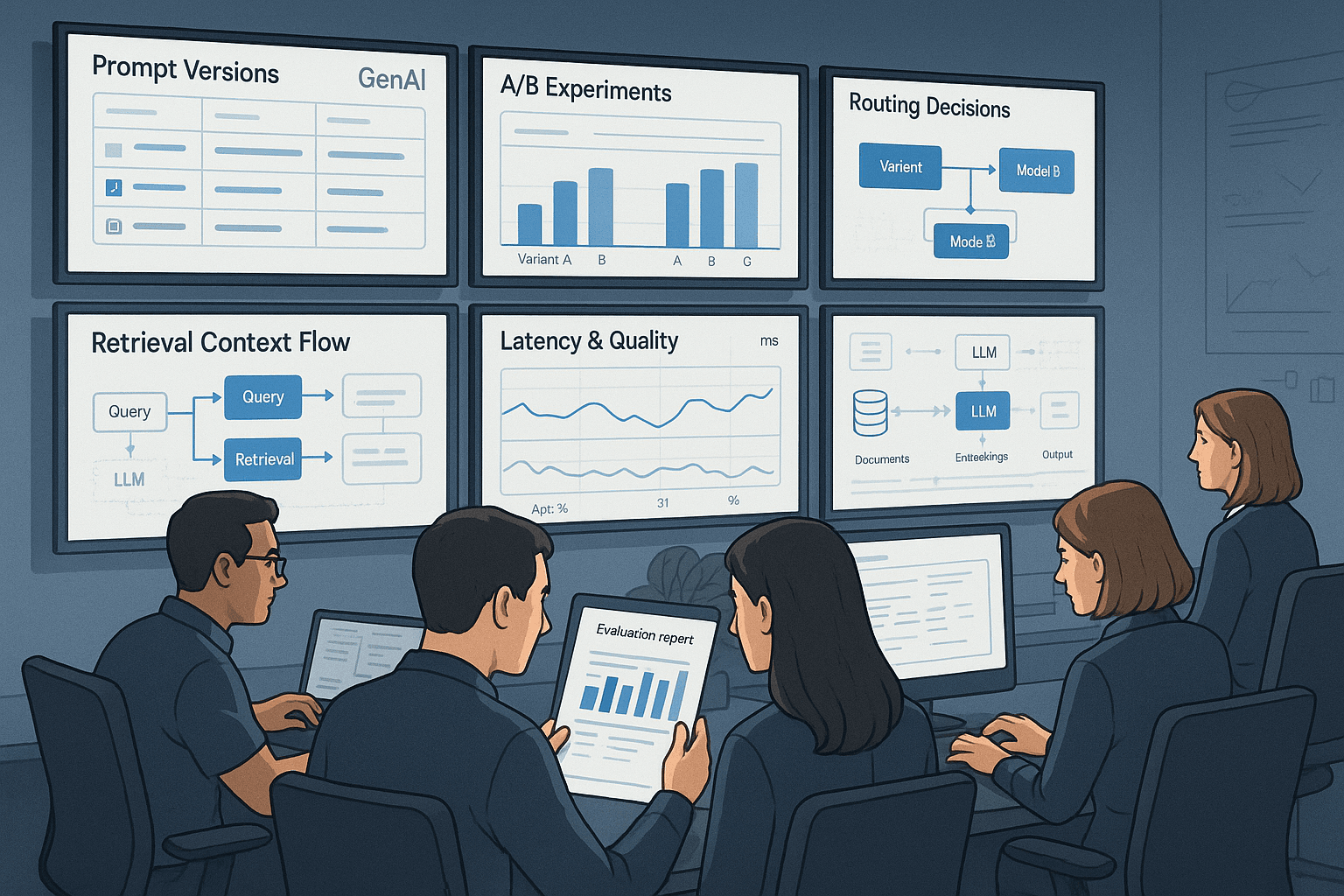
A team ships a customer-support copilot that works beautifully in demos. It summarizes tickets, drafts replies, pulls policy snippets from a knowledge base, and even tags escalations. The first month in production looks encouraging: resolution time drops, agents like the UI, and leadership starts asking where else the system can be deployed.
Then the failure reports start to accumulate.
The copilot gives great answers for billing questions but struggles with account recovery. It performs well for short tickets but gets confused on long back-and-forth threads. A new product launch causes a spike in questions with unfamiliar terminology, and answer quality dips. One prompt tweak improves tone but hurts citation accuracy. Another reduces hallucinations but makes responses too terse to be useful. Engineers begin editing prompt text directly in the codebase. Product managers create separate “temporary” prompt variants for enterprise customers. Retrieval settings get changed alongside system prompts, but nobody can say which modification actually caused the improvement or regression.
Three months later, the team has what many production GenAI teams eventually create by accident: a brittle, under-instrumented prompt stack with folklore instead of engineering discipline.
At this point, the instinctive response is often: maybe we need fine-tuning.
Sometimes that’s true. But in many production systems, teams reach for fine-tuning before they have exhausted the much cheaper, faster, and often surprisingly powerful levers available in prompt architecture, context assembly, decomposition, and routing. The issue is not that prompting “doesn’t work.” The issue is that the team is treating prompt changes as copy edits rather than system changes that deserve hypothesis-driven experimentation, versioning, evaluation, and rollout controls.
That is the core shift this article is about: prompt optimization in production is not artisanal prompt crafting. It is an experimental program.
If you operate LLM systems at scale, your prompt is not a string. It is the executable interface between user intent, dynamic context, model behavior, tool use, and business policy. Improving it reliably requires the same rigor you would apply to ranking models, fraud rules, retrieval systems, or recommendation pipelines.
The most effective teams I’ve seen do five things consistently before they invest in fine-tuning:
- They define prompt changes as testable hypotheses tied to failure modes.
- They version prompt templates, context policies, and routing logic independently.
- They evaluate changes offline against representative workloads before exposing them online.
- They gate releases with regression checks on quality, safety, cost, and latency.
- They instrument the system so they can explain why a change worked or failed.
Done well, this buys you a lot. You can improve reliability without retraining. You can customize behavior per intent without creating a model zoo. You can move faster because rollback is simple. And most importantly, you can learn systematically which parts of the stack actually matter.
The pattern: production prompt quality is usually a systems problem, not a wording problem
When teams say “the prompt needs work,” they often mean one of several different failure classes:
- The instructions are underspecified or internally conflicting.
- The wrong context is being assembled for the task.
- Too much context is being included, causing distraction or dilution.
- The model is being asked to solve multiple subproblems in one pass.
- The same prompt is being used for intents that require different behavior.
- Retrieval quality is poor, but the prompt is blamed.
- Tool-selection policy is weak, so the model guesses instead of calling a system.
- Output constraints are unclear, leading to format drift or unverifiable claims.
- Prompt edits improved one metric while quietly regressing another.
In other words, “prompt optimization” usually spans at least four layers:
- Template architecture: system instructions, few-shot examples, output schema, decomposition scaffolding.
- Context assembly: what retrieval results, memory, metadata, and tool outputs get passed into the model.
- Routing: which prompt/model/tool chain handles which request.
- Evaluation and controls: how you measure changes, catch regressions, and roll out safely.
If you optimize only the visible text of the prompt while ignoring the other three, you’ll see inconsistent gains and high regression risk.
A useful mental model is to treat every LLM request as a function of three inputs:
response = f(template, context, route)
Most teams can only tell you the final output and maybe the model name. Mature teams can reconstruct all three inputs for any response in production.
That difference is enormous.
Why the naive approach fails
The naive workflow usually looks like this:
- Someone notices a bad output.
- They manually tweak wording in the system prompt.
- They test on a few remembered examples.
- If the outputs look better, they ship the change broadly.
- A week later, another issue appears, and the cycle repeats.
This approach fails for several reasons.
1. You optimize for anecdotes, not distributions
Remembered failures are useful for diagnosis, but dangerous as the only benchmark. Production workloads are heterogeneous. A prompt that fixes one class of failure can damage adjacent cases, especially when you alter tone, verbosity, citation rules, or decomposition instructions.
Without a representative evaluation set segmented by intent, language, complexity, and user tier, you’re tuning to anecdotes.
2. Prompt edits are entangled with context changes
In real systems, prompt updates often coincide with retrieval tweaks, chunking changes, tool additions, and new metadata fields. If you change multiple variables at once, you lose attribution. Teams then develop cargo-cult beliefs like “adding more examples always helps” or “the latest model is worse,” when the actual cause may be retrieval noise or a broken router.
3. Single-prompt designs hide task heterogeneity
A support summarizer, policy question-answering assistant, sales research bot, and coding copilot do not benefit equally from the same template. Even within one application, intents vary. “Answer this factual question from docs” and “draft a tactful customer response” have different optimization goals. Forcing them through a single generic prompt creates avoidable compromise.
4. No one defines what “better” means operationally
Teams say they want higher quality, but what matters in production is multi-objective:
- factuality/citation correctness
- task completion
- policy adherence
- format validity
- tone
- latency
- token cost
- tool-call rate
- escalation rate
- human acceptance or edit distance
A prompt that increases answer completeness by 5% but doubles cost and latency may or may not be an improvement depending on the workflow. Without explicit tradeoff rules, optimization becomes political.
5. Lack of observability turns failures into mysteries
If you cannot inspect prompt version, retrieved context, route decision, model parameters, tool traces, and evaluation labels for a bad response, you cannot debug effectively. Teams compensate with superstition: “the model was having a bad day.” Usually the system was.
A better approach: build a prompt optimization program, not a pile of prompts
The right move is to establish an experimental program with clear ownership, artifacts, and release processes. Think of it as lightweight model operations for prompt-based systems.
The backbone is simple:
- standardized prompt/template versioning
- intent-aware routing
- dynamic context policies
- offline eval harnesses
- online experiments and guarded rollouts
- trace-level observability
- a failure-analysis loop feeding new hypotheses
This does not need to be bureaucratic. In fact, the goal is to make prompt changes faster and safer by making them legible.
Architecture: separate the optimization surfaces
A common mistake is storing everything in one giant prompt blob. Instead, define separate, versioned components.
1. Instruction template layer
This includes:
- system message
- developer/task instructions
- output schema or format contract
- few-shot examples
- refusal/safety policy text
- decomposition scaffolding, if any
Version these independently from other system components. A template version should be immutable once released, with metadata such as:
- template_id
- semantic purpose
- supported intents
- expected input schema
- expected output schema
- model compatibility notes
- owner
- changelog
Treat prompt templates like code artifacts, not inline strings.
2. Context assembly layer
This layer decides what dynamic information gets passed to the model. It usually includes:
- retrieved documents
- conversation history
- user/account metadata
- product catalog or policy snippets
- tool outputs
- memory summaries
- confidence signals
Each of these should have an explicit inclusion policy. For example:
- include last 6 messages for short support threads, but summarize older history beyond that
- include top 4 retrieved chunks for policy QA, but only top 2 for drafting tasks
- exclude low-confidence retrieval results below a relevance threshold
- attach account tier metadata only for billing and entitlement intents
- provide tool output instead of raw logs when the task is explanation rather than diagnosis
This is where many prompt gains come from. Better context curation often outperforms more elaborate instruction writing.
3. Routing layer
Instead of one prompt for everything, use lightweight routing to select the best path per request. Routes can vary by:
- intent
- complexity
- user segment
- language
- need for citations
- need for tool use
- latency budget
- confidence or ambiguity
Typical routes might be:
- FAQ-style doc QA with strict groundedness
- workflow execution with tool calling
- long-thread summarization
- draft generation with tone controls
- escalation recommendation
Routing can be rule-based first. It does not need a classifier on day one. In fact, a robust deterministic router based on product surface, UI action, or explicit user mode is often preferable early on because it is debuggable.
4. Evaluation and policy layer
Every route should declare:
- primary success metrics
- regression guardrails
- acceptable latency/cost envelope
- online rollout strategy
- fallback behavior
This allows you to optimize routes differently. For example, a compliance-sensitive QA route may accept higher latency for stronger groundedness, while a live chat drafting route may prefer lower latency and tolerate lighter context.
Start with failure taxonomies, not clever ideas
The easiest way to waste time is to brainstorm prompt improvements without a structured understanding of failure modes.
Build a taxonomy from production traces and human review. A practical starter taxonomy looks like this:
- Grounding failures: answer unsupported by provided sources; incorrect citation; invents policy.
- Instruction failures: ignores required format; misses mandatory steps; wrong persona.
- Context failures: omitted key detail from thread; included irrelevant retrieved docs; stale memory dominates.
- Reasoning/decomposition failures: mixes summarization with action recommendation badly; fails to compare options.
- Tooling failures: should have called retrieval/tool but didn’t; called wrong tool; over-relied on tool output.
- Routing failures: request sent to the wrong template or model.
- UX failures: too verbose; too terse; tone mismatch; hard to edit.
- Performance failures: latency spike; token budget overrun; timeout-induced truncation.
For each class, collect examples, frequency, user impact, and suspected root cause. Then convert those into hypotheses.
Examples:
- “For policy QA, reducing retrieved chunks from 8 to 4 and requiring per-claim citations will decrease unsupported claims without hurting answer completeness.”
- “For long support threads, replacing raw history older than 10 turns with a rolling summary will reduce confusion and token cost.”
- “For refund requests, a dedicated route with structured case-state metadata will outperform the generic support prompt on resolution accuracy.”
- “For knowledge-search intents, using a smaller cheaper model for query rewriting plus a stronger model for answer synthesis will improve grounding/cost balance.”
Now you have an engineering backlog rather than a prompt-writing contest.
Designing prompt experiments that actually teach you something
A good prompt experiment changes one meaningful variable at a time, uses a fixed eval slice, and logs enough metadata to support comparison.
The variables worth testing usually fall into a few buckets.
Template variables
- instruction ordering
- explicit success criteria
- output schema strictness
- few-shot inclusion and example selection
- chain-of-thought replacement with structured intermediate fields
- refusal wording
- verbosity guidance
- explicit use/non-use of provided context
Context variables
- number of retrieved chunks
- chunk size and overlap
- reranker on/off
- metadata filtering
- recency weighting
- conversation truncation policy
- summary vs raw history
- inclusion of user/account state
- inclusion of prior tool outputs
Routing variables
- route split thresholds
- model selection by intent/complexity
- fallback triggers
- tool-first vs answer-first strategies
- confidence-based escalation
Orchestration variables
- single-pass response vs staged decomposition
- draft-then-verify
- retrieve-then-answer vs answer-with-tool-fallback
- planner/executor split
- self-check step with constrained rubric
A note on decomposition: teams often overcomplicate it. You don’t need exotic agent loops for most prompt optimization. Simple staged pipelines frequently work well:
- classify intent
- retrieve/select context
- generate draft in structured form
- validate for citations/format/policy
- render final response
This kind of decomposition improves reliability because each step has a narrower objective and can be evaluated separately.
Offline evals: the minimum viable harness
Before any online rollout, you want an offline harness that can answer: did this change help, hurt, or simply move behavior around?
At minimum, your harness should support:
- replaying representative production examples
- pinning model, temperature, and tool settings
- comparing prompt/context/router variants
- collecting structured judgments
- segmenting results by intent and difficulty
- computing cost and latency estimates
Build an eval set from real traffic
Synthetic evals are useful, but production optimization should be grounded in actual traces. Sample from recent traffic and label examples across key strata:
- top intents
- high-value user segments
- difficult edge cases
- known failure classes
- different context lengths
- multilingual traffic if relevant
- tasks requiring citations/tools vs pure drafting
Keep the eval set versioned. Annotate each sample with:
- request text
- route or expected intent
- available context snapshot
- expected output properties
- gold answer if feasible
- failure category tags
- business priority
In many enterprise workflows, exact gold answers are unrealistic. That’s fine. Use rubric-based evaluation where needed.
Use layered metrics, not one score
For most GenAI tasks, you need both automated and human/LLM-judge metrics.
Examples:
- Format validity: parse success, schema compliance.
- Groundedness: are claims supported by provided documents/citations?
- Task completion: did it answer the actual question or perform the requested transformation?
- Instruction adherence: followed template constraints.
- Conciseness/verbosity band: token or sentence-level heuristics.
- Safety/policy: refusal correctness, sensitive-data handling.
- Edit distance to accepted human output: useful for drafting workflows.
- Latency and token usage: measured or estimated.
LLM-as-judge can be helpful, especially for broad coverage, but use it carefully. Constrain the rubric, keep model versions fixed, and calibrate against human labels on a subset. For compliance-heavy or high-stakes tasks, human review remains essential.
Segment everything
Average improvements are misleading. Suppose a new template improves overall score by 3%, but only because it helps easy FAQ cases while hurting complex account-resolution tickets. If the latter drive most business value, the change is a regression.
Always segment by:
- intent n- route
- context length
- user tier
- language
- retrieval hit quality
- human-labeled difficulty
A variant that loses overall may still become the best route-specific prompt.
Online evals and rollouts: where teams either build trust or lose it
Offline gains are necessary, not sufficient. Production behavior changes when traffic distribution, retrieval freshness, and user expectations come into play.
Use controlled rollouts.
Recommended rollout sequence
- Shadow evaluation: replay live requests to the candidate variant without showing outputs to users.
- Internal dogfood: route employee/internal traffic first.
- Canary release: expose to a small percentage of low-risk traffic.
- Segmented A/B: compare against control on targeted intents.
- Progressive ramp: increase exposure while monitoring guardrails.
- General availability: only after stable results.
Online metrics that matter
Depending on the product, track:
- acceptance rate of suggested output
- human edit rate / edit distance
- re-prompt rate
- fallback/escalation rate
- citation click-through or correction rate
- resolution rate
- downstream task completion
- user satisfaction
- latency p50/p95/p99
- tokens per request
- tool-call frequency and success
- abstain/refusal rate
Importantly, connect prompt variants to downstream business outcomes. A more “helpful” sounding response is not better if it increases agent correction workload.
Regression gates
Prompt releases should have explicit gates. For example:
- no more than 1% drop on groundedness for policy QA
- no more than 10% increase in median token cost
- p95 latency increase under 300 ms
- schema validity above 99.5%
- no increase in unsafe disclosure category
These gates create discipline and reduce endless subjective debate.
Prompt versioning: the missing control plane in many teams
If you do one thing after reading this, make it this: implement proper versioning for prompts, context policies, and routes.
A useful release unit is not “the prompt.” It is a configuration bundle containing:
- template version
- few-shot set version
- retrieval policy version
- truncation/summarization policy version
- routing policy version
- model/version
- decoding params
- tool availability and schema version
Every production response should log the bundle ID. That enables reproducibility and rollback.
Practical storage patterns
You do not need a specialized vendor platform to start. Many teams succeed with:
- prompts/templates in Git
- structured YAML/JSON manifests for route configs
- a prompt registry table in Postgres or an internal config service
- CI checks for schema validity and missing metadata
- deployment tooling that promotes bundles across environments
A sample manifest might define:
- route: support_policy_qa
- template: support_policy_qa_v12
- few_shot_pack: grounded_citations_v3
- retrieval_policy: kb_rerank_top4_v5
- history_policy: summarize_over_8_turns_v2
- model: gpt-x-large
- temperature: 0.1
- max_tokens: 500
- eval_suite: policy_qa_regression_v9
- owner: support-ai-team
This is boring in the best possible way. Boring is what you want in production controls.
Dynamic context policies beat static “stuff everything in” approaches
One of the highest-ROI changes in production systems is moving from static context stuffing to dynamic context policies.
The naive approach says: include as much relevant information as fits.
That often fails because more context is not monotonically better. Excess context can:
- dilute salient facts
- introduce contradictory or stale information
- increase latency and cost
- make citation attribution harder
- raise the chance the model anchors on irrelevant details
Instead, define intent-specific context policies.
Examples of dynamic policies
For policy QA
- retrieve top 20 candidates
- rerank to top 4
- require source diversity cap so one noisy doc doesn’t dominate
- include short source descriptors
- exclude conversation history except the last user query and one prior clarification
For support-thread summarization
- include the last 8 turns verbatim
- replace earlier turns with a rolling summary
- attach structured ticket metadata and previous resolution state
- exclude retrieval unless a linked article is explicitly referenced
For sales call prep
- include CRM fields, last meeting notes, account signals
- summarize long news/profile docs before final answer generation
- use recency weighting for context freshness
For code-generation assist
- include only the files/functions in focus plus dependency signatures
- compress unrelated files into symbol summaries
- attach linter/test failures rather than full logs
These policies frequently matter more than instruction wording.
Model and tool comparisons: optimize the whole route, not just the primary model
Prompt optimization without fine-tuning also means resisting the urge to solve every quality issue by upgrading to the most expensive model everywhere.
The right question is not “which model is best?” It is “which model/tool combination is best for this route under our constraints?”
A practical comparison framework
For each route, compare candidate setups on:
- quality metrics for that route
- schema adherence
- groundedness/tool reliability
- latency p50/p95
- token efficiency
- total cost per successful task
- operational robustness under long context
You may find patterns like:
- a smaller model works fine for classification/routing and query rewriting
- a mid-tier model is sufficient for structured extraction
- a larger model materially improves synthesis on ambiguous, high-value cases
- one model is better at strict JSON adherence, another at nuanced drafting
- a tool-augmented route beats a bigger model guessing from prompt context alone
Common production pattern: cascade by difficulty
A highly effective pattern is routing by complexity:
- cheap classifier/router determines intent and complexity
- smaller model handles routine or low-risk cases
- larger model handles ambiguous, high-value, or long-context cases
- tool-verified path required for policy-sensitive tasks
This often produces better cost-quality tradeoffs than one heavyweight default route.
Cost and latency tradeoffs in practice
Prompt optimization affects both directly.
- More few-shot examples increase tokens and latency.
- More retrieval chunks increase context cost and may reduce answer quality.
- Additional validation steps improve reliability but add latency.
- Multi-stage pipelines can be cheaper than one large-model call if earlier stages use smaller models.
- Summarization steps add work but can lower total cost for long threads by shrinking downstream context.
The only sane way to manage this is to measure cost per successful task, not cost per request alone.
For example, if a two-stage route increases request count by 30% but cuts agent edit time enough to improve acceptance materially, it may be the cheaper system overall.
Implementation details: what to build first
If your team is early but already in production, here is a practical order of operations.
Phase 1: establish observability and artifacts
Build or standardize logging for every request:
- request ID
- user/task metadata
- route selected
- model/version
- prompt/template version
- context policy version
- retrieved docs and scores
- tool calls and outputs
- token counts
- latency breakdown
- final output
- user outcome signals if available
Without this, everything else is slower.
Then externalize prompt/config artifacts from app code. Put them under reviewable version control with owners.
Phase 2: create a core eval suite
Start with 200–500 representative examples for your highest-value routes. Include known bad cases. Label enough dimensions to support triage.
Automate replay and comparison so engineers can run:
- baseline bundle
- candidate bundle
- diff report by metric and segment
You want this to become normal pre-merge or pre-release workflow.
Phase 3: split monolithic prompts into route-specific bundles
Identify your top 3–5 intents and give each a dedicated route configuration. This alone often yields major gains because you stop overfitting one prompt to incompatible goals.
Phase 4: introduce dynamic context controls
Instrument token usage and retrieval effectiveness. Then test:
- fewer but higher-quality chunks
- reranking
- history summarization thresholds
- metadata inclusion by intent
- confidence-based abstention when context is weak
Phase 5: add online experiment controls
Support shadow mode, canaries, A/B assignment, and fast rollback. If you can do this for regular product changes, you can do it for prompt bundles too.
Phase 6: formalize ownership and review
Prompt systems become unmanageable when nobody owns the route end-to-end. For each route, assign a directly responsible team or individual for:
- template changes
- retrieval/context policy
- eval suite health
- rollout approval
- incident response
This matters more than teams expect.
Failure analysis: how mature teams learn faster
When a bad output reaches a user, don’t stop at “the model hallucinated.” Run a structured postmortem.
Ask:
- What route handled the request?
- Was the route correct?
- What context was included, and what was missing?
- Did retrieval return the right evidence?
- Did the prompt provide clear instructions for this case?
- Should a tool have been called?
- Was the output invalid, unsupported, incomplete, or just poorly phrased?
- Did existing evals contain similar cases?
- What guardrail failed to catch it?
- What minimal change would reduce recurrence?
Classify the fix type:
- add eval coverage
- adjust routing
- improve retrieval/reranking
- alter context inclusion
- split route by intent
- tighten output schema
- add validation step
- only then consider fine-tuning
This discipline prevents teams from using fine-tuning as a catch-all for unresolved systems issues.
When prompt optimization is enough, and when fine-tuning becomes justified
You should absolutely fine-tune when the economics and task characteristics support it. But it should come after prompt/system optimization has clarified the remaining gap.
Prompt optimization is often enough when:
- failures are strongly tied to context quality or missing tools
- tasks differ significantly by intent and can be routed
- you need rapid iteration and easy rollback
- behavior changes frequently with product/policy updates
- you need explainability around system behavior
Fine-tuning becomes more justified when:
- you need consistent style/format across massive volume and prompt overhead is costly
- few-shot examples consume too many tokens repeatedly
- the task is narrow, stable, and well-labeled
- you’ve hit a ceiling with template/context/routing changes
- latency or cost pressure makes long prompts unattractive
- specialized behavior is hard to elicit reliably through prompting alone
Even then, the experimental program still matters. Fine-tuned models also need route definitions, context policies, evals, and rollout controls.
A realistic governance model for scale
At scale, prompt optimization needs just enough process to avoid chaos.
A workable model:
- Product/ops define route goals and business metrics.
- AI/ML engineers own architecture, routing, eval harnesses, and release controls.
- Domain experts review failure cases and label nuanced quality dimensions.
- Platform teams provide registries, tracing, feature flags, and experiment infrastructure.
Set review requirements based on risk. A drafting prompt for internal notes may need lightweight approval. A route generating policy answers for customers should require stricter eval evidence and staged rollout.
Keep a change log that answers:
- what changed
- why it changed
- which eval slices improved/regressed
- what online ramp plan applies
- who approved it
This creates institutional memory and dramatically reduces repeated mistakes.
A concrete example workflow
Suppose your support copilot is underperforming on account-access issues.
Baseline symptoms
- good tone, poor resolution accuracy
- frequent omission of required identity-verification steps
- high agent edit rate
- long threads cause inconsistent recommendations
Failure analysis findings
- generic support route handles these requests alongside low-risk FAQ intents
- retrieval pulls broad help-center content but misses internal workflow guidance
- prompt asks for empathy, brevity, and helpfulness, but not structured step enforcement
- long conversation history causes key account-state details to get buried
Experimental plan
Hypothesis 1: A dedicated account-access route with structured account-state context will improve required-step adherence.
Hypothesis 2: Replacing older thread history with a case summary will reduce inconsistency on long tickets.
Hypothesis 3: A validator pass checking for mandatory verification steps before final render will reduce unsafe omissions.
Candidate architecture
- router identifies account-access intent
- retrieval uses a filtered corpus for account recovery procedures
- context includes ticket state, verification status, last 6 messages, and rolling summary
- generation prompt produces structured fields first: issue type, required checks, recommendation, customer-facing draft
- validator checks required fields and policy compliance
- renderer converts structured output to agent-facing draft
Eval plan
Offline:
- 300 labeled account-access cases
- metrics: required-step adherence, groundedness, agent edit distance, latency, tokens
- compare baseline generic route vs dedicated route
Online:
- shadow mode for one week
- 10% canary for account-access traffic only
- gates: no groundedness regression, +10% step adherence, <15% token increase, p95 latency <1.5s added
This is a normal engineering program. Nothing magical. But compared to ad hoc prompt tweaking, it produces learnings you can reuse across other intents.
The takeaways
If your team is operating GenAI systems at scale, prompt optimization should not look like a chat transcript full of increasingly desperate wording changes. It should look like product and ML engineering.
Treat prompts as versioned artifacts. Separate template, context, and routing decisions. Build eval suites from production reality. Segment results by intent. Gate releases on regressions. Log enough data to explain failures. Optimize cost and latency per successful task, not just per request. And fix retrieval, context policy, and orchestration issues before assuming you need fine-tuning.
The teams that do this consistently get two advantages. First, they improve quality faster with less risk. Second, they develop a real understanding of where their system’s bottlenecks actually are.
That understanding is what turns prompt optimization from ad hoc tweaking into a production capability.
And once you have that capability, you’ll know exactly when fine-tuning is worth it—and when it’s just a very expensive substitute for better engineering.