Model Routing Strategies for Production GenAI: When to Cascade, Escalate, or Specialize
Most teams do not start by designing a routing layer. They start with one model, one prompt, and a deadline.
That is usually the right call. A single strong model gets you to demo day fast. It reduces moving parts, keeps failure analysis tractable, and helps the team learn the actual workload before building abstractions.
Then production arrives.
Traffic grows. Some requests are trivial and do not need a premium model. Others are high-risk and absolutely do. Product asks for lower latency. Finance asks why your support assistant costs more per ticket than a human junior agent in some geographies. Security asks whether the cheaper model is safe enough to handle regulated workflows. Engineering notices the same prompt works great for FAQ retrieval but fails on structured extraction, and the fallback strategy is basically “retry and pray.”
This is where model routing becomes a real systems problem, not a prompt problem.
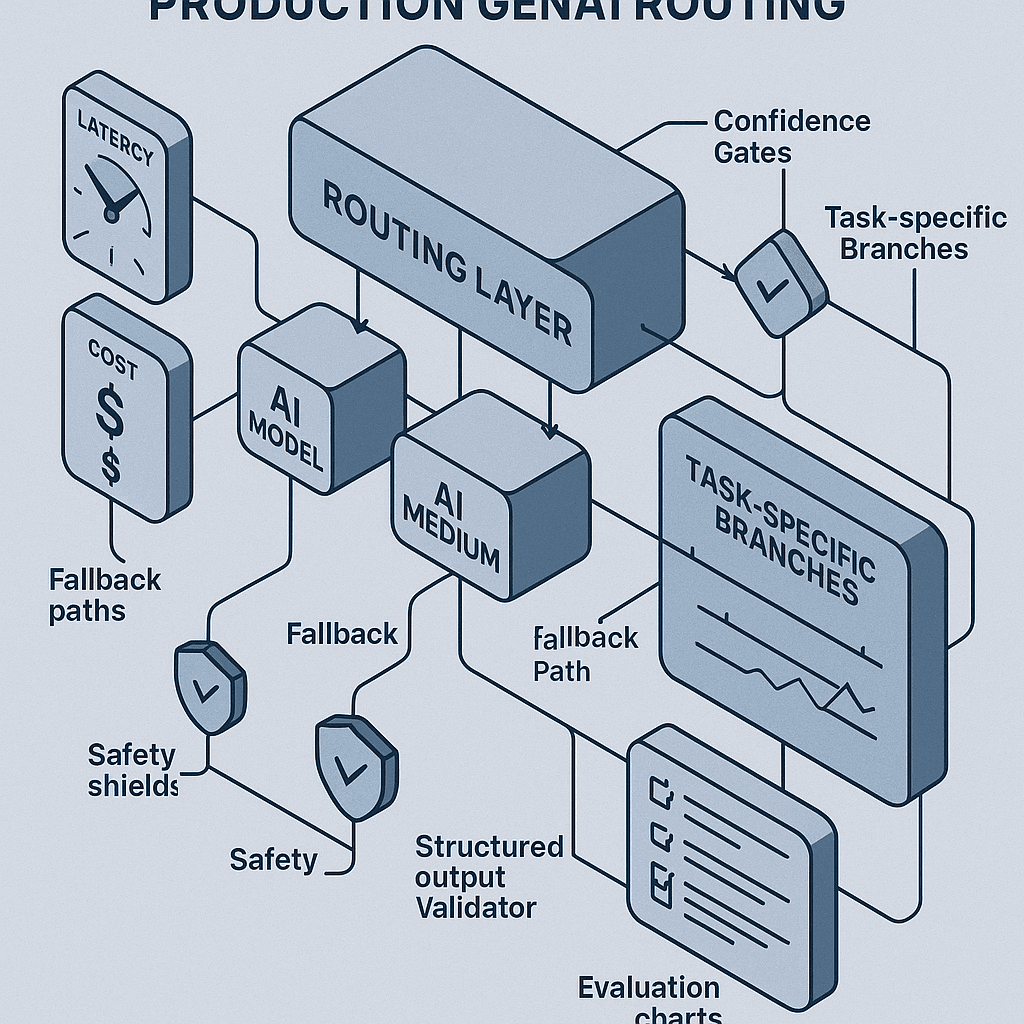
A production routing layer is the policy engine that decides which model, toolchain, prompt variant, and validation path should handle a request. It exists to optimize across multiple objectives at once:
- Quality
- Safety
- Latency
- Cost
- Reliability of structured outputs
- Operational simplicity
The mistake I see most often is treating routing as a thin if/else wrapper around model names. In production, routing is a decision system with its own failure modes, metrics, and evaluation harness. If you do it well, you can cut inference spend substantially, improve tail latency, and reduce user-visible failures. If you do it poorly, you create hidden complexity, inconsistent behavior, and a debugging nightmare where nobody can explain why model A answered one customer and model B answered another.
This article is a practical guide to deciding when to use three core routing patterns:
- Cascade: start with a smaller, faster, cheaper model and escalate only when needed
- Escalation: promote requests to stronger models based on confidence, risk, or failed validation
- Specialization: route classes of tasks to models or pipelines that are especially good at them
I’ll cover where each pattern works, why naive routing fails, how to implement routing safely, how to evaluate routers offline before shipping, and how to think about cost and latency tradeoffs without accidentally degrading quality.
A real production scenario
Consider a customer-support copilot for a B2B SaaS company. It needs to handle:
- Simple FAQ answers from docs
- Account-specific troubleshooting using CRM and ticket history
- Structured extraction from incoming emails
- Drafting policy-sensitive responses for refunds, legal issues, and incident communications
- Internal agent assistance where correctness matters more than speed
The team starts with one premium general-purpose model for everything. Early results are good enough. Then the system scales to 500,000 requests per day.
Now problems appear:
- FAQ traffic dominates volume, but premium-model quality is unnecessary there
- Structured extraction occasionally returns malformed JSON despite “strict” prompting
- Policy-sensitive workflows need stronger guardrails and perhaps a stronger model
- Some CRM-grounded queries require tool use and multi-step reasoning; others do not
- Tail latency is too high when every request hits retrieval, tools, and the biggest model
- Failures are opaque because logs only show the final response, not the route selection rationale
The natural response is often ad hoc optimization:
- “Use the mini model for short prompts”
- “If the answer looks bad, retry with the expensive one”
- “Route legal questions to the best model”
- “If JSON fails to parse, ask the same model to fix it”
These can work temporarily. But they are not yet a routing strategy. They are patches.
The durable pattern is to explicitly classify request types, define risk levels, assign target SLOs, and treat route selection as a first-class subsystem.
The routing patterns to know
At a high level, most production routing can be decomposed into three patterns.
1. Cascade routing
In a cascade, requests start on a cheaper or faster path. Only some are promoted to stronger models.
Typical example:
- Small model handles obvious FAQ questions
- If retrieval confidence is low or answer confidence is weak, escalate to medium model
- If the task is policy-sensitive or validation fails, escalate to premium model
The value of a cascade is obvious: many requests are easy. You do not want to pay premium inference cost for low-complexity work.
The risk is also obvious: your confidence signal is imperfect. If the router incorrectly believes a hard request is easy, quality drops.
2. Escalation routing
Escalation is similar to cascades but is best understood as a broader control pattern: stronger paths are invoked when there is evidence the current path is insufficient.
Triggers can include:
- Low classifier confidence
- Low retrieval quality
- Structured-output validation failure
- Safety-policy uncertainty
- Tool failure or contradiction across tools
- User dissatisfaction signals
- High business risk category
In production, escalation is often more important than initial routing. Most systems can classify obvious easy cases. The real challenge is robustly detecting when the chosen path is no longer trustworthy.
3. Specialization routing
Some workloads are not best served by a single family of models. You may have:
- A compact model fine-tuned for extraction
- A larger reasoning model for policy-heavy drafting
- A code-capable model for SQL generation or API orchestration
- A domain-specific model or pipeline for classification, moderation, or OCR correction
Specialization works when task boundaries are stable and measurable. It fails when task taxonomies are vague, overlapping, or constantly changing.
In practice, production systems often combine all three:
- Specialize first by task family
- Cascade within each family from fast/cheap to strong/expensive
- Escalate on failures such as low confidence, validation errors, or safety flags
Why the naive approach fails
The naive approach to routing sounds reasonable: choose the small model when possible, the large model when necessary, and use simple heuristics. But several recurring failure modes show up.
Failure mode 1: confidence is implied, not measured
Teams often say things like “if the model seems uncertain” or “if retrieval is weak.” But uncertainty needs an operational definition.
Examples of bad proxies:
- Response length
- Presence of hedge words like “might” or “possibly”
- Token logprobs without calibration
- A self-reported confidence score generated by the same model
These can be weak signals. They may correlate with quality in some contexts and completely fail in others.
A production router needs confidence signals tied to outcomes you can evaluate. For example:
- Retrieval top-k similarity margin and evidence coverage
- Classifier probability calibrated on held-out data
- Structured-output validity rate
- Historical answer accuracy for specific route + task combinations
- Cross-check consistency for critical fields
Failure mode 2: retries masquerade as routing
A lot of systems “route” by sending the same request to the same model with a slightly altered prompt after failure. That is not routing. That is hoping stochasticity fixes the problem.
Retries are useful for transient API issues. They are not a strategy for repeated schema failures, weak reasoning, or policy noncompliance. If the first path fails for a structural reason, the next path should change something meaningful:
- Stronger model
- Different prompt contract
- Tool-enabled path
- Constrained decoding or grammar-based generation
- Human review for high-risk cases
Failure mode 3: one router is asked to solve too many problems
Sometimes teams build a giant intent classifier and expect it to infer:
- task type
- risk level
- required model strength
- whether tools are needed
- whether retrieval is needed
- whether the output must be structured
That usually becomes brittle. Different routing decisions rely on different features and have different cost-of-error profiles.
A better pattern is layered routing:
- Eligibility routing: what paths are even allowed for this request?
- Task routing: what type of work is this?
- Complexity/risk routing: what capability level is required?
- Validation/escalation routing: did the selected path produce acceptable output?
Failure mode 4: no one defines the objective function
Cost reduction sounds good until quality erodes in exactly the cases that matter. Routing requires explicit optimization targets.
For example, for a support assistant you might say:
- Keep average cost under X per resolved conversation
- Keep p95 latency under Y seconds for FAQ and Z seconds for account-specific troubleshooting
- Keep structured extraction valid-schema rate above 99.5%
- Keep hallucination rate on grounded answers below A%
- Keep policy-violation rate below B%
Without this, routing degenerates into local optimization by whichever team shouts loudest.
Failure mode 5: no route-level observability
When routing works, people forget it exists. When it fails, nobody can reconstruct what happened.
You need route-level logs for:
- Router inputs and features
- Chosen path
- Confidence and thresholds
- Retrieval stats
- Validation outcomes
- Escalation reasons
- Final result metrics
- User feedback or downstream correction signals
Without this, you cannot improve the router systematically.
A better approach: routing as an architecture, not a heuristic
The robust pattern is to build routing as a policy layer with explicit stages, measurable features, and evaluation gates.
A pragmatic production architecture looks like this:
textIncoming Request
   |
   v
Policy + Eligibility Layer
   - tenant policy
   - data sensitivity
   - feature flags
   - allowed tools/models
   |
   v
Task Router
   - faq / extraction / drafting / tool-use / policy-sensitive
   |
   +-------------------------------+
   |                               |
   v                               v
Specialized Path A                 Specialized Path B
(e.g. extraction)                  (e.g. grounded answer)
   |                               |
Complexity Gate                    Complexity Gate
   - easy => small model           - easy => small model
   - medium => medium model        - medium => medium model
   - hard/risky => premium         - hard/risky => premium
   |                               |
Generation + Tools                 Generation + Tools
   |                               |
Validation Layer                   Validation Layer
   - schema                        - grounding
   - consistency                   - citation coverage
   - safety                        - safety
   |                               |
Escalation / Fallback ------------>
   |
   v
Final Response / Human Review / Safe Failure
This architecture matters because it separates concerns. The task router does not need to perfectly estimate everything. The validation layer can catch failures and trigger escalation. Policy can ban low-cost models for regulated workflows. Specialized pipelines can use different prompts and constraints.
When to cascade
Cascades make sense when the workload has a large volume of easy cases and the cost delta between models is meaningful.
Good candidates:
- FAQ answering over well-structured docs
- Simple summarization
- Basic classification
- Low-risk drafting with strong retrieval support
- Internal tasks where occasional escalation is acceptable
Bad candidates:
- High-stakes legal, medical, or financial advice
- Sparse-context reasoning where “easy vs hard” is difficult to detect
- Workloads where the small model fails silently in subtle ways
- User-facing domains where inconsistency across turns is particularly harmful
A practical cascade design
Suppose you have three models:
- Small: low cost, low latency, good enough for straightforward tasks
- Medium: balanced cost and quality
- Premium: highest capability, highest cost and latency
A useful cascade policy could be:
- Send all eligible low-risk FAQ queries to the small model with retrieval
- If retrieval evidence quality falls below threshold, escalate to medium
- If answer grounding validator fails, escalate to premium
- If the request includes regulated keywords or refund policy decisions, bypass lower tiers and go directly to premium or human review
This is already much better than “small for short prompts.” It uses task and evidence quality, not superficial prompt properties.
Confidence signals for cascades
Useful signals often include:
- Retrieval score margin between top candidate documents and alternatives
- Evidence coverage: does retrieved context contain answer-bearing spans?
- Query intent certainty from a trained classifier
- Historical route performance for that intent class
- Tool necessity prediction
- Output validator confidence
- Risk classification
Do not rely on one signal if you can combine a few stable ones.
A common pattern is a lightweight learned router:
- Inputs: task class, retrieval stats, prompt length, entity count, tool-needed probability, tenant risk tier, prior failure indicators
- Output: choose small/medium/premium path or direct human review
This router can be a traditional ML model, gradient-boosted tree, logistic regression, or even well-designed rules before you have enough data. It does not need to be an LLM.
When to escalate
Escalation is what saves you from overconfidence.
The cleanest mindset is this: initial routing predicts the likely best path; escalation corrects routing errors and output failures.
Good escalation triggers
1. Structured-output validation failure
If the output must conform to a schema, treat parsing and semantic validation as hard gates.
Examples:
- JSON parse failed
- Required fields missing
- Field types invalid
- Enum value outside allowed set
- Date or currency format invalid
- Extracted totals do not match line-item sums
Do not simply “accept and repair downstream” if the output drives automation. Schema failure should trigger a stronger path or a constrained generation strategy.
2. Grounding failure
For retrieval-augmented answers:
- cited evidence does not support claims
- key claims lack citations
- answer references non-retrieved facts
- retrieval context is insufficient or contradictory
Grounding failures often justify escalation to a stronger model with the same context, or to a tool-based workflow that gathers better evidence.
3. Safety or policy ambiguity
Some requests are not outright disallowed but require more careful handling. Examples include:
- partial refund exceptions n- legal escalation language
- security incident communication
- HR policy interpretations
These should often route to a premium model with specialized prompts and stricter validators, or to a human review lane.
4. Tool failure or uncertainty
If API calls fail, return incomplete data, or produce contradictory records, the right move is not always “answer anyway.” The router should be able to switch from autonomous generation to a clarification, deferred response, or human handoff.
Escalation should change the contract
The mistake in escalation design is calling a stronger model with the exact same weak contract.
A proper escalation changes one or more of:
- Model capability
- Prompt specificity
- Available tools
- Context package
- Output constraints
- Verification rigor
- User experience behavior
For example, after a schema failure:
- Small model path: free-form extraction into JSON schema
- Escalated path: premium model with native structured output mode, schema validator, and deterministic post-check
Or after low-grounding confidence:
- Initial path: small model over top-5 retrieval chunks
- Escalated path: premium model with re-ranking, more context, and answer-with-citations-only policy
When to specialize
Specialization is powerful because different tasks fail differently.
Example specializations that often pay off
Structured extraction
Extraction is often better served by:
- schema-native output modes
- constrained decoding
- task-specific prompts
- field-by-field validation
- domain-tuned smaller models
You do not necessarily need your best reasoning model for invoice, claims, or ticket field extraction. You need consistency, format reliability, and robustness to messy input.
Tool orchestration
Tasks involving SQL generation, API planning, or multi-step workflows often benefit from models optimized for tool use, plus strict execution guards. The routing decision is not just which model to use, but whether to invoke an agentic path at all.
Policy-sensitive drafting
For legal, compliance, HR, or public communications, use a dedicated path with:
- stronger model
- curated system instructions
- restricted output style
- policy retrieval
- reviewer visibility
- stricter audit logging
Classification and moderation
Do not overuse general-purpose LLMs for simple classification if a smaller classifier or rules system performs better and cheaper. A high-throughput moderation or intent layer may be better implemented without a general chat model.
The trap with specialization
Do not create twelve special-case routes before you have evidence they are needed. Every specialized path introduces operational burden:
- more prompts
- more eval datasets
- more deployment coordination
- more route drift
- more troubleshooting complexity
Specialize where the task boundaries are clear and the gain is material.
Structured-output reliability: routing’s most underrated use case
Teams often treat structured-output reliability as a prompting issue. In production it is a routing issue too.
If some downstream automations require near-perfect schema adherence, your routing layer should know that and choose a path optimized for it.
For example, imagine incoming emails must be converted into this schema:
json{
  "customer_id": "string",
  "issue_type": "billing|bug|feature_request|security",
  "severity": "low|medium|high|critical",
  "refund_requested": true,
  "dates": ["ISO-8601"],
  "entities": [{"name": "string", "type": "product|plan|person"}]
}
The wrong way to handle this is one generic generation prompt across all models and a parser afterward.
A better route design is:
- Classify whether the request needs structured extraction
- Route to extraction-optimized path
- Prefer native structured output or constrained decoding
- Validate syntax and semantics
- If validation fails, escalate to a stronger extraction path
- If still failing on high-risk cases, route to human review
This pattern can produce much better reliability than trying to make a general answer-generation route also do extraction.
How to evaluate routers offline
This is where many teams underinvest. They benchmark models, but not the routing policy. That is a mistake.
A router changes overall system behavior. It needs its own eval suite.
Build a routing eval dataset
Your dataset should contain representative requests with labels such as:
- task type
- risk tier
- gold or reference answer
- whether tools are required
- whether retrieval is sufficient
- whether structured output is required
- acceptable latency band
- acceptable cost band
- whether human review is required
Also record outcomes for candidate routes:
- quality score per route
- safety score per route
- structured validity per route
- latency per route
- cost per route
This can come from historical traffic plus adjudicated samples.
Evaluate the router, not just the model
Measure:
- Route accuracy: did the router select an acceptable path?
- Cost-quality frontier: what cost do you pay for each quality target?
- Escalation precision/recall: does escalation happen when it should?
- False cheap-route rate: how often did the router keep a request on a low-cost path when quality was unacceptable?
- Premium overuse rate: how often did the router send easy requests to expensive models?
- SLA compliance: p50/p95 latency by request class
- Structured-output success rate by route
- Safety-policy compliance by route
Think of the router as a classifier with asymmetric costs. Sending a hard legal request to a cheap model may be far worse than sending an easy FAQ to the premium model.
Use counterfactual replay where possible
If you log enough request and route data, you can replay historical traffic through candidate router policies offline.
For each request, estimate:
- what route policy A would choose
- what route policy B would choose
- expected quality/cost/latency from prior observed route outcomes or new batched eval runs
This lets you compare candidate policies before deployment.
Calibrate thresholds, do not guess them
If your router outputs a confidence score for escalation, tune the threshold against business objectives.
For example:
- Threshold 0.4 may reduce cost significantly but allow too many poor answers
- Threshold 0.7 may preserve quality but barely reduce premium usage
Plot threshold sweeps over:
- average cost
- average latency
- route distribution
- failure rate on high-risk subsets
This is how you choose thresholds responsibly.
Model and tool comparisons: what actually matters
You do not need perfect model rankings. You need route-specific comparisons.
Compare candidates on dimensions that match the route’s job.
For small/fast models
Look for:
- low latency
- low cost per token/request
- good enough instruction following
- stable structured output on simple schemas
- acceptable grounding when context is strong
These models are ideal for high-volume, low-risk, evidence-rich workloads.
For medium models
Look for:
- better robustness on ambiguous prompts
- improved tool use
- higher schema adherence under moderate complexity
- stronger multi-document synthesis
These often become the workhorse tier in a good cascade.
For premium models
Use them where they earn their keep:
- policy-sensitive drafting
- difficult reasoning
- contradictory evidence reconciliation
- complex tool orchestration
- critical structured extraction with fallback constraints
The mistake is using premium models as the default instead of the exception.
Tools are part of the route
Model routing is often really model + toolchain routing.
Examples:
- no-retrieval answer path vs retrieval-augmented answer path
- static prompt path vs API-backed account lookup path
- extraction-only path vs OCR + extraction path
- direct answer path vs human-approval workflow
Many quality problems attributed to “weak model choice” are actually route design failures where the model lacked the right context or tools.
Cost and latency tradeoffs without quality collapse
The point of routing is not just cost reduction. It is efficient quality.
A simple way to think about expected cost
If your route distribution is:
- 70% small model
- 20% medium model
- 10% premium model
Then expected cost per request is roughly:
0.7 * small_cost + 0.2 * medium_cost + 0.1 * premium_cost + router_overhead + validation_overhead
But do not forget hidden costs:
- extra retrieval and re-ranking
- repeated tool calls on escalations
- validation services
- retries due to malformed outputs
- human review for unresolved cases
Sometimes a slightly stronger first-pass model reduces overall cost by avoiding expensive escalations.
Optimize tail latency, not just averages
Routing can improve p50 while damaging p95 if escalations are frequent and slow.
Track latency by stage:
- router
- retrieval
- model inference
- validation
- escalation path
- tool execution
A two-stage cascade may lower average latency while making some users wait much longer. Whether that is acceptable depends on the workflow.
Use parallelism carefully
In some high-value workflows, you may run validations or even alternate paths in parallel:
- generate answer and run grounding validator simultaneously
- run intent classifier and retrieval in parallel
- run cheap extractor and schema validator, while preparing escalation context in the background
Parallelism can reduce wall-clock latency, but increases compute cost. Use it selectively where latency is especially valuable.
Implementation details that matter in production
1. Start with rules, then learn
For many teams, the best first router is a transparent rules engine backed by a few stable classifiers.
Example:
- if regulated tenant or sensitive workflow => premium-only eligible
- if extraction schema required => extraction path
- if FAQ intent and high retrieval confidence => small model
- if refund/legal/security => premium or human approval
- if schema validation fails => escalate
This gets you observability and control. Later, you can replace or augment parts with learned routing.
2. Keep route decisions explainable
Every route should emit a reason code such as:
task=faq, risk=low, retrieval_conf=high => small_rag_v2task=extraction, schema=invoice_v3 => extractor_medium_v1policy_sensitive=true => premium_policy_draft_v4validator_failure=missing_required_field => escalate_premium_structured
Engineers need this for debugging. Product and compliance teams need it for trust.
3. Version routes independently
You should be able to version:
- router policy
- model choice
- prompt template
- tool configuration
- validator logic
Otherwise, route regressions become impossible to isolate.
4. Make fallback explicit
Fallback should not mean “whatever still works.”
Define for each route:
- retriable failures
- escalation target
- user-visible behavior on failure
- human handoff conditions
- safe-failure message if no reliable route exists
This is especially important in safety-sensitive systems. A graceful refusal or handoff is often better than a low-confidence answer.
5. Separate model failure from route failure
If a request fails, ask:
- Was the wrong route chosen?
- Was the chosen model insufficient?
- Were tools missing or broken?
- Did validation fail to catch a bad output?
- Did escalation fail to trigger?
These are different remediation paths.
6. Budget tokens and context by route
Not every route needs the same context window or verbosity. Small-model FAQ paths may use compact retrieval packs. Premium paths may justify broader context.
Route-specific context management can materially reduce cost.
7. Watch for route drift
User behavior changes. Product adds new flows. Documentation quality shifts. A route that worked three months ago may silently degrade.
Monitor:
- route distribution shifts
- escalation rate changes
- validator failure spikes
- quality drops by tenant or intent class
- rising premium usage without quality gains
A concrete routing design example
Let’s make this tangible with a production support system.
Route families
- FAQ grounded answer
- Account-specific troubleshooting
- Structured extraction from inbound messages
- Policy-sensitive drafting
- Human review lane
Routing policy
Step 1: Eligibility and risk
Inputs:
- tenant compliance tier
- request channel
- user role
- detected PII/sensitive content
- workflow type
Rules:
- regulated/high-sensitivity workflows cannot use small model
- external customer-facing policy drafts require premium path or approval
- missing customer identity blocks account-specific tool use until resolved
Step 2: Task routing
Classifier labels request as one of:
- faq
- troubleshoot
- extract
- draft_policy
- unknown
Unknown goes to medium generalist with strict monitoring or to clarification.
Step 3: Route by family
FAQ grounded answer
- retrieval over help center
- if high retrieval confidence and low risk => small RAG path
- else => medium RAG path
- grounding validator checks claim-citation support
- failures escalate to premium RAG path
Account-specific troubleshooting
- CRM and ticket tools available
- medium tool-using model by default
- premium if multiple systems involved or prior tool inconsistency detected
- if tool calls fail, ask clarifying question or defer
Structured extraction
- extraction model/path with schema-native output
- validator checks required fields and semantic constraints
- failed validation escalates to premium structured path
- repeated failure => human review
Policy-sensitive drafting
- premium only
- policy retrieval mandatory
- constrained style template
- approval workflow before send
Example metrics
Track by route:
- answer acceptance rate
- grounding pass rate
- schema-valid rate
- escalation rate
- average cost/request
- p95 latency
- human-review rate
- correction rate from agents
This is what turns routing from folklore into an operational discipline.
The tradeoff that matters most: consistency vs optimization
There is one tradeoff teams often underestimate: the more aggressively you optimize with routing, the more you risk inconsistent behavior across similar requests.
Users notice inconsistency faster than they notice your cloud bill.
If two nearly identical questions get visibly different answer quality because one hit a cheaper path, trust erodes.
Ways to manage this:
- keep route boundaries stable and interpretable
- route by task/risk/evidence, not arbitrary prompt characteristics
- preserve style and response contract across models as much as possible
- use premium paths for high-visibility customer interactions if inconsistency cost is high
- maintain conversation-level route continuity where appropriate
Sometimes the right decision is to accept a somewhat higher cost for a more consistent experience.
Practical takeaways
If you are designing routing for a production GenAI system, here is the battle-tested version:
- Do not start with elaborate routing. Start with one reliable path, learn the workload, then add routing where cost, latency, or reliability pressure justifies it.
- Treat routing as a policy system. It is not just if/else around model names. It should incorporate eligibility, task type, risk, validation, and escalation.
- Use cascades when easy cases dominate. They are excellent for high-volume, low-risk, evidence-rich tasks.
- Use escalation as your safety net. Initial routing will be wrong sometimes. Validation-triggered escalation is what keeps quality from collapsing.
- Specialize only where the payoff is clear. Structured extraction, tool orchestration, and policy-sensitive drafting are common wins.
- Optimize structured outputs as a route, not a prompt. Use schema-aware paths, validators, and explicit fallback.
- Evaluate the router offline. Measure route accuracy, escalation precision/recall, cost-quality frontier, schema success, safety, and latency by class.
- Instrument everything. Reason codes, route versions, validation results, and escalation triggers are mandatory for production learning.
- Be honest about tradeoffs. Lower average cost is meaningless if high-risk failures increase or customer trust drops.
- Prefer graceful failure to confident failure. The best routing layer knows when not to answer, when to ask for clarification, and when to hand off.
The end state is not “always use the cheapest model possible.” It is “use the cheapest route that reliably satisfies the quality, safety, and latency requirements of the specific task.”
That sounds obvious, but building it well requires something many GenAI projects initially avoid: operational discipline.
And that is exactly why model routing becomes such a competitive advantage in production. Once your workload is real, the winners are not the teams with the fanciest demos. They are the teams that can explain, evaluate, and control how every request gets the level of intelligence it actually needs.