Handling Partial Failure in LLM Toolchains: Timeouts, Degraded Modes, and Recovery Design
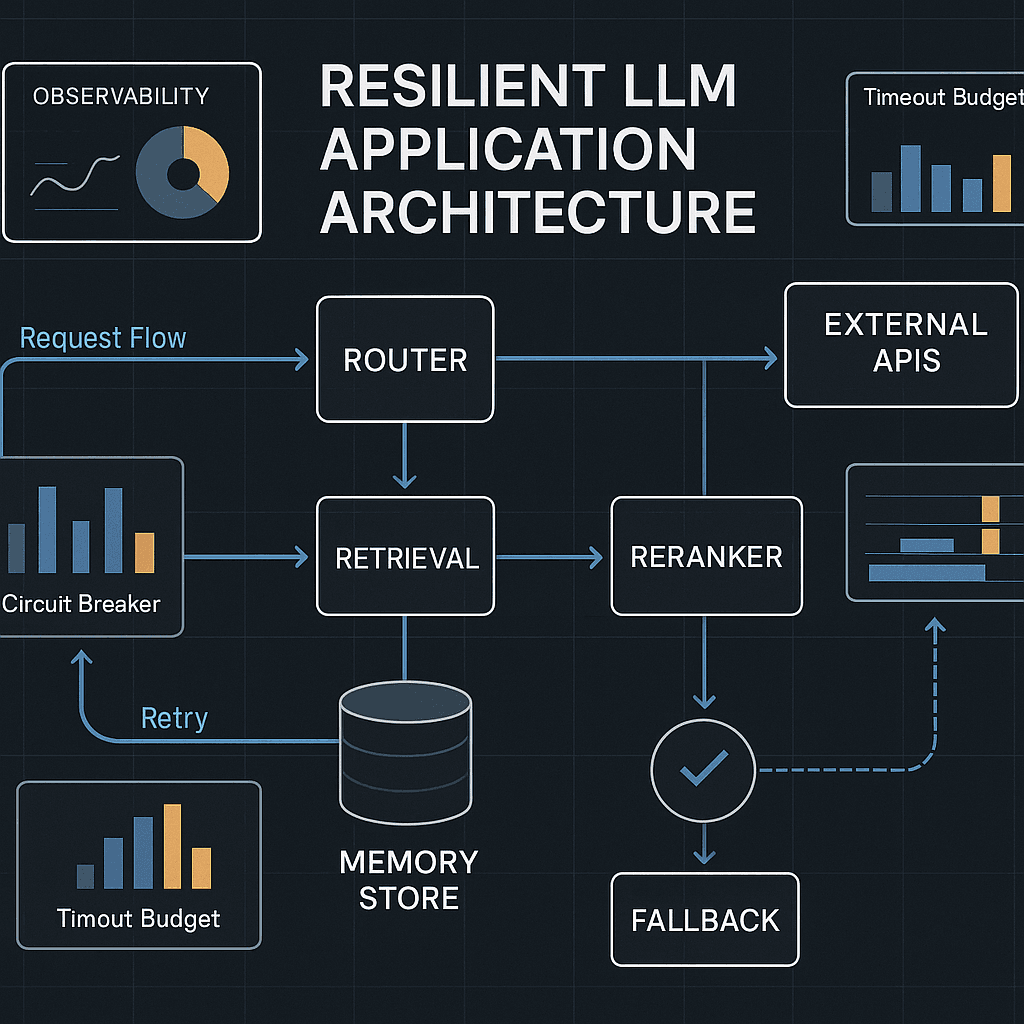
The first version of an LAG/RAG assistant usually fails in an oddly human way: it looks competent right up until one dependency blinks.
A search index gets slow. The reranker returns after the request deadline. A CRM API rate-limits you for 90 seconds. Your memory store has a regional hiccup. The JSON validator rejects a perfectly useful answer because one optional field is missing. Nothing is fully down, but the user still gets a useless experience: a spinner, a generic apology, or worse, a confident answer assembled from half-broken state.
This is one of the biggest differences between a demo-grade LLM workflow and a production service. In a prototype, every component is assumed available and every stage is treated as mandatory. In production, almost every component should be treated as conditionally available, variably slow, and semantically unreliable. The question is not whether retrieval, tools, rerankers, memory, or guardrails will fail. The question is whether your system remains useful when they fail partially.
That is what resilience means in LLM systems. Not “five nines” at the model endpoint. Not merely retrying failed HTTP requests. Resilience means preserving user value when some fraction of the reasoning-and-tooling graph is degraded.
In practice, that requires a different design mindset:
- Build fallback graphs, not linear chains.
- Assign timeout budgets per stage, not one giant request timeout.
- Distinguish correctness-critical dependencies from quality-improving dependencies.
- Define degraded-answer policies in product terms, not just infrastructure terms.
- Measure partial-failure behavior with targeted evals, not only happy-path benchmarks.
This article is a field guide to doing that.
We’ll walk through a failure taxonomy for LLM toolchains, explain why naive retry-and-timeout logic makes things worse, and then lay out a practical architecture for degraded modes, recovery paths, and observability. The examples assume a system with a planner or orchestrator, retrieval, reranking, external tools, memory, and output validation, but the patterns generalize to most GenAI stacks.
A realistic failure scenario
Consider an internal support assistant used by customer success teams. A user asks:
“Summarize the last three escalations for Acme Corp and tell me whether we promised a refund.”
A typical implementation might do the following:
- Classify intent.
- Retrieve CRM account info.
- Retrieve support tickets from a case system.
- Retrieve conversation history from a memory store.
- Rerank relevant documents.
- Ask the LLM to synthesize an answer with citations.
- Validate the output schema and redact sensitive fields.
On paper this looks robust. In practice, here is what happens at peak load:
- CRM API latency jumps from p95 400 ms to p95 2.5 s.
- Ticket search succeeds but returns stale results because one shard lags.
- Memory store times out intermittently at 20% error rate.
- Reranker model queue backs up and adds 1.2 s.
- Structured output validation fails because one citation ID is null.
The naive orchestrator waits for everything because every node is coded as required. Total request timeout is 8 seconds. At 8 seconds, the user gets:
“Sorry, I’m unable to process your request right now.”
That is a product failure, not merely a dependency failure.
A better system would do something like this:
- Use a 500 ms soft budget for memory; continue without it if missed.
- Use a 1.2 s budget for CRM; if unavailable, answer from tickets and note account-level financial commitments may be incomplete.
- Skip reranking if retrieval result set is already small.
- If structured citation schema fails, salvage answer text and degrade to unstructured references.
- Mark the answer with a confidence and coverage note visible to the user.
- Emit telemetry that says: request succeeded in degraded mode because CRM and memory were unavailable.
Now the user gets:
“I found three recent escalations from support tickets. I could not verify CRM financial commitments due to a temporary system issue, so refund promise status may be incomplete. Based on available tickets, I did not find an explicit refund promise. Here are the relevant case references...”
That is not perfect. But it is useful, honest, and operationally sane.
The rest of this article is about systematically designing for that outcome.
Pattern identification: most LLM pipelines are over-coupled
The recurring pattern behind brittle LLM systems is over-coupling across stages that should not have equal criticality.
Teams often build toolchains as if they were deterministic ETL jobs:
classify -> retrieve -> rerank -> tool call -> validate -> respond
That shape is convenient for demos, but it encodes several bad assumptions:
- Every stage is mandatory.
- Every failure should abort the whole request.
- More retries always increase success probability.
- The latest upstream data is required for any useful answer.
- Validation failures imply answer failure.
- User experience can be handled separately from orchestration.
In reality, LLM systems contain at least three different classes of components:
1. Hard dependencies
If they fail, the request should fail or be blocked.
Examples:
- Authentication and authorization checks
- Safety-critical policy checks
- Payment execution confirmations
- PII redaction in regulated workflows
- Deterministic business-rule validators for downstream actions
2. Soft dependencies
If they fail, answer quality drops, but a useful response may still be possible.
Examples:
- Rerankers
- Long-term memory retrieval
- Secondary knowledge sources
- Enrichment APIs
- Citation formatting layers
- Hallucination scoring or self-critique stages
3. Optional embellishments
If they fail, almost nobody should notice.
Examples:
- Query rewriting for nicer search recall
- Follow-up suggestion generation
- Secondary summary compression
- Explanatory metadata
- Non-essential formatting transforms
A lot of outages happen because teams accidentally treat soft dependencies like hard dependencies. The user does not need every stage to succeed; they need a response that is truthful about its limits and still useful.
Why the naive approach fails
There are several specific ways naive recovery logic makes LLM pipelines worse under stress.
Failure amplification through serial waiting
If a request fan-outs to five services and waits for all of them, tail latency compounds. Even when each dependency is individually healthy, the chance that one exceeds the budget increases rapidly.
For a simple example, if five independent stages each succeed within deadline 95% of the time, the combined probability of all five succeeding within deadline is about 77%.
That is before you consider retries, queueing effects, and correlated failures.
Retries can create self-inflicted incidents
A common anti-pattern is blind retries at every layer:
- HTTP client retries the tool call 3 times
- Orchestrator retries the tool node 2 times
- Workflow engine retries the whole request 2 times
A transient 429 from a downstream tool becomes a retry storm that worsens saturation. In LLM systems, this is especially dangerous because each retry may also re-run expensive upstream model calls.
The right question is not “can we retry?” but “what is the cost of retrying versus degrading?”
Validation layers often destroy salvageable work
Teams add schema validation, citation checks, or policy filters late in the pipeline. That is good. But then they make the entire output all-or-nothing.
If a 95%-correct response fails a non-critical field check, they throw away the whole answer. The user gets nothing, despite the system having enough information to be useful.
Resilient systems separate:
- actionability validation: must pass to execute an action
- presentation validation: nice to have for display
- recoverable formatting validation: can be repaired or downgraded
One timeout for the whole request hides decision quality
A top-level 15-second timeout sounds safe until you realize you have not decided how to spend those 15 seconds. The system drifts into accidental behavior:
- retrieval consumes 6 seconds under load
- reranking takes 4
- model synthesis takes 3
- validation takes 2
The request times out anyway, but now you have no clear degraded mode strategy.
Timeouts are product decisions, not only technical ones. If users prefer a partial answer in 3 seconds over a full answer in 12, your architecture should reflect that.
“Best effort” without policy creates unsafe ambiguity
If you simply continue when things fail, the model may fill gaps with plausible guesses. That is worse than a transparent degraded answer.
A resilience design must specify:
- what kinds of missing evidence are acceptable
- which claims require tool confirmation n- what uncertainty language must be shown
- when the model must refuse rather than infer
Without that policy layer, degraded mode turns into hallucination mode.
A better approach: architect for graceful degradation
The practical alternative is to design the request path as a capability graph with explicit fallback behavior.
At a high level, each request should answer four questions:
- What user outcome is being attempted?
- Which dependencies are required to achieve a minimally useful outcome?
- Which dependencies only improve quality or coverage?
- What should the system say and do if each dependency is slow, stale, unavailable, or contradictory?
That leads to an architecture with six core elements:
- Capability-based decomposition
- Per-stage timeout budgets
- Fallback graphs instead of linear pipelines
- Degraded-answer policies
- Circuit breakers and bounded retries
- Observability tied to user-visible outcomes
Let’s unpack each.
1. Capability-based decomposition
Model the system in terms of capabilities rather than implementation stages.
For example, instead of saying:
- call vector search
- call reranker
- call CRM API
- call memory API
Say:
- establish account context
- gather recent incident evidence
- verify refund commitments
- personalize with prior conversation context
- generate answer with traceable evidence
Each capability can then map to one or more providers with quality tiers.
Example capability map:
-
account_context- primary: CRM live API
- fallback: cached nightly replica
- degraded: none
-
incident_evidence- primary: case search + reranker
- fallback: case search only
- degraded: recent case cache
-
refund_verification- primary: CRM notes + finance tool
- fallback: CRM notes only
- degraded: unavailable, must disclose incomplete verification
-
conversation_personalization- primary: memory store
- fallback: recent session context only
- degraded: omit personalization
This framing matters because it lets you decide availability in terms of user value rather than implementation purity.
2. Per-stage timeout budgets
A resilient system allocates a latency budget across stages based on value density.
Suppose your end-to-end interactive SLA is 4 seconds p95. You might assign:
- request parsing/routing: 100 ms
- auth/policy: 150 ms
- retrieval fan-out: 800 ms soft, 1200 ms hard
- reranking: 250 ms optional
- external tool verification: 900 ms soft, 1400 ms hard if required for certain claims
- LLM generation: 1200 ms
- post-processing/validation: 200 ms
- response assembly and logging: 100 ms
Two important ideas here:
Soft vs hard deadlines
A soft deadline means “if this isn’t back by then, continue without it.” A hard deadline means “past this point, the request must end or switch to a more severe degraded path.”
For example:
- memory retrieval: soft 300 ms, no hard wait
- reranking: soft 200 ms, skip if missed
- payment confirmation tool: hard 1000 ms if user asked whether payment succeeded
Budget inheritance
Downstream components should know the remaining budget. If the retrieval phase already consumed 1 second of a 3-second target, the LLM should switch to a shorter prompt and a faster model, or reduce tool use.
This is a strong argument for explicit deadline propagation in orchestration metadata.
3. Fallback graphs instead of linear chains
This is the core architecture change.
Instead of a single request path, define a directed graph of fallback decisions.
A simple example for enterprise Q&A:
- start
- classify request
- if action request -> require hard validations
- if informational request -> allow degraded evidence paths
- gather evidence
- parallel: search docs, fetch account metadata, fetch memory
- if doc search fails -> try lexical search cache
- if account metadata fails -> continue with docs only
- if memory fails -> omit personalization
- improve evidence
- if >20 candidates and budget remains -> rerank
- else skip rerank
- synthesize
- if evidence coverage high -> generate answer with citations
- if evidence coverage medium -> generate answer with uncertainty disclosure
- if evidence coverage low -> answer narrowly or ask clarifying follow-up
- validate
- if action schema fails -> block action, provide explanation
- if citation schema fails -> downgrade citation rendering, keep answer text if safe
This graph can be implemented in a workflow engine, application code, or a planner. The specific framework matters less than making fallback transitions explicit and testable.
4. Degraded-answer policies
This is where many teams underinvest.
A degraded mode is not “show generic error text.” It is a product policy for what the assistant is allowed to claim, how it should communicate uncertainty, and what alternatives it should offer.
You should define degraded-answer policy by request class.
Informational Q&A
Allowed degraded behavior:
- answer from partial evidence
- explicitly state missing sources
- narrow scope to verified subset
- provide references that were actually retrieved
- offer retry or follow-up actions
Not allowed:
- infer absent facts as if verified
- cite unavailable tools or memory
Decision support
Allowed degraded behavior:
- summarize available evidence
- identify blocked verification step
- recommend human review or retry
Not allowed:
- present recommendation as complete if a critical source failed
Action-taking workflows
Allowed degraded behavior:
- collect user intent
- explain why action cannot complete yet
- offer to retry, queue, or hand off
Not allowed:
- execute state-changing action without mandatory confirmations
Personalized assistants
Allowed degraded behavior:
- answer using current-turn context only
- say personalization history is temporarily unavailable
Not allowed:
- fabricate remembered preferences
These policies should be represented in prompts, orchestration logic, and UI copy. If they only exist in a design doc, they will not survive incident conditions.
5. Circuit breakers and bounded retries
Classic reliability patterns still apply, but the tradeoffs change in LLM systems.
Circuit breakers
Use circuit breakers around dependencies that can become slow or unhealthy enough to poison the whole request path.
Good candidates:
- external SaaS APIs
- reranker services
- memory stores
- secondary retrieval systems
- output moderation or validation services that sit on the hot path
When the breaker opens, don’t just return failure. Route to a predefined degraded mode.
Example:
- reranker unhealthy -> search-only evidence path
- memory store unhealthy -> session-only context path
- finance verification API unhealthy -> informational answer only, no financial commitment claim
A breaker without a fallback path is just faster failure.
Retries
Retry only when all of the following are true:
- the failure is plausibly transient
- the operation is idempotent or safe to repeat
- there is enough remaining latency budget
- a retry has higher expected value than degrading immediately
Practical guidance:
- retry 429/503 with jittered backoff only once in interactive flows
- do not retry deterministic validation failures without transformation or repair
- avoid nested retries across layers
- prefer hedged requests only for read-heavy, high-value dependencies with strict cancellation
For many quality-improving stages like reranking, the correct strategy is usually “skip, don’t retry.”
6. Observability tied to user-visible outcomes
Traditional service metrics are necessary but insufficient.
If you only monitor availability and latency for individual services, you can miss the fact that your user experience is collapsing through partial degradation.
Track request outcomes like this:
- full_success
- degraded_success_search_only
- degraded_success_no_memory
- degraded_success_unverified_tool_claims_blocked
- validation_salvaged_text_only
- hard_failure_auth
- hard_failure_safety
- hard_failure_no_minimum_evidence
This lets you answer operational questions such as:
- What percentage of answers are succeeding in degraded mode?
- Which dependency most often causes degradation?
- Which degraded mode still leads to acceptable user satisfaction?
- Are we over-triggering hard failures where a safe degraded answer was possible?
That telemetry should be joined with:
- stage latency percentiles
- timeout reasons
- stale-data indicators
- cache hit rates
- model choice and token usage
- retry counts
- circuit breaker state
- validation failure categories
- user correction or dissatisfaction signals
In practice, this becomes the backbone of both incident response and system tuning.
Implementation details: a reference architecture
Here is a concrete architecture pattern that works well for many LLM applications.
Request orchestrator with capability contracts
Use an orchestrator that treats each capability as a contract with fields like:
criticality: hard | soft | optionaldeadline_msminimum_evidence_requiredfallback_providersstaleness_toleranceretry_policydegraded_user_message_keyclaim_restrictions
For example:
yamlcapability: refund_verification
criticality: soft
deadline_ms: 900
minimum_evidence_required:
  any_of:
    - crm_notes
    - finance_api
fallback_providers:
  - crm_notes_cache
staleness_tolerance: 24h
retry_policy:
  max_attempts: 1
  retry_on: [429, 503]
degraded_user_message_key: refund_status_incomplete
claim_restrictions:
  - do_not_claim_refund_promised_without_tool_confirmation
This contract becomes executable policy.
Evidence envelope instead of raw tool outputs
Normalize all retrieval and tool outputs into an evidence envelope:
json{
  "source": "crm_notes_cache",
  "status": "stale_success",
  "latency_ms": 140,
  "observed_at": "2026-07-13T10:03:00Z",
  "coverage": ["account_notes", "refund_mentions"],
  "confidence": 0.71,
  "claims_allowed": ["summarize_notes"],
  "claims_disallowed": ["confirm_current_financial_commitment"],
  "data": {"items": []}
}
This is much better than handing the model arbitrary tool strings, because it gives the generation layer structured knowledge about what is and is not safe to claim.
Two-pass generation for sensitive workflows
For workflows with meaningful correctness risk, use a two-pass pattern:
-
Evidence summarization pass
- compress available evidence
- explicitly enumerate missing or failed sources
- classify answerability and claim limits
-
User-answer pass
- generate the response under those claim limits
- attach visible uncertainty wording where required
This pattern is often more reliable than asking a single model call to reason over raw partial tool outputs while also obeying nuanced degradation rules.
It costs more tokens, but it usually reduces unsafe overreach.
Validation as layered salvage, not binary rejection
Implement validation in layers.
Layer 1: safety and action gating
Must pass, otherwise block or refuse.
Examples:
- forbidden content policies
- authz checks
- required confirmations for state-changing actions
Layer 2: semantic claim checks
If these fail, downgrade claims or mark unverified.
Examples:
- answer says “refund promised” but no confirming evidence exists
- answer mentions user preference from memory, but memory was unavailable
Layer 3: formatting/presentation checks
If these fail, repair or degrade rendering.
Examples:
- malformed JSON
- missing citation object field
- markdown rendering issue
A robust system should salvage through Layer 3 failures whenever possible.
For example, if your consumer requires JSON but the answer text is otherwise usable:
- try constrained repair with a small fast model or parser
- if repair fails and the interaction is chat, render plain text plus visible caveat
- if the interaction is API-only and schema is mandatory, return structured error plus any non-sensitive debug metadata
Model and tool comparisons: resilience implications
Teams often compare models only on benchmark quality. For partial-failure handling, other characteristics matter too.
Fast model vs large model in degraded paths
A common pattern is:
- use larger model for full evidence synthesis
- use smaller, faster model for degraded or low-evidence responses
Why this works:
- degraded responses often require narrower scope and less reasoning depth
- latency budgets are tighter after tool delays
- users benefit more from timeliness and transparency than incremental eloquence
Tradeoff:
- smaller models may be worse at careful uncertainty phrasing or instruction following
- you may need stricter prompting and validation on degraded paths
A practical design is model tiering by evidence richness:
- high evidence + high value request -> stronger model
- partial evidence + low actionability -> faster cheaper model
- action workflows -> stronger model plus hard validators
Hosted tool APIs vs replicated data stores
Live external APIs give freshness but worsen availability and latency variance. Replicated or cached stores improve resilience but risk staleness.
A battle-tested pattern is to define source tiers:
- Tier 1: live authoritative API
- Tier 2: near-real-time replica/cache
- Tier 3: periodic snapshot or index
Then define claim permissions per tier.
Example:
- Tier 1 can confirm “current account owner”
- Tier 2 can summarize recent account context with stale notice
- Tier 3 can support general historical context only
This is far better than pretending all retrieval sources are equivalent.
Reranker choices
Rerankers often improve quality but are rarely critical enough to justify blocking the whole request.
Compare options by:
- median and p95 latency
- queue sensitivity under burst load
- quality lift when candidate set is already small
- whether lexical + vector hybrid retrieval narrows the need for reranking
In many production systems, reranking should be conditional:
- skip if candidate count < N
- skip if remaining budget < X ms
- skip if retrieval confidence already high
- skip if circuit breaker open
That can save real money and reduce timeout-driven failures with modest quality loss.
Cost and latency tradeoffs
Resilience is not free. You are trading some combination of quality, freshness, complexity, and cost.
Here are the most common tradeoffs.
More fallbacks increase operational complexity
Every fallback path needs:
- prompt behavior
- claim policy
- tests
- telemetry
- maintenance
Too many branches become impossible to reason about. The trick is not to maximize fallback permutations, but to define a small number of meaningful degraded modes.
A good heuristic is 3–5 named modes per major request class.
Caching reduces latency but introduces stale truth
If you introduce caches or replicas to survive tool/API failures, you need explicit staleness semantics.
Do not simply pass cached data to the model as if it were live. Include:
- age of data
- source tier
- claims that are still safe
- claims that must be blocked
Extra validation and two-pass generation cost tokens
A two-pass summarize-then-answer architecture can noticeably improve degraded-mode safety, but it adds inference cost and latency. Use it selectively:
- high-risk domains
- requests likely to produce consequential claims
- workflows where source failures are common
For lightweight informational use cases, a single well-designed pass may be enough.
Parallel retrieval improves latency but complicates cancellation
Parallel fan-out is usually the right choice, but only if you aggressively cancel work once the minimum evidence threshold is met or the deadline expires.
Otherwise, you pay for useless work and create downstream load. This matters especially when tool calls trigger billed requests or model-based rerankers.
Evaluation strategy: test failure behavior explicitly
This is where many teams still have a gap. They evaluate answer quality on clean data and healthy dependencies, then discover in production that resilience logic has never been tested.
You need a partial-failure eval suite.
Failure-mode matrix
Create scenarios by request type x dependency failure.
Example dimensions:
Request types:
- informational Q&A
- account summary
- policy lookup
- recommendation support
- action request
Dependency conditions:
- retrieval timeout
- reranker timeout
- memory unavailable
- stale replica only
- external API 429
- validation formatting failure
- contradictory source data
- deadline exhausted before synthesis
For each scenario, define expected behavior:
- answer or refuse?
- what claims are allowed?
- what user-visible disclosure is required?
- what telemetry label should appear?
Metrics that matter
Evaluate more than answer correctness.
Useful resilience metrics include:
- degraded success rate
- minimum usefulness score under failure
- unsafe claim rate under missing evidence
- unnecessary refusal rate
- latency under induced failures
- salvage rate after validator failure
- retry amplification factor
- fallback path activation frequency
If you have human raters, ask them to score:
- usefulness despite degradation
- honesty about uncertainty
- appropriateness of next step
- whether the answer over-claimed beyond evidence
Chaos testing for LLM pipelines
Run controlled fault injection in staging and, where safe, in production.
Examples:
- add 800 ms latency to reranker
- fail memory store 30% of time
- return stale cache marker from CRM replica
- inject malformed citation payloads
- force circuit breaker open on secondary tool
Then verify:
- the right degraded mode is activated
- user copy is accurate
- costs do not spike due to retries
- cancellation actually stops abandoned work
- observability identifies the exact failure cause
If you are serious about resilience, this should be part of release qualification.
User-visible error handling: make degradation legible
One of the easiest mistakes is hiding all internal failure behind either silence or technical jargon.
Good user-visible handling should:
- preserve trust
- explain limitations succinctly
- state what is still included
- suggest a next step when relevant
Examples:
Bad:
- “Tool invocation failed.”
- “An internal error occurred.”
- “Could not complete request.”
Better:
- “I found the recent support cases, but I couldn’t access the account notes system just now, so I may be missing any refund commitment recorded there.”
- “I can summarize the policy from our knowledge base, but I can’t verify the latest account-specific exception right now.”
- “I’m unable to complete the account update because confirmation from the billing system is temporarily unavailable. I can retry or prepare the request for a human handoff.”
That last part matters: degraded modes should often include an alternative path, not just a caveat.
A practical retry and timeout playbook
If you want a concise operational playbook, this is a good starting point.
For retrieval
- fan out in parallel
- soft timeout 300–800 ms depending on use case
- proceed with partial results
- use cache or lexical fallback if vector retrieval misses deadline
- avoid retries unless transport failure happens very early and budget remains
For rerankers
- treat as optional in most interactive systems
- skip on tight budgets or open circuit
- do not retry in user-facing hot path
- periodically measure quality delta to confirm it is worth running
For memory stores
- use short soft timeout
- fall back to session-local context
- forbid claims that depend on unavailable memory
- never fabricate remembered preferences or facts
For external business tools
- classify by action-criticality
- for read tools, allow source-tier fallbacks when policy allows
- for write tools, require idempotency keys and hard validations
- retry at most once on transient failures with jitter and remaining budget checks
For validation layers
- separate action gating from presentation formatting
- salvage answer text if safe
- use repair transforms before rejection on formatting issues
- log validation categories, not just pass/fail
For the final LLM call
- pass explicit source availability and claim restrictions
- shorten prompts when budget shrinks
- switch models if necessary
- require uncertainty phrasing when evidence is partial
What this looks like in code and prompts
Even if your orchestration is graph-based, much of the resilience behavior comes down to what context you hand the model.
A useful generation input often includes:
- user request
- normalized evidence envelopes
- list of failed/unavailable capabilities
- claim restrictions
- required disclosure text snippets
- answer mode: full | degraded | blocked_action
Example instruction fragment:
textYou are answering with partial system availability.
Available evidence sources: support_tickets_live, policy_kb.
Unavailable sources: crm_notes_live, memory_store.

You may:
- summarize and cite available ticket and policy evidence
- state that refund verification is incomplete

You must not:
- claim that a refund was promised unless directly supported by available evidence
- imply you checked CRM notes or memory
- personalize based on unavailable memory

If relevant, include this disclosure naturally:
"I couldn't access account notes at the moment, so refund commitment verification may be incomplete."
This kind of structured prompting is far more reliable than hoping the model infers limitations from missing tool outputs.
Takeaways
Handling partial failure in LLM toolchains is not a peripheral reliability concern. It is the core design problem once you connect models to retrieval systems, rerankers, memory stores, validators, and external tools.
The teams that build resilient GenAI services do a few things differently:
- They classify dependencies by criticality instead of treating every stage as required.
- They allocate timeout budgets per capability and propagate deadlines.
- They design fallback graphs with named degraded modes.
- They define product policies for what the assistant may say when evidence is partial.
- They use circuit breakers and bounded retries to avoid failure amplification.
- They treat validation as layered salvage rather than binary rejection.
- They instrument degraded outcomes as first-class metrics.
- They run evals and chaos tests specifically for partial failure.
Most importantly, they optimize for usefulness under imperfect conditions, not just correctness under perfect ones.
That is the production mindset shift. Your system does not need to be flawless when every dependency is healthy. It needs to remain honest, bounded, and helpful when some of them are not.
If you get that right, your LLM application stops behaving like a brittle chain of demos and starts behaving like a service your users can actually rely on.