Failure-Tolerant JSON Streaming for LLM Applications: Designing Incremental Structured Output That Survives Interruptions
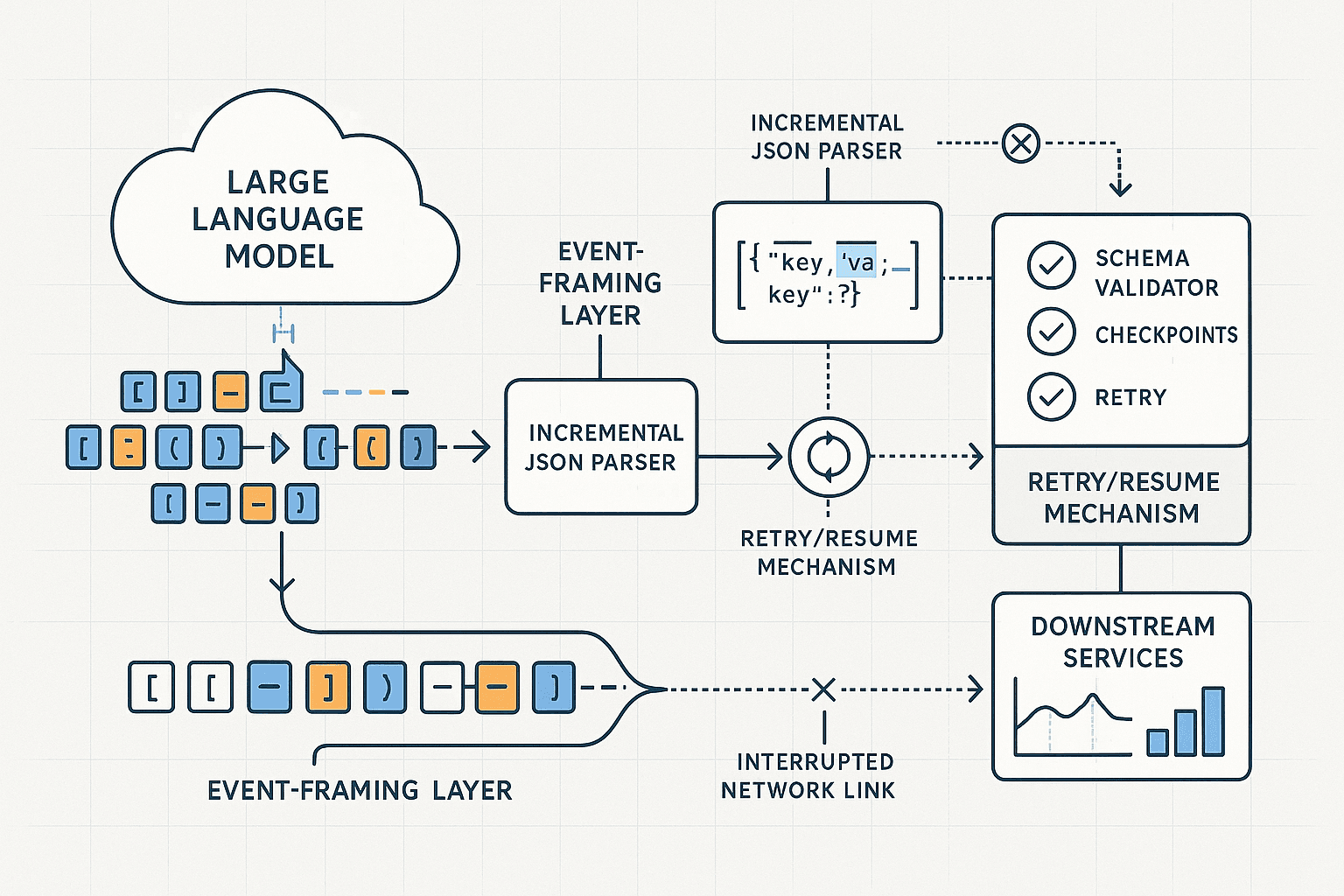
Teams usually discover the hard part of structured LLM output at the worst possible moment: after the demo works.
In the demo, the model streams a neat JSON object into a web client. The UI updates live. A downstream service consumes the object and kicks off automation. Everyone leaves the room feeling that “streaming structured output” is basically solved.
Then production traffic arrives.
A mobile client drops halfway through a response, leaving an unterminated array. A model retry changes the shape of an object after 700 tokens. A provider emits valid tokens but not valid JSON prefixes. A downstream consumer reads a partially assembled field and treats it as final. An engineer adds one field to the schema, and suddenly mid-stream validators start rejecting outputs that used to pass. Support tickets appear because users saw a progress UI that looked authoritative, but the final object was rolled back after the validator failed.
This is the real problem: not “how do I get the model to emit JSON,” but “how do I design a system where partially delivered structured output remains useful, bounded, recoverable, and trustworthy under interruption?”
If your application streams free text, interruption is mostly a UX problem. If your application streams structured output that feeds code, workflows, search indexing, agents, or compliance systems, interruption becomes a contract problem.
The pattern I see repeatedly is that teams conflate three different things:
- token streaming,
- structured output generation,
- contract-safe incremental delivery.
They are not the same.
A model can stream tokens quickly and still be a terrible source of incremental structured data. A model can produce valid final JSON while making every intermediate prefix unusable. And a system can expose “partial JSON” in a way that creates more operational risk than waiting for the full object.
The better approach is to treat streaming structured output as a distributed systems problem with an LLM in the loop. That means event framing, checkpointed validation, resumability, explicit partial-state semantics, observability, and evals that test not just final correctness but prefix trustworthiness.
This article walks through a production architecture for failure-tolerant JSON streaming, explains why naive approaches fail, and outlines implementation patterns that survive truncation, schema drift, retries, and disconnects.
The production failure pattern
Let’s make this concrete.
Suppose you are building an incident investigation copilot for internal operations teams. A user asks:
“Analyze these logs and produce a machine-readable incident summary with severity, likely root causes, impacted services, mitigations, and follow-up actions.”
Your backend asks an LLM to stream this response as JSON because:
- the UI wants to show fields appearing in real time,
- another workflow engine wants to start triage as soon as
severityandimpacted_servicesare known, - a case-management system stores the final object.
The target schema might look like this:
json{
  "incident_id": "string",
  "severity": "SEV1|SEV2|SEV3|UNKNOWN",
  "summary": "string",
  "impacted_services": ["string"],
  "likely_root_causes": [
    {
      "cause": "string",
      "confidence": 0.0,
      "evidence": ["string"]
    }
  ],
  "mitigations": ["string"],
  "follow_up_actions": [
    {
      "owner": "string",
      "action": "string",
      "priority": "P0|P1|P2"
    }
  ]
}
The naive implementation usually looks like this:
- ask the model to “return only valid JSON matching this schema,”
- stream text tokens from the provider to client,
- concatenate tokens into a buffer,
- occasionally run
JSON.parse(buffer)and hope it succeeds, - when it succeeds, treat the latest parsed object as the partial state,
- if the network breaks, retry the request.
This fails in multiple ways.
Failure mode 1: valid final object, invalid prefixes
Most JSON documents are invalid at almost every intermediate prefix. You may have:
- a dangling quote,
- an open object,
- an array missing a closing bracket,
- an object whose key appeared but value is incomplete,
- a number partially emitted as
0.before becoming0.87.
A stream can be perfectly healthy while every prefix is unparsable. If your partial-state strategy depends on repeatedly parsing the full buffer as complete JSON, you will get long spans with no usable updates, then sudden jumps. That often defeats the purpose of streaming.
Failure mode 2: semantically unstable fields
Even if you can parse some prefixes, fields may be revised mid-stream.
The model might first emit:
json{"severity":"SEV2"
and later revise contextually by continuing with a different structure in a retry or by changing nearby fields before the final close. If downstream automation starts paging teams based on early unstable fields, you have turned token-level speculation into operational action.
Failure mode 3: schema drift mid-stream
This is common when prompts evolve or models behave inconsistently under long contexts.
A model may start with:
json{"impacted_services":["auth-api","billing-worker"]
but later emit a shape like:
json"follow_up_actions":["notify team"]
when your schema expects action objects. Worse, retries from a different model version or provider may produce subtly different keys like impact_services or root_causes.
Final-output validation catches this eventually. Incremental consumers need earlier guardrails.
Failure mode 4: duplicated prefixes on retry
When a request is retried after timeout or transport failure, providers may re-generate a response from scratch. If the client simply appends new tokens to the old buffer, you get duplicate content or contradictory structures.
Failure mode 5: client disconnect and resumability gaps
A browser tab reloads. A mobile app backgrounding event drops the socket. The backend may still be receiving tokens, or the provider stream may terminate. If you have no event IDs, no checkpoints, and no persisted partial-state model, the client has no principled way to resume.
Failure mode 6: downstream consumers trust the wrong abstraction
This is the most dangerous one. Teams expose “partial JSON” without defining what partial means.
Does a field appearing once mean it is final? Can array items be appended only, or revised in place? Can object keys disappear later? What checkpoint level is required before a consumer may act?
Without explicit semantics, every consuming service invents its own interpretation.
Why the naive approach fails
The root issue is that raw JSON is not a good wire format for incremental trust.
JSON is excellent as a final serialization format. It is weak as a streaming contract when the producer is a probabilistic model and the channel can fail.
Three mismatches matter.
1. Syntax completion does not align with useful partial state
Useful partial state often exists before a whole JSON document is syntactically complete. For example:
- you may know
severitywith high confidence, - you may have three complete
impacted_servicesentries, - you may have one fully formed
follow_up_actionobject.
A monolithic JSON parser cannot expose these safely unless you either:
- parse incrementally with a proper streaming parser, or
- stop using “single JSON document” as the transport abstraction.
2. LLMs generate sequences, not transactions
Traditional services typically emit structured responses atomically. An LLM emits a token sequence that may contain self-correction, drift, and local inconsistency before stabilization.
So if you stream raw tokens directly to a consumer and call that “structured output,” you are pushing sequence semantics into systems expecting transactional semantics.
3. Retry boundaries and transport boundaries are external to JSON
JSON does not define message IDs, replay protection, checkpointing, ordering, resumability, or at-least-once semantics. If the network breaks, JSON alone gives you no way to tell whether you should:
- continue assembling,
- discard the old partial object,
- merge new content,
- or start a new generation epoch.
That logic belongs in an event protocol around the JSON, not inside wishful prompts.
The better approach: separate generation, framing, validation, and commitment
The most robust architecture I’ve seen uses four layers:
- Generation layer: obtains structured intent from the model.
- Framing layer: converts model output into ordered stream events with IDs and semantics.
- Validation/state layer: incrementally parses, validates, and checkpoints partial state.
- Consumption layer: exposes trust-scoped updates to UI and downstream systems.
Instead of treating streamed JSON bytes as the contract, you treat events plus checkpoints as the contract.
A reference architecture
A practical design looks like this:
textClient
  ↕
Streaming Gateway (SSE/WebSocket/gRPC stream)
  ↕
Orchestrator
  ├─ LLM Provider Adapter
  ├─ Incremental Parser / Normalizer
  ├─ Schema Validator + Checkpoint Engine
  ├─ Partial State Store
  ├─ Retry / Resume Controller
  └─ Observability Pipeline
  ↕
Downstream Consumers / UI / Workflow Engine
The key idea is that the client rarely receives raw provider tokens directly. Instead, the orchestrator turns generation output into higher-level events like:
stream_startedfield_startedfield_updatedarray_item_committedcheckpoint_validstream_interruptedstream_resumedstream_completedstream_failed
You can still expose token-level UX if you want, but downstream contracts should bind to checkpointed semantic events, not arbitrary token prefixes.
Pattern 1: Use event framing, not naked JSON, on the wire
If you need reliability, frame the stream explicitly.
A minimal event schema might be:
json{
  "stream_id": "uuid",
  "epoch": 2,
  "sequence": 184,
  "timestamp": "2026-09-09T12:00:00Z",
  "type": "field_updated",
  "path": "$.summary",
  "payload": {
    "value_fragment": "Database connection saturation observed in us-east-1"
  },
  "checkpoint": {
    "level": "syntactic",
    "complete": false
  }
}
For commit-worthy updates, emit stronger events:
json{
  "stream_id": "uuid",
  "epoch": 2,
  "sequence": 211,
  "type": "array_item_committed",
  "path": "$.follow_up_actions[0]",
  "payload": {
    "value": {
      "owner": "db-platform",
      "action": "Increase pool limits and rebalance connections",
      "priority": "P0"
    }
  },
  "checkpoint": {
    "level": "schema_valid",
    "complete": true,
    "validator_version": "incident-schema-v5"
  }
}
This buys you several things immediately:
- ordered replay,
- idempotent client assembly,
- resumption by
(stream_id, epoch, sequence), - a distinction between tentative and committed state,
- better observability.
SSE vs WebSockets vs gRPC
For many applications, SSE is enough and easier to debug. It works well when:
- server-to-client streaming is one-way,
- reconnects can be handled with last-event IDs,
- scale and infra simplicity matter.
WebSockets are useful when clients need active backpressure, bidirectional acknowledgments, or control messages like “pause”, “request snapshot”, or “resume from sequence 184”.
gRPC streaming is a solid fit for service-to-service contracts where typed streaming and controlled infrastructure matter more than browser ergonomics.
My default recommendation:
- UI/browser: SSE unless you need true bidirectional control.
- Mobile or stateful apps with resume/ack complexity: WebSockets.
- Internal microservices: gRPC stream or Kafka-like event bus plus API facade.
Pattern 2: Prefer patch/event semantics over monolithic object prefixes
There are two broad ways to stream structured output.
Option A: Stream one final JSON document as bytes
Pros:
- simple mental model,
- easy if you only care about final output,
- minimal transformation layer.
Cons:
- partial prefixes are mostly invalid,
- hard to validate incrementally,
- poor retry/resume semantics,
- consumers struggle to know what is stable.
Option B: Stream JSON patches, field events, or NDJSON records
Pros:
- each event can be independently valid,
- natural checkpoint boundaries,
- better for resumability and idempotency,
- easier to drive incremental UI.
Cons:
- more orchestration complexity,
- requires assembly logic,
- prompts/tooling may need adaptation.
In production, Option B usually wins.
Three practical formats:
- NDJSON: one valid JSON object per line.
- JSON Patch (RFC 6902)-like ops:
add,replace,remove. - Custom semantic events: domain-aware events like
candidate_root_cause_added.
What I recommend most often
If your downstream consumers are generic and schema-driven, use patch-style events.
If your UI or workflows are domain-specific and high-value, use semantic events on top of an internal patch model.
For example, internally you may store:
json{ "op": "add", "path": "/impacted_services/0", "value": "auth-api" }
But externally emit:
json{ "type": "impacted_service_committed", "service": "auth-api" }
That gives you a stable contract even if internal object layout changes.
Pattern 3: Introduce validator checkpoints with explicit trust levels
This is the most important design move.
Not all partial state should be equally trusted.
Define checkpoint levels such as:
- token: raw bytes/tokens only, no structural guarantee.
- syntactic fragment: fragment belongs to a parsable incremental structure.
- field complete: a scalar field or object field is complete.
- item complete: an array item is complete and schema-valid.
- subtree valid: a nested object passes schema checks.
- document valid: full response matches final schema.
- business valid: cross-field or domain rules pass.
Then require consumers to declare the minimum checkpoint level they accept.
Example:
- UI typing indicator may accept
token. - “Impacted services” pill list may require
item complete. - Triage automation may require
subtree validforseverityandimpacted_services. - Database persistence may require
document valid. - Pager escalation may require
business valid.
This is how you avoid the classic mistake where an early partial field accidentally triggers real-world side effects.
Validator design
Use layered validators:
- Incremental syntax parser
- recognizes complete strings, numbers, object fields, array items.
- Schema validator
- JSON Schema, Pydantic, Zod, protobuf-adjacent typed structs.
- Business rule validator
- e.g.
SEV1must include at least one impacted service and a mitigation.
- e.g.
- Stability heuristic
- optional, e.g. field unchanged for N events or confirmed in finalization phase.
A useful tactic is to mark values with metadata:
json{
  "value": "SEV2",
  "status": "tentative",
  "checkpoint": "field_complete",
  "first_seen_seq": 45,
  "last_updated_seq": 45
}
Later, when no further changes occur and subtree validation passes:
json{
  "value": "SEV2",
  "status": "committed",
  "checkpoint": "business_valid",
  "first_seen_seq": 45,
  "last_updated_seq": 62
}
Pattern 4: Make retries epoch-based, not append-based
Retries are where many structured streams become unrecoverable.
Never assume a retried generation can simply append to prior raw output.
Instead, assign each generation attempt an epoch.
stream_ididentifies the logical request.epochidentifies a specific generation attempt.sequenceidentifies ordered events within an epoch.
If an upstream retry occurs, start a new epoch. Consumers should know that:
- events within the same epoch are ordered and mergeable,
- events across epochs require reconciliation rules.
Reconciliation strategies
There are three common strategies.
1. Latest-epoch-wins
Simple and often correct for UI.
- discard tentative state from older epoch,
- preserve only committed checkpoints if policy allows,
- render new epoch as authoritative.
Good for:
- user-facing assistants,
- low-risk structured summaries.
2. Checkpoint-carry-forward
Preserve validated subtrees from prior epochs and ask the model to continue from them.
Example:
- epoch 1 produced valid
severityandimpacted_services, - stream died while generating
follow_up_actions, - epoch 2 prompt includes validated fields as locked context and requests only missing sections.
Good for:
- longer outputs,
- expensive generations,
- workflows where some fields are stable and expensive to regenerate.
3. Externalized state machine
The orchestrator, not the model, owns the object state. The model produces field/item candidates; the orchestrator merges only valid updates.
Good for:
- high-stakes automation,
- multi-stage extraction pipelines,
- systems with strong type contracts.
This is my preferred architecture for reliability. It treats the model as a candidate generator, not the final source of truth.
Pattern 5: Design prompts and tool interfaces for incremental commitment
A lot of streaming reliability is lost because prompts ask the model for a giant final object in one shot.
Better patterns:
A. Sectional generation
Generate top-level fields or subtrees in sequence:
- classify severity,
- list impacted services,
- generate root causes,
- generate mitigations,
- generate follow-up actions.
Each section gets its own validation and commit boundary.
Tradeoff:
- higher orchestration complexity,
- sometimes slightly higher latency to first complete document,
- much better partial reliability.
B. Tool/function calling for atomic units
If your provider supports tool/function calling with typed arguments, use it for commit units such as:
set_severity(severity, rationale)add_impacted_service(service)add_follow_up_action(owner, action, priority)
This often outperforms freeform JSON streaming because each call is already framed and typed.
Tradeoffs:
- tool-call latency overhead,
- provider-specific behavior differences,
- some models are slower but more structurally reliable in tool mode.
C. Two-pass generation
Pass 1: stream user-visible reasoning summary or text explanation. Pass 2: produce structured object non-streaming or semi-streaming with stronger validation.
This is a pragmatic compromise when users want responsiveness but downstream consumers need stronger contracts.
Model and tool comparisons
In practice, you’re balancing four axes:
- structured reliability,
- latency to first useful partial,
- total cost,
- orchestration complexity.
Raw text JSON prompting
Best when:
- low stakes,
- final-only parsing is acceptable,
- provider/tool support is limited.
Weakness:
- worst option for trustworthy partial delivery.
Provider-native structured output / JSON mode
Best when:
- you need better final schema adherence,
- provider enforces constrained decoding or schema-aware generation.
Weakness:
- intermediate streaming guarantees may still be weak,
- some providers guarantee final validity more than prefix usability.
Tool/function calling
Best when:
- actions/fields can be emitted as discrete typed operations,
- you want natural event boundaries.
Weakness:
- can increase round trips or internal planning overhead,
- arrays of many items may become expensive if each item is a separate call.
Grammar/constrained decoding
Best when:
- schema rigidity matters,
- invalid syntax is unacceptable,
- you can tolerate some latency or implementation complexity.
Weakness:
- may reduce generation flexibility,
- can be harder with deeply nested or dynamic schemas,
- doesn’t alone solve retry/resume semantics.
My rule of thumb:
- If partial structured output drives real systems, avoid raw token-streamed monolithic JSON as your primary contract.
- Prefer tool calls or patch-style constrained events.
- Use final JSON as an artifact, not the live transport contract.
Implementation details that matter in production
1. Incremental parsing strategy
Use a real incremental parser, not repeated JSON.parse on the full buffer.
You want the parser to surface events like:
- object start/end,
- array start/end,
- key complete,
- scalar complete,
- array item complete.
This lets you detect stable boundaries. For example:
- once a string scalar closes, a field may be
field_complete, - once an object inside an array closes and validates, it becomes
item_completeand can be committed.
For languages with mature ecosystems:
- Python: event-driven parsers such as
ijson, custom state machines, Pydantic for subtree validation. - TypeScript/Node: streaming parsers like
clarinet,stream-json, plus Zod for validation. - JVM/Go/Rust: use event/token parsers and explicit typed assembly.
2. Partial state store
Persist partial state server-side.
At minimum store:
stream_id,epoch, latestsequence,- current assembled object state,
- per-field metadata (
tentative,committed, checkpoint level), - append-only event log,
- validator outcomes,
- provider request metadata.
If the client reconnects, the server can send:
- a compact state snapshot,
- then replay events after
last_sequence.
Do not make the browser the only holder of partial assembly state if resumability matters.
3. Snapshot plus log replay
This is a standard event-sourcing pattern and fits extremely well here.
Store:
- periodic snapshots of assembled state,
- full ordered event log.
On reconnect:
- load latest snapshot for
(stream_id, epoch), - replay subsequent events,
- if epoch superseded, send epoch transition event,
- continue live stream.
This is far cleaner than trying to reconstruct state from provider tokens after the fact.
4. Disconnect recovery protocol
A robust resume handshake looks like this:
Client sends:
json{
  "stream_id": "uuid",
  "last_seen_epoch": 2,
  "last_seen_sequence": 184
}
Server responds with one of:
resume_ok+ replay from 185,epoch_advanced+ snapshot of latest epoch,stream_terminal+ final status,stream_not_found.
If you use SSE, leverage Last-Event-ID where possible, but still keep your own logical stream IDs and epochs.
5. Fallback strategy when structure breaks
At some point, some streams will become unrecoverable.
Define explicit fallback modes.
Fallback A: degrade to text stream
If the structure repeatedly fails but user responsiveness matters, continue streaming explanatory text while marking structured extraction as delayed.
Fallback B: stop streaming, switch to final-only structured retry
If downstream reliability matters more than interactivity, terminate incremental structured mode and launch a non-streaming or constrained retry that produces only the final validated object.
Fallback C: partial commit plus missing-field repair
Commit validated subtrees, mark unresolved fields as missing, and run targeted repair prompts or deterministic post-processing later.
This is often the best operational compromise.
For example:
json{
  "severity": "SEV2",
  "impacted_services": ["auth-api", "billing-worker"],
  "likely_root_causes": null,
  "status": {
    "likely_root_causes": "generation_failed_repair_pending"
  }
}
6. UX tradeoffs: token delight vs contract honesty
Teams often oversell structured streaming in the UI.
Users see fields appear live and assume they are final. Then fields change or disappear.
A better UX distinguishes:
- draft values,
- verified values,
- finalized report.
Examples:
- greyed-out fields for tentative values,
- checkmarks when schema/business validation passes,
- explicit “still analyzing” state for arrays that may grow,
- clear messaging when stream reconnects or restarts.
If a field can change, design the UX so that change is unsurprising.
In operational tools, honesty beats flashy token streaming.
Cost and latency tradeoffs
Reliability features are not free.
Lowest latency, lowest reliability
- direct provider token stream to client,
- prompt for final JSON,
- parse at end.
Pros:
- minimal backend work,
- fastest time-to-first-token.
Cons:
- weak trust in partial structure,
- poor recovery,
- debugging pain.
Middle ground
- orchestrator mediates provider stream,
- incremental parser + schema checkpoints,
- patch/field events to clients,
- final validation at completion.
Pros:
- good reliability/latency balance,
- suitable for most production apps.
Cons:
- added infra complexity,
- some latency before first committed event.
Highest reliability
- tool calls or constrained decoding,
- section-by-section generation,
- event sourcing, resumability, repair passes,
- business-rule validation before downstream action.
Pros:
- strongest contract,
- best for automations and regulated workflows.
Cons:
- higher latency,
- more tokens and orchestration cost,
- more engineering investment.
As a rough operational heuristic:
- if a bad partial can only confuse a user for a moment, optimize for responsiveness,
- if a bad partial can trigger automation, optimize for commitment semantics,
- if a bad partial can create compliance or safety risk, avoid exposing it as trusted structured data at all.
Observability for broken streams
If you don’t instrument this, you will not understand failure.
Track metrics at several layers.
Stream transport metrics
- stream start rate,
- disconnect rate,
- reconnect success rate,
- resume latency,
- event replay volume,
- epoch restart rate.
Structural metrics
- time to first syntactic fragment,
- time to first field-complete checkpoint,
- time to first schema-valid subtree,
- final document validity rate,
- invalid event rate by path,
- schema drift frequency by model/provider/version.
Consumer trust metrics
- number of downstream actions triggered from tentative vs committed states,
- rollback rate after tentative UI render,
- repair-pass frequency,
- percentage of streams ending in fallback mode.
Model behavior metrics
- structured failure rate by prompt version,
- per-field instability rate,
- duplicate item emission rate,
- average number of revisions per field,
- tool-call success vs raw JSON success.
A particularly useful dashboard is a prefix survivability funnel:
- started,
- produced first parsable unit,
- produced first schema-valid unit,
- resumed successfully after interruption,
- produced document-valid final,
- produced business-valid final.
That tells you where the pipeline is actually failing.
Evals: measure trust in partial outputs, not just final JSON correctness
Most teams eval final correctness and stop there. That misses the core production risk.
You need streaming evals.
Build a failure-oriented eval suite
Create test cases that simulate:
- truncation at random token boundaries,
- disconnect after N events,
- provider retry from scratch,
- duplicate event replay,
- out-of-order delivery,
- schema version changes mid-stream,
- malformed partial object emission,
- field revisions late in generation.
For each test, measure whether downstream consumers can still behave correctly.
Metrics that matter
1. Prefix parseability
At what percentage of stream positions does the system expose a valid incremental unit?
This is better than asking whether raw prefixes are parseable, because event framing may make units parseable even when raw JSON is not.
2. Time to first trustworthy field
How long until a checkpoint level acceptable for a given consumer appears?
Example:
- TTFTF for
severityatbusiness_valid.
3. Partial trust precision
Of fields/items marked committed, how often were they actually stable in the final object?
This is crucial. If you commit too early, trust precision drops.
4. Partial trust recall
Of final stable fields, how many could have been safely committed earlier?
If recall is too low, your system is conservative and loses streaming value.
5. Resume consistency
After interruption and resume, does reconstructed state exactly match what a clean uninterrupted run would have yielded under your contract semantics?
6. Downstream action safety
How often would a downstream consumer acting on allowed checkpoints make the same decision as when acting on the final business-valid object?
This is the eval that leadership actually cares about.
Example eval harness
A practical harness does this:
- run prompts against recorded inputs,
- capture raw provider token stream,
- generate synthetic interruption points,
- replay through orchestrator,
- compare emitted checkpoints/events against gold expectations,
- score consumer-level outcomes.
You should version:
- schema,
- validator logic,
- prompt template,
- model/provider,
- repair strategy.
Otherwise you won’t know which change improved or regressed survivability.
A concrete implementation blueprint
Here’s a battle-tested blueprint for many enterprise apps.
Step 1: define a partial-state contract
For every field, decide:
- can it stream?
- can it revise?
- what is the minimum commit unit?
- what checkpoint is required for downstream use?
Example:
severity: scalar, revisable until business-valid.impacted_services: append-only committed items after schema validation.summary: draft text stream, final commit only at document completion.follow_up_actions: object-per-item commit.
Step 2: choose event schema
Define events with:
stream_id,epoch,sequence,- event type,
- path,
- payload,
- checkpoint metadata,
- schema/validator version.
Step 3: mediate all provider output through an orchestrator
No direct provider-to-client streaming for structured contracts.
The orchestrator:
- parses provider chunks,
- emits semantic events,
- persists state,
- applies validators,
- handles retries and resumes.
Step 4: checkpoint aggressively at subtree boundaries
Commit only complete scalars, objects, or array items.
Avoid “whole document or nothing.”
Step 5: separate UI streaming from automation streaming
You may expose richer draft updates to UI than to workflows.
That is healthy.
For example:
- UI channel receives
field_updateddraft events. - workflow channel receives only
*_committedevents.
Step 6: implement repair and fallback paths
When validation breaks:
- attempt targeted repair if cost-effective,
- otherwise finalize partial object with unresolved status,
- or rerun in stronger constrained mode.
Step 7: ship with streaming-specific evals and dashboards
Do not rely on anecdotal success from happy-path demos.
Common anti-patterns
Let me call out the mistakes I see most.
Anti-pattern 1: “We use JSON mode, so streaming is safe.”
JSON mode may help final validity. It does not automatically give you trustworthy incremental prefixes, resume semantics, or downstream commit rules.
Anti-pattern 2: letting clients invent merge logic
If every frontend and microservice assembles partial state independently, you will get inconsistency. Centralize assembly semantics.
Anti-pattern 3: no distinction between draft and committed values
This guarantees accidental misuse.
Anti-pattern 4: retried streams append into same buffer
This creates subtle corruption that is painful to debug.
Anti-pattern 5: final validation only
By the time final validation fails, the UI may have shown misleading data and automations may already have acted.
Anti-pattern 6: treating all fields equally
Some fields are naturally append-only and stream well. Others are unstable until the end. Design contracts accordingly.
Practical takeaways
If you remember only a few things, make them these.
First, raw streamed JSON is usually the wrong abstraction for production reliability. It is a final artifact format, not a sufficient incremental contract.
Second, separate token streaming from structured commitment. Your UI may enjoy token-level responsiveness, but downstream systems should consume checkpointed semantic events.
Third, introduce trust levels. A field should not become actionable merely because characters for it appeared in a stream.
Fourth, handle retries with epochs and event logs, not by appending new bytes to old partial buffers.
Fifth, persist partial state server-side and support snapshot-plus-replay if resumability matters.
Sixth, evaluate prefix survivability and downstream action safety, not only final JSON correctness.
Finally, be honest about tradeoffs. The more your business depends on partially delivered structured data being correct, the more your architecture should look like a resilient state machine and less like a pretty token demo.
That’s the mature posture for LLM streaming in production: treat the model as a generator of candidate structure, wrap it in framing and validation, expose partial outputs with explicit trust semantics, and make interruption a first-class design case rather than an edge case.
When you do that, streaming structured output stops being fragile magic and becomes a system your teams can actually depend on.