Drift-Proofing Production RAG: Detecting Corpus, Query, and Answer Quality Shifts Before Users Do
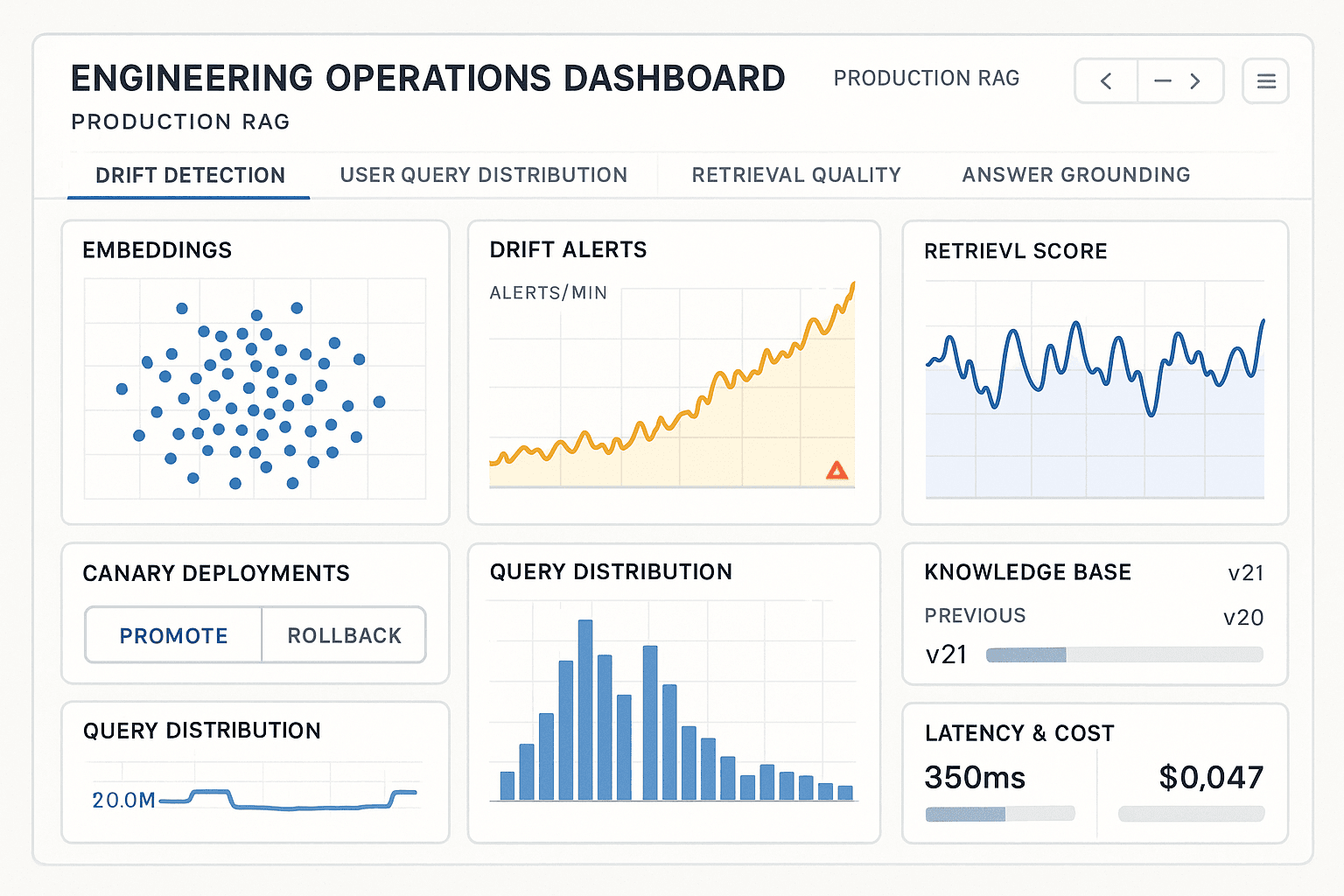
Most RAG systems do not fail all at once. They degrade sideways.
A team launches a support assistant over product docs, release notes, and internal runbooks. In staging, it looks excellent. The benchmark set is green. Early users are impressed. Then, over six weeks, support escalations start creeping up.
Not because the model suddenly got worse in some obvious way. The failure is messier:
- The docs team reorganized the knowledge base and introduced hundreds of near-duplicate pages.
- A product launch shifted user traffic from “how do I configure SSO?” to “why does SCIM fail for enterprise tenants on EU shards?”
- An embedding model update changed nearest-neighbor behavior enough to demote a few high-value documents.
- The answer model became more verbose after a provider-side refresh, which made grounded answers look more confident while citing less useful context.
- A chunking change improved average retrieval scores but quietly harmed one critical workflow with long tabular documents.
None of these issues individually trips a simple uptime monitor. The API is healthy. P95 latency is fine. Token costs are within budget. But the system users experience is deteriorating.
That is what production drift looks like in retrieval-augmented generation systems. It is not a single metric going red. It is a slow divergence among the world your system was tuned for, the corpus it can access, the queries users now ask, and the answers the model currently produces.
If you run RAG in production, drift-proofing is not a nice-to-have observability layer. It is the operational discipline that keeps your launch quality from decaying in silence.
This article lays out a practical approach to drift-proofing production RAG systems. I’ll focus on three drift surfaces that matter most in real deployments:
- Corpus drift: the knowledge base changes in content, structure, freshness, duplication, and metadata quality.
- Query drift: user requests evolve in vocabulary, intent mix, difficulty, ambiguity, and language.
- Answer-quality drift: retrieval relevance, grounding, completeness, and actionability regress even if the system still returns fluent text.
The key idea is simple: monitor each stage separately, evaluate end-to-end continuously, and create rollback paths for every component that can drift.
The pattern behind most RAG incidents
Across production systems, the same pattern shows up repeatedly:
- Teams evaluate only the answer model, not the pipeline.
- They treat retrieval as static infrastructure rather than a learned component with changing behavior.
- They monitor latency and cost aggressively, but monitor relevance and grounding weakly.
- They deploy corpus changes, embedding changes, reranker changes, and prompt changes without canaries.
- They assume user feedback will reveal quality regressions fast enough.
That last assumption is especially dangerous. Users are noisy sensors. Many bad answers are never reported. Some are accepted even when wrong. In enterprise contexts, users often workaround degraded assistants rather than filing bugs. By the time complaint volume spikes, trust is already damaged.
The production lesson is that RAG quality needs the same layered defenses you would apply to any distributed system:
- leading indicators, not just lagging complaints
- stage-level metrics, not just final-response thumbs-up/down
- canary rollouts, not atomic swaps
- versioned assets and rollback plans
- SLOs tied to business-critical slices, not only global averages
Why the naive monitoring approach fails
The naive RAG monitoring setup usually looks like this:
- track request count, latency, token usage, error rate
- maybe collect thumbs-up/down feedback
- maybe run a nightly benchmark on a static eval set
This is better than nothing, but it misses the mechanics of drift.
Failure mode 1: static eval sets go stale
A fixed benchmark can tell you whether you are regressing on what you already know to test. It does not tell you whether traffic moved into new intents, new phrasing, new languages, new products, or newly difficult cases.
If your eval set was built around top support intents from Q1, it may be mostly irrelevant after a major launch in Q2. The dashboard says quality is stable because your test has stopped representing reality.
Failure mode 2: retrieval regressions hide behind fluent generation
Generation models are very good at producing plausible text around weak evidence. In practice, that means answer quality can degrade while surface fluency remains high. A larger or more instruction-tuned model may actually mask retrieval failures better than a weaker one.
If your monitoring relies on user-visible incoherence, you will miss groundedness decay early.
Failure mode 3: aggregate metrics hide business-critical slices
Suppose global retrieval precision drops from 0.83 to 0.80. Maybe that does not matter. But if that decline is concentrated in your highest-value enterprise admin queries, it matters a lot.
RAG incidents are often slice-specific:
- one document family
- one language
- one user persona
- one product area
- one query length band
- one recency-sensitive workflow
Averages smooth over exactly the regressions your users care about.
Failure mode 4: the corpus itself is rarely treated as a monitored system
Teams monitor applications and models but not the knowledge substrate.
In production, corpus changes are one of the biggest sources of quality instability:
- parsing failures after a CMS template change
- chunk explosions from malformed HTML
- broken metadata inheritance
- duplicate or superseded documents not getting de-prioritized
- ACL changes causing retrieval gaps
- freshness gaps between source systems and the vector index
If you do not instrument corpus ingestion as a first-class pipeline, retrieval quality can quietly rot even while the retrieval service remains “up.”
A better approach: treat RAG drift as a multi-layer quality system
The robust architecture is to monitor and evaluate five layers separately, then connect them with correlated alerts:
- Source and ingestion layer: what changed in the underlying documents?
- Index and retrieval layer: can the system still find the right evidence?
- Query layer: are users asking different questions than before?
- Generation and grounding layer: are answers still supported and useful?
- Business outcome layer: are user success metrics stable on critical tasks?
A practical production architecture looks like this:
textSource Systems
  -> Ingestion/Parsing
  -> Canonical Document Store (versioned)
  -> Chunking + Metadata Enrichment
  -> Embeddings + Lexical Index + Optional Graph/Structured Stores
  -> Retriever(s) + Reranker
  -> Prompt Builder / Context Packager
  -> Answer Model
  -> Post-processing / Citation / Guardrails
  -> User Response

Parallel observability paths:
- corpus diffing and ingestion QA
- retrieval trace logging
- sampled query labeling and clustering
- answer-grounding evaluation
- canary eval harness per deployable component
- alerting + rollback automation
The design principle is that every deployable artifact should be versioned and observable:
- corpus snapshot version
- parser version
- chunker version
- embedding model version
- ANN index version
- lexical retrieval config version
- reranker version
- prompt template version
- answer model version
- citation/guardrail policy version
If a component can change behavior, it needs both a canary path and a rollback path.
Drift surface 1: corpus drift
Corpus drift is the most under-monitored part of RAG and often the easiest place to get early warning.
What corpus drift actually includes
It is not only “new documents were added.” It also includes:
- document count changes by source or category
- content edits to existing high-value documents
- structural changes in pages or exports
- duplication growth
- title/URL churn that breaks metadata priors
- deletion or archival of previously retrievable documents
- ACL or tenancy changes
- stale sync windows
- chunk distribution changes
- entity distribution shifts: new product names, features, error codes, regions
Instrument corpus health like a data pipeline
For each ingestion run, track:
- documents added, updated, deleted
- parse success/failure rate by source
- average and percentile document length
- chunk count per document distribution
- metadata completeness rate
- duplicate and near-duplicate rates
- orphan chunk rate
- ACL attachment completeness
- source-to-index freshness lag
- semantic diff concentration: how much changed in high-traffic document families
This catches very practical failures. Example: a docs platform introduces collapsible sections rendered client-side, but your scraper only sees the shell HTML. Parse success remains technically “successful,” yet chunk information density collapses. If you only track ingest success, you miss it. If you track average extracted text length and entropy by template family, you catch it quickly.
Build corpus change detection around impact, not just volume
A 5,000-document update in a low-traffic area may matter less than a 12-page change in your billing docs.
Weight corpus change alerts using:
- historical retrieval frequency of affected documents
- association with business-critical query classes
- recency-sensitive domains like pricing, compliance, feature flags
- proportion of canonical versus duplicate material affected
A useful metric is traffic-weighted corpus churn:
textsum over changed documents:
  (historical retrieval share of document) x (magnitude of semantic/content change)
This is a much better early-warning signal than raw “documents changed today.”
Practical corpus drift detectors
In production, I recommend at least these detectors:
-
Structural extractor drift
- compare extracted text length, heading count, table count, link count by source template
- trigger when distributions shift materially
-
Duplicate inflation
- semantic near-duplicate rate at doc and chunk level
- alert if duplicate growth exceeds threshold in key collections
-
Freshness lag
- time from source update to searchable availability
- SLOs by source type, especially for incident docs and release notes
-
Metadata degradation
- missing product tags, locale tags, ACLs, timestamps, doc type
- often the silent cause of reranking problems
-
Coverage drift
- compare named entities, error codes, SKUs, features, and policy terms in fresh source data vs indexed corpus
- good for launch-heavy environments
Thresholds that work in practice
Do not alert on every fluctuation. Use tiered thresholds:
- warn: unusual but possibly benign
- page: likely quality impact on production traffic
- freeze/rollback gate: canary failed or critical corpus defect
Example thresholds:
- parse text length median drops >20% for a top-traffic template family
- freshness lag P95 exceeds 30 min for incident-response docs
- near-duplicate chunk rate increases >15% week-over-week in the product docs corpus
- metadata completeness for
product_areafalls below 97% on newly indexed docs - traffic-weighted corpus churn exceeds 2x baseline without corresponding canary pass
The exact values depend on your business. The point is to alert on likely user impact, not arbitrary data movement.
Drift surface 2: query distribution shift
Your users will not continue asking the same questions forever. If the system is successful, the traffic itself changes.
What query drift looks like
Common forms:
- new vocabulary after launches or incidents
- increased tail queries from broader adoption
- shift from navigational to diagnostic or policy questions
- more multi-hop, comparative, or exception-handling requests
- language/localization changes
- longer pasted logs and stack traces
- rising adversarial or policy-edge prompts
This drift matters because retrieval and prompting are usually tuned to an older traffic mix.
Build a query observability layer, not just logs
At minimum, log per query:
- raw query and normalized query
- user segment/persona/tenant if permitted
- language
- embedding vector or cluster ID
- lexical and semantic retrieval scores
- reranker score profile
- retrieved doc IDs and ranks
- answer citations
- latency and token usage
- user actions after answer: click, reformulate, abandon, escalate
Then compute rolling distributions for:
- intent clusters
- query length
- language mix
- named entities and product terms
- ambiguity indicators
- unseen-term ratio
- retrieval confidence profile
- follow-up/reformulation rate
Use both statistical and semantic drift detection
Simple statistical tests are useful:
- Jensen-Shannon divergence on token, entity, or intent distributions
- Population Stability Index on query features
- KL divergence on cluster proportions
But semantic clustering is usually more informative than token-level monitoring. In production, I like a setup where queries are continuously embedded, clustered, and assigned to rolling topic buckets. Then monitor:
- growth/decline of known clusters
- appearance of new clusters
- changes in top queries per cluster
- degradation concentrated in one cluster
This helps answer the operational question that matters: what kind of user need is changing?
Leading indicators of query drift harming quality
The best early-warning signals are usually behavioral and retrieval-adjacent:
- rising zero-result or low-confidence retrieval rate
- higher reformulation rate within a session
- increased abandonment after answer
- more broad retrieval score dispersion
- more context-window saturation from longer queries or retrieved chunks
- larger fraction of queries landing in “unknown/new cluster” buckets
A common pattern is that query drift shows up first as retrieval uncertainty, then as answer quality decline.
Slice your monitoring by business-critical cohorts
Do not only monitor global query drift. Segment by:
- product line
- customer tier
- geography
- language
- authenticated role/persona
- query class: how-to, troubleshooting, policy, account, integration
- recency sensitivity
This is how you catch issues like “enterprise admin SCIM troubleshooting drifted hard after the launch” instead of “overall quality seems roughly okay.”
Drift surface 3: retrieval and answer-quality drift
This is where teams usually feel pain, but by the time they notice it here, the root cause may already be elsewhere.
Separate retrieval quality from generation quality
You should evaluate at least three different things:
- Retrieval relevance: were the right documents/chunks surfaced?
- Context sufficiency: given the retrieved context, was there enough evidence to answer?
- Answer grounding and usefulness: did the model produce a supported, complete, actionable answer?
If you collapse these into a single thumbs-up metric, debugging gets much harder.
Retrieval metrics that matter in production
For labeled eval sets, use standard IR metrics:
- Recall@k
- MRR / NDCG
- Precision@k
- success@k on business-critical doc families
But in live traffic, you often need proxy and weak-label metrics too:
- citation click-through rate
- answer-supported-by-top-k judge rate
- reformulation-after-top-k retrieval rate
- doc overlap consistency against a stable shadow retriever
- retrieval confidence margin between top results
If you have no explicit labels, bootstrap them from:
- historical successful support resolutions
- docs linked by human agents
- click models
- sampled annotation by SMEs
- LLM-assisted relevance labeling, audited on a gold subset
Grounding decay is a real phenomenon
Even when retrieval remains healthy, answer quality can drift because:
- the generation model changes behavior
- prompt edits alter citation habits
- context packing starts truncating key evidence
- longer documents lead to “lost in the middle” effects
- reranking shifts diversity versus relevance tradeoffs
Track grounding explicitly. Useful metrics include:
- percent of answer claims supported by cited spans
- unsupported-claim rate
- citation coverage: fraction of substantive answer sentences with evidence
- contradiction rate against retrieved context
- abstention appropriateness rate when evidence is insufficient
- answer completeness on task-specific rubrics
These can be measured via a combination of human review, targeted rubric evals, and LLM-as-judge methods calibrated on trusted gold sets.
The right way to use LLM judges
LLM judges are useful, but dangerous if uncalibrated.
Use them for scale, not as unquestioned truth.
Best practice:
- maintain a human-labeled gold set per critical task family
- evaluate judge agreement with humans regularly
- use rubric-based prompts with explicit support requirements
- ask judges to quote supporting spans, not just rate quality
- separate relevance judging from answer-quality judging
- monitor provider/model changes for judge drift too
A practical pattern is a two-tier evaluation system:
- small, high-quality human-labeled benchmark for calibration and release gates
- larger LLM-labeled rolling sample for trend detection
Build answer-quality canaries, not just retrieval canaries
When you change prompt templates, models, rerankers, or chunking, run canary traffic through the new path and compare:
- retrieval recall proxies
- grounding rate
- unsupported-claim rate
- user reformulation rate
- escalation rate
- latency and cost
A change that boosts answer length and user satisfaction but increases unsupported claims may still be unacceptable in regulated or support-critical environments.
Implementation architecture for drift-proofing
A production-ready drift-proofing stack does not need to be exotic, but it does need clean data contracts.
Core components
-
Versioned corpus registry
- stores source snapshots, parser outputs, chunk manifests, metadata schemas
- supports diffing between corpus versions
-
Retrieval trace store
- logs query, retrieval candidates, scores, selected context, citations, and answer metadata
- essential for slice analysis
-
Eval service
- runs offline benchmarks and online sampled evals
- supports labeled, weak-labeled, and LLM-judge workflows
-
Drift detector service
- computes corpus, query, and answer-quality drift metrics
- emits alerts and rollout recommendations
-
Canary router
- sends a controlled fraction of traffic to new models, indexes, prompts, or retrievers
- compares metrics against the baseline path
-
Rollback controller
- can revert to previous corpus snapshot, embedding/index version, reranker, prompt, or model
- ideally automated for severe regressions
Recommended data model for traces
Per request, capture:
- request_id, session_id, timestamp
- tenant/cohort attributes allowed by policy
- query text, normalized text, language, cluster ID
- retriever configs and versions
- candidate doc IDs, chunk IDs, scores, ranks
- reranker inputs/outputs
- context included/excluded and truncation reasons
- model name/version
- prompt template/version
- citations emitted
- answer text and structured annotations
- user actions and downstream outcomes if available
Without this, postmortems turn into guesswork.
Evaluation strategy: combine fixed, rolling, and canary evals
The best production RAG teams do not rely on one eval style. They run three.
1. Fixed regression suite
Use a high-quality labeled set for release gating.
Include:
- representative common tasks
- business-critical edge cases
- recent incident regressions
- no-answer/insufficient-context cases
- fresh-content cases where recency matters
Gate major changes on:
- retrieval recall floors
- grounding minimums
- unsupported-claim ceilings
- latency and cost budgets
2. Rolling production sample eval
Nightly or continuous sampled traffic evaluation is how you detect real-world drift.
Sample across:
- top-volume clusters n- high-value tenants
- new or growing clusters
- low-confidence retrieval cases
- recent corpus-change-affected areas
Run both retrieval and answer-quality checks. Keep a trend dashboard over 7/30-day windows.
3. Online canary evals
Before full rollout, test new components on live traffic slices.
Compare baseline vs canary on:
- retrieval quality proxies
- groundedness
- user reformulation
- task completion proxy
- latency
- token cost
Use sequential testing or Bayesian monitoring if you want earlier decisions without waiting for huge sample sizes.
Alerting strategy: page on correlated evidence, not on single noisy metrics
RAG quality metrics are noisy. Paging on a single judge score dip is a good way to burn out the team.
A better alert policy uses correlated conditions.
Examples:
Retrieval regression alert
Trigger if all are true for a critical slice over a rolling window:
- Recall proxy down >8%
- reformulation rate up >10%
- top-k score margin down materially
Corpus issue alert
Trigger if:
- traffic-weighted corpus churn > threshold
- AND parse/text extraction anomaly present
- AND affected document family appears in top retrieved docs for current traffic
Grounding decay alert
Trigger if:
- unsupported-claim rate exceeds baseline by >X
- AND citation coverage drops
- AND no corresponding retrieval improvement explains the tradeoff
The point is to alert on probable incidents, not metric weather.
Rollback strategies that actually work under pressure
You cannot drift-proof production RAG if rollback means “rebuild everything and hope.”
Make these components independently revertible
- corpus snapshot
- chunking policy
- embedding model
- ANN index build
- lexical retrieval weights
- reranker model
- prompt template
- answer model
- post-processing/citation policy
Common rollback playbooks
-
Corpus rollback
- revert to previous snapshot for affected source only
- preserve fresh unaffected sources
- useful when a parser/template issue corrupts one corpus family
-
Dual-index fallback
- keep old and new indexes live during embedding migrations
- route critical slices to old index if canary underperforms
-
Shadow reranker rollback
- continue logging candidate sets while reverting reranker decisions
- helps diagnose whether regression is reranker-specific
-
Prompt/model rollback
- fastest response for sudden grounding decay after provider changes
-
Safe-mode answering
- tighten answer policy to quote/cite more aggressively or abstain more often
- useful during incident mitigation when retrieval confidence is degraded
Automate rollback gates where possible
Examples:
- do not promote a new index if canary recall proxy is down on enterprise-admin slice
- automatically route to prior prompt version if unsupported-claim rate exceeds threshold for 30 minutes
- freeze corpus promotion when metadata completeness drops below minimum
Human approval should remain for high-impact changes, but machines should catch obvious failures faster than a Slack thread can.
Model and tool choices: what changes the drift profile
Different architecture choices shift where drift will hurt you.
Dense-only retrieval vs hybrid retrieval
Dense-only is simpler and often strong on semantic matching, but more brittle to:
- new product codes
- exact identifiers
- rare entities
- abrupt vocabulary shifts
Hybrid retrieval adds lexical search, which usually improves resilience to query drift, especially around proper nouns, error strings, and newly introduced terms.
Tradeoff:
- hybrid adds infra and tuning complexity
- but in production support/search settings, it often pays for itself in drift resistance
With or without rerankers
A reranker typically improves top-k quality, but it becomes another drift-sensitive model.
Pros:
- better relevance at low context budgets
- often improved grounding downstream
Cons:
- extra latency and cost
- another component to canary, monitor, and rollback
- can overfit old query distributions if not re-evaluated carefully
Large answer models vs smaller models
Larger answer models often improve synthesis and instruction-following. They also often hide retrieval weakness better, which can delay detection.
Smaller models:
- cheaper
- lower latency
- sometimes more obviously fail when retrieval is poor, which is operationally easier to notice
Larger models:
- better user experience when well-grounded
- potentially riskier if your grounding monitors are weak
LLM judges from same provider as answer model
Convenient, but be careful:
- shared blind spots
- synchronized provider updates can shift both generation and judgment
If the eval budget allows, diversify at least some judges or keep a strong human-labeled calibration set.
Cost and latency tradeoffs of drift-proofing
Teams sometimes resist comprehensive monitoring because it looks expensive. Compared to shipping blind, it is almost always cheaper.
Still, there are real tradeoffs.
Main cost drivers
- storing detailed retrieval traces
- continuous sampled evals
- LLM-judge calls
- maintaining canary traffic and dual indexes
- human labeling for calibration
Practical ways to control cost
- sample intelligently instead of evaluating every request
- oversample critical slices and low-confidence cases
- use smaller judge models for broad screening, larger judges for adjudication
- cache document-level relevance labels where possible
- run expensive grounding checks on stratified samples, not all traffic
- retain full-fidelity traces for a shorter period, aggregate features longer-term
Latency-conscious architecture patterns
- perform drift detection asynchronously from user serving path
- log retrieval candidates once; reuse them for multiple evals
- use shadow traffic rather than inline duplicate execution when possible
- reserve online canaries for a subset of traffic
- compute heavy semantic clustering in batch or stream processors, not request path
A good rule: production monitoring should almost never materially hurt user-facing latency. Most of the work belongs in the observability plane, not the serving plane.
What a mature dashboard looks like
By the time a RAG system is business-critical, your ops dashboard should answer these questions quickly:
- Did the corpus change materially in areas users care about?
- Did user traffic shift into new query classes?
- Did retrieval quality degrade overall or for a specific slice?
- Did answer grounding decay even if retrieval looked stable?
- Which versioned component changed most recently?
- Is the canary better or worse than baseline?
- Can we rollback only the affected component without broad disruption?
If your dashboard cannot answer these in minutes, incident response will be slower than it needs to be.
A pragmatic rollout plan for teams that are not there yet
If your current setup is basic, do not try to build the perfect observability system in one pass.
Phase 1: establish traceability
Add versioning and trace logging for:
- corpus snapshot
- retriever/reranker versions
- prompt and model versions
- retrieved docs and citations
- user reformulations and escalations
This alone massively improves debugging.
Phase 2: add corpus and query drift monitors
Implement:
- source freshness lag
- parse/text extraction anomaly checks
- duplicate growth checks
- query clustering and new-cluster detection
- low-confidence retrieval and reformulation monitoring
Phase 3: add continuous quality evals
Stand up:
- fixed labeled regression suite
- rolling sampled traffic evals
- calibrated LLM-judge pipeline
- critical-slice dashboards
Phase 4: canaries and rollback automation
Add:
- dual-path canary execution
- component-level rollback controls
- release gates tied to quality thresholds
This progression gets you from reactive troubleshooting to true drift management.
The takeaways
Production RAG does not stay good just because it launched good.
Documents change. Users change. Retrieval behavior changes. Models change. Even when every component is nominally healthy, the fit between them can decay.
The teams that keep RAG quality stable do a few things consistently:
- treat corpus ingestion as a monitored production pipeline
- monitor query distribution shifts semantically, not just operationally
- measure retrieval quality separately from answer quality
- track grounding explicitly because fluency hides failure
- run fixed, rolling, and canary evals together
- alert on correlated evidence, not one noisy score
- version and rollback every component that can drift
If I had to reduce all of this to one operating principle, it would be this:
Do not wait for users to tell you your RAG system has drifted. Instrument the places where drift begins, evaluate where it surfaces, and keep rollback paths ready before trust starts to erode.
That is how you make a RAG system feel reliable months after launch, not just on demo day.