Positional Bias in Long-Context LLM Systems
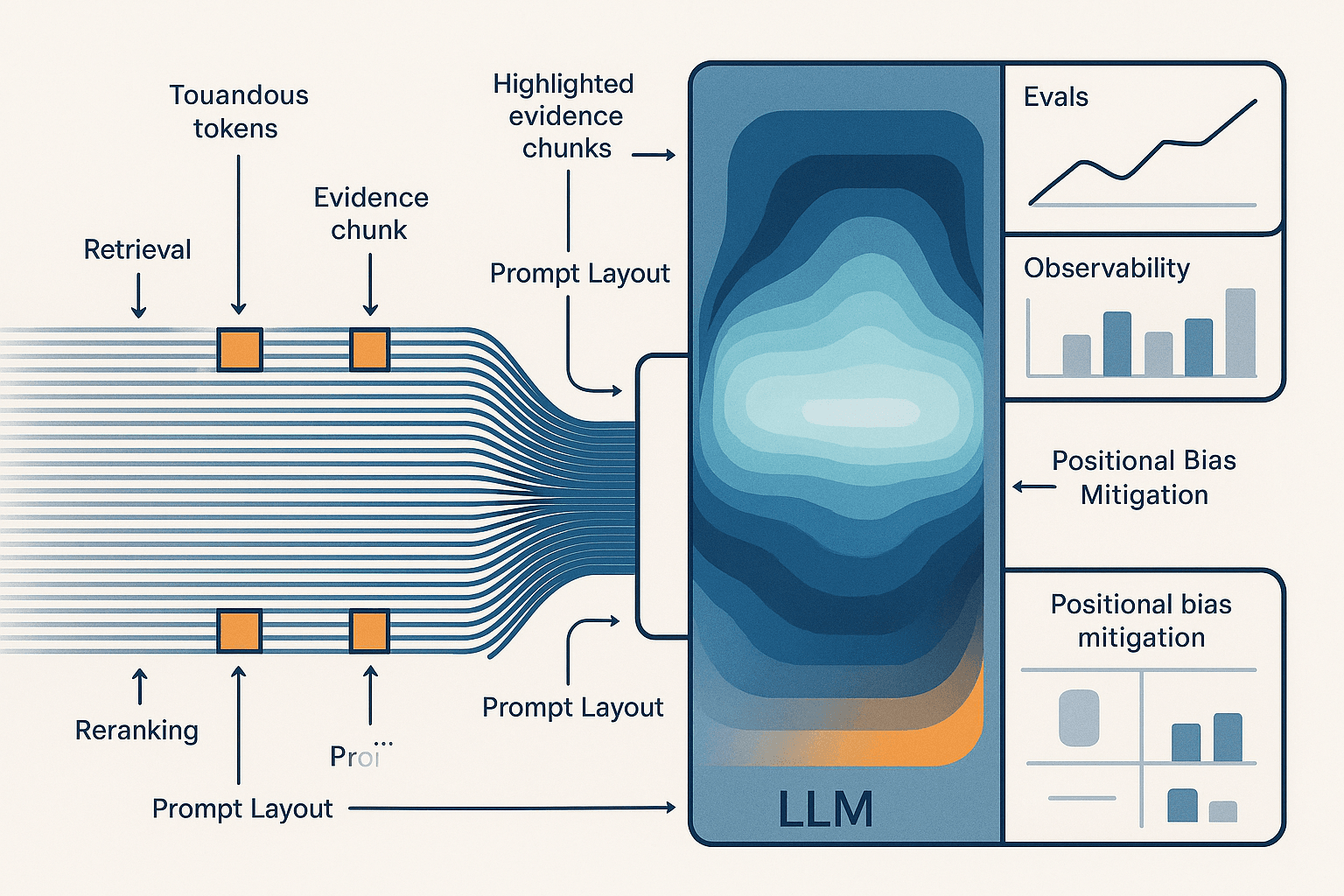
Teams usually discover positional bias the hard way: not in a benchmark report, but in a customer escalation that seems impossible to reproduce.
A support agent asks an internal assistant, "Can enterprise customers export audit logs through the admin API?" The retrieval layer does its job. It pulls the current product policy, the admin API docs, a changelog entry, and an old migration note. Somewhere around chunk seven, the answer is plainly stated: export is supported, but only on the Enterprise Plus tier and only after enabling an account-level flag. The assistant confidently answers, "Yes, audit log export is available through the admin API for enterprise customers," omitting both constraints.
At first glance this looks like a retrieval problem. Maybe the right document was missing. Maybe reranking failed. Maybe the chunking strategy split the crucial sentence. But when the team inspects the trace, the evidence is there. In fact, when they move the exact same chunk closer to the end of the prompt, accuracy jumps. When they pin a summary of the constraint near the beginning, accuracy jumps again. When they bury that same chunk in the middle of a 40k-token prompt, performance drops.
That is positional bias in production: evidence quality depends not just on whether context is included, but where it appears.
Long-context models have improved dramatically, but "supports 128k" or "supports 1M tokens" should not be confused with uniform evidence use across that window. Most real systems still exhibit strong positional effects. Critical passages near the start or end of context are often used more reliably than passages in the middle. Some models over-index on recency. Others show primacy effects. Many degrade when multiple semantically similar chunks compete, especially if the decisive one is buried between boilerplate and retrieved near-duplicates.
This article is about treating positional bias as a first-class engineering problem. Not a paper-reading curiosity, but a failure mode you can measure, isolate, and mitigate with architecture, prompt layout, and evals.
The recurring production pattern
The same pattern appears across teams and domains:
- A legal assistant cites the first contract clause it sees and misses the exception buried in an appendix.
- A coding copilot patches code according to the latest stack trace but ignores a middle-of-context design constraint from the issue description.
- A healthcare operations bot sees the eligibility rule, but misses the denial condition because it appears in a long policy excerpt inserted between more salient passages.
- A customer support assistant answers from a highly ranked FAQ chunk while ignoring a more specific account-level policy note placed later in the prompt.
In each case, teams initially blame one of three things:
- Retrieval quality: "The right evidence wasn’t found."
- Model quality: "We need a better long-context model."
- Prompt quality: "We need stronger instructions to use all supplied context."
Sometimes one of those is true. But positional bias is the hidden fourth category: the answer degraded because the decisive evidence was present but badly placed.
This distinction matters because the remedies are different.
If evidence is missing, you improve indexing, retrieval, metadata, or chunking. If evidence is present but buried, you improve prompt layout, evidence ordering, salience shaping, and context budgeting. If you don’t separate those cases in your evaluation framework, your team will chase the wrong fix.
What positional bias looks like in practice
There are a few common signatures.
1. Lost-in-the-middle behavior
The classic case: answer quality is high when relevant evidence appears near the beginning or end of the prompt, and lower when the same evidence appears in the middle.
This is especially visible when:
- the prompt contains many retrieved chunks
- multiple chunks are topically similar
- the user question is underspecified
- the answer depends on a short exception or qualifier rather than the dominant document theme
The middle becomes a kind of semantic swamp. The model sees the evidence, but does not reliably privilege it at generation time.
2. Recency dominance
The model overweights the last few chunks before generation. This often happens in conversational systems that append a large retrieval block immediately before the answer turn. The final chunks become disproportionately influential, even if earlier chunks are more authoritative.
3. Primacy dominance
Some prompt designs make the model anchor too strongly on early context. This is common when the first retrieved chunk is broad and confident, while later chunks provide narrower but more correct constraints.
4. Constraint omission
The model captures the main answer but drops qualifications like:
- only for certain plans
- except in regulated regions
- after admin approval
- not for legacy tenants
- applies only after version 3.2
These are often short, low-token-density facts embedded inside otherwise less salient chunks.
5. Citation mismatch despite present evidence
The model cites a plausible but non-decisive chunk, while the real supporting evidence appears elsewhere in the prompt. This is a strong signal that the model is not using context uniformly.
Why the naive approach fails
The naive architecture for retrieval-augmented generation usually looks like this:
- Retrieve top-k chunks by similarity.
- Maybe rerank them.
- Concatenate them in score order.
- Add an instruction like "Answer only using the provided context."
- Feed the whole thing into a big context window model.
This works surprisingly often, which is why it survives. But it fails systematically in long-context settings for several reasons.
Similarity ranking is not prompt-layout optimization
Retrieval scores estimate relevance to the query. They do not estimate where a chunk should be placed in context to maximize model use.
A chunk can be ranked correctly and still be ineffective if inserted into a low-attention region of the prompt.
Rerankers optimize document ordering, not generation behavior
Cross-encoders and learned rerankers improve relevance ordering, but they are still upstream components. They do not account for the generation-time positional preferences of the target LLM.
The best chunk at rank 4 may need to be placed first, last, or repeated as a summary to have reliable effect.
"Use all context" instructions are weak control signals
Prompt instructions do help at the margins, but they rarely override deep model tendencies. Telling a model to weigh all evidence equally does not make it so.
Bigger context windows do not eliminate selective attention
Vendors market context length, but application behavior depends on effective use of the full window. More room often encourages teams to stuff more context, which can worsen positional competition and distractibility.
Concatenation hides provenance and salience
When all chunks are rendered in a uniform blob, critical evidence looks the same as background material. The model gets no structural hint about which passages are authoritative, decisive, or exceptions.
A better approach: design for evidence use, not just evidence inclusion
The better mental model is this: a long-context LLM application is not just a retrieval system plus a generator. It is a retrieval-to-prompt layout system whose job is to make the right evidence easy for the model to notice, compare, and preserve in the answer.
That requires work at four layers:
- Evidence selection: choose the right chunks.
- Evidence shaping: compress, label, and expose decisive facts.
- Evidence placement: order chunks and summaries to counter positional bias.
- Evidence verification: evaluate answer quality under positional permutations.
If you only optimize layer 1, you will miss a large class of failures.
Reference architecture for positional-bias-aware RAG
A production architecture I like for high-stakes long-context QA looks like this:
Stage 1: Retrieval
Use hybrid retrieval, typically BM25 plus dense retrieval, with metadata filters where available.
Why hybrid? Dense retrieval is good at semantic matching but can blur narrow lexical constraints. BM25 often surfaces exact-plan names, version numbers, exception phrases, or API flags that matter disproportionately in these tasks.
Stage 2: Deduplication and diversity control
Cluster near-duplicate chunks before prompt assembly. If your prompt contains five versions of the same broad policy paragraph, they can drown out the one chunk containing the exception.
At this stage, enforce simple diversity heuristics:
- max chunks per source document
- max chunks per semantic cluster
- preference for chunks containing explicit answer-bearing entities or negations
Stage 3: Query-aware reranking
Use a reranker to score chunk relevance, but do not stop there. Add a second score estimating decisiveness:
- contains direct answer span
- contains exception language
- contains policy constraints
- contains latest effective date
- comes from higher-authority source
A practical implementation is to use a lightweight classifier or LLM pass that labels chunks as one of:
- direct answer
- supporting background
- exception/constraint
- conflicting evidence
- irrelevant
This classification often matters more for prompt placement than raw relevance ranking.
Stage 4: Salience shaping
Before final prompt assembly, create structured evidence artifacts:
- verbatim chunks for citation fidelity
- micro-summaries for each chunk, one or two lines max
- constraint summaries for exceptions and caveats
- source labels including authority, recency, and document type
Example evidence card:
- Source: Admin API docs, updated 2026-03-02, authoritative
- Micro-summary: Audit log export supported only for Enterprise Plus tenants.
- Constraint: Requires account-level feature flag enabled by support.
- Verbatim excerpt: "The audit log export endpoint is available only to Enterprise Plus workspaces after the AuditExport feature flag is enabled."
This improves the chance that decisive facts survive generation without forcing the model to re-derive them from a long passage.
Stage 5: Prompt layout assembly
Instead of simple concatenation, structure the context into zones:
- Task and answer requirements
- Decision-critical facts summary
- Primary evidence cards
- Secondary/background evidence
- Conflicts or ambiguities
- Output schema
This layout exploits the fact that many models respond better when important constraints are surfaced early and reinforced near generation.
A common pattern is to place concise decision-critical summaries near the top, then detailed evidence, then a final reminder immediately before the answer format.
Stage 6: Answer generation with grounded output schema
Require fields such as:
- answer
- confidence
- constraints
- cited_sources
- unresolved_conflicts
If constraints are mandatory output fields, omission becomes easier to detect both for the model and in evaluation.
Stage 7: Post-generation verification
Run a verifier pass when stakes justify it. The verifier checks whether the answer omitted any constraint present in evidence cards labeled direct answer or exception/constraint.
This can be done with a cheaper model than the generator, especially if the check is narrow and structured.
Prompt layout patterns that work
There is no universally optimal ordering, but a few patterns consistently outperform naive score-order concatenation.
Pattern 1: Summary sandwich
Put a concise, query-specific summary of decisive facts before the long evidence block, and a shorter reminder after it.
Structure:
- instructions
- decisive facts summary
- full evidence
- answer checklist with critical constraints
This works because it gives the model an early anchor and a late reminder.
Pattern 2: Start-middle-end anchoring
If you must include many chunks, intentionally place the most important items at the beginning and near the end, with lower-priority background in the middle.
A simple heuristic:
- top authority direct answer chunk: beginning
- strongest exception chunk: end
- broad background chunks: middle
Pattern 3: Conflict-first framing
When sources disagree, surface the conflict explicitly before the evidence block. Otherwise the model may average across sources and produce an invalid compromise.
Example:
"Note: Source A says feature is available for Enterprise customers broadly. Source B, a newer policy document, restricts it to Enterprise Plus with a feature flag. Prefer newer policy source if conflict exists."
Pattern 4: Constraint extraction lane
For domains with many caveats, maintain a dedicated prompt section titled Critical constraints and exceptions. This can dramatically reduce qualifier omission.
Pattern 5: Source-authority labeling
Add compact labels such as:
- authoritative
- latest
- deprecated
- background only
This gives the model extra structure for weighing evidence without extra tokens from long explanations.
Implementation details that matter more than teams expect
Chunk size and chunk purpose should differ
Many teams use one chunking strategy for retrieval and prompting. That is often suboptimal.
Use smaller chunks for retrieval recall, but compose larger or differently shaped evidence units for prompting. For example:
- retrieval chunks: 200–400 tokens with overlap
- prompt evidence cards: 80-token summary plus 200-token excerpt
This lets you preserve citation fidelity while reducing prompt bloat and improving salience.
Exceptions deserve first-class treatment
Negations and qualifiers are fragile. Build explicit detectors for phrases like:
- only if
- except
- unless
- not available for
- deprecated after
- requires approval
- limited to
If a chunk contains this kind of language, boost its decisiveness score and consider placing it in the constraint lane regardless of raw retrieval rank.
Recency and authority should be encoded structurally
Do not assume the model will infer that a changelog from last month supersedes a setup guide from two years ago. Label this directly.
Good:
Authority: product policy (canonical)Updated: 2026-04-12Status: supersedes 2024 migration note
Bad:
- hoping the model infers source precedence from filenames or prose
Avoid long homogeneous evidence blocks
Ten similarly formatted chunks in a row are hard for humans to scan and often hard for models to use. Interleave compact summaries with excerpts or collapse repetitive background into a single synthesized note.
Repetition can help, but only if controlled
Repeating a crucial fact in two locations can improve reliability. Repeating five similar chunks usually hurts. The point is not volume; it is strategic reinforcement.
A useful rule: repeat only the top one or two decisive constraints, and repeat them in compressed form.
How to evaluate positional bias properly
If your eval set uses fixed chunk ordering, you are probably underestimating the problem.
A positional-bias eval harness should ask: holding evidence constant, how much does answer quality change when evidence position changes?
The core experiment
For each question:
- Identify the decisive evidence chunk(s).
- Assemble a realistic prompt with background context.
- Generate multiple prompt variants where decisive evidence appears at different positions:
- early
- middle
- late
- repeated early+late
- Keep total token count roughly constant.
- Score answer correctness, completeness, and citation quality.
You are not testing retrieval here. You are testing prompt-position sensitivity.
Metrics that reveal the issue
Track more than exact-match accuracy.
Useful metrics:
- Position sensitivity delta: max accuracy minus min accuracy across placements
- Constraint recall: whether required qualifiers appeared
- Citation alignment: whether cited evidence contains the decisive fact
- Answer consistency: variance in structured outputs across permutations
- Unsupported confidence: high-confidence wrong answers when evidence is present but buried
Constraint recall is especially important. In many business systems, the main answer is directionally right while the omitted caveat creates the incident.
A practical eval matrix
For each sample, vary:
- decisive chunk position: start/middle/end
- number of distractor chunks
- source conflict presence
- context length bucket: 4k/16k/64k+
- chunk formatting: plain text vs evidence cards
- model choice
This gives you a grid that surfaces where your system breaks.
Synthetic tests are useful, but not sufficient
You should absolutely build synthetic lost-in-the-middle probes. They are cheap and controllable. But also include real traces from production where users asked ambiguous questions and the answer depended on a buried exception.
Synthetic evals tell you whether the phenomenon exists. Trace-based evals tell you whether it matters for your users.
Example eval harness design
A minimal production-ready harness might store records like:
- query
- gold answer
- required constraints
- authoritative evidence chunk ids
- distractor chunk ids
- prompt assembly template id
- placement condition
- model id
- output
- scores
Then define placement conditions such as:
direct_start_constraint_enddirect_middle_constraint_middledirect_end_constraint_endsummary_start_verbatim_middle_constraint_end
This lets you compare architecture choices, not just models.
One valuable derived metric is buried-evidence failure rate:
fraction of cases where authoritative evidence is present, but answer fails only when the evidence is placed in low-salience positions.
That metric helps settle debates internally. It distinguishes retrieval misses from layout failures.
Model comparisons: what to test for
Do not ask "Which model has the largest context window?" Ask:
- How stable is answer quality under evidence permutation?
- How well does the model retain qualifiers from middle-context passages?
- How much does it benefit from summaries versus raw chunks?
- How much does citation fidelity degrade with long prompts?
- What is the cost of adding verifier passes or repeated summaries?
In practice, you will often find tradeoffs like these:
Large premium model
Pros:
- better long-context robustness
- better conflict resolution
- stronger instruction following
Cons:
- higher cost per token
- potentially higher latency
- still not immune to lost-in-the-middle effects
Mid-sized fast model
Pros:
- low latency
- cheap enough for multiple passes or verifier loops
- often good with structured evidence cards
Cons:
- more sensitive to prompt layout
- weaker with ambiguous or conflicting sources
Specialized reranker + smaller generator
Pros:
- can outperform a single large model if evidence shaping is strong
- better cost profile for high-volume workloads
Cons:
- more moving parts
- more engineering complexity in summaries and verification
This is why architecture matters. A well-shaped pipeline using a cheaper generator can beat a naive pipeline using an expensive flagship model.
Cost and latency tradeoffs
Mitigations are not free. You are often trading prompt tokens, extra passes, and orchestration complexity for reliability.
Salience shaping increases preprocessing cost
Generating micro-summaries or constraint labels adds latency. But it may reduce total prompt size enough to offset generation cost, especially if done offline for static corpora.
Best practice:
- preprocess and cache summaries for stable documents
- generate query-specific summaries only for top few candidate chunks
Repetition uses tokens strategically
Repeating a one-line constraint twice may add 30 tokens and save an incident. Repeating whole chunks wastes budget. Prefer compressed repetition over raw duplication.
Verification passes improve precision selectively
A post-generation verifier can add 200–800 ms depending on model and load, but you do not need it on every request.
Common gating strategies:
- run verifier only for high-risk intents
- run verifier only when confidence is high but evidence conflict exists
- run verifier only when constraints were expected but omitted
Layout-aware prompting can shrink context
If you summarize background and elevate decisive evidence, you often need fewer raw chunks. This improves both cost and latency while reducing positional interference.
Observability patterns for positional bias
Most teams have logs for retrieved documents and final answers. That is not enough.
You need observability that can answer:
- Was the needed evidence present?
- Where in the prompt did it appear?
- Was it summarized or labeled as decisive?
- Did the final answer preserve its constraints?
- When the answer failed, was the problem missing evidence or buried evidence?
What to log per request
At minimum:
- retrieved chunk ids and scores
- reranked order
- final prompt order
- token offsets or approximate position bands for each chunk
- chunk labels: direct answer, background, exception, conflict
- source authority and recency
- answer fields and citations
- verifier results, if any
This enables failure slicing by position.
Dashboards worth building
Accuracy by decisive evidence position band
Bucket decisive evidence into early/middle/late and plot answer quality. If middle-band performance is consistently worse, you have direct evidence of positional bias.
Constraint omission rate by context length
Watch whether qualifier omission increases as prompts get longer.
Citation drift
Track cases where the answer cites non-authoritative or non-decisive chunks despite decisive evidence being present.
Buried-versus-missing breakdown
For failed answers, classify:
- decisive evidence not retrieved
- retrieved but dropped before prompt assembly
- included but buried
- included and salient, but still not used
This taxonomy is operationally useful. Different owners can act on different buckets.
Human review patterns
For incident analysis, render prompt traces visually with:
- chunk order
- chunk labels
- authority indicators
- highlighted gold evidence spans
- answer text aligned to cited sources
Engineers can usually spot layout pathologies much faster from this than from raw prompt text.
A practical mitigation playbook
If I inherited a long-context system showing positional issues, I would usually do the following in order.
1. Build a permutation eval before changing models
Take 100–300 representative tasks and create position variants. Measure constraint recall and answer correctness. Without this, you won’t know whether later improvements came from retrieval, prompt layout, or luck.
2. Add decisiveness labeling
Even crude labels for direct answer / exception / background will improve prompt assembly decisions.
3. Introduce evidence cards
Replace raw chunk dumps with compact summaries plus short verbatim excerpts and source metadata.
4. Reserve prompt real estate for constraints
Add a dedicated critical constraints section near the top and a checklist near the answer instruction.
5. Reduce background redundancy
Cap repetitive chunks and collapse low-value context into one summary note.
6. Place decisive evidence intentionally
Do not trust score order. Put direct answer and exception evidence in high-salience positions.
7. Add a verifier for high-risk flows
Particularly where omitted qualifiers create compliance, billing, or safety issues.
8. Add buried-evidence observability
You want to know, weekly, whether your failures are trending toward retrieval misses or layout misses.
A concrete example prompt layout
For a policy QA assistant, a strong template might look like this:
- System/task instructions
- Required answer format
- Critical constraints and exceptions
- Direct answer evidence cards
- Conflicting or superseded evidence cards
- Background evidence cards
- Final answer checklist:
- mention plan limitations
- mention prerequisites
- prefer latest canonical policy source
- cite source ids
Notice the philosophy: the model should not have to discover the answer structure from a sea of text. We make the decisive dimensions explicit.
When to redesign the product instead of the prompt
Sometimes the right answer is not more prompt engineering.
If users repeatedly ask questions whose answers depend on a tiny exception inside 80 pages of policy, consider product changes:
- extract structured policy facts into a knowledge layer
- store plan restrictions and prerequisites in a queryable database
- use the LLM for explanation, not for first-principles policy inference
- ask a clarifying question before answering
Long context is powerful, but it should not be your only data model.
A lot of positional bias pain comes from asking the model to do latent information extraction, ranking, conflict resolution, and answer synthesis in one pass over loosely structured text. If a fact is critical enough, make it explicit upstream.
The key takeaway
In long-context systems, relevance is only half the job. Placement is the other half.
A chunk can be retrieved correctly, reranked correctly, and still fail operationally because it lands in the wrong part of the prompt or is surrounded by too much competing context. That is why teams need to move from retrieval-centric thinking to evidence-use-centric thinking.
The practical path is straightforward:
- evaluate with evidence permutations, not fixed layouts
- separate direct answers from exceptions and background
- shape salience with summaries, labels, and structure
- place decisive evidence intentionally
- add observability that distinguishes buried evidence from missing evidence
If you do this, you will not eliminate positional bias entirely. No current long-context model is perfectly position-invariant in realistic applications. But you will turn a mysterious, hard-to-reproduce class of failures into something measurable and improvable.
That is the real production goal: not pretending the model reads every token equally, but building systems that remain reliable even when it does not.