Designing SLOs and Error Budgets for Production GenAI Systems
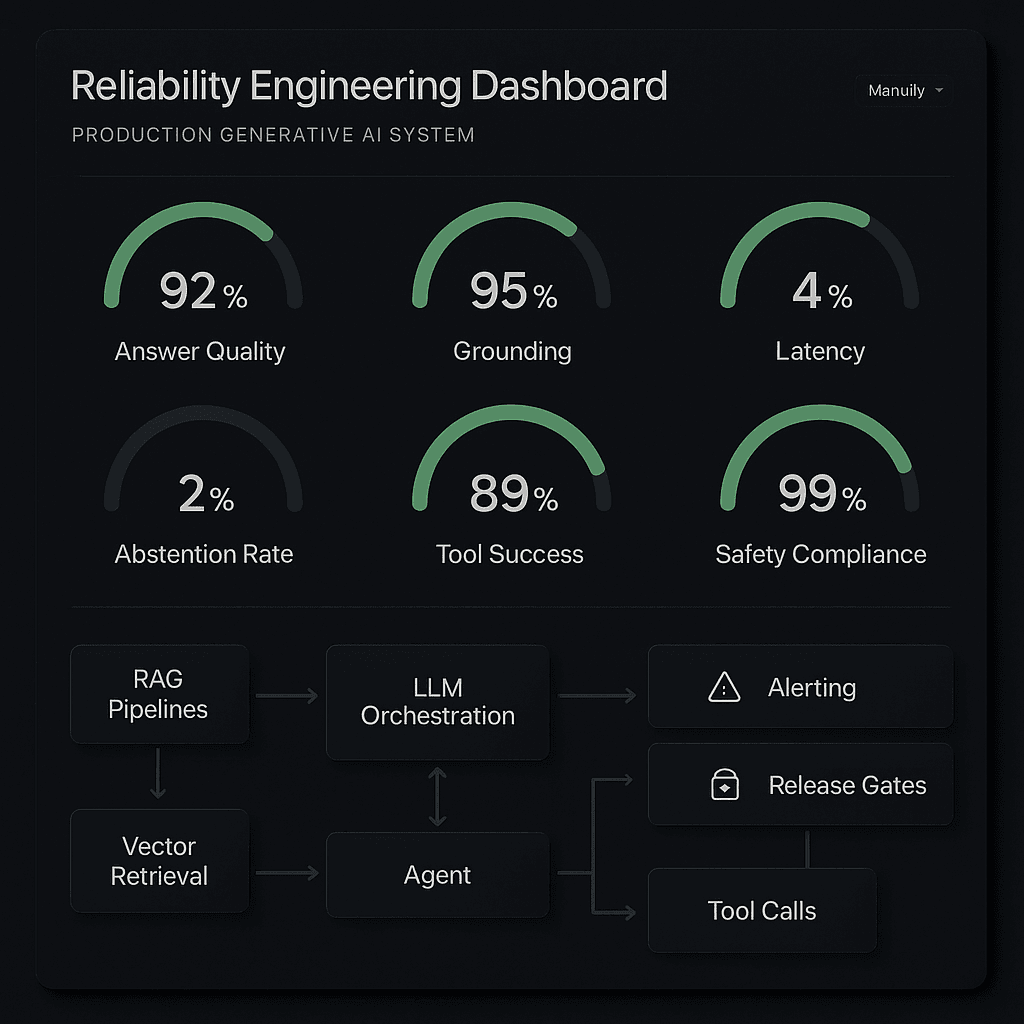
The incident usually does not start with a GPU outage.
It starts with a CEO forwarding a screenshot.
A customer asked a support copilot whether a regulated product could be used in a specific jurisdiction. The system answered quickly, confidently, and incorrectly. Retrieval returned three documents, but the model stitched together an answer from a stale policy memo and a marketing FAQ. No traditional uptime alarm fired. API availability was 99.98%. Median latency was under two seconds. Infrastructure looked healthy.
But the system was not healthy in any way that mattered.
By the time the team pieced together what happened, they found multiple issues hiding behind “the service is up”:
- Retrieval relevance had degraded after an indexing change.
- The answerer had become less willing to abstain when evidence was weak.
- A routing tweak sent more traffic to a cheaper model with worse citation discipline.
- Tool calls to the policy service were succeeding at the HTTP layer but returning semantically incomplete data.
- Safety classifiers were passing content that should have triggered a compliance handoff.
- Cost per resolved conversation had climbed because retries and multi-step plans increased silently.
This is the central operational truth of GenAI systems: availability is necessary, but it is nowhere near sufficient.
If you run retrieval-augmented generation, copilots, or tool-using agents in production, your users do not experience your system as “API reachable” or “GPU cluster healthy.” They experience it as: did I get a useful, grounded, timely, safe answer at an acceptable cost? And when the system was unsure, did it fail in the right direction?
That means the reliability frame has to expand. You need service-level objectives that reflect what the product actually promises. You need error budgets not only for downtime, but also for hallucination exposure, unacceptable latency tails, failed tool trajectories, missing abstentions, and spend overruns. And you need those budgets wired into release gates, alerting, model rollouts, and operational runbooks.
This article lays out a practical way to do that for RAG and agent systems.
The pattern: GenAI failures are multi-dimensional, not binary
Classic web services let you anchor reliability on a few measures: uptime, request latency, and maybe correctness for deterministic business flows. Production GenAI systems break that simplicity because the application behavior emerges from multiple probabilistic components:
- intent routing n- retrieval and ranking
- context assembly
- model generation
- tool selection and execution
- safety policy enforcement
- caching and fallback behavior
- human handoff or abstention logic
A user-visible failure can come from any one component, or from interactions between them.
For example:
- The model is capable, but retrieval fetches the wrong chunk.
- Retrieval is good, but the prompt template allows unsupported synthesis.
- The answer is factually correct, but too slow for the workflow.
- The content is helpful, but the tool action fails on argument formatting.
- The model abstains too often, reducing task completion.
- The model abstains too rarely, increasing hallucination risk.
- A cheaper model saves cost but lowers grounding fidelity on long contexts.
- Safety blocks improve compliance but create false positives that break enterprise workflows.
The naive SRE move is to treat all of this as “model quality” and monitor one offline benchmark plus some API health metrics. That almost always fails because production quality is not one scalar.
GenAI operations work better when you separate the reliability surface into a small set of service promises that map to user outcomes and operating constraints:
- Answer quality: Was the response useful and correct enough for the task?
- Grounding: Was the answer supported by approved evidence?
- Latency: Did the system respond within workflow-appropriate timing?
- Abstention behavior: Did it decline or escalate when uncertainty was high?
- Tool success: Did external actions/data fetches succeed semantically, not just technically?
- Safety and policy compliance: Did the output stay within legal, policy, and brand boundaries?
- Cost efficiency: Did the system stay within unit economics while meeting the above?
These become your GenAI SLO dimensions.
Why the naive approach fails
The naive approach usually looks like some combination of the following:
- One infrastructure SLO: 99.9% API success rate
- One latency SLO: p95 under 5 seconds
- One monthly offline model score on a benchmark set
- Ad hoc QA for prompt or model changes
- Incident response only when customers complain
This fails for several reasons.
1. Uptime hides semantic failure
A RAG assistant that answers every request with plausible nonsense can still have excellent uptime. If your only paging condition is HTTP 5xx, you are operationally blind to the failures users care about most.
2. Aggregate model scores hide workflow-specific regressions
A model can improve on a broad benchmark while becoming worse at your domain tasks:
- weaker citation fidelity
- more overconfident synthesis
- worse schema adherence on tool arguments
- degraded multilingual retrieval robustness
- slower long-context performance
You need task-level and pipeline-level objectives, not just model-level scores.
3. Mean metrics hide bad tails
Average latency and average quality are especially misleading in GenAI. A small slice of pathological requests can dominate support load, compliance risk, or cloud spend.
Typical examples:
- p50 latency is fine, but p99 explodes on multi-tool plans.
- average answer quality is stable, but hard compliance queries regress sharply.
- average cost per request looks okay, but long conversations consume the monthly budget.
4. Missing abstention targets encourage the wrong behavior
Teams often tell the model to “be helpful” and then punish abstentions because they look like product failure. The result is predictable: fewer refusals, more fabricated answers. If the system should sometimes say “I don’t know” or route to a human, that behavior needs its own objective.
5. Tool success measured as HTTP success is meaningless
In agentic systems, a tool call can return 200 OK and still be useless:
- the SQL query omitted a necessary filter
- the CRM record is stale or partial
- the action executed twice
- a side effect happened but confirmation parsing failed
- the search API returned top results unrelated to the user’s entity
You need semantic tool correctness, not transport-level success.
6. Cost becomes an afterthought until it is an incident
Many teams do not operationalize cost until bills spike. By then, the system may already rely on expensive long contexts, cascaded retries, or overuse of premium models. Cost should be treated like a first-class reliability constraint because a system that cannot be economically sustained is not production healthy.
A better approach: Define a GenAI reliability contract
The most useful mental model is a reliability contract for each GenAI product surface. Not one universal SLO for “the chatbot,” but a contract for a specific experience and risk profile.
A support search assistant, an internal engineering copilot, and a claims-processing agent should not share the same thresholds.
For each surface, define:
- intended user outcome
- allowed evidence sources
- acceptable failure modes
- unacceptable failure modes
- latency expectations by workflow
- escalation/abstention policy
- cost envelope
- safety and compliance requirements
Then derive measurable indicators and targets.
For a production RAG assistant, your contract might be:
- Provide grounded answers to policy and product questions using only approved enterprise knowledge sources.
- If evidence is insufficient or conflicting, abstain and recommend a human or authoritative workflow.
- Respond fast enough for in-flow use in support operations.
- Include citations for every non-trivial factual claim.
- Stay under a maximum cost per resolved conversation.
- Never provide prohibited compliance guidance without escalation.
That contract is what your SLOs should encode.
The SLO dimensions that matter in GenAI
Below is a practical set of SLO categories. Not every product needs all of them, but most production systems need more than uptime and latency.
1. Answer quality SLO
This is the most obvious and the hardest. “Quality” is too vague unless you decompose it.
Useful subdimensions:
- task completion: did the answer enable the user to complete the intended task?
- factual correctness: were the claims accurate?
- instruction adherence: did the answer follow format and policy?
- usefulness: did it answer the actual question at the right level?
For production use, avoid relying on a single LLM judge score. Use a composite.
A practical quality SLI stack:
- Human-reviewed score on stratified samples for high-risk flows
- LLM-as-judge on larger samples with calibrated agreement checks
- Workflow proxy metrics such as resolution without re-ask, edit distance, or human acceptance rate
- Golden task suites for release gating
Example SLO:
- On support-policy queries, at least 92% of sampled answers must be rated “acceptable or better” by calibrated review, measured weekly.
This is not perfect, but it is concrete enough to operate.
2. Grounding SLO
For RAG systems, grounding deserves its own objective because high-quality style with poor grounding is one of the most dangerous failure modes.
Grounding asks: are the answer’s factual claims supported by approved context?
Typical grounding SLIs:
- citation coverage: percentage of factual answers containing citations
- citation validity: percentage of citations that actually support associated claims
- unsupported claim rate: percentage of answers containing material claims absent from provided evidence
- evidence sufficiency rate: percentage of answers generated when retrieval met a minimum evidence threshold
Example SLOs:
- 98% of non-trivial factual responses must include at least one citation.
- Unsupported material claim rate must remain below 1.5% on audited samples.
- For regulated query classes, unsupported claim rate must remain below 0.2%.
If you only track “retrieval hit rate,” you will miss unsupported synthesis. Grounding must be measured at the answer level.
3. Latency SLO
Latency still matters, but the threshold depends heavily on use case.
A legal review assistant may tolerate 12 seconds. A call-center copilot probably cannot.
For GenAI, segment latency by path:
- first-token latency
- full-response latency
- retrieval latency
- tool execution latency
- planner latency vs executor latency
- fallback path latency
This matters because the user experience may be acceptable if first token arrives quickly even when the final answer takes longer, while some agent workflows need hard completion bounds.
Example SLOs:
- p95 first-token latency under 1.8s for support-copilot read queries
- p95 final answer latency under 6s for single-hop RAG queries
- p95 completion latency under 15s for agent flows with up to two tool calls
Without path segmentation, latency fixes turn into guesswork.
4. Abstention and escalation SLO
This is the most underused SLO in GenAI.
If the system is designed to abstain when evidence or confidence is inadequate, then abstention quality is part of reliability.
Useful SLIs:
- justified abstention rate: percentage of low-evidence/high-risk cases where the system abstained appropriately
- unnecessary abstention rate: percentage of answerable cases where it abstained
- unsafe answer-on-should-abstain rate: percentage of cases where the system answered despite insufficient evidence or policy constraints
- escalation success rate: percentage of abstentions that route users to a useful next step
Example SLOs:
- On low-evidence regulated queries, unsafe answer-on-should-abstain rate must stay below 0.5%.
- On answerable support KB queries, unnecessary abstention rate must stay below 6%.
This keeps teams from optimizing in the wrong direction. A system that never abstains may look more helpful right until it becomes a governance problem.
5. Tool success SLO
For agents and tool-using copilots, tool success is often more operationally important than free-form answer quality.
Measure success in layers:
- invocation success: tool called correctly with valid schema
- execution success: tool completed without technical error
- semantic success: tool result actually satisfied the intended subtask
- end-to-end task success: user goal was completed
Example SLIs:
- function-call schema validity rate
- tool timeout rate
- planner-to-tool mismatch rate
- duplicate side-effect rate
- end-to-end task completion rate for scripted scenarios
Example SLOs:
- Tool invocation schema validity above 99.5%
- Semantic tool success above 95% for account lookup flows
- Duplicate side-effect rate below 0.1% for write actions
For write actions, idempotency and confirmation semantics are non-negotiable parts of reliability design.
6. Safety and compliance SLO
Safety is often treated as a policy layer, not an SLO. In production, that is a mistake.
You need measurable policy outcomes:
- prohibited content leakage rate
- regulated advice violation rate
- PII exposure rate
- policy classifier false negative/false positive rates
- handoff compliance for restricted intents
Example SLOs:
- Zero tolerance for confirmed prohibited-action execution.
- PII exposure rate below 0.05% on audited samples.
- Regulated guidance violation rate below 0.1% for specified intent classes.
Safety SLOs should usually be tighter than quality SLOs because the business risk is asymmetric.
7. Cost SLO
Many teams resist calling cost an SLO because “cost isn’t reliability.” In practice, for GenAI it is an operational limit just like latency.
If your architecture only works at unsustainable spend, you do not have a production-ready system.
Useful cost SLIs:
- cost per request
- cost per resolved conversation
- average tokens per successful task
- retrieval/tool cost per task
- retry amplification factor
- premium-model routing rate
Example SLOs:
- p95 cost per resolved support conversation under $0.18
- Premium-model usage below 12% of total requests unless release override is active
- Retry amplification factor below 1.15
Cost SLOs are especially important when teams adopt cascades, multi-pass retrieval, or agentic decomposition. Those patterns can improve quality while quietly destroying margins.
Turning SLOs into error budgets
SLOs become operationally useful when they create budgets for change.
An error budget is the amount of unreliability you can consume in a period while still meeting the SLO. In GenAI, that concept applies naturally beyond availability.
If your grounding SLO says unsupported material claims must stay below 1.5% weekly, then your grounding error budget is 1.5% of relevant responses in that period.
If your latency SLO says p95 under 6 seconds, your budget is the allowed tail exceedance relative to your chosen measurement method.
If your cost SLO says p95 cost per resolved conversation under $0.18, then cost spikes consume budget too.
Think in separate budgets by dimension:
- availability budget
- latency budget
- grounding budget
- abstention budget
- tool success budget
- safety budget
- cost budget
Why separate budgets? Because remediation and release policy differ.
If you are burning latency budget but not grounding budget, you may tune retrieval fan-out, caching, or model size.
If you are burning grounding budget but not latency budget, you might add stricter evidence thresholds, rerankers, or answer constraints.
If you are burning safety budget, you probably stop launches faster than you would for cost overages.
Budget policy example
For a customer-support RAG system:
- Safety budget breach: immediate launch freeze, incident review, policy rollback path
- Grounding budget at 50% burn mid-window: halt prompt/model experiments without approval
- Latency budget at 75% burn: disable expensive fallback path, activate cache preference
- Cost budget at 80% burn: tighten premium routing threshold, shorten context packing, review retry loops
This is where SLOs stop being dashboards and become governance.
Architecture implications: instrument the pipeline, not just the endpoint
You cannot manage GenAI SLOs if all telemetry is attached to the final response.
Instrument every stage of the pipeline with request lineage.
For a RAG system, capture at minimum:
- request metadata: tenant, product surface, risk class, route
- query rewrite output
- retrieval candidates, scores, filters, source IDs
- reranker outputs
- selected context chunks and token counts
- model name, prompt version, sampling params
- generated answer and citations
- grounding check outputs
- safety classifier outputs
- abstention/escalation decision
- token usage and cost estimate
- user outcome proxies: thumbs, edit, re-ask, escalation, resolution
For an agent system, add:
- plan steps
- tool selection rationale or confidence
- function-call arguments
- tool response payload summaries
- side-effect IDs and idempotency keys
- retries and repair loops
- final state and task completion marker
Without this lineage, your postmortems become speculation.
A minimal architecture for SLO-aware GenAI operations usually includes:
-
Online serving path
- request router
- retrieval/tool orchestration
- model inference
- policy enforcement
- response delivery
-
Observability and event logging layer
- structured events per pipeline stage
- prompt/model/version identifiers
- cost and latency attribution
-
Evaluation layer
- online sampling for audits
- offline golden-set runner
- judge models and human review queue
- drift analysis and segment reporting
-
Control plane
- release gates
- model routing rules
- feature flags
- rollback and fallback controls
-
Reliability operations
- SLO dashboards
- budget burn alerts
- runbooks and incident workflows
If you do not have a dedicated evaluation and control plane, SLOs will remain aspirational.
Evaluation strategy: combine offline, online, and adversarial views
The biggest mistake teams make is trying to derive all SLO confidence from one evaluation mode.
You need at least three.
1. Offline regression suites
These are your golden datasets and scenario tests. They are essential for release gating.
Include:
- representative user tasks
- known edge cases
- adversarial prompts
- low-evidence cases where abstention is expected
- tool-argument correctness scenarios
- policy and safety test cases
Segment them by risk and workflow. A 500-question mixed bag is less useful than targeted suites:
- support-policy-grounding
- billing-workflow-tool-use
- regulated-advice-abstention
- multilingual-retrieval
- long-context-precision
Offline evals are where you compare prompts, models, retrieval settings, rerankers, and policies before rollout.
2. Online sampled audits
Offline datasets age quickly. Production traffic does not.
Sample real requests for audit, stratified by:
- query class
- tenant or customer segment
- risk category
- latency bucket
- model route
- retrieval confidence bucket
- tool-use vs no-tool path
Run a mix of:
- automated grounding checks
- LLM judge scoring
- human review for high-risk slices
This is where your answer quality, grounding, safety, and abstention SLIs gain credibility.
3. Adversarial and chaos-style evaluation
Production GenAI reliability also needs deliberate stress:
- corrupted retrieval indices
- stale document versions
- empty retrieval result sets
- tool partial failures
- malformed tool payloads
- prompt injection attempts
- long conversation memory contamination
- context-window pressure
These are the semantic equivalent of resilience testing in distributed systems. If your architecture handles only the happy path, your SLOs will collapse under real load.
Model and tool tradeoffs: better SLOs often require cascades
There is no single best model for every SLO dimension.
A larger model may improve answer quality and tool planning while hurting cost and latency. A smaller model may be fine for extraction or routing but poor at nuanced abstention. A specialist reranker may improve grounding more cheaply than upgrading the generator.
Practically, many production systems use model and tool cascades:
- small model for classification/routing
- embedding model plus retriever and reranker for evidence selection
- medium model for most generation
- premium model only for hard or high-risk cases
- separate verifier model for grounding/safety checks
This architecture often dominates “send everything to the smartest model” on both economics and controllability.
Example tradeoff pattern:
- If grounding budget is burning, first improve retrieval quality, chunking, filters, and reranking before upgrading the main generator.
- If tool schema validity is poor, introduce constrained decoding or stronger function-calling models rather than merely increasing prompt instructions.
- If latency is burning, reduce retrieval fan-out, use cached summaries, stream earlier, or reserve premium models for escalations.
- If cost is burning, apply confidence-based routing and shorter context assembly before replacing the whole stack.
The reliability lesson: optimize the component most responsible for the breached SLO, not the most visible one.
Implementation details: concrete SLO design for a RAG assistant
Let’s make this tangible with a support and policy RAG assistant.
Service definition
Users: customer-support agents
Allowed sources:
- approved product KB
- policy repository
- pricing rules service
Not allowed:
- open web
- stale draft documents
- unsupported legal/compliance advice
Expected behaviors:
- answer straightforward factual questions with citations
- abstain or escalate when evidence is conflicting or absent
- route pricing lookups to tool-backed source when required
Proposed SLO set
Availability:
- 99.9% successful responses excluding upstream identity-provider failures
Latency:
- p95 first token < 1.5s
- p95 full response < 5.5s for non-tool RAG
- p95 full response < 8.0s for tool-backed pricing queries
Grounding:
- citation coverage >= 99% for factual responses
- unsupported material claim rate < 1.0%
- regulated-query unsupported claim rate < 0.2%
Answer quality:
- audited acceptability >= 93% overall
- audited acceptability >= 97% for top 20 support intents
Abstention:
- unsafe answer when abstention required < 0.5%
- unnecessary abstention on answerable KB queries < 5%
Tool success:
- pricing tool semantic success >= 98%
- function argument validity >= 99.7%
Safety:
- prohibited compliance guidance violation rate < 0.1%
- PII leakage rate < 0.05%
Cost:
- p95 cost per conversation < $0.15
- premium model route share < 10%
How to measure these in practice
Grounding measurement approach:
- require span-level or sentence-level citation linking in generated outputs
- run automated citation support checks using verifier prompts or rules
- audit a weekly stratified sample with human reviewers
- tag failures by root cause: retrieval miss, stale source, unsupported synthesis, citation mismatch
Abstention measurement approach:
- maintain a labeled set of “should answer” and “should abstain/escalate” examples
- in online traffic, infer likely should-abstain candidates from low retrieval score, conflicting documents, or policy intent class
- review sampled cases where the model answered despite low evidence
Tool success measurement approach:
- log both raw tool payloads and normalized semantic outcomes
- define per-tool success criteria, e.g. “returned correct price for specified SKU and region” rather than “API succeeded”
- add canary scenarios executed continuously against sandbox or mirrored data
Cost measurement approach:
- compute request-level and conversation-level cost from tokens, retrieval calls, reranker usage, and tool/API charges
- segment by route, tenant, prompt version, and model
- include hidden cost multipliers: retries, verifier passes, agent loop depth
Release gates
Before promoting a change, require it to pass:
- no regression on safety suite
- no regression greater than X on grounding suite
- latency increase less than defined threshold on representative traffic replay
- cost increase within budget envelope
- abstention calibration within approved band
A sample release policy:
- Prompt-only change: can ship if offline grounding and safety are non-inferior and online canary remains within 10% of budget burn baseline for 24 hours.
- Model change: requires offline suite pass, shadow traffic evaluation, canary on 5% traffic, and explicit sign-off if any critical slice regresses.
- Retrieval/indexing change: requires relevance eval, grounding eval, stale-doc audit, and rollback-ready index versioning.
This may sound heavy, but if your assistant influences customer or regulated decisions, it is lighter than recurring incident cleanup.
Implementation details: SLO design for an agent system
Agents complicate reliability because the user-visible result depends on multi-step planning and side effects.
Suppose you run an internal IT operations agent that can:
- look up account status
- reset credentials
- open service tickets
- query device inventory
Here the dominant SLOs shift somewhat.
Service definition
Expected behaviors:
- complete approved actions accurately and once
- ask clarifying questions when required fields are missing
- never execute disallowed actions
- provide traceable summaries of actions taken
Proposed agent SLO set
Task success:
- scripted end-to-end task completion >= 94%
Action safety:
- unauthorized side-effect execution = 0
- duplicate side-effect rate < 0.05%
Tooling:
- function-call schema validity >= 99.9%
- tool timeout rate < 1%
- semantic tool success >= 97%
Clarification/abstention:
- missing-required-field clarification compliance >= 99%
- unsafe answer/action without clarification < 0.2%
Latency:
- p95 completion latency < 18s for up to 3 tool steps
Cost:
- average cost per completed task < target threshold
- p95 tool-call count per completed task within defined ceiling
Safety/compliance:
- restricted action policy violation rate = 0
Agent-specific runbook triggers
- spike in duplicate actions: inspect idempotency keys, retry policy, confirmation parser
- planner drift after model upgrade: compare plan step distribution and tool-choice confusion matrix
- latency tail growth: inspect tool queueing, serial execution patterns, and repair-loop frequency
- cost spike: inspect loop depth, repeated tool calls, and fallback-to-premium rate
For agent systems, your error budgets often need tighter controls around side effects than around answer phrasing. That changes both architecture and operations.
Alerting: page on budget burn and risk, not every dip
One anti-pattern is to alert on every noisy quality metric. Another is to alert only on infrastructure failures. Neither works.
A better pattern is multi-window, multi-burn-rate alerting adapted from SRE, applied to GenAI dimensions.
Examples:
- Page immediately on any confirmed safety policy breach above critical threshold.
- Page when grounding budget burn rate predicts breach within the current window for high-risk intent classes.
- Warn, don’t page, on moderate latency burn for low-risk internal workflows.
- Create business-hours alerts for rising unnecessary abstention if user productivity is affected but risk is low.
- Trigger finance/ops alert when cost budget burn exceeds threshold for two consecutive windows.
Also segment alerts. You may be fine overall while one tenant, language, or regulated intent class is failing badly.
Useful alert slices:
- by intent class
- by tenant/customer tier
- by model route
- by retrieval index version
- by tool/action type
- by language/region
If a single global quality score drives alerting, the important failures will be diluted.
Operational runbooks: what teams should actually do when budgets burn
An SLO without a runbook is a nice chart.
Your runbooks should map breached dimensions to likely causes, diagnostics, mitigations, and rollback levers.
Runbook: grounding budget burn
Possible causes:
- retrieval recall regression
- chunking/index bug
- stale or draft documents included
- prompt encourages unsupported synthesis
- model route changed to weaker citation behavior
Diagnostics:
- compare retrieval hit/relevance by intent class before/after deployment
- inspect unsupported claim samples and source documents
- analyze citation mismatch patterns
- check index freshness and source filtering
- compare route distribution across models
Mitigations:
- tighten source allowlists
- increase abstention threshold on low-evidence cases
- enable stronger reranker
- reduce context packing noise
- rollback prompt/model/index version
Runbook: abstention budget burn
Possible causes:
- threshold drift after retrieval scoring changes
- prompt wording pushes overconfidence
- evaluator/judge calibration drift
- policy router misses high-risk intents
Diagnostics:
- inspect answered low-evidence cases
- compare abstention rate by retrieval confidence bucket
- review confusion matrix for “should answer” vs “should abstain” set
Mitigations:
- recalibrate abstention policy
- introduce evidence sufficiency gate before generation
- route uncertain cases to stronger verifier or human handoff
Runbook: tool success budget burn
Possible causes:
- schema changes in tool APIs
- planner confusion after model swap
- malformed arguments in edge cases
- retries causing duplicate actions
- upstream systems returning semantically incomplete data
Diagnostics:
- inspect failure by tool name and argument pattern
- replay canary tasks
- compare planner outputs pre/post release
- examine idempotency and retry logs
Mitigations:
- tighten JSON schema and constrained decoding
- add argument validators and repair prompts
- disable affected tools behind flags
- require confirmation on risky write actions
Runbook: cost budget burn
Possible causes:
- route shift to premium model
- increased context length from retrieval fan-out
- retries and verifier passes growing silently
- agent loops or tool chatter
Diagnostics:
- compare token and tool usage by route and prompt version
- inspect conversation length distribution
- measure cache hit rates
- quantify fallback frequency
Mitigations:
- increase cache utilization
- cap context size and plan depth
- raise threshold for premium escalation
- shorten system prompts and context templates
- add early exit and stop conditions
Common traps when implementing GenAI SLOs
Trap 1: too many SLOs
If you define 30 top-level objectives, nobody can operate them. Start with one per critical dimension and add sub-metrics beneath them.
Trap 2: unreviewable quality metrics
If quality scoring depends on a rubric nobody trusts, the SLO will be ignored. Calibrate LLM judges against humans and publish disagreement rates.
Trap 3: no segmentation
A global pass rate can hide catastrophic failure in one high-risk class. Always segment by intent and risk.
Trap 4: no release linkage
If teams can ship prompt, retrieval, or model changes without SLO gate checks, the SLOs are observational only.
Trap 5: impossible targets too early
Do not start with five nines of factuality. Start with a realistic contract, measure honestly, then tighten where the product demands it.
Trap 6: treating safety only as a classifier problem
Many safety failures are architectural:
- wrong source access
- missing tool permissions
- poor escalation logic
- lack of hard constraints on action execution
The best safety SLOs combine model checks with system design.
Practical rollout plan for engineering leaders
If your team has no formal GenAI SLO program yet, do this in phases.
Phase 1: define the contract
For each GenAI surface:
- specify intended tasks
- classify risk levels
- define answer vs abstain expectations
- identify approved evidence/tools
- establish latency and cost envelope
Phase 2: instrument the pipeline
Add structured logs and lineage across retrieval, generation, tools, and policy decisions. You cannot manage what you cannot attribute.
Phase 3: stand up evals
Create:
- offline golden suites
- online sampling and review
- high-risk human audit queue
- cost and latency segmentation dashboards
Phase 4: set initial SLOs and budgets
Use current performance as baseline. Set targets slightly tighter than current stable operation, not fantasy numbers.
Phase 5: wire to delivery controls
Integrate SLO checks into:
- canary analysis
- model routing updates
- prompt deployment
- retrieval/index release process
- rollback policy
Phase 6: write runbooks and escalation policy
Predefine who gets paged, what freezes shipping, and what levers exist for rollback or degradation.
Phase 7: iterate by business risk
Tighten objectives first where failures are expensive or dangerous:
- regulated guidance
- side-effectful agents
- executive-facing assistants
- customer-visible surfaces
The key mindset shift
Production GenAI reliability is not “how often the model endpoint is available.” It is “how consistently the system delivers acceptable outcomes under uncertainty and constraint.”
That means your SLOs have to speak the language of outcomes:
- quality good enough for the task
- grounded in approved evidence
- timely enough for the workflow
- humble enough to abstain when necessary
- correct enough in tool use to complete real work
- safe enough for the domain
- efficient enough to sustain economically
When you define SLOs this way, a few good things happen immediately.
First, architecture discussions improve. Teams stop arguing abstractly about “best model” and start asking which component is burning which budget.
Second, release decisions improve. Prompt changes, retrieval tweaks, model swaps, and tool integrations become governed by measurable impact, not anecdote.
Third, incident response improves. Instead of saying “the bot got worse,” you can say “grounding budget is burning in pricing queries after index v43, while latency and cost remain stable.” That is an operable diagnosis.
Finally, trust improves. Product leaders, risk teams, and engineers can align around an explicit reliability contract rather than vague expectations.
That is what mature GenAI operations should look like.
Not the illusion that these systems are deterministic.
But the discipline to measure, budget, and govern the uncertainty they inevitably contain.