Designing Semantic Caches for RAG Answers Without Cross-User Leakage or Grounding Drift
The failure mode usually appears in a triumphant demo.
A team adds a semantic cache in front of a RAG pipeline and immediately cuts latency by 40% and model spend by half. Similar questions now reuse previous answers. The dashboard looks great for a week. Then support tickets arrive.
One customer asks, “What is our renewal clause?” and gets a cached answer generated for a different customer with a different contract template. Another user asks about the parental leave policy and receives an answer citing a policy PDF that was replaced yesterday. A compliance reviewer discovers that cached answers are being returned even after document access was revoked. An engineer traces one especially confusing incident: the cache returned a linguistically similar answer to a semantically similar query, but the retrieval corpus had changed just enough that the answer was no longer grounded in the top documents for that user.
This is the dark side of semantic caching in retrieval-augmented generation systems. The cost and latency gains are real. So are the risks. Unlike ordinary response caches, a semantic cache does not key on exact inputs. It intentionally reuses outputs for “similar enough” requests. In a generic chatbot that may be acceptable. In a production RAG system with tenant isolation, document-level ACLs, freshness requirements, and evolving corpora, “similar enough” can become “dangerously wrong” very quickly.
The good news is that semantic caching is still worth doing. The bad news is that the naive implementation is almost always unsafe. If you cache final answers without modeling authorization, grounding, freshness, and uncertainty, you are not really building a cache. You are building a probabilistic replay system with unclear blast radius.
The pattern I have seen work is straightforward in principle:
- Treat semantic cache hits as candidates, not truth.
- Scope cacheability to security and grounding domains.
- Separate reusable retrieval artifacts from reusable final answers.
- Revalidate grounding and freshness before serving.
- Assign every hit a risk score and use that score to decide whether to serve, refresh, or bypass.
- Instrument the cache like a ranking system, not just a key-value store.
That sounds heavier than dropping Redis in front of your LLM calls, because it is. But if your RAG system matters enough to optimize, it matters enough to optimize safely.
The pattern behind successful semantic caching in RAG
In production, semantic caches succeed when they are designed around the fact that a RAG answer is not a pure function of the user’s text. It is a function of:
- the user query
- the user identity
- the tenant or organization
- the user’s current permissions
- the retrieval corpus state
- the retrieval configuration
- the prompt template and answer policy
- the model version
- any tools invoked during answer generation
- time-sensitive business rules and freshness windows
A naive semantic cache ignores most of these dimensions. It stores an embedding of the user query and a final answer, then returns the nearest neighbor above some cosine similarity threshold. That can work for public FAQs or static knowledge bases with no personalization and weak consequences for mistakes. It breaks down as soon as the output depends on hidden context.
The production pattern is to think in terms of cache domains and replayability.
- Replayable as-is: final answers that can be safely reused if authorization, grounding, freshness, and policy constraints still hold.
- Replayable with light revalidation: answers that can be reused if supporting documents are still available and materially unchanged.
- Not replayable, but partially reusable: retrieval results, query rewrites, decomposition plans, or tool outputs that can save work without blindly reusing the full answer.
- Never replayable: answers containing user-specific data, ephemeral values, privileged content, or outputs derived from volatile tools.
Once teams formalize these categories, the architecture becomes clearer.
Why the naive approach fails
The naive approach usually has four assumptions:
- Similar query text implies similar answer.
- Similar answer implies equivalent grounding.
- The same tenant boundary is enough for safe reuse.
- A single similarity threshold can balance precision and hit rate.
All four are wrong often enough to cause trouble.
1. Similar query text does not imply similar answer
Consider two questions:
- “What’s our cancellation policy for enterprise plans?”
- “What’s our cancellation policy for reseller-managed enterprise plans?”
These are semantically close in embedding space. But the second may depend on a different contract addendum. A broad semantic threshold may collapse important qualifiers.
The problem gets worse when the phrasing is generic and the business meaning is hidden in metadata:
- “Can I share this dashboard externally?”
The answer may differ by tenant plan, workspace admin settings, region, or current security policy. The text alone is under-specified.
2. Similar answer does not imply equivalent grounding
In RAG, the real product is not just the words in the answer. It is the answer plus its grounding in documents the current user is allowed to access. An answer that was grounded yesterday in documents A, B, and C may be unsupported today because:
- A was deleted or superseded
- B is no longer visible to the user
- C changed in a way that invalidates the claim
- the retrieval index was rebuilt and now returns a different top-k set
Serving the old answer without revalidation creates grounding drift: the answer remains plausible, but its support no longer exists for this user at this moment.
3. Tenant boundary is necessary but insufficient
Many teams correctly add tenant_id to the cache key or namespace and think they are safe. They are not.
Inside a tenant, different users may have different access rights to folders, documents, records, projects, tickets, or contracts. A cached answer generated for a finance admin should not be reused for a contractor in the same tenant just because the question is similar.
Even group-based ACLs can be too coarse. If access changes frequently, the set of visible documents for a user can diverge from the set visible when the answer was first cached. The cache must account for authorization at least at the level of the retrieved evidence set.
4. A single threshold is not enough
Semantic similarity thresholds are often tuned offline on nearest-neighbor precision. That is useful, but not sufficient. The correct threshold depends on:
- query type
- answer type
- user sensitivity
- corpus volatility
- grounding requirements
- whether tools were used
- model behavior
A threshold that works for “how do I reset SSO?” may be unsafe for “what does this contract permit?” Production systems need thresholding plus policy.
The better approach: a layered semantic caching architecture
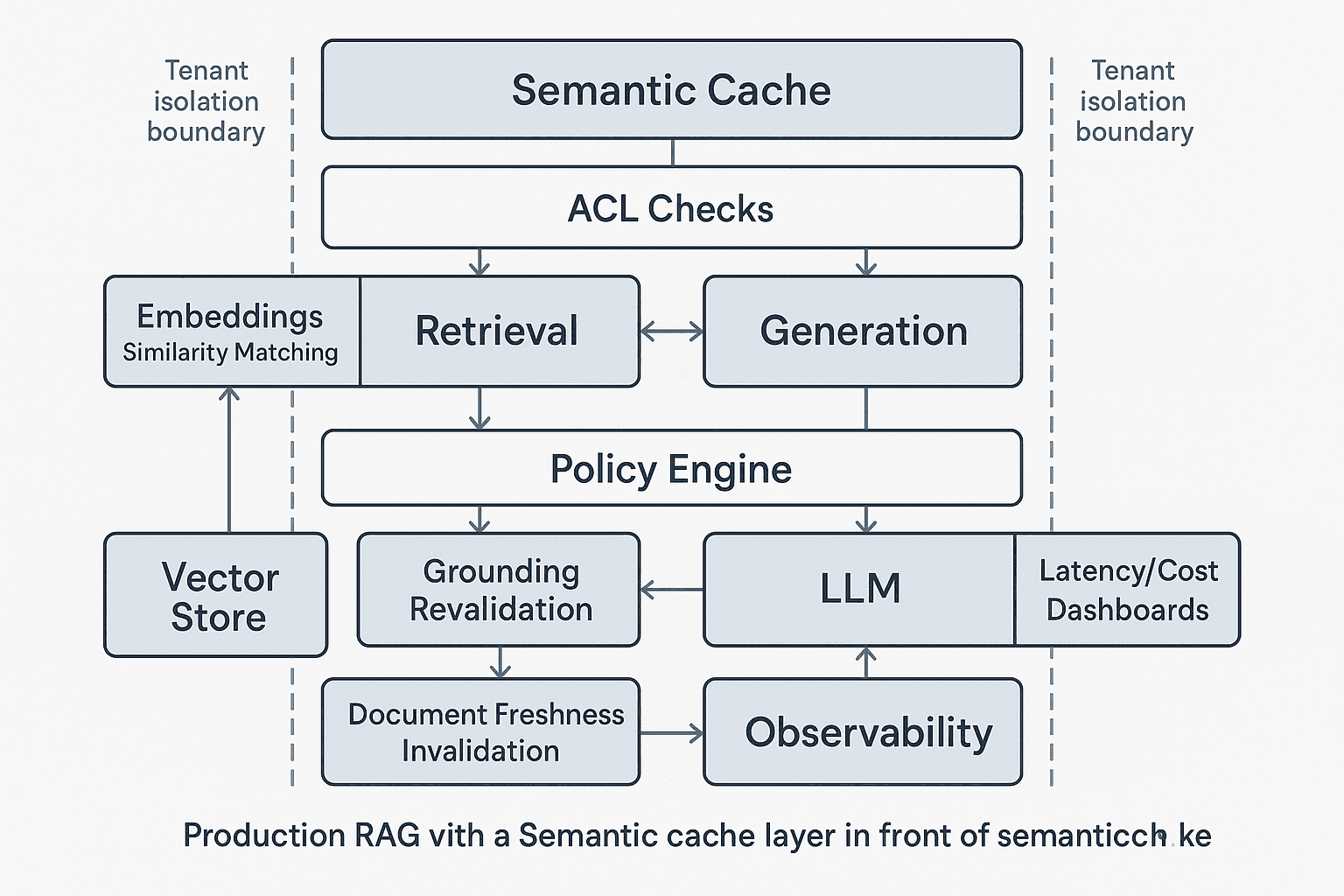
The architecture I recommend has three distinct cache layers and one decision layer.
Layer 1: Query understanding cache
Cache low-risk intermediate artifacts such as:
- query normalization
- query rewrite/paraphrase
- intent classification
- decomposition plans
- routing decisions
These are often cheap to validate and do not expose source content directly. Reusing them can cut latency without reusing a potentially stale final answer.
Layer 2: Retrieval artifact cache
Cache retrieval-side outputs such as:
- filtered search queries
- vector search results IDs
- hybrid retrieval result sets
- reranked document IDs and scores
- extracted snippets
This is often the highest-leverage and safest cache in RAG. If a semantically similar query arrives from a user with equivalent access context, reusing candidate document IDs or reranking features can save vector DB and reranker cost while still allowing fresh generation.
Layer 3: Final answer cache
Cache the final answer only when the answer is sufficiently generic, policy-stable, and replayable after revalidation. Every final answer entry should include:
- normalized question representation
- query embedding and maybe additional sparse terms
- tenant/security scope
- ACL scope fingerprint
- retrieval evidence IDs and versions
- answer text and citations
- prompt/template version
- model version
- generation policy flags
- creation time and freshness TTL
- confidence/risk metadata
Decision layer: cache hit policy engine
A semantic cache lookup should not immediately return content. It should return candidate entries that are scored by a policy engine using:
- semantic similarity
- scope compatibility
- ACL compatibility
- grounding validity
- freshness state
- answer-type risk
- model/prompt compatibility
- observed past quality for similar hits
The policy engine then decides one of four actions:
- Serve: low-risk hit, maybe with citation recheck only
- Serve with revalidation note/path: rare, usually for internal tools where latency matters and silent background refresh is acceptable
- Refresh from cached retrieval: reuse retrieval artifacts but regenerate answer
- Bypass cache: full retrieval + generation
This architecture sounds elaborate, but in practice it maps to modular services teams already have: auth service, retrieval service, LLM gateway, metadata store, and observability pipeline.
What to cache: final answers vs retrieval artifacts
The easiest way to reduce semantic cache risk is to cache fewer final answers and more intermediate artifacts.
When caching final answers makes sense
Final answer caching is effective for:
- public or organization-wide FAQs with stable canonical answers
- policy answers grounded in versioned documents with clear supersession rules
- repeated support questions where the answer is mostly templated
- low-personalization internal knowledge queries with broad readability
Examples:
- “How do I configure Okta SAML?”
- “What is the current PTO carryover rule?”
- “Where is the SOC 2 report stored?” if access is broadly shared
In these cases, answer reuse can significantly cut end-to-end latency because you avoid both retrieval and generation.
When caching retrieval artifacts is better
Retrieval artifact caching is preferable for:
- user-specific or role-specific answers
- corpora that change frequently
- answers generated from many dynamic snippets
- scenarios where grounding matters more than phrasing consistency
- workflows using strong answer synthesis or formatting steps
Examples:
- “Summarize open security exceptions for my team.”
- “What’s the status of this customer escalation?”
- “What does our MSA allow in this region?”
Here, reusing the document shortlist or reranked context is safer than replaying the prior answer.
Rule of thumb
If the expensive part is retrieval and the answer wording must be fresh, cache retrieval artifacts.
If the answer is stable, broadly shareable, and tied to versioned canonical content, consider caching final answers with revalidation.
If the answer depends on live tools, personalized data, or hidden state, do not cache the final answer unless you can separately validate every dependency.
Security: tenant and ACL isolation are table stakes
Cross-user leakage is the failure everyone remembers. Preventing it requires more than a namespace prefix.
Use multi-dimensional cache scoping
At minimum, every cache candidate should be constrained by:
tenant_id- environment or deployment region
- data residency boundary if relevant
- authz context fingerprint
- retrieval configuration version
- prompt/model policy version
The critical piece is the authorization fingerprint.
ACL fingerprinting strategy
Do not attempt to key the cache by raw user ID unless every answer is strictly personal. That destroys hit rate. Instead, fingerprint the effective access context in a way that safely groups equivalent users.
Possible inputs:
- role set
- group memberships
- project or workspace memberships
- data entitlements
- document collections allowed
- legal holds or region restrictions
Store an acl_fingerprint with the cache entry and require either:
- exact match, or
- a verified superset/subset rule depending on your access model
In practice, exact-match fingerprints are simplest and safest, but may lower hit rate. Some teams improve reuse by computing a visibility signature over the specific retrieved document set rather than the entire global permission graph.
For example, when caching a final answer based on document IDs [d1, d7, d9], store a compact proof that the original user could access those three docs. On replay, verify that the current user can also access all cited docs. This often preserves hit rate better than matching all permissions globally.
Never trust retrieval results alone for auth
If your vector store applies ACL filters during retrieval, that is good but not enough. A cached answer can outlive the original retrieval conditions. Always re-check access to cited evidence at serve time for final answer cache hits. If any cited doc is no longer authorized, demote the hit to regenerate or bypass.
Grounding revalidation: the antidote to drift
The biggest conceptual mistake teams make is treating a cached answer as the asset. In a RAG system, the real asset is the answer-evidence pair.
A final answer cache entry should therefore contain structured grounding metadata:
- cited document IDs
- chunk IDs or passage IDs
- document versions or content hashes
- snippet hashes if chunking can change independently
- retrieval scores and reranker scores
- answer spans mapped to citations if available
Before serving a semantic hit, run a grounding revalidation step.
Revalidation levels
Choose the cheapest sufficient level for the risk class.
Level 0: metadata-only checks
- Are all cited docs still present?
- Are versions/content hashes unchanged?
- Is the current user still authorized?
- Has the freshness TTL expired?
If yes, serve.
Level 1: retrieval consistency check
- Re-run retrieval or reranking cheaply
- Confirm the prior evidence docs remain in top-k or top-reranked set above minimum score
If yes, serve or regenerate from same evidence.
Level 2: answer support check
- Use an NLI/support model or LLM verifier to test whether the cached answer is supported by the currently retrieved evidence
If yes, serve. If not, regenerate.
Level 3: full regeneration
- Run full RAG pipeline
Not every query needs Level 2. But high-risk answers often do.
Versioning matters more than TTLs
TTLs alone are a blunt instrument. They help with freshness, but not with immediate invalidation after a document change. Better is to pair TTLs with version-aware invalidation.
Each cache entry should reference:
- corpus snapshot ID, or
- per-document version IDs / hashes, or
- collection-level generation counters
When source documents change, invalidate affected entries based on citation graph or collection membership. If exact invalidation is expensive, mark entries as “revalidate-on-read.” That gives you correctness without trying to instantly purge every derivative artifact.
Freshness invalidation in real systems
A production invalidation strategy usually combines four mechanisms.
1. TTL by content class
Use different TTLs for different domains:
- HR policy: hours to days if docs are versioned and rarely updated
- product docs: hours
- contracts: short TTL plus strict version checks
- ticket/project state: minutes or no final answer caching
- live metrics: no final answer caching
Do not use a single global TTL.
2. Event-driven invalidation
Emit invalidation events when:
- documents are created, updated, or deleted
- ACLs change
- collections are reindexed
- prompt or answer policy changes
- model versions change materially
Downstream, either hard-delete matching entries or mark them stale.
3. Dependency indexing
Maintain a reverse map from document IDs to cache entry IDs. When a document changes, you can identify impacted cached answers quickly. This can be stored in a side index keyed by doc ID.
4. Revalidate-on-read
For volatile corpora where eager invalidation is too expensive, mark entries as requiring metadata and authorization checks on access. This trades a small amount of lookup latency for significantly better correctness.
Cache hit risk scoring: the key control surface
You will not get safe behavior from similarity thresholding alone. You need a composite risk score.
A practical hit risk score can combine:
- semantic distance to nearest cached query
- margin over second-best candidate
- query intent class
- answer sensitivity class
- corpus volatility score
- ACL complexity score
- evidence age
- evidence version mismatch count
- whether all citations remain authorized
- retrieval consistency score
- prior acceptance or thumbs-up/down rate for similar hits
- whether tools or live data were involved
- model/prompt version skew
Then define policy bands such as:
- Low risk: serve final answer
- Medium risk: reuse retrieval artifacts, regenerate answer
- High risk: bypass cache
- Critical risk: bypass and log for review if there was a near-hit with security mismatch
This is where teams often ask whether they need an ML model just to decide cache hits. Usually no at first. A weighted heuristic score works well enough:
risk = w1*(1-similarity) + w2*freshness_penalty + w3*acl_penalty + w4*grounding_penalty + w5*volatility + w6*tool_penalty + ...
Start with rules, then graduate to learned policies once you have labeled outcomes.
Similarity thresholds: calibrate by class, not globally
A single cosine similarity threshold like 0.92 is attractive because it is simple. It is also almost always wrong.
Instead, define thresholds by query or answer class. Example:
- canonical FAQ: high recall acceptable, threshold 0.86
- procedural setup docs: 0.89
- policy/HR/legal answers: 0.94 plus revalidation
- personalized operational summaries: final answer caching disabled
Also consider using a two-stage match:
- embedding similarity for candidate generation
- cross-encoder or LLM pairwise equivalence check for top candidate
This often improves precision substantially for ambiguous near-neighbors. Yes, it adds a little latency, but far less than a full generation call.
What embeddings should you use?
Use the same family of embeddings you trust for semantic retrieval, but validate them for cache matching separately. Retrieval relevance and answer replayability are related, not identical.
In practice:
- Dense embeddings are fast and good for candidate generation.
- Sparse lexical features help preserve critical qualifiers like SKU names, policy terms, or clause labels.
- A hybrid score often works best for cache matching in enterprise domains.
You may also want a normalized query representation step that strips noise but preserves safety-critical qualifiers. For example, normalize date formatting and politeness, but do not collapse “reseller-managed” and “direct enterprise.”
Implementation details: data model and request flow
Here is a concrete shape for a final answer cache entry.
json{
  "cache_entry_id": "ce_123",
  "tenant_id": "t_42",
  "region": "us-east-1",
  "query_text_normalized": "what is our parental leave policy",
  "query_embedding": "...",
  "query_sparse_terms": ["parental", "leave", "policy"],
  "intent_class": "policy_lookup",
  "sensitivity_class": "medium",
  "acl_fingerprint": "acl_abcd",
  "retrieval_config_version": "r7",
  "prompt_version": "p19",
  "model_version": "gpt-x.y",
  "answer_text": "Employees receive ...",
  "citations": [
    {
      "doc_id": "doc_55",
      "chunk_id": "chunk_55_3",
      "doc_version": "v12",
      "content_hash": "h1"
    }
  ],
  "doc_dependency_ids": ["doc_55"],
  "corpus_snapshot": "cs_2026_07_29_10",
  "created_at": "2026-07-29T10:15:00Z",
  "ttl_expires_at": "2026-07-30T10:15:00Z",
  "tool_usage": [],
  "quality_signals": {
    "grounding_score": 0.97,
    "user_feedback": 0.92
  }
}
And a simplified request flow:
- Normalize query.
- Classify intent/sensitivity/cacheability.
- Compute query embedding.
- Retrieve top semantic cache candidates within tenant/region/security namespace.
- For each candidate, apply policy filters:
- prompt/model compatibility n - ACL compatibility
- TTL/freshness checks
- citation auth checks
- Compute risk score.
- If low risk, optionally run grounding metadata revalidation and serve.
- If medium risk, reuse retrieval artifacts if available and regenerate answer.
- If high risk or no candidate, run full retrieval + generation.
- Write back cache entry only if answer passes cacheability policy.
Cacheability policy at write time
A lot of safety comes from being selective about what enters the cache.
Do not cache final answers when:
- the answer includes user-specific identifiers or personalized results
- tools queried live mutable systems
- the retrieval evidence set is too broad or weakly supporting
- the answer required extensive reasoning over volatile content
- confidence or grounding score is low
- citations are missing or low quality
Do cache final answers when:
- evidence is narrow, explicit, and versioned
- the answer is generic within an authorized group
- the answer policy is stable
- citations are complete
- the domain has manageable freshness requirements
Evaluation strategy: treat the cache as a ranking and safety system
Most teams evaluate semantic caches only on hit rate and latency. That is incomplete and dangerous.
You need offline and online evaluation across at least six dimensions.
1. Hit precision
Of the cache hits you would have served, how many are actually acceptable compared with a fresh run?
Build a labeled set of query pairs and candidate cached answers. For each candidate, label:
- equivalent and safe to serve
- equivalent only after revalidation
- not equivalent
- unauthorized
- stale/ungrounded
This becomes your precision-at-threshold dataset.
2. Grounding preservation
For final answer hits, measure:
- citation validity rate
- citation authorization validity rate
- support score against current evidence
- rate of grounding drift over time
A cache hit that sounds right but is unsupported should count as a failure even if users do not notice.
3. Security isolation
Construct adversarial evaluation sets where similar queries span:
- different tenants
- different ACL groups in same tenant
- recently revoked access
- collections with overlapping terminology but distinct entitlements
Your goal is effectively zero unauthorized serves. Treat near-miss matches with auth failures as high-priority alerts.
4. Freshness behavior
Replay document update streams and measure:
- stale serve rate after source mutation
- time to effective invalidation
- success rate of revalidate-on-read
- percentage of regenerated answers after invalidation
5. Cost and latency impact
Break down savings by layer:
- query understanding cache hit rate
- retrieval artifact cache hit rate
- final answer cache hit rate
- average tokens saved
- vector DB queries saved
- reranker calls saved
- p50/p95 latency improvement
This matters because final answer caching is not always where the ROI is. Often retrieval artifact caching provides most of the savings with less risk.
6. User outcome metrics
Track downstream effects:
- helpfulness rating by source of answer (fresh vs cached)
- escalation rate
- correction/regeneration rate
- citation click-through rate
- abandonment after cached response
If hit rate goes up while trust goes down, the cache is not helping.
Observability: what to log and dashboard
A semantic cache should be observable like a recommender or retrieval system.
For every request, log:
- cache lookup attempted?
- candidate IDs and similarity scores
- threshold and policy version used
- selected action: serve / regenerate / bypass
- risk score and component breakdown
- ACL check result
- citation auth check result
- freshness/version check result
- retrieval consistency check result
- latency by stage
- token and model cost saved or spent
- user feedback outcome if available
Useful dashboards:
- hit rate by intent class
- serve rate by risk band
- stale-hit prevention rate
- unauthorized-hit prevention rate
- regeneration-after-hit rate
- latency saved by cache layer
- cost saved by cache layer
- drift incidents over time
- model/prompt skew effects on hit quality
Useful alerts:
- any unauthorized serve event
- spike in stale-hit prevention or grounding failures
- hit precision drop after embedding/model upgrade
- unusual concentration of hits from one cache entry
- cache layer latency approaching fresh-path latency
Model and tool comparisons: where to spend and save
The main tradeoff is not just “cache or no cache.” It is what kind of model or tool you use for each decision.
Embedding model for candidate generation
Requirements:
- cheap
- low latency
- stable enough across versions
- good semantic recall in your domain
This is usually a small-to-medium embedding model. Re-embed historical cache entries carefully when changing embedding models; mixed embedding spaces can silently degrade matches.
Cross-encoder or reranker for equivalence filtering
Requirements:
- better precision than embeddings alone
- acceptable additional latency for top-N candidates
A small reranker model often gives a strong precision boost for cache candidate selection, especially where wording is similar but qualifiers matter.
LLM verifier for grounding support
Requirements:
- only used on medium/high-risk final answer hit candidates
- prompted to judge support, not rewrite answer
This is a good place for a smaller, cheaper model if the task is constrained. You do not need your most expensive generator model to check whether cited passages still support the answer.
Generator model
If the cache causes frequent regenerations from retrieval artifacts, you can often pair that with a smaller generation model for low-risk procedural answers and reserve the expensive model for harder cases. Semantic caching and model routing work well together.
Cost/latency guidance
A common sweet spot looks like this:
- cheap embedding lookup for all requests
- lightweight rules for most cache bypass decisions
- optional reranker for top 5-20 candidates
- metadata-only revalidation for low-risk hits
- LLM support verifier only for medium-risk, high-value domains
- full generation only when needed
The mistake is using a verifier on every request and eating the savings, or using no verifier where the domain clearly requires one.
Practical tradeoffs and failure-containment patterns
Some battle-tested patterns:
Prefer conservative serve policies at launch
At first, optimize for precision over hit rate. A semantic cache that serves fewer but safer hits is much easier to expand than one that ships security or stale-content incidents.
Segment by domain early
Do not launch one global cache policy. Segment by:
- policy/HR/legal
- product docs
- support runbooks
- customer-specific contracts
- operational/ticketing data
Each domain gets its own cacheability policy, TTLs, and thresholds.
Add explicit “non-cacheable” labels upstream
Let retrievers, tools, or answer templates mark outputs as non-cacheable. For example, if a tool call hits live CRM data, that should flow through as a no-cache constraint on final answers.
Keep evidence with the cache entry
Do not just store the answer blob. Store evidence identifiers and enough metadata to cheaply verify support. This is what makes safe replay feasible.
Make bypass cheap operationally
If your bypass path is slow or flaky, teams will be tempted to loosen cache policies. Invest in the fresh path too. Safe cache systems rely on graceful fallback.
Plan for model and prompt churn
Semantic cache quality often drops after changing:
- embedding model
- query normalization logic
- retriever config
- prompt template
- generator model
Version everything and consider compatibility windows rather than assuming old cache entries remain equally good.
A concrete rollout plan
If I were implementing this from scratch for a production RAG system, I would phase it in like this.
Phase 1: Retrieval artifact caching only
- Cache query normalization, routing, and retrieval results.
- Scope by tenant and retrieval filters.
- No final answer cache yet.
- Measure latency and cost savings.
This gets safe wins quickly.
Phase 2: Final answer caching for low-risk domains
- Restrict to canonical FAQ-like answers.
- Require citations and document version metadata.
- Revalidate auth and doc versions on read.
- Use conservative thresholds.
Phase 3: Introduce risk scoring and segmented policies
- Add intent/sensitivity classification.
- Different thresholds by domain.
- Add retrieval consistency checks for medium-risk classes.
Phase 4: Event-driven invalidation and dependency graph
- Reverse index from docs to cache entries.
- Invalidate or mark stale on content or ACL changes.
Phase 5: Verifier models and learned policy tuning
- Use a verifier for support checks where needed.
- Learn better risk weights from labeled serve outcomes.
This sequence gives teams time to build trust in the system rather than betting everything on final-answer replay from day one.
What engineering leaders should insist on
If you are reviewing a proposal for semantic caching in a RAG product, ask these questions:
- What exactly are we caching: final answers, retrieval artifacts, or both?
- How is tenant isolation enforced?
- How is document-level authorization rechecked on replay?
- What metadata is stored to prove grounding?
- How are source changes invalidating or revalidating cache entries?
- Which domains are allowed to serve final answer hits?
- What is the risk score and who owns its thresholds?
- What is the stale or unauthorized serve SLO?
- What observability tells us the cache is helping rather than harming?
- How do prompt/model/retriever changes affect compatibility with cached entries?
If the answer to most of these is “we’ll just set a high similarity threshold,” the design is not ready.
The takeaway
Semantic caching in RAG can absolutely reduce cost and latency. But it is not a generic nearest-neighbor trick. It is a controlled replay system operating over answers whose correctness depends on authorization, evidence, time, and configuration.
The naive design caches final answers by embedding similarity and calls it done. That is how you get cross-user leakage, stale policies, and plausible but ungrounded responses.
The production design is layered and selective. Cache intermediate artifacts aggressively. Cache final answers sparingly. Treat every semantic hit as a candidate that must survive scope checks, ACL checks, freshness checks, and grounding revalidation. Use risk scoring instead of a single threshold. Instrument the whole thing like a ranking and safety pipeline. And phase it in conservatively, starting where replayability is strongest.
If you do that, semantic caching becomes one of the few RAG optimizations that can improve both user experience and infrastructure efficiency at the same time. If you do not, it becomes a fast path to serving the wrong answer quickly, confidently, and at scale.