Designing Policy-as-Code Guardrails for Production GenAI: Enforcing Safety, Compliance, and Action Limits at Runtime
A team ships a customer-support copilot that can search knowledge bases, draft refund emails, open CRM cases, and trigger account actions through internal tools. In staging, it looks solid. The prompts are careful. The system message says not to reveal secrets, not to exceed refund limits, and to ask for manager approval before risky actions. Product is happy.
Three weeks into production, the first incident arrives.
A user pastes a long complaint thread that includes another customer’s forwarded email chain. The retriever pulls a policy document and a cached ticket summary from the wrong region because the indexing pipeline tagged jurisdiction inconsistently. The model drafts a response that quotes personal data it should never have surfaced. Then, in a separate interaction, an agent asks the copilot to “make it right,” and the model proposes a refund larger than the frontline support limit. It does not actually call the refund tool, but the suggestion itself is enough to create operational confusion because agents start assuming the AI can authorize exceptions. A month later, a red-team exercise shows something worse: by phrasing a request as an “audit simulation,” a user can reliably coax the model to emit policy-sensitive internal guidance that the prompt explicitly forbids.
None of these failures came from a single catastrophic bug. They came from a familiar production misconception: treating safety and compliance as prompt-writing problems.
That works until it doesn’t. Prompt instructions are not enforcement. They are hints delivered to a stochastic system competing with user input, retrieved context, prior conversation, and latent model behavior. If the thing you need is “never call this tool without approval,” “never reveal data across tenants,” or “never send funds above this threshold without two-step review,” then you do not have a prompting problem. You have a control-plane problem.
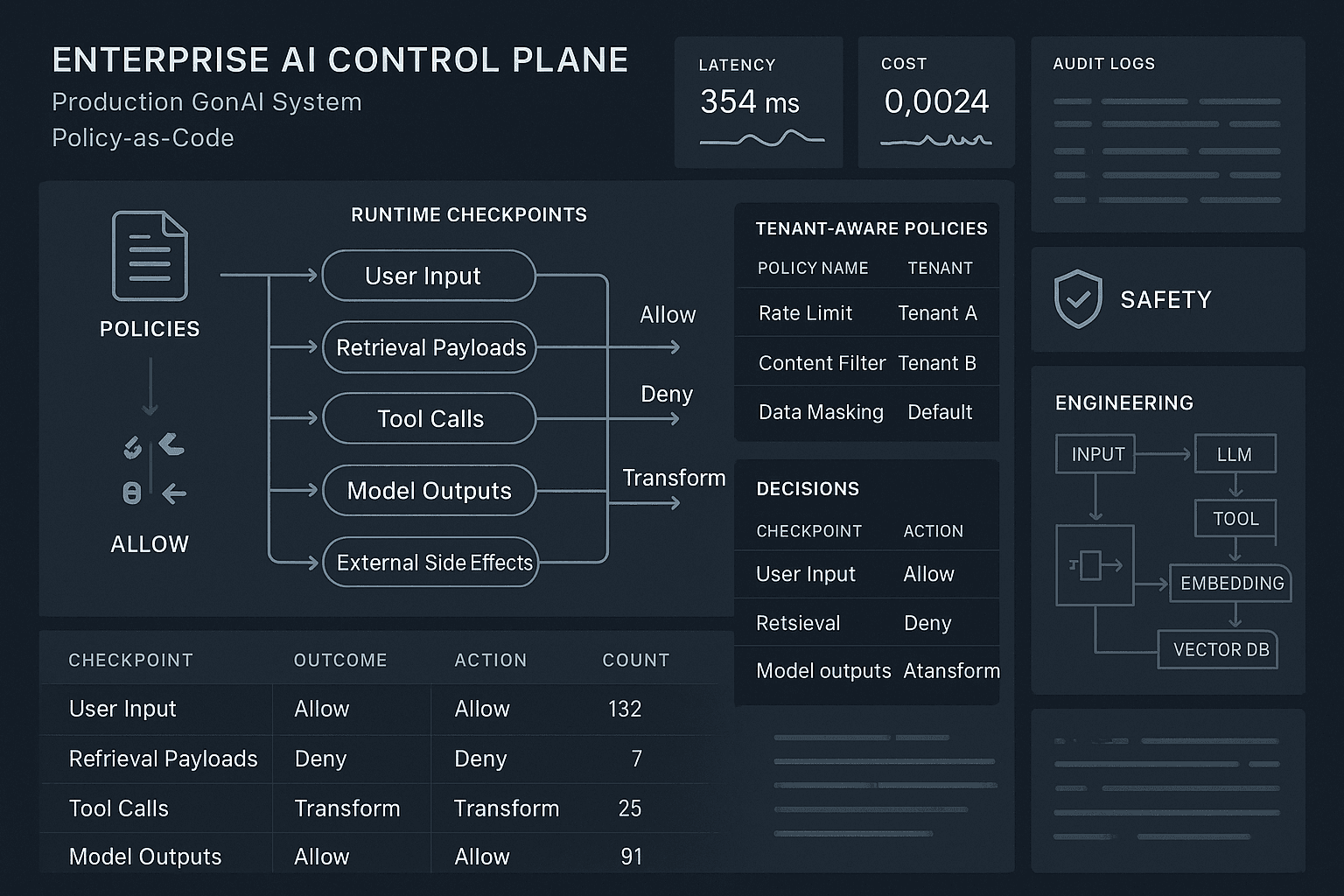
This is where policy-as-code guardrails matter. Instead of burying critical constraints in prompts, you define executable policies that run at specific points in the application lifecycle: before a model sees the input, after retrieval, before a tool call executes, after the model drafts an answer, before approval-required actions, and before side effects reach external systems. Policies can allow, deny, request approval, or transform data. They can be tenant-aware, role-aware, region-aware, and action-aware. They can be tested offline, versioned, audited, and rolled out gradually like any other production control.
That shift sounds obvious once stated. In practice, many teams still implement “guardrails” as a mix of prompt templates, regex filters, and an ad hoc moderation endpoint added late in the request path. The result is a brittle system that blocks benign traffic, misses high-risk flows, creates unexplained latency, and slowly loses developer trust.
The production challenge is not simply adding more checks. It is designing a policy architecture that enforces real constraints at runtime without quietly destroying answer quality, throughput, and engineering velocity.
The pattern behind most GenAI control failures
When production GenAI systems fail on safety or compliance, the root causes cluster into a few repeatable patterns.
First, teams collapse all controls into one stage: “screen the prompt” or “screen the final answer.” But risk enters and exits the system at multiple boundaries:
- User input may contain prohibited requests, secrets, prompt injections, or regulated data.
- Retrieved context may contain stale, over-broad, or cross-tenant information.
- Tool arguments may exceed action limits or target the wrong account.
- Model output may reveal hidden chain-of-thought-like internals, sensitive excerpts, or instructions that violate policy.
- Side effects may create tickets, refunds, messages, code changes, purchases, or account updates that require stronger controls than text generation alone.
Second, teams confuse classification with enforcement. A moderation model can say “high risk,” but unless the application knows what to do next—block, redact, downgrade capabilities, require approval, or route to a specialist queue—the signal is operationally useless.
Third, they treat policy as static. Real organizations need context-aware decisions: one tenant allows customer-email drafting but not autonomous sends; one geography requires PII masking before model exposure; one user role can view legal templates but not execute account changes; one model is approved for summarization but not medical answer generation.
Fourth, they fail to separate content risk from action risk. A model may be allowed to discuss a refund policy but not authorized to execute a refund above a threshold. It may summarize legal language but not provide final legal advice. It may draft code but not merge to production. This distinction matters because pure content moderation often misses the operational danger: the expensive or irreversible side effect.
Finally, teams underinvest in evaluation. They verify that obvious disallowed prompts get blocked, but they do not test retrieval poisoning, argument overreach, policy precedence conflicts, false positives on routine support traffic, or the way guardrails affect quality and latency under realistic load.
The result is a system with hidden coupling between safety controls and product behavior. A retrieval redaction rule silently removes context quality. A moderation call adds 700 ms p95 latency. A deny rule causes the assistant to become evasive in harmless cases. A too-coarse transform rewrites user inputs and confuses the model. Developers start bypassing the policy path in internal features “temporarily,” and the control plane decays.
Why the naive approach fails
The naive production architecture usually looks like this:
- Add strong system prompts.
- Add a moderation API call on user input.
- Maybe scan output with regexes for banned phrases or PII.
- Hope tool use behaves because the prompt says to ask permission.
This fails for structural reasons.
Prompts are advisory, not authoritative
A prompt can influence model behavior, but it cannot enforce organization-level invariants. If the assistant must never expose cross-tenant data, the only reliable solution is to ensure cross-tenant data never enters the model context and never exits approved channels. Likewise, if refunds above $100 require approval, that check belongs in the tool execution path, not in the text generation prompt.
Single-stage moderation misses the real attack surface
Many high-severity failures are not in the raw user text. They appear in:
- Retrieved passages injected into context
- Tool arguments inferred by the model
- Output assembled from hidden application data
- Action requests generated after a long conversation
You can moderate the user’s prompt perfectly and still leak the wrong document or execute the wrong operation.
Regexes and brittle filters create false confidence
Simple filters catch low-effort violations and miss everything nuanced. They also produce perverse incentives. Teams start tuning prompts to avoid the filter instead of solving the policy issue, or they overblock normal language and damage product quality.
Hardcoded guardrails don’t survive scale
Once you have multiple products, tenants, regions, models, and tools, hardcoded if/else logic spreads across services. No one knows the effective policy. Changes become dangerous. Audit requests become painful. Every launch requires engineering archaeology.
Safety controls compete with performance budgets
A stack of uncoordinated checks can add seconds. If every stage calls a separate LLM-based classifier, plus a DLP service, plus custom rule engines, plus audit persistence, you blow your latency budget. Teams then start disabling controls on “trusted” paths without a principled risk model.
The fix is not more scattered checks. It is a deliberate runtime policy architecture.
A better approach: guardrails as a policy decision layer
A production-grade GenAI system benefits from treating guardrails as a control plane with explicit policy decision points.
Think in terms borrowed from zero-trust security and API gateways.
- Policy Enforcement Points (PEPs): Places where the app must ask, “Is this allowed, denied, transformed, or approval-gated?”
- Policy Decision Point (PDP): The service or engine that evaluates policy based on facts and returns a decision.
- Policy Information Point (PIP): Sources of facts needed for decisions: tenant config, user role, region, data classification, tool metadata, model risk tier, current session state.
- Audit Log / Evidence Store: Structured records of what was checked, what facts were used, what decision was made, and what action was taken.
In GenAI, the main PEPs typically are:
- Input ingress – user message, uploaded file, API request, agent instruction.
- Retrieval egress – documents or snippets selected for model context.
- Prompt assembly – final context package before model invocation.
- Tool invocation – function name, arguments, confidence, target entity, estimated blast radius.
- Model output – final user-visible response or machine-consumable structure.
- Approval checkpoint – workflows that need human or secondary-system signoff.
- Side-effect execution – actual write to CRM, email send, refund issue, repo merge, order place.
At each point, policy can return one of a small number of standardized actions:
- allow – proceed unchanged
- deny – block and provide reason / fallback
- transform – redact, mask, narrow, sanitize, or rewrite structured arguments
- challenge – require additional authentication, confirmation, or user clarification
- escalate – send to human review or specialist queue
- approve_required – create approval task and pause execution
- degrade – reduce capabilities, switch to retrieval-only mode, disable tools, or route to a safer model
This model is powerful because it separates decision logic from application flow while keeping enough structure to be testable and observable.
The reference architecture
A practical architecture for policy-as-code guardrails in production often looks like this:
1. Orchestrator
The application or agent runtime coordinates the request lifecycle:
- receives input
- fetches relevant context
- calls models
- interprets tool calls
- manages session state
- invokes policy checks at every PEP
This can live in your backend, your agent framework, or a dedicated orchestration service. The key is that policy checks are explicit and mandatory, not optional helper calls.
2. Policy engine
Use a real policy engine or build one with policy-like semantics. Common choices include:
- OPA/Rego for deterministic rule evaluation
- Cedar if you want expressive authorization-style policies with principal/resource/action semantics
- Custom DSL / YAML policies if you need simpler operator-friendly configuration
- Hybrid: deterministic policy engine plus classifier/model signals as facts
My bias in production: keep the final decision deterministic whenever possible. Use models for labeling or risk scoring, not for the actual allow/deny semantics unless the use case truly demands fuzzy judgment.
3. Risk signal services
These provide facts to the policy engine:
- PII and DLP detectors
- prompt injection detectors
- jailbreak heuristics
- document sensitivity classifiers
- toxicity/abuse classifiers
- action-risk scorers
- account trust or fraud signals
- tenant configuration and compliance metadata
Not every signal must be model-based. Fast deterministic checks do a lot of work.
4. Capability registry
Every model, tool, and action should have metadata:
- risk tier
- allowed tenants / regions
- supported data classes
- max action scope
- approval thresholds
- latency/cost profile
- fallback options
Without a capability registry, policies become hardcoded against raw tool names and model IDs.
5. Approval service
For workflows like large refunds, outbound messaging, privileged code changes, or regulated document generation, integrate with an approval system. Don’t fake this in prompts. Policies should be able to pause execution and create an approval artifact with relevant context.
6. Audit and observability pipeline
Store structured events for every policy decision:
- request ID, tenant, user role
- PEP stage
- input facts and redacted evidence
- matched rules and policy version
- allow/deny/transform decision
- resulting action and downstream effect
- latency contribution per policy component
This is essential not just for compliance, but for debugging quality regressions.
What to enforce at each runtime checkpoint
The biggest mistake teams make is applying the same style of control everywhere. Different stages need different rules.
1) Input guardrails
The goal here is not to solve everything at ingress. It is to classify the request, reject obviously disallowed content, and derive facts for later steps.
Typical checks:
- tenant and user authentication state
- role-based capability access
- request type classification
- PII/secrets detection in uploaded or pasted content
- prompt injection cues in user-supplied instructions or files
- prohibited topic screening when required
- jurisdiction or business-unit context derivation
Typical actions:
- deny direct requests for disallowed categories
- transform by masking detected secrets before model exposure
- degrade to “answer-only, no tools” mode for suspicious prompts
- challenge by asking for a narrower request or explicit confirmation
Example policy:
- If user role = contractor and uploaded file classification = internal-confidential, deny model exposure and route to approved search-only workflow.
- If tenant = healthcare and input contains probable PHI, only allow models in approved HIPAA environment and force transcript retention off.
2) Retrieval payload guardrails
This stage is underbuilt in many systems and is one of the highest-value controls.
Retrieved documents are not inherently safe just because they came from “your system.” They may be stale, misclassified, cross-tenant, over-scoped, or maliciously injected.
Typical checks:
- tenant boundary and ACL verification per document/chunk
- region/jurisdiction consistency
- data classification checks before inclusion in prompt
- relevance and minimality constraints
- source freshness/version requirements
- anti-poisoning heuristics for unusual source trust patterns
- snippet-level redaction for PII or secrets
Typical actions:
- deny inclusion of documents that fail access or region checks
- transform by redacting sensitive fields from snippets
- narrow top-k or source domains for high-risk tasks
- escalate if retrieval result set indicates data-governance inconsistency
This is also where “least privilege context” matters. If the user asks about refund policy, the model does not need a customer’s raw billing record unless the task truly requires it.
3) Prompt assembly guardrails
Before sending the final prompt to the model, validate the assembled context package:
- total token budget by data sensitivity class
- prohibited combinations of data types in one context window
- allowed system instructions for this tenant/use case
- model selection versus content classification
- max conversation history depth for high-risk contexts
Typical action:
- transform by dropping low-value context first, not high-value policy instructions
- switch to a safer model or smaller capability set if context contains sensitive classes
A common production issue is that prompt assembly quietly drifts as developers add more context sources. This stage catches that drift.
4) Tool argument guardrails
This is where text safety becomes operational safety.
Every tool call should be treated like an API request from an untrusted planner.
Checks should include:
- tool permission for user, tenant, and environment
- argument schema validation
- entity ownership verification
- max refund/payment/action amount
- dangerous parameter combinations
- idempotency requirements
- rate/volume limits
- confidence thresholds or evidence requirements
- out-of-band approval thresholds
Typical actions:
- deny if arguments exceed authority
- transform by clamping amount or removing unsupported fields
- challenge by asking the model or user to supply missing identifiers
- require approval for high-value or irreversible actions
If you do nothing else, do this well. A model may hallucinate arguments, infer the wrong account, or overgeneralize authority. Tool execution must never trust the model’s implied permissions.
5) Output guardrails
Output checks matter, but they should be specific and scoped.
Checks may include:
- disallowed content categories
- sensitive data leakage detection
- unsupported legal/medical/financial advice markers
- citation presence or provenance requirements
- policy-conformant refusal style
- structured output schema validation
Typical actions:
- transform by masking leaked values
- deny and regenerate with reduced context or stricter template
- degrade by returning retrieval-backed answer only
Be careful here: output filters are where teams often overblock and wreck UX. If the output stage becomes your main safety mechanism, you are usually compensating for weak controls upstream.
6) Approval and side-effect guardrails
For nontrivial actions, separate “the model proposed it” from “the system executed it.”
Policies here should inspect:
- action class and blast radius
- financial thresholds
- external communication target
- environment (sandbox/staging/prod)
- prior approvals or dual-control requirements
- temporal rules (e.g., no overnight deploys)
- anomaly signals compared to normal operator behavior
The execution service should verify the approval artifact and policy version before committing the side effect.
That last point matters. Otherwise, you can approve one thing and execute another after context drift.
Deny, allow, and transform: why transform is underrated
Most guardrail discussions focus on allow/deny. In production, transform is often the best control because it preserves utility.
Examples:
- Mask account numbers before prompt exposure.
- Replace exact birthdate with age band.
- Strip system-prompt-looking text from a retrieved HTML artifact.
- Narrow tool arguments to the authorized account only.
- Reduce retrieved snippets to relevant paragraphs instead of dropping the source entirely.
- Replace a risky action with a draft requiring human send.
Transform is powerful because it turns policy from a blunt blocker into a shaping layer. But it needs care:
- Transforms must be deterministic and auditable.
- The model should know enough about what changed to stay coherent.
- You need evals to ensure transformed inputs still support task success.
Tenant-aware and context-aware policy design
Most enterprise GenAI systems are multitenant and multi-context by default. If your policy framework cannot express this cleanly, it will collapse into conditionals.
The effective decision should depend on facts like:
- tenant contract / feature flags
- jurisdiction and data residency
- user role and training level
- interaction channel (internal, external, API, email)
- model risk tier
- tool blast radius
- source document classification
- current workflow state
- customer segment or account trust
A useful policy shape looks like this conceptually:
- principal: who is asking or acting
- resource: what data, tool, or target entity is involved
- action: read, summarize, draft, send, refund, modify, approve
- context: tenant, region, risk score, channel, model, session state
Then define policy in terms of these abstractions, not application-specific one-offs.
For example:
- Support agents may draft outbound email for customers in their region using approved templates, but autonomous send requires supervisor approval when sentiment = escalated or compensation_amount > 0.
- Retrieval from legal repository is allowed for summarization, but the final answer must include citations and cannot be presented as legal advice to external users.
- A lower-cost model is permitted for ticket triage but not for claims adjudication where structured extraction accuracy and audit requirements are stricter.
Model and tool comparisons: where to use deterministic rules vs models
Guardrail stacks tend to become expensive because teams use LLMs for every check. Resist that unless necessary.
A practical split:
Use deterministic rules for:
- access control and tenant boundaries
- region/data residency checks
- tool authorization and action thresholds
- schema validation
- approval requirements
- exact-match secret patterns
- environment restrictions
- policy precedence
These are crisp, explainable, low latency, and auditable.
Use smaller classifiers or specialized models for:
- PII/PHI detection where patterns alone underperform
- prompt injection detection
- document sensitivity classification
- harmful content categories with nuanced language
- anomaly/risk scoring on tool requests
Prefer smaller, cheaper models or fine-tuned classifiers here. They are faster and easier to benchmark than full LLM judges.
Use LLMs carefully for:
- semantic redaction suggestions in messy documents
- nuanced policy labeling where deterministic signals are insufficient
- fallback explanation generation after a policy deny
- high-recall offline review of policy blind spots
I generally avoid using a frontier LLM as the final online policy arbiter for allow/deny. It is expensive, slower, and less stable over time. Better to use the LLM to produce a structured risk assessment that deterministic policy then interprets.
Cost and latency tradeoffs
Production teams often discover too late that guardrails cost nearly as much as generation.
Common sources of overhead:
- multiple serial classifier calls
- repeated DLP scans of the same text at different stages
- heavyweight output review on every low-risk response
- synchronous audit writes in the request path
- policy engines fetching remote facts one by one
A few battle-tested patterns help.
Risk-tier the request path
Not every request needs every check. Define low, medium, and high-risk lanes.
- Low risk: internal summarization of user-owned docs, no tools, approved model
- Medium risk: retrieval over mixed enterprise corpus, user-visible answer
- High risk: external communication, financial action, regulated content, privileged tools
Then apply deeper checks only where justified.
Cache and reuse facts
If you already classified a document chunk as confidential and region=EU during indexing, reuse that metadata at retrieval time instead of rescanning raw text.
Push checks earlier in the data lifecycle
Classify documents on ingestion. Register tool limits in metadata. Derive tenant policy bundles ahead of runtime. Cheap runtime decisions depend on rich precomputed facts.
Parallelize independent checks
Input DLP, role lookup, tenant feature resolution, and basic jailbreak heuristics can often run in parallel. Do not serialize what doesn’t need serialization.
Separate user-facing latency from asynchronous evidence capture
The decision itself must be recorded reliably, but full evidence packaging and analytics pipelines can often run async after the response path commits the minimal required audit event.
Degrade capabilities instead of blocking entire requests
If a prompt injection detector is uncertain, you may disable tool use but still allow retrieval-backed Q&A. That preserves utility without taking the highest-risk path.
Implementation details: a concrete runtime flow
Here is a practical flow for a production copilot request.
-
Ingress
- Request arrives with tenant, user, session, channel metadata.
- Orchestrator asks PDP for input policy decision with derived facts and raw content hashes.
- PDP returns allow + transform(mask secret) + capability_mode=no-write-tools.
-
Retrieval
- Retriever fetches candidate chunks.
- For each chunk, enforce ACL, tenant, region, and classification filters before ranking.
- Apply snippet redactions where policy demands.
- If too few compliant chunks remain, return a policy-aware fallback rather than silently using noncompliant ones.
-
Prompt assembly
- Build context with only approved chunks and system instructions for this use case.
- Check model suitability: if sensitive data class present, route to approved model endpoint.
-
Model generation / tool planning
- Ask the model for either answer text or structured tool intent.
- Treat tool intent as untrusted proposed action.
-
Tool check
- Validate tool name, arguments, user authority, entity ownership, thresholds, and approval requirement.
- If over limit, PDP returns approve_required with exact scope and reason.
-
Approval workflow
- Create approval artifact with frozen arguments, policy version, evidence, and expiration.
- On approval, execution service revalidates artifact integrity and current environment policy compatibility.
-
Output review
- For user-visible responses, run scoped checks for leakage and policy-required disclaimers/citations.
- If failed, either transform or regenerate under stricter constraints.
-
Side-effect execution
- Execute only through a controlled service, never directly from model output.
- Record final action outcome linked to all preceding policy events.
-
Audit / analytics
- Emit structured telemetry: which rules fired, what transforms applied, latency by stage, downstream success/failure.
This sounds like extra plumbing because it is. But if your product can send emails, move money, change records, or expose sensitive data, that plumbing is the product.
Offline policy testing: where mature teams pull ahead
Prompt-based guardrails are hard to test systematically. Policy-as-code is testable if you treat policies like software.
You want at least four layers of evaluation.
1. Unit tests for policy semantics
Given facts X, the PDP should return decision Y.
Examples:
- refund amount 50, agent tier 1 => allow
- refund amount 250, agent tier 1 => approve_required
- retrieval chunk tenant mismatch => deny
- PHI present and noncompliant model endpoint => deny or reroute
These tests catch precedence bugs and regressions quickly.
2. Scenario tests for end-to-end workflows
Simulate complete interactions with retrieval, model planning, tools, and approvals.
Examples:
- cross-tenant document accidentally retrieved
- user asks model to “simulate” a prohibited operation
- model proposes tool args with wrong customer ID
- approval granted for old arguments after conversation changed
The point is to verify the control plane, not just individual rules.
3. Adversarial and red-team datasets
Build corpora for:
- jailbreak attempts
- prompt injection hidden in retrieved docs
- subtle policy-sensitive leakage requests
- malformed or overbroad tool arguments
- benign traffic likely to trigger false positives
Track both security metrics and product metrics. A great deny rate is not useful if normal customer-support cases become unusable.
4. Shadow evaluation in production
Run new policies in report-only mode first.
Measure:
- what would have been denied/transformed
- false positive samples by team and tenant
- latency delta by path
- downstream success impact: answer acceptance, task completion, escalation rate
This is one of the most important rollout practices. Many good-intentioned guardrails fail not because they are unsafe, but because they are operationally clumsy.
Metrics that actually matter
Don’t stop at “blocked 98% of red-team prompts.” Track guardrails as part of system quality.
Recommended metrics:
Safety/compliance
- policy violation escape rate
- high-severity side-effect prevention rate
- approval bypass rate
- cross-tenant/context leakage incidents
- sensitive-data exposure rate by stage
Quality
- task success rate with guardrails on vs off
- answer helpfulness delta after transforms
- citation/provenance compliance rate
- human escalation rate and resolution quality
Efficiency
- p50/p95 latency contribution per PEP
- cost per request by risk lane
- percent of requests requiring expensive model-based checks
- cache hit rate for policy facts
Developer velocity
- time to ship policy change
- number of application services embedding duplicated policy logic
- percentage of policies covered by unit/scenario tests
- policy rollback/override frequency
If you are not measuring quality and efficiency alongside safety, your controls will degrade the product invisibly.
Keeping policy from becoming a developer tax
Guardrails fail culturally when they become a mysterious platform tax. Developers bypass them because they slow iteration or behave unpredictably.
A few practical patterns help:
Make policy integration opinionated and easy
Provide SDK wrappers or middleware so that tool registration, model invocation, retrieval filtering, and audit emission automatically go through PEPs. If engineers need five manual steps to adopt guardrails, many won’t.
Keep policy authoring separate from application deploys when possible
Versioned policy bundles with staged rollout let safety/compliance teams move faster without asking every product team for code changes.
Return explainable decisions
A deny should come with machine-readable reasons and developer-friendly debugging info. “Blocked by policy” is not enough. Teams need to know whether the issue was ACL mismatch, tool threshold breach, unsupported data class, or malformed arguments.
Prefer capability degradation over hard failure where possible
Developers and users tolerate “tool use disabled for this request” better than random total refusal. The system should fail soft when the risk model allows it.
Build policy diffing and simulation tools
Before rollout, teams should be able to ask: which traffic would this new rule affect, by tenant, by stage, and by severity? This is the difference between disciplined change management and fear-driven stagnation.
Common failure modes even with policy-as-code
Policy-as-code is not magic. I keep seeing a few recurring mistakes.
Overcentralized, under-modeled policy
One giant ruleset becomes unreadable. Break policies into domains: data access, model routing, tool authorization, approval rules, output requirements.
No clear precedence model
What wins if one rule allows and another transforms or denies? Define precedence explicitly. In most systems: deny > approve_required > transform > allow.
Transform drift
Teams add redaction/transformation logic without measuring answer degradation. Eventually the model becomes unhelpful because context quality collapsed.
Weak identity propagation
If tenant, user role, channel, and workflow state do not propagate reliably across orchestrator, retriever, model runtime, and tool executor, policy decisions become inconsistent. Identity and context propagation are foundational.
Missing execution revalidation
A tool call can be approved under one state and executed later under another. Revalidate before side effects.
Treating audit as an afterthought
If you cannot reconstruct why an action happened, your controls are incomplete, no matter how many classifiers you run.
A realistic rollout path
If your current system relies mostly on prompts, don’t try to boil the ocean. Roll out in stages.
Phase 1: Protect side effects
- Put all tool execution behind a policy-enforced gateway.
- Add schema validation, entity ownership checks, thresholds, and approvals.
- Separate draft vs execute permissions.
This often removes the highest operational risk quickly.
Phase 2: Fix retrieval governance
- Enforce ACL and tenant/region checks on retrieved chunks.
- Add document classification metadata to your index.
- Implement minimality and redaction rules for prompt context.
This addresses many data leakage paths.
Phase 3: Add model/input/output policies
- Introduce request risk lanes.
- Add model routing based on data class and task.
- Apply targeted output checks only where needed.
Phase 4: Mature testing and observability
- Unit test policies.
- Add shadow mode rollouts.
- Track task success and latency impact alongside safety metrics.
Phase 5: Externalize policy management
- Move scattered logic into versioned policy bundles.
- Add simulation, diffing, and delegated policy authoring workflows.
The core mindset shift
The key idea is simple: if a rule matters in production, it must exist outside the model as executable policy.
“Don’t reveal secrets” is not a guardrail.
- Secret scanning before context assembly is.
- Retrieval ACL enforcement is.
- Output leakage checks are.
- Audit logs proving the checks ran are.
“Ask for approval before large refunds” is not a guardrail.
- Tool threshold checks are.
- Approval artifacts are.
- Execution-time revalidation is.
“Follow regional compliance requirements” is not a guardrail.
- Tenant- and jurisdiction-aware policy over data, models, and tools is.
The mature production posture is not to trust the model to uphold organizational constraints. It is to constrain what the model can see, what it can propose, what it can execute, and what can leave the system—using deterministic policy where possible and model-based signals where necessary.
That gives you something prompts alone never will: enforceability.
And enforceability is what turns safety guidance into an actual production control.
Takeaways
- Prompt instructions are useful behavioral guidance, but they are not runtime enforcement.
- Real GenAI risk lives across multiple boundaries: inputs, retrieval, prompt assembly, tool arguments, outputs, approvals, and side effects.
- Build explicit policy decision points and enforce them through a control plane.
- Prefer deterministic policy for crisp constraints like access, thresholds, approvals, schema, and region rules.
- Use models to generate risk signals, not to replace policy semantics by default.
- Treat tool execution as the highest-value safety boundary because that is where text becomes operational impact.
- Retrieval governance is often the most overlooked leakage control.
- Transform actions are frequently better than blunt deny rules because they preserve product utility.
- Test policies like software: unit tests, scenario tests, adversarial datasets, and shadow rollouts.
- Measure safety together with quality, latency, cost, and developer velocity, or your guardrails will fail in practice even if they look good on paper.
If you are building production GenAI systems, guardrails should look less like carefully worded commandments and more like an API gateway for model-era applications: explicit checkpoints, executable rules, context-aware decisions, auditable outcomes, and a hard separation between what the model suggests and what the system is actually allowed to do.