Designing Idempotent Tool-Calling Loops for Production LLM Agents
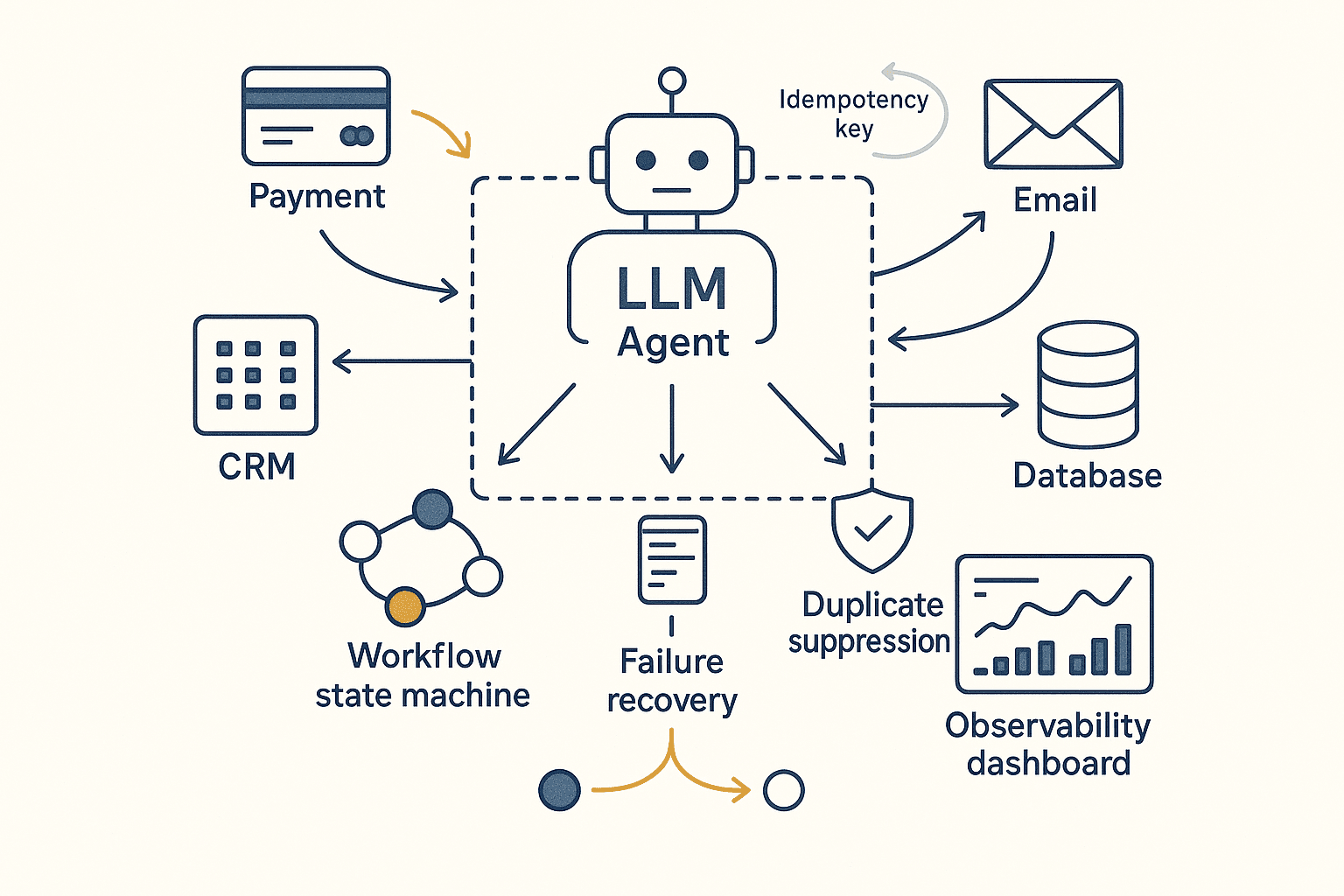
At 2:13 a.m., a customer support agent powered by an LLM receives a frustrated message: “I was charged twice and got three confirmation emails.” The incident channel fills up quickly. Finance sees duplicate payment captures. Support sees the same refund request reopened twice. The CRM shows conflicting notes because two tool calls wrote overlapping summaries back to the customer record. The engineering team checks traces and finds something depressingly familiar: the agent loop called a payment tool, timed out waiting for the response, reasoned that the action may not have happened, retried the tool, then proceeded to send a confirmation email on both the first and second path. A human reviewing the logs can tell what happened. The system, at runtime, could not.
This is the difference between a demo agent and a production agent.
In demos, tool calls are usually treated like function calls inside a single process: call the thing, get the result, continue. In production, tool calls are distributed systems operations. They cross process boundaries, time out, partially fail, get replayed, race with each other, and interact with external systems that may or may not support clean retry semantics. The model is not the only source of nondeterminism. Networks, databases, queues, vendors, browser sessions, and human-in-the-loop steps all introduce ambiguity.
If your agent can call tools repeatedly—and nearly every useful agent can—then idempotency is not a nice-to-have. It is the control surface that keeps retries from becoming duplicate charges, duplicate emails, duplicate tickets, and inconsistent writes across systems.
The core production lesson is simple: never let the model be the sole authority on whether an action should run again. The orchestration layer needs first-class concepts for side effects, operation identity, workflow state, duplicate suppression, and recovery. The model can decide intent. The platform must decide execution.
This article is a practical guide to designing idempotent tool-calling loops for production LLM agents. I’ll cover the recurring failure pattern, why the naive approach fails, what better architecture looks like, how to classify side effects, how to structure retries, how to design workflow state, what to log, what to evaluate, and where the real tradeoffs are.
The recurring failure pattern
The production incidents tend to look different on the surface, but they share a common shape.
A user asks the agent to do something that involves one or more external writes:
- charge a card
- send an email
- create or update a ticket
- schedule a meeting
- issue a refund
- update a CRM record
- modify an order
- trigger a deployment
The agent reasons over the request, chooses tools, and enters a loop like this:
- inspect state
- call tool
- read tool result
- reason about next step
- possibly retry or call another tool
The failure starts when a tool invocation ends in an ambiguous state:
- client timeout before response arrives
- connection drop after the vendor received the request
- orchestrator restart after dispatch but before persisting the result
- model token limit truncates the tool result
- queue retry replays the job
- user resubmits the same request
- upstream API returns 500 but actually completed the write
- concurrency causes two agent runs to act on the same entity
Then the loop asks the wrong question: “Should I try again?”
That sounds reasonable, but for side-effecting operations it is incomplete. The right question is: “Do I already have an operation with this intent in flight or completed, and what is the safe recovery path for this exact operation identity?”
Without that distinction, retries become re-executions.
I’ve seen this happen in several common forms:
Pattern 1: Timeout-induced duplicate writes
The agent calls charge_customer(order_id=123, amount=49.00). The payment provider completes the charge but the network times out before the response is returned. The orchestrator reports a timeout to the model. The model says “try again.” Now you have two charges unless the payment call is protected by a stable idempotency key.
Pattern 2: Orchestrator replay after crash
The tool call was sent successfully, but the process crashed before marking the step complete. On recovery, the workflow replays from the last durable checkpoint and emits the same tool call again.
Pattern 3: Duplicate user intent across channels
A user asks in chat, then clicks a UI button, then replies to an email. Three requests express the same intent. If your system lacks request correlation and dedupe windows, three independent agent runs may send three emails or create three tickets.
Pattern 4: Multi-step inconsistency
The agent updates a CRM, then sends an email, then creates an internal ticket. The CRM write succeeds, the email succeeds, and the ticket creation fails permanently. A naive retry of the whole plan will duplicate the first two steps. A naive retry of only the failed step may leave the workflow in a state that the model can’t reliably infer.
Pattern 5: Competing agent runs
Two separate workflows operate on the same business entity. A support agent run issues a refund while a retention agent run simultaneously offers account credit. Both are locally “correct.” Together they violate policy and create accounting headaches.
All of these are idempotency problems, not just prompt problems.
Why the naive approach fails
The naive design for agent tool use usually has four assumptions baked in:
- tool calls are cheap to repeat
- the latest model context is enough to infer execution state
- retries are a transport concern, not a business concern
- successful API responses are the main source of truth
Each assumption fails in production.
Tool calls are not all equivalent
Some tools are read-only. Some are write operations but naturally idempotent. Some are side-effecting and must never be replayed without an operation key. Some have irreversible effects. Yet many agent frameworks expose all tools through the same generic interface, making “call tool again” look harmless.
A weather lookup and a payment capture should not share the same retry logic.
Model context is an unreliable execution ledger
Teams often stuff prior tool outputs into the conversation and hope the model can infer what already happened. This works until it doesn’t.
Context windows truncate. Summaries compress away critical identifiers. Tool outputs are phrased inconsistently. The model may fail to bind “the refund attempt from two turns ago” to the exact external operation ID that matters. Worse, the model may hallucinate certainty about whether a step succeeded.
Execution state must live in a deterministic workflow store, not only in the prompt.
Retries can create new business events
Infrastructure engineers know retries improve reliability. Product and finance teams know retries can multiply business actions. Both are right.
A retry of an HTTP GET is usually fine. A retry of “send money,” “email customer,” or “create order” is not just transport recovery; it is a potential duplicate event. The retry policy must be coupled to the business semantics of the operation.
Success is often ambiguous
In distributed systems, there is a notorious gap between “request sent” and “response received.” If you only record success on a clean 200 response, you have no principled way to recover from partial failures. You need to represent uncertain outcomes explicitly: dispatched, acknowledged, completed, unknown, compensating, failed-permanent.
That ambiguity is the normal case for robust systems, not an edge case.
A better approach: separate agent reasoning from operation execution
The most robust production pattern is to split the system into two layers:
- Reasoning layer: the LLM plans and selects actions
- Execution layer: a deterministic orchestrator validates, deduplicates, dispatches, records, retries, and reconciles actions
The model proposes. The workflow engine commits.
The architecture in practice
A production-safe tool-calling loop typically looks like this:
- User request enters an agent workflow with a workflow ID and correlation metadata.
- The model proposes a tool action with structured arguments and an intent label.
- The orchestrator canonicalizes the action into an operation envelope.
- Policy checks run: permissions, side-effect class, concurrency guardrails, rate limits, approval requirements.
- An idempotency key is computed or retrieved based on the operation identity.
- The orchestrator checks the operation store for an existing matching operation.
- If found, it returns the prior result or current status instead of executing again.
- If not found, it persists a pending operation record durably before dispatch.
- The tool adapter executes the call to the external system with vendor-level idempotency fields where supported.
- The result is reconciled into the operation record with external IDs, status, timestamps, and artifacts.
- The model receives a normalized tool result that references the durable operation state, not just raw API text.
- On timeout or failure, recovery logic runs from the operation state, not from model guesswork.
That split is the single biggest improvement most teams can make.
Operation envelope: the unit of execution
Every proposed tool call should be turned into a structured operation envelope, something like:
json{
  "operation_id": "op_01J...",
  "workflow_id": "wf_01J...",
  "run_id": "run_01J...",
  "tool_name": "capture_payment",
  "intent": "collect_payment_for_order",
  "entity_type": "order",
  "entity_id": "order_123",
  "arguments_canonical": {
    "customer_id": "cust_456",
    "order_id": "order_123",
    "amount_cents": 4900,
    "currency": "USD"
  },
  "side_effect_class": "external_irreversible",
  "idempotency_key": "payment:order_123:capture:4900:USD:v1",
  "status": "pending_dispatch",
  "created_at": "...",
  "attempt_count": 0
}
The exact schema varies, but the principle is consistent: the system should identify and track the business operation independently of any single model turn.
Side-effect classification: not all tools deserve the same loop
One of the fastest ways to improve safety is to classify tools by side-effect semantics and tie execution policy to that class.
A practical taxonomy is:
1. Pure reads
Examples:
- search knowledge base
- fetch account status
- query inventory
- retrieve weather
Policy:
- retries generally safe
- no idempotency key required, though request tracing still helps
- can often be executed inline with aggressive timeouts
- caching may reduce cost and latency
2. Internal deterministic writes
Examples:
- write workflow note to your own database
- set internal status field
- append audit event
Policy:
- use database transaction semantics
- enforce unique constraints where possible
- still assign operation IDs for replay safety
- easier to make exactly-once within your own boundary
3. External idempotent writes
Examples:
- create payment intent with provider idempotency support
- create support ticket where your API accepts a client token
- update CRM object by primary key with version check
Policy:
- always pass stable idempotency keys to the external API
- persist the mapping of your operation ID to external request ID
- retries allowed through orchestrator only
4. External non-idempotent or weakly idempotent writes
Examples:
- send email through a provider without strong dedupe support
- trigger webhook to a partner system
- submit browser automation step against a fragile UI
- place phone call
Policy:
- add your own duplicate suppression layer
- prefer outbox pattern and delivery records
- require stronger confirmation before retry
- consider approval or reconciliation before replay
5. Irreversible or regulated actions
Examples:
- capture funds
- issue refund
- change subscription billing state
- execute trade
- send compliance-sensitive communication
Policy:
- explicit policy gates
- durable checkpoints before dispatch
- strict idempotency keying
- human approval or dual control where needed
- post-action reconciliation jobs
- richer audit logs and alerts
This classification should be part of the tool registry, not hidden in documentation. The orchestrator should know, for each tool, what retry policy, timeout, concurrency rule, and approval path apply.
Idempotency keys: design them as business identities, not transport IDs
The phrase “use idempotency keys” is common advice, but the implementation details matter.
A bad idempotency key is a random UUID generated at retry time. That only makes each request unique; it does not unify equivalent attempts.
A good idempotency key is stable across retries for the same intended business operation and different across meaningfully different operations.
What should an idempotency key represent?
It should represent the identity of the intended effect.
For example:
payment:order_123:capture:4900:USDrefund:charge_789:fullemail:acct_456:template_password_reset:2026-07-07ticket:conversation_123:create_billing_escalation
Often you also need a version suffix to handle policy or parameter changes:
payment:order_123:capture:4900:USD:v2
That prevents accidental dedupe across semantically different workflows after your business logic changes.
Canonicalize arguments before hashing
If you derive keys from arguments, canonicalization matters.
Normalize:
- field ordering
- units, especially money and timestamps
- casing
- optional/default fields
- whitespace
- enum names
Then either store the canonical tuple directly or hash it. If you hash, keep the unhashed canonical components available in logs for debugging.
Scope keys correctly
A common mistake is scoping too narrowly or too broadly.
Too narrow:
- key based on workflow run ID
- retries from another run bypass dedupe
Too broad:
- key based only on customer ID
- blocks valid repeated actions over time
Good scopes often include:
- business entity ID
- action type
- semantic parameters
- sometimes a time window or version
Distinguish dedupe keys from trace IDs
You still need request IDs, trace IDs, and attempt IDs.
- trace ID: follows a request across services
- attempt ID: uniquely identifies one dispatch try
- operation ID: internal durable identifier for the logical action
- idempotency key: stable business identity for duplicate suppression
Teams often conflate these and lose the ability to reason about retries.
Retry semantics: retries must be state-aware
The orchestrator should not treat all failures the same. A good retry design starts with explicit operation states.
A useful state model:
plannedpending_dispatchdispatchedacknowledgedcompleted_successcompleted_noopfailed_retryablefailed_permanentunknown_outcomecompensatingcompensated
Why so many states? Because production recovery depends on knowing the difference between “we never sent it,” “we sent it but don’t know what happened,” and “we know it happened.”
Retry policy by failure mode
Before dispatch persisted?
- safest is to avoid this state entirely; persist first
Failed before send
- safe to retry with same operation identity
Timed out after send
- do not blindly resend
- check external system by idempotency key or lookup API
- move to
unknown_outcomeand schedule reconciliation
Explicit rate limit / 429
- retry with backoff, same idempotency key
5xx from provider
- depends on provider contract; some 5xx responses may still have committed side effects
- use reconciliation endpoint where available
Validation failure / 4xx semantic error
- permanent failure unless arguments change under a new operation version
Process crash after dispatch
- recover from durable operation record, not from reissuing the request immediately
Backoff strategy
Use exponential backoff with jitter for transport or capacity failures. But the more important point is bounded retries plus reconciliation. Infinite retry loops on ambiguous writes are how systems produce disasters slowly.
In many systems, the right pattern is:
- limited immediate retries for clearly safe cases
- transition ambiguous cases to reconciliation queue
- notify the workflow and possibly the user of pending status
- resume once external state is confirmed
This is particularly important for payments, fulfillment, and messaging.
Duplicate suppression beyond idempotency keys
Idempotency keys are necessary, but not sufficient.
You also need duplicate suppression at the workflow and event levels.
Sources of duplicates
- user sends the same request multiple times
- upstream event bus delivers at least once
- webhook retries from vendors
- job queue replays after timeout
- multi-tab UI actions
- multiple agents responding to same trigger
Practical suppression patterns
1. Inbox/outbox tables
For inbound events, persist an inbox record keyed by source event ID and ignore duplicates.
For outbound side effects, use an outbox table that records the exact intended message or action before delivery. Workers deliver from the outbox and mark delivery status durably.
This pattern is boring and extremely effective.
2. Semantic dedupe windows
For actions like “send follow-up email,” exact argument matching may not be enough. You may need a business rule such as:
- do not send the same template to the same user more than once in 24 hours unless explicitly overridden
That is not pure idempotency; it is policy-level duplicate suppression.
3. Per-entity concurrency locks
If only one active workflow should mutate an order or account at a time, use a lease/lock keyed by entity ID. Keep lock ownership in durable workflow state and expire leases carefully.
This prevents competing runs from racing each other into inconsistent writes.
4. State machine guards
If order state is already refunded, do not allow another refund operation to plan as executable. A lot of duplicate actions can be blocked by checking current entity state before dispatch.
Compensating actions: what to do when exactly-once is impossible
Exactly-once delivery across arbitrary external systems is not a realistic guarantee. What you can build is:
- at-most-once for some actions
- effectively-once through idempotency and reconciliation for many actions
- compensating workflows when duplicates or partial completion happen anyway
Compensating actions are not just “undo.” Many side effects are not fully reversible.
Examples:
- duplicate charge -> issue refund, add internal note, notify finance
- duplicate email -> suppress future follow-ups, annotate incident, possibly send apology
- CRM update conflict -> merge or restore fields from audit log
- deployment triggered twice -> mark one run superseded and reconcile environment state
A good compensating design includes:
- a mapping from action type to possible compensations
- preconditions for running compensation
- a separate operation identity for compensation itself
- auditability linking original and compensating operations
- policy for human escalation when compensation is risky
Do not make the model invent compensations on the fly for high-risk systems. Let the model choose among approved compensation playbooks exposed as tools or policies.
Workflow state design: keep the ledger outside the prompt
If there is one architectural takeaway to emphasize, it is this: your workflow state is the ledger of truth for side effects.
The model context should be a projection of that ledger, not the ledger itself.
What to persist
At minimum, persist:
- workflow ID and run ID
- user request and normalized intent
- operation records for each proposed tool call
- idempotency key
- canonicalized arguments
- side-effect class
- operation state transitions with timestamps
- external request IDs and external object IDs
- attempt records and error categories
- policy decisions and approvals
- compensation links
- final user-visible outcome
Why event history beats only final state
You want both current state and event history.
Current state lets the orchestrator resume quickly. Event history lets you debug incidents and compute metrics like duplicate suppression rate, unknown outcome rate, and average reconciliation delay.
If you can afford it, store state transitions as append-only events plus a materialized current-state view.
Resume behavior
On restart, the workflow should:
- load current workflow and open operations
- for any
dispatchedorunknown_outcomeoperations, reconcile before re-dispatch - for
failed_retryable, apply policy-based retry - for
completed_*, return prior results to the model if needed
The key point is that resumption logic must be deterministic and not require the model to “remember” what happened.
Tool adapter design: normalize provider weirdness
Provider APIs vary wildly in their support for idempotency, lookup, and error semantics. Your tool adapter layer should absorb that variability.
For each external system, define:
- whether vendor-side idempotency keys are supported
- max idempotency retention window
- whether the provider offers lookup by client reference or request ID
- whether 5xx can still indicate committed writes
- retryable error codes
- rate limit behavior
- consistency model and propagation delay
Then expose a normalized contract upward to the orchestrator.
Example normalized tool result
json{
  "operation_id": "op_01J...",
  "tool_name": "capture_payment",
  "dispatch_status": "unknown_outcome",
  "provider": "stripe",
  "provider_request_id": "req_abc",
  "provider_object_id": null,
  "retry_recommendation": "reconcile_before_retry",
  "raw_status_code": 504,
  "safe_user_message": "Payment status is being confirmed."
}
The model does not need the entire provider-specific mess. It needs a reliable summary of what it can say and what the system will do next.
Observability: if you can’t see duplicate pressure, you will ship incidents
Idempotent design is not complete without observability. Most teams log prompts and tool outputs, but not the execution semantics that matter.
You need dashboards and alerts for the operation layer.
Metrics to track
At minimum:
- operations by tool and side-effect class
- duplicate suppression count and rate
- retries by tool and failure category
- unknown outcome rate
- reconciliation success rate and lag
- compensation rate
- time spent in each operation state
- concurrent mutation conflicts by entity type
- vendor idempotency hit rate
- user-visible duplicate incidents
Structured logs
Every operation attempt should log:
- workflow ID
- operation ID
- idempotency key
- attempt ID
- tool name
- side-effect class
- canonical argument fingerprint
- provider request ID
- state transition
- latency
- error category
- dedupe decision reason
This is what lets you answer, quickly, “Did we send it twice, or only think we might have?”
Tracing
Distributed traces should connect:
- user request
- model planning span
- policy evaluation span
- operation store lookup/write
- tool adapter dispatch
- provider response or timeout
- reconciliation job
- compensation job
In incidents, these traces are more valuable than raw prompt logs.
Alerting
Good alerts include:
- spike in
unknown_outcomefor a high-risk tool - duplicate suppression drops unexpectedly to zero
- compensation rate rises above baseline
- a provider’s idempotency lookup starts failing
- many operations stuck in
dispatchedlonger than SLA
Evaluation strategy: test failure semantics, not just answer quality
This is where many LLM teams underinvest. They evaluate whether the model chose the right tool or produced the right text, but not whether the system behaves safely under retries and ambiguity.
For tool-calling agents, evals need to cover execution semantics.
Eval dimensions that matter
1. Intent-to-operation correctness
Given a request, does the system produce the right operation identity and idempotency key?
Examples:
- same request phrased differently should map to same logical operation when appropriate
- materially different requests should not collide on the same key
2. Retry safety
Inject timeouts, connection resets, 429s, and ambiguous 5xx responses. Verify:
- no duplicate external write
- state transitions are correct
- retries use same idempotency key
- ambiguous outcomes go to reconciliation
3. Replay safety
Crash the orchestrator after dispatch but before commit. Replay the workflow. Verify no duplicate action occurs.
4. Concurrency safety
Run two workflows against the same entity with overlapping actions. Verify locks, guards, or state machine rules prevent bad interleavings.
5. Compensation correctness
Simulate partial failure and verify approved compensation flow runs, with linked audit trail.
6. User-facing behavior under uncertainty
Verify the assistant says “I’m confirming payment status” rather than falsely claiming success or failure.
Build a fault-injection harness
Do not wait for real vendor outages to test this.
A useful harness can simulate for each tool:
- success
- timeout after commit
- timeout before commit
- duplicate webhook delivery
- 429 with retry-after
- 500 with eventual consistency
- malformed response
- long propagation delay
Then run end-to-end scenarios and assert on operation counts and final external state.
Metrics for eval success
Beyond accuracy, track:
- duplicate side effects per 10k runs
- mean reconciliation time
- percent of ambiguous outcomes resolved without human intervention
- false dedupe rate
- lock contention rate
- extra latency added by safety controls
- cost overhead from reconciliation and logging
These are the real production KPIs.
Model and tool tradeoffs
Different model and tool designs interact with idempotency in important ways.
Larger models vs smaller models
Larger models may do better at choosing when an action is needed, but they do not eliminate distributed systems ambiguity. A smarter model is not a substitute for an operation ledger.
Smaller models with stricter orchestration often outperform larger models in reliability-sensitive workflows because the safety comes from deterministic execution semantics.
My default guidance:
- use the model for intent classification, slot filling, policy explanation, and conditional planning
- use deterministic code for operation identity, dedupe, retries, and recovery
Free-form tool calling vs constrained schemas
Free-form tool use is flexible but dangerous for side-effecting actions.
Prefer:
- typed tool schemas
- canonical argument normalization
- policy metadata attached to each tool
- explicit “dry-run” or “plan-only” mode for risky actions
Constrained schemas make idempotency easier because you can reliably derive operation identity from normalized fields.
Direct agent-to-tool calls vs queue-backed execution
Direct inline calls minimize latency but increase coupling and reduce replay safety.
Queue-backed or workflow-engine-backed execution adds some latency, but gives you:
- durable checkpoints
- retries outside the model loop
- better backpressure handling
- replay/recovery control
- clearer observability
For read-heavy low-risk tools, inline is often fine. For writes to external systems, I strongly prefer durable execution.
Cost and latency tradeoffs
All of this safety infrastructure costs something.
You are adding:
- operation store reads/writes
- canonicalization logic
- queue or workflow engine overhead
- reconciliation jobs
- richer logging and tracing
- lock management
- policy checks
That increases p50 and p99 latency, and definitely increases engineering complexity.
But the comparison should not be “safe system vs simpler system.” It should be “safe system vs incident cost.”
A few concrete tradeoffs:
Inline execution
Pros:
- lower latency
- simpler stack
Cons:
- weaker replay safety
- ambiguous outcomes handled poorly
- harder to recover from process death
Good for:
- pure reads
- low-risk internal operations
Durable orchestration
Pros:
- strong recovery semantics
- easier reconciliation
- better observability
Cons:
- higher latency
- more infrastructure
Good for:
- payments
- messaging
- ticketing
- order modifications
- any regulated or customer-visible side effect
Rich reconciliation
Pros:
- prevents duplicates after ambiguous failures
- improves correctness with flaky vendors
Cons:
- extra API calls
- slower final confirmation
In practice, users tolerate “I’m confirming status” much better than duplicate charges.
Implementation blueprint
If you are building this from scratch, here is a pragmatic sequence.
Phase 1: classify tools and add operation records
- create a tool registry with side-effect class
- wrap all side-effecting tools with an operation envelope
- persist operation records before dispatch
- add stable operation IDs and attempt IDs
Phase 2: introduce idempotency keys and dedupe store
- define canonicalization per tool
- generate business-level idempotency keys
- enforce uniqueness in operation store where appropriate
- return existing results on dedupe hits
Phase 3: add explicit state machine and retries
- model operation states explicitly
- separate retryable, permanent, and unknown outcomes
- implement bounded retries with jitter
- add reconciliation jobs for ambiguous cases
Phase 4: add concurrency controls and compensation
- per-entity leases or optimistic version checks
- policy guardrails for irreversible tools
- compensation playbooks for common failure modes
Phase 5: observability and eval harness
- metrics, traces, dashboards, alerts
- failure injection in staging and CI
- scenario-based regression suite
Example pseudocode for execution wrapper
pythondef execute_tool_operation(workflow_id, tool_name, raw_args, intent):
    tool_meta = tool_registry[tool_name]
    args = canonicalize(tool_name, raw_args)
    entity_ref = derive_entity_ref(tool_name, args)
    idem_key = derive_idempotency_key(tool_name, intent, args, entity_ref)

    existing = operation_store.find_by_idempotency_key(idem_key)
    if existing and existing.status in TERMINAL_OR_REUSABLE_STATES:
        return existing.normalized_result

    op = existing or operation_store.create_if_absent(
        workflow_id=workflow_id,
        tool_name=tool_name,
        intent=intent,
        entity_ref=entity_ref,
        canonical_args=args,
        side_effect_class=tool_meta.side_effect_class,
        idempotency_key=idem_key,
        status="pending_dispatch",
    )

    if tool_meta.requires_entity_lock:
        acquire_lock(entity_ref, workflow_id)

    try:
        operation_store.transition(op.id, "dispatched")
        attempt_id = operation_store.new_attempt(op.id)

        response = tool_adapter.dispatch(
            tool_name=tool_name,
            args=args,
            idempotency_key=idem_key,
            attempt_id=attempt_id,
        )

        normalized = normalize_response(tool_name, response)
        operation_store.record_result(op.id, normalized)

        if normalized.status == "completed_success":
            operation_store.transition(op.id, "completed_success")
        elif normalized.status == "completed_noop":
            operation_store.transition(op.id, "completed_noop")
        elif normalized.status == "unknown_outcome":
            operation_store.transition(op.id, "unknown_outcome")
            enqueue_reconciliation(op.id)
        elif normalized.status == "failed_retryable":
            operation_store.transition(op.id, "failed_retryable")
            enqueue_retry(op.id)
        else:
            operation_store.transition(op.id, "failed_permanent")

        return operation_store.get_normalized_result(op.id)

    finally:
        if tool_meta.requires_entity_lock:
            release_lock(entity_ref, workflow_id)
The code is simplified, but the important part is the ordering:
- canonicalize
- dedupe lookup
- durable record creation
- dispatch
- normalized result recording
- recovery based on explicit state
Hard-earned takeaways
A few battle-tested rules are worth stating plainly.
1. Never let the model decide duplicate suppression by itself
The model should not infer “probably safe to retry” for irreversible actions. Put duplicate suppression in the execution layer.
2. Every side-effecting tool call needs a stable business identity
If you cannot define what makes two calls “the same operation,” you are not ready to automate that action.
3. Unknown outcome is a first-class state
Do not collapse ambiguity into failure. Ambiguous writes require reconciliation.
4. Persist before dispatch
If you send to an external system before you durably record the operation, recovery becomes guesswork.
5. Use provider idempotency support, but never rely on it blindly
Vendors differ in retention windows and semantics. Keep your own operation ledger.
6. Exactly-once is not the goal; controlled side effects are
You will not achieve perfect global exactly-once execution across all tools. You can achieve systems that are safe, auditable, and recoverable.
7. Evaluate failure handling as a product feature
If your eval suite only measures answer quality, it will miss the production failures that matter most.
8. Pay the latency tax where the business risk demands it
Fast duplicate charges are worse than slow confirmed charges. Users remember the former.
Production LLM agents do not fail mainly because the model picked the wrong verb. They fail because a distributed operation with side effects was treated like a local function call. Once you reframe tool execution as a workflow problem—with operation identities, idempotency keys, state machines, dedupe, reconciliation, and observability—the design becomes much more predictable.
That predictability is what separates an interesting agent from an operationally trustworthy one.
If your team is deploying agents that can write to payments, messaging systems, CRMs, ticketing platforms, or any other external system customers care about, build the idempotency layer before you need it. Doing it after the first duplicate-charge incident is always more expensive.