Designing Human-in-the-Loop Escalation Paths for Production GenAI Systems
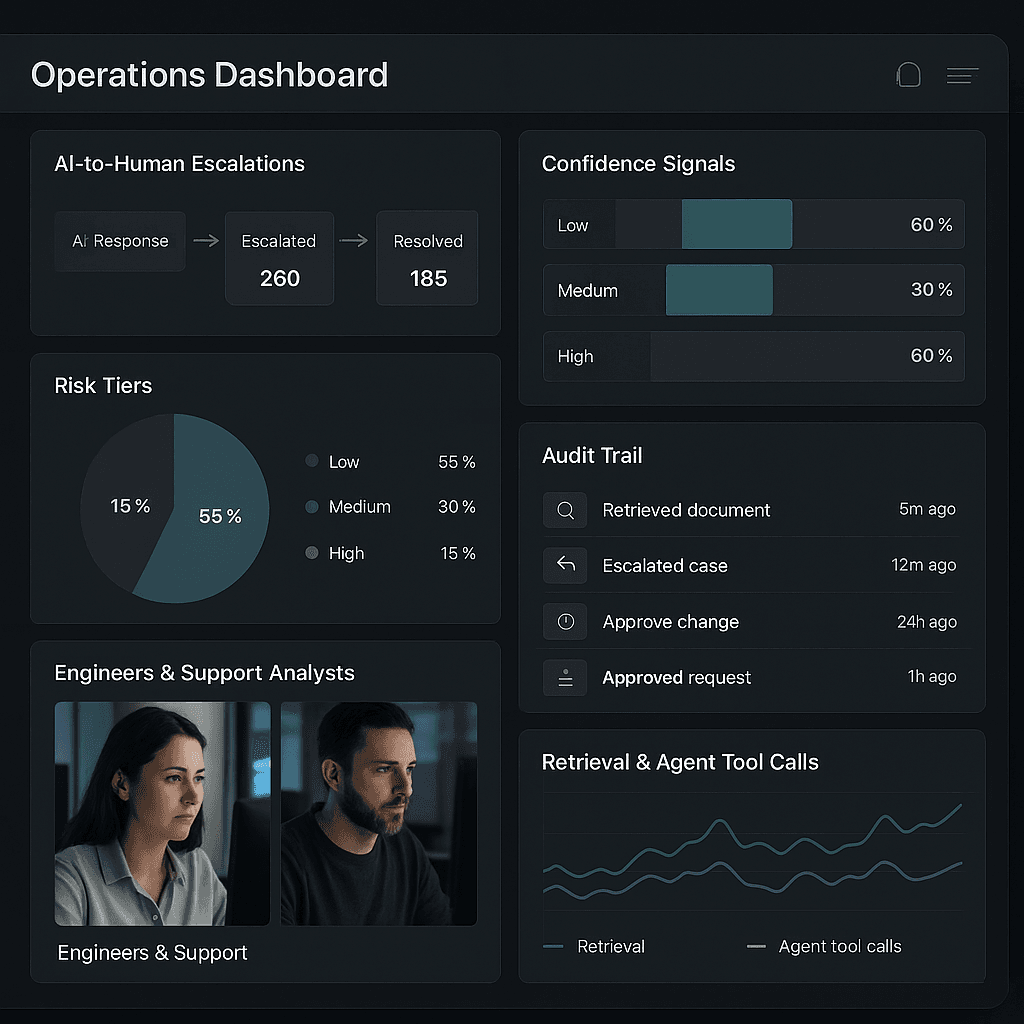
The failure mode usually doesn’t look dramatic at first. It looks like a normal Tuesday.
A support copilot drafts a refund exception email that sounds perfectly reasonable, except it cites an internal policy that was superseded three weeks ago. A sales assistant offers contract language that is close to legal-approved wording, but not actually the approved clause. An internal agent opens a ticket, queries three systems, and confidently proposes a remediation step for a customer environment it should never touch without approval. Nobody notices immediately because the model didn’t crash, the API returned 200, and the output read like something a competent colleague might have written.
Then the organization discovers the real issue: not that the model made a mistake, but that the system had no disciplined way to decide when it should stop, ask a clarifying question, defer the answer, or hand the case to a human.
That is the production problem.
Most teams spend their early GenAI cycles on the model and prompt, then on retrieval quality, then on tool integration. Human review often arrives as a compliance requirement or as an emergency patch after the first incident. Someone adds a Slack channel, a manual approval step, or a “please verify” disclaimer, and hopes this counts as governance.
It doesn’t. In production, human-in-the-loop is not a generic safety blanket. It is an operational subsystem with policy, routing, interfaces, queueing, SLAs, auditability, and feedback loops. If you design it poorly, you create hidden toil, latency blowups, and the illusion of safety without actual risk reduction. If you design it well, you get a system that knows when to continue autonomously, when to ask for more information, when to make a recommendation for approval, and when to hand off completely.
The core idea is simple: escalation is a product and systems design problem, not just a model confidence problem.
The pattern behind repeated GenAI incidents
Across RAG assistants, support copilots, back-office agents, and workflow automations, the same pattern appears:
- The team assumes the model can self-assess reliably.
- The team uses a single threshold or vague confidence score to trigger review.
- Human review gets bolted on after generation rather than designed into the workflow.
- The queue grows in unpredictable ways because the escalation policy is not tied to business risk and service levels.
- Reviewed cases are treated as one-off exceptions instead of training data for improving prompts, retrieval, tools, and evaluations.
The common root cause is that teams treat escalation as an edge-case handler. In production, escalation is part of the normal control plane.
You need explicit answers to questions like:
- When should the system answer directly?
- When should it ask a clarifying question before proceeding?
- When should it refuse or defer because required evidence is missing?
- When should it generate a recommendation that requires human approval before action?
- When should it bypass AI output entirely and route to a human specialist?
- How quickly must each path resolve, and who owns that SLA?
- What evidence should be attached to the handoff so the human reviewer is not forced to reconstruct context?
Without these answers, “human in the loop” becomes “human somewhere after the fact.”
Why the naive approach fails
The naive design usually has one of two forms.
The first form is “always ask the model how confident it is.” The system prompts the model to provide an answer and a confidence number from 1 to 10, or low/medium/high. Teams then gate automation on that value.
This fails because model self-reporting is weakly calibrated for operational risk. A model can produce low confidence on a correct answer when wording is unfamiliar, or high confidence on a wrong answer because the latent pattern looks common. More importantly, self-confidence is not the right unit of control for most workflows. The real question is not “does the model feel confident?” but “does the system have sufficient evidence and authorization to perform this class of task under current conditions?”
The second form is “send everything questionable to human review.” This feels safer, but breaks quickly.
It breaks on cost: every reviewed item becomes variable labor.
It breaks on latency: users don’t tolerate agentic workflows that pause unpredictably.
It breaks on consistency: different reviewers make different calls unless policies are operationalized.
It breaks on visibility: teams underestimate queue growth until review becomes the bottleneck.
And it breaks on improvement: if you cannot categorize why items were escalated, you cannot systematically reduce future escalations.
A human review step is not automatically a safety improvement. If humans are overloaded, under-contextualized, or approving mechanically, you have simply moved the failure boundary.
A better approach: escalation as a risk-tiered decision architecture
The more robust design is to treat escalation as a decision architecture built from multiple signals.
At a high level, a production GenAI system should classify each interaction or action into one of four outcomes:
- Proceed automatically: answer or act with no human intervention.
- Ask/clarify: request missing information from the user or another system.
- Recommend/await approval: produce a proposed answer or action, but require explicit human approval before release or execution.
- Defer/hand off: route the case to a human or specialized queue.
This classification should depend on three dimensions:
- Risk tier of the task
- Quality and completeness of available evidence
- Capability and reliability profile of the current model/tool path
Risk tiers should be business-defined, not model-defined
Start by mapping workflows into risk tiers. For example:
Tier 0: Low-risk informational tasks
- Summarizing internal docs
- Drafting non-binding content
- Basic FAQ responses with cited sources
Tier 1: Medium-risk recommendation tasks
- Suggesting support responses
- Drafting SQL for analyst review
- Recommending knowledge-base updates
Tier 2: High-risk transactional or external communication tasks
- Sending customer-facing billing decisions
- Updating records in systems of record
- Producing legal, medical, HR, or security-sensitive drafts
Tier 3: Critical tasks with material impact
- Issuing refunds over threshold
- Executing infrastructure changes
- Approving access changes
- Triggering compliance notifications
For each tier, define allowed autonomy. A typical pattern:
- Tier 0: auto-answer allowed if evidence is adequate
- Tier 1: auto-draft allowed; publish may require confidence/evidence thresholds or spot review
- Tier 2: recommendation-only or approval-required
- Tier 3: AI may assist with context gathering, but human decision is mandatory
This sounds obvious, but many failures come from skipping this explicit mapping and allowing one general-purpose assistant to operate with the same autonomy across radically different risk contexts.
Evidence quality matters more than generic confidence
The right escalation signals often come from the system around the model, not from the model’s introspection.
For RAG systems, useful signals include:
- Retrieval coverage: Did we retrieve enough relevant documents?
- Retrieval agreement: Do top results support the same answer or conflict?
- Source authority: Are retrieved sources from approved repositories, current versions, and correct policy domains?
- Citation grounding: Can each critical claim be tied to evidence?
- Freshness: Are documents within the validity window for the task?
- Query ambiguity: Did multiple interpretations of the user question yield materially different results?
For agentic systems, additional signals include:
- Tool success rate: Did all required tool calls succeed deterministically?
- Tool output validity: Were schemas, business rules, and preconditions satisfied?
- Action reversibility: Can the action be rolled back safely?
- Scope fit: Is the requested action within allowed permissions and policy?
- Plan complexity: How many steps, branches, or external dependencies were involved?
- State uncertainty: Are there missing fields, conflicting records, or stale system snapshots?
For conversational systems, add:
- Intent ambiguity
- Identity/authorization confidence
- Sentiment/distress or urgency signals
- Presence of exceptions or edge-case language
These signals are much more operationally useful than asking the model whether it is sure.
Separate answer quality from action authorization
One subtle but important pattern: a model may be capable of generating a high-quality recommendation while still being unauthorized to execute the next step.
For example, an incident-response copilot may correctly identify a likely remediation for a failing service but should not restart production systems automatically. A refund assistant may accurately draft a response but not issue the refund without review if the amount exceeds threshold or policy interpretation is involved.
This leads to a key design principle:
Do not use one threshold for both “is this answer probably right?” and “is the system allowed to act?”
Those are different decisions and need different policies.
A reference architecture for escalation-aware GenAI systems
A practical architecture has six control points.
1. Intake classifier
Before retrieval or generation, classify the request on:
- task type
- risk tier
- user identity/role
- required systems or tools
- potential policy domains involved
- need for clarification before any answer
This can be implemented as a lightweight model call, rules engine, or hybrid. In many production settings, a small fast model plus deterministic rules works better than sending everything to your largest model.
2. Evidence assembly layer
For RAG, this means retrieval, filtering, reranking, and source validation. For agents, it means gathering tool outputs, policy constraints, and state snapshots. The output should include both content and machine-readable metadata used for escalation decisions.
Example metadata:
- retrieved_doc_count
- authoritative_source_ratio
- evidence_freshness_score
- conflicting_sources_flag
- required_fields_present
- tool_failures_count
- policy_match_version
3. Decision policy engine
This is where the system decides: proceed, ask, approve, or handoff.
Importantly, this should not live only inside a prompt. Put the policy in code or policy configuration where it is inspectable and testable.
A simplified policy example:
- If risk_tier >= 3, never auto-execute
- If user identity cannot be verified, ask or handoff
- If retrieval has conflicting authoritative sources, defer to human review
- If amount > $500, draft recommendation and require finance approval
- If required customer record fields are missing, ask clarification
- If tool chain exceeds 5 steps and includes irreversible action, require approval
4. Response/action generator
Only after the policy engine determines the allowed path should the model generate the answer, draft, or recommendation in the right mode.
Different modes may use different prompts and models:
- direct answer mode
- clarification mode
- recommendation-for-approval mode
- human handoff summary mode
This matters because the best output for a human reviewer is usually not the same as the best output for an end user.
5. Human review interface and queueing layer
This is where many teams underinvest. A review step needs structured context, reason codes, queue routing, and SLA ownership.
The interface should show:
- user request
- proposed response/action
- escalation reason(s)
- supporting evidence/citations
- retrieved docs or tool outputs
- policy checks passed/failed
- risk tier
- suggested next actions
- editable fields and approval controls
6. Feedback and learning pipeline
Every escalated case should produce analyzable data:
- why it was escalated
- what the human changed
- whether the escalation was necessary
- whether the final outcome was correct
- what root cause class applies: prompt, retrieval, policy, tool, data quality, or user ambiguity
Without this pipeline, your HITL process becomes pure operational drag instead of a source of system improvement.
Escalation policies for RAG systems
RAG-specific escalation design benefits from being explicit about evidence sufficiency.
A common anti-pattern is allowing the model to answer from partial retrieval and then attaching citations as decoration. In a production system, citations should function as a control surface.
When RAG should answer directly
Direct answer is reasonable when:
- the task is low-risk
- retrieval returns enough high-authority documents
- top sources agree
- source freshness meets policy
- the answer can be fully grounded in retrieved context
- no policy exception or ambiguity is detected
A good implementation pattern is to require claim-level grounding for certain answer classes. For example, policy statements, pricing, and eligibility criteria must be tied to approved source snippets.
When RAG should ask a clarifying question
Clarification is better than escalation when the uncertainty is user-side rather than evidence-side.
Examples:
- “Which product version are you using?”
- “Is this request about employee benefits in the US or EU?”
- “Do you want the current policy or the archived policy that applied last quarter?”
You want the system to ask clarifying questions early, before retrieval broadens into multiple conflicting domains or before the model averages across incompatible policies.
When RAG should defer or hand off
Escalate when:
- authoritative sources conflict
- the latest policy is missing from indexed content
- the question requires interpretation beyond documented policy
- the requested answer crosses into regulated or high-risk advice
- the user appears to be seeking an exception rather than a standard answer
- retrieved evidence is sparse or stale, but the task risk is high
A useful heuristic is that escalation should trigger not only on low evidence, but on evidence conflict. Many teams focus on coverage but miss contradiction detection.
Useful evals for RAG escalation
Measure more than answer correctness:
- precision/recall of escalation decisions
- false-autonomy rate: cases the system answered directly but should have escalated
- over-escalation rate: cases escalated unnecessarily
- grounding sufficiency rate
- conflict-detection accuracy
- clarification usefulness rate
- time-to-resolution by path
False autonomy is the metric to watch most carefully in high-risk domains. A system that escalates too much is expensive. A system that fails to escalate the dangerous 2% is where incidents happen.
Escalation policies for agentic systems
Agents introduce a harder problem because the system is not just generating language. It is making plans, calling tools, and potentially mutating state.
The right mental model is that escalation can happen at three levels:
- before planning
- during plan execution
- before committing an action
Before planning
Escalate early when the requested goal itself is risky or under-specified.
Examples:
- “Delete old customer accounts” without retention-policy context
- “Fix the invoice issue for this enterprise account” where multiple remediation paths exist
- “Investigate and resolve this incident” when blast radius is unknown
In these cases, the system should either ask for constraints or route to a human owner.
During execution
Escalate when the agent encounters:
- repeated tool failures
- inconsistent system state
- missing authorizations
- unexpected branching or dependency growth
- ambiguous entity resolution
- outputs outside policy bounds
A concrete rule I’ve used: if an agent takes more than N high-latency tool steps without converging, stop and summarize for human review rather than letting it wander. This controls both cost and operational unpredictability.
Before commit
Approval gates should sit immediately before irreversible, external, or sensitive actions.
Typical approval-required actions:
- sending external communications
- editing systems of record
- financial transactions
- infrastructure changes
- permission changes
- policy exceptions
The model can do substantial work before this point: gather context, propose action, draft communication, estimate impact, and assemble evidence. But the final act should require human confirmation when risk warrants it.
Eval strategy for agents
For agentic systems, evaluate the escalation layer with scenario tests that include partial failures and adversarial ambiguity. Track:
- unsafe non-escalation rate
- approval-gate bypass rate
- unnecessary human-touch rate
- step-count before escalation
- cost per resolved task by path
- reviewer override rate
- rollback-trigger rate for actions that were approved
Agent systems also need environment-based evals, not just transcript evals. A plan can look coherent in text while still failing in real tool interactions.
Confidence signals beyond self-reporting
If you only adopt one idea from this article, make it this: confidence should be inferred from observable system behavior and evidence quality, not just from the model saying “I’m 92% confident.”
Useful signal families include:
Retrieval signals
- top-k relevance distribution
- margin between best and next-best interpretations
- source authority labels
- document freshness
- citation coverage of critical claims
- contradiction or policy version mismatch detection
Generation signals
- constrained decoding/schema adherence
- consistency across sampled drafts for high-stakes reasoning
- unsupported claim detection
- completion truncation or refusal anomalies
Tooling signals
- API success/failure rates
- validation errors
- mismatch between requested and actual entities
- stale read/write windows
- missing required preconditions
Workflow signals
- task complexity score
- number of tool steps taken
- whether the request crosses domains
- presence of exception language like “override,” “special case,” or “just this once”
- whether the user is authenticated for the requested operation
Human-history signals
- prior reviewer correction rates for similar cases
- known weak intents or domains
- drift since the last prompt/retrieval/index update
- recent incident or policy-change windows
A practical implementation is to compute a composite escalation score, but do not collapse everything into one opaque number if you can avoid it. Reviewers and operators need interpretable reason codes, such as:
- MISSING_AUTH_SOURCE
- MULTI_POLICY_CONFLICT
- AMBIGUOUS_USER_INTENT
- IRREVERSIBLE_ACTION
- TOOLCHAIN_NONCONVERGENCE
- HIGH_VALUE_TRANSACTION
These codes make policy auditable and queues manageable.
UI patterns that actually help humans review quickly
A bad review UI destroys the value of HITL.
The worst pattern is dropping a reviewer into a free-form chat transcript and making them reverse-engineer what happened. That increases review time, inconsistency, and blind approval.
Better patterns:
1. Show the proposed action and its rationale separately
Reviewers need to answer two questions quickly:
- What is the system proposing?
- Why does it believe this is correct or allowed?
Put the recommendation, evidence, and failed/passed checks in distinct sections.
2. Use structured approve/edit/reject controls
Do not make reviewers rewrite from scratch unless necessary. Let them:
- approve as-is
- approve with edits
- reject with reason code
- request more information
- route to specialist queue
Capture these actions structurally for downstream learning.
3. Highlight deltas and uncertainty hotspots
If the model drafted an email from a template, highlight the variable segments. If a policy answer depends on one fragile clause, surface that clause. If a tool output failed validation, point directly to the problematic field.
4. Preserve citations and system traces
For RAG, include source links and snippets. For agents, include a compact execution trace: tools called, key outputs, and blocked checks. Humans need evidence, not just prose.
5. Optimize for queue throughput, not maximal context density
Reviewers should not have to read everything every time. Use progressive disclosure:
- summary at top
- reasons for escalation
- recommendation
- evidence tabs
- full trace only if needed
This is how you keep review time bounded.
Queue design, staffing, and SLA tradeoffs
Human review is where architecture meets operations reality.
If your escalation design ignores queueing, you will accidentally create a shadow BPO inside your engineering system.
Design queues by specialization and risk
Do not put all escalations into one bucket. Common queue dimensions:
- policy/legal review
- support exception handling
- finance approvals
- security/infrastructure approvals
- language/brand review for outbound communication
Then route within those queues by urgency and value.
Define SLA by path, not by system overall
A user asking a low-risk documentation question should not inherit the latency of a Tier 3 approval workflow. Publish path-specific expectations:
- direct answer: seconds
- clarification loop: seconds to minutes
- approval-required recommendation: minutes to hours
- specialist handoff: hours or business day
Users tolerate delay better when the reason and next step are explicit.
Model the economics of escalation
Many teams optimize model spend but ignore review labor, which often dominates.
Simple cost model:
- direct automation cost = model + retrieval + tool/API cost
- escalated case cost = automation cost + reviewer labor + queue overhead + rework cost
If review takes 4 minutes on average and the reviewer cost is meaningful, over-escalation can erase any value from the automation. Conversely, under-escalation can create rare but severe incident costs. You need both numbers.
Watch for hidden bottlenecks
Operational bottlenecks often show up as:
- spikes after policy changes or index lag
- one specialist queue handling most “exceptions”
- approvals arriving faster than experts can review
- the same escalation reason dominating for weeks
- high reviewer disagreement rates
These are signals that your system design, not just your staffing, needs adjustment.
Auditability and compliance-by-construction
In high-stakes domains, an escalation path is also an audit mechanism.
You should be able to reconstruct:
- what the user asked
- what evidence the system retrieved
- what the model proposed
- which policy rules fired
- why escalation occurred
- who approved, edited, or rejected
- what final output or action was taken
- which model, prompt, index version, and tool versions were used
This is not just for compliance. It is vital for incident response and model change management.
A practical event log schema often includes:
- request_id
- user_id / role
- risk_tier
- model_version
- prompt_version
- retrieval_index_version
- tool_versions
- evidence_ids
- escalation_reason_codes
- reviewer_id
- reviewer_action
- final_decision
- timestamps for each stage
Store enough to debug and evaluate, but with appropriate data minimization and privacy controls.
How to use human review data without creating another mess
The promise of HITL is that reviewed cases become fuel for improvement. The trap is that teams collect review data but never operationalize it, or worse, they create a brittle workflow dependent on constant review.
The right loop is not “add more humans.” It is “learn why the system needed them.”
Classify root causes
For every reviewed case, attach one root cause category:
- prompt/instruction failure
- retrieval miss
- retrieval conflict/freshness issue
- tool failure or missing capability
- policy engine too strict or too loose
- missing business data
- user ambiguity
- unsupported task
This lets you prioritize engineering fixes.
Mine reviewer edits systematically
Reviewer edits are gold, but only if normalized.
Examples:
- frequent addition of one missing disclaimer suggests prompt fix
- repeated citation replacement suggests reranking or source authority issue
- constant correction of one policy clause suggests stale index or bad chunking
- repeated approval of a certain exception class suggests policy threshold is too conservative
Feed changes into evals before production rollout
Every recurring escalation class should produce regression cases for:
- prompt eval sets
- retrieval evals
- tool validation tests
- policy simulation tests
- end-to-end scenario evals
Do not jump straight from reviewer observations to broader autonomy. First prove that the failure mode is reduced in evaluation.
Resist the “permanent manual review” trap
Some teams become comfortable with approval steps and never eliminate them, even after evidence shows a path is reliable. Others remove approval too early because review feels expensive.
The better pattern is staged autonomy:
- recommendation only
- approval required for all cases
- approval required for sampled cases or threshold-triggered cases
- auto-execute with monitoring and rollback where possible
Use production evidence to graduate paths deliberately.
Model and tool choices for escalation-aware systems
There is no single best model for every stage.
In practice, a tiered model architecture often works best:
- small/fast model for intake classification and clarification detection
- medium model for most grounded drafting tasks
- larger model for complex synthesis, long-context review, or difficult exception summarization
- deterministic code/rules for policy checks and hard constraints
This gives you better cost and latency control than routing all work through your largest model.
Cost and latency tradeoffs
A few practical observations:
- Using a cheaper, fast model for upfront risk classification can reduce expensive downstream calls.
- Clarifying early is often cheaper than retrieving broadly and generating a likely-wrong answer.
- Approval-required workflows can tolerate slower synthesis if they materially reduce reviewer time.
- For agent systems, strict tool validation and bounded step limits save more money than squeezing token costs.
- Better retrieval quality frequently reduces human review more effectively than upgrading to a larger generation model.
If you are deciding where to spend effort, improving retrieval authority, policy rules, and UI ergonomics often pays off sooner than chasing the next benchmark model.
An implementation blueprint
Here is a concrete rollout approach that works for many teams.
Phase 1: Instrument before automating
Start by logging:
- request type
- risk tier
- retrieval/tool signals
- model output
- whether a human intervened anyway
- downstream correction or incident signals
Even before full HITL, this gives you baseline false-autonomy data.
Phase 2: Introduce explicit outcome modes
Implement the four-way decision:
- proceed
- ask
- recommend/approve
- handoff
Make the policy engine explicit in code.
Phase 3: Launch review UI with reason codes
Do not start with email or Slack approvals if the workflow is material. Build minimal structured review surfaces with captured actions and timestamps.
Phase 4: Create eval suites from early escalations
Turn live escalations into test cases. Separate by RAG, tool use, policy, and ambiguity.
Phase 5: Tighten path-specific policies
Once data accumulates, tune by path, not globally. You will likely discover that one workflow can safely automate further while another should remain approval-heavy.
Phase 6: Graduate autonomy carefully
Reduce review load only where:
- false-autonomy is low
- reviewer overrides are rare
- evidence sufficiency is strong
- rollback exists or impact is bounded
This is how you avoid both reckless automation and permanent manual drag.
What good looks like in practice
A well-designed production system does not try to appear universally capable. It behaves like a disciplined operator.
It answers directly when the task is low-risk and the evidence is solid.
It asks clarifying questions when the user has not provided enough context.
It stops when policy evidence is conflicting or stale.
It drafts recommendations for human approval when the answer may be right but the action is sensitive.
It hands off with a compact, evidence-backed summary when specialist judgment is required.
And crucially, it learns from every one of those handoffs.
That is the real maturity curve for GenAI operations. Not “can the model do it?” but “can the system choose the right level of autonomy, consistently, under real production conditions?”
If you get that right, human-in-the-loop stops being an apologetic patch and becomes what it should be: a control system for safe, scalable automation.
Takeaways
- Human-in-the-loop is an operational subsystem, not a disclaimer or a generic review step.
- Escalation decisions should be based on risk tier, evidence sufficiency, and tool/workflow reliability, not only model self-confidence.
- Separate answer quality from action authorization.
- Build explicit outcome modes: proceed, ask, recommend/approve, handoff.
- Put escalation policy in code and configuration, not only in prompts.
- For RAG, focus on grounding, authority, freshness, and contradiction detection.
- For agents, gate before risky goals, during non-convergent execution, and before irreversible actions.
- Invest in reviewer UI, queueing, and SLA design early; otherwise review becomes your hidden bottleneck.
- Treat review data as structured product feedback for prompts, retrieval, tools, and evals.
- Use staged autonomy to expand automation deliberately, based on measured false-autonomy and override rates.
Production GenAI systems need judgment about when not to proceed. Your escalation path is where that judgment becomes real.