Designing Grounded Citation Pipelines for Enterprise RAG: How to Make Source Links Verifiable, Stable, and Useful
Most enterprise RAG teams discover the same thing the hard way: adding a “Sources” section is easy, building citations that actually deserve user trust is not.
A typical failure looks deceptively small. An internal support assistant answers a policy question, gives a confident paragraph, and attaches three source links at the bottom. A manager clicks the first link and lands in the right document but the wrong section. The second link points to a stale revision. The third contains related language but does not support the claim the model made. The answer is maybe directionally correct, but the citations create a worse outcome than no citations at all: they imply verification where none exists.
This is the core problem with citation layers in enterprise RAG. Users do not just want links. They want evidence. They want to know which sentence in the answer is supported by which passage in which document revision, and whether that support is direct, partial, or weak. In high-stakes deployments—policy, legal ops, healthcare operations, financial services, internal knowledge systems—bad citations are not a cosmetic bug. They are a trust regression.
The naive implementation is common:
- Ingest documents.
- Chunk them.
- Retrieve top-k chunks.
- Ask the model to answer and “cite sources.”
- Attach the retrieved document URLs.
This pipeline often demos well. It also breaks in production for predictable reasons:
- The answer fuses claims across chunks, but citations are attached only at the document level.
- The model cites chunks it never used, or ignores chunks it did use.
- Chunk boundaries split critical evidence across passages.
- Source URLs are unstable across reindexing or document revisions.
- Retrieved chunks are relevant to the topic but do not actually support the generated wording.
- UI patterns overstate certainty, especially when support is partial.
- Teams evaluate answer quality but not citation quality.
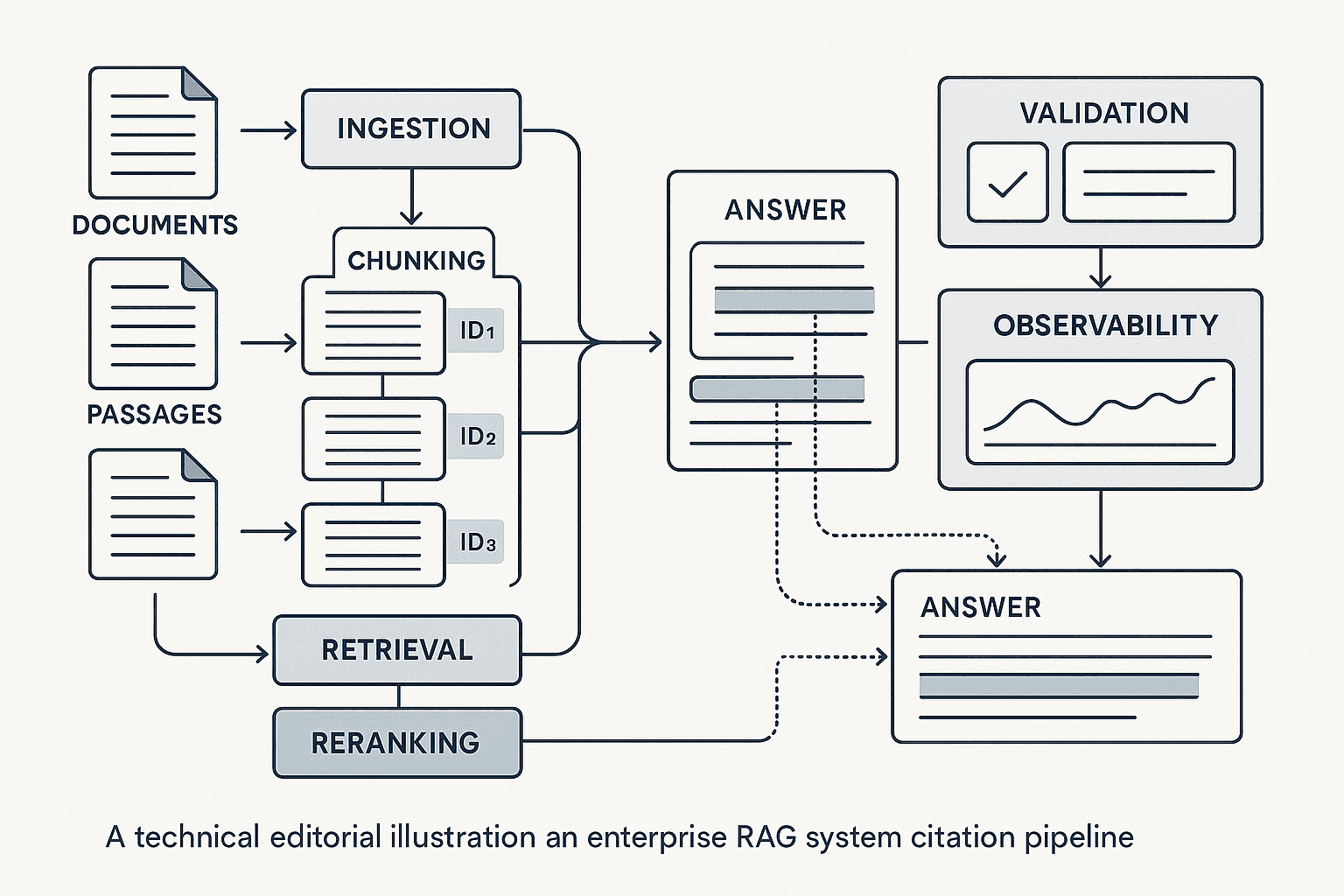
If you want grounded citations that are verifiable, stable, and useful, you need to treat citation as its own subsystem, not an afterthought hanging off retrieval. In practice, that means designing for passage-level attribution, stable identifiers, claim-to-evidence mapping, explicit support scoring, post-generation validation, and observability that can explain trust failures when they happen.
This article walks through a production approach.
The pattern behind citation failures
Across teams, the failure pattern is consistent: the system treats retrieval as proof. But retrieval only gives candidate evidence, not validated support.
A retrieved chunk can be:
- topically relevant but not claim-supporting,
- partially supportive but missing qualifiers,
- outdated relative to the document revision users care about,
- semantically close but procedurally wrong,
- or supportive only when combined with another passage.
That distinction matters because users interpret citations as an audit trail. In their mental model, a citation means: “If I click this, I should be able to verify the claim.” If what they get instead is “this was somewhere in the retrieval set,” trust erodes fast.
The deeper pattern is that answer generation and evidence attribution are separate tasks:
- Generation asks: what should be said?
- Attribution asks: what exact evidence supports each claim?
- Validation asks: does the cited evidence actually justify the wording used?
Many systems collapse all three into one model call. That keeps architecture simple, but it makes failures opaque. When a citation is wrong, you cannot tell whether the issue came from ingestion, chunking, retrieval, reranking, prompt construction, answer synthesis, or the model inventing unsupported links.
Why the naive approach fails
Let’s make this concrete.
Suppose an employee asks: “Can contractors access customer production data for troubleshooting?”
The retriever returns:
- a security policy chunk describing least-privilege access,
- a support runbook chunk about incident debugging,
- a vendor management policy chunk about contractor obligations,
- and a privacy standard chunk about approval requirements.
The model generates:
“Contractors may access customer production data only when necessary for approved troubleshooting, subject to least-privilege controls and documented authorization.”
This answer sounds plausible. It might even be substantively correct. But from a citation standpoint, it is already risky:
- “only when necessary” may come from one passage,
- “approved troubleshooting” from another,
- “least-privilege controls” from a third,
- “documented authorization” from a fourth,
- and the combination may never be stated explicitly in any source.
If the system appends four document links, users assume each supports the whole sentence. In reality, each supports only part of it, and some may add constraints the answer omitted, such as manager approval, logging requirements, or an exception process.
This is citation drift: the answer wording drifts beyond what the cited evidence directly supports.
There are several technical reasons this happens.
1. Chunk-level retrieval is not claim-level grounding
Retrieval returns passages optimized for relevance to the query, not necessarily support for each answer claim. Dense retrieval is particularly good at semantic similarity, which is useful, but similarity is not entailment.
A chunk about “debugging customer issues” may rank highly even if it never says contractors are allowed to do the work. A chunk about “authorized personnel” may rank highly even if contractors are excluded elsewhere.
2. Generation compresses and merges evidence
LLMs are good at synthesizing across documents. That is useful for answer quality, but dangerous for attribution. The more concise and polished the answer, the easier it is for unsupported connective tissue to appear:
- “therefore” logic,
- implied conditions,
- generalized rules from narrow exceptions,
- temporal assumptions across document revisions,
- and omission of qualifiers.
3. URLs and chunk references are often unstable
Enterprise content moves. SharePoint links change. Confluence pages get revised. PDFs are re-uploaded. HTML sections reflow. If your citations point to ephemeral storage paths or row IDs from a vector store, users eventually click dead or misleading links.
4. Document-level citations hide ambiguity
When support is partial, document-level links make everything look equally strong. That is a UX failure and a governance failure. In high-stakes settings, users need support granularity: exact passage, confidence, revision date, and the nature of support.
5. Teams rarely evaluate citation correctness directly
A system can score well on answer helpfulness while doing badly on citation support. If you do not run claim-support evals, unsupported citations ship unnoticed until users catch them.
A better approach: treat citations as a first-class pipeline
A production-grade citation subsystem has six layers:
- Ingestion with stable document and passage identities
- Chunking designed for evidence retrieval, not only recall
- Retrieval and reranking optimized for support, not just similarity
- Answer assembly with explicit claim-to-passage mapping
- Post-generation citation validation and support scoring
- UX and observability that expose uncertainty and debug regressions
The architecture can be implemented in different ways, but the key design principle is consistent: preserve evidence structure from ingestion through answer rendering.
Reference architecture
A practical architecture looks like this:
Ingestion layer
For each source document, store:
doc_canonical_id: stable enterprise identifier independent of storage locationdoc_version_id: immutable revision identifierdoc_titledoc_uri_current: current human-viewable URLdoc_uri_canonical: stable resolver URL if availablesource_system: SharePoint, Confluence, GDrive, S3, CMS, etc.effective_date,last_modified,owner,access_controls- structural parse: headings, paragraphs, tables, list items, section hierarchy
Then produce passages with:
passage_id: deterministic ID derived from canonical doc + version + structural offsetssection_path: e.g.Security Policy > Production Access > External Personnelchar_start,char_endwithin normalized source texttoken_start,token_endif neededpassage_text- neighboring context references: previous/next passage IDs
- content type: paragraph, bullet list, table row, note, exception, footnote
If documents have meaningful anchors, generate stable deep links to sections. If not, build your own citation resolver service that can open a document at or near the cited passage using stored offsets and text fingerprints.
Indexing layer
Maintain multiple indices:
- dense vector index for semantic recall,
- BM25/keyword index for exact terms, policy IDs, and named entities,
- metadata filters for version, business unit, jurisdiction, document status,
- optional section-level index for structural retrieval.
For each passage, also store embeddings for:
- raw passage text,
- heading + passage text,
- expanded synthetic context if you use contextual retrieval.
Retrieval and reranking layer
Use a staged approach:
- Query rewrite or decomposition if the request contains multiple sub-questions.
- Hybrid retrieval over dense + sparse + metadata-filtered candidates.
- Passage-level reranking using a cross-encoder or LLM reranker optimized for support.
- Optional evidence assembly to combine neighboring or parent/child passages when support spans chunk boundaries.
Answer planning and generation layer
Instead of asking the model to produce one freeform answer with citations, break the task into:
- claim planning,
- evidence selection,
- answer drafting constrained to selected evidence,
- citation attachment at sentence or span level.
Citation validation layer
After answer generation, run a separate validator that checks whether each claim is:
- directly supported,
- partially supported,
- unsupported,
- contradicted,
- or support-ambiguous.
This can be implemented with entailment models, verifier prompts, or both.
Serving/UI layer
Render citations inline or per sentence, with support metadata:
- source title,
- section path,
- revision date,
- exact highlighted passage,
- support strength,
- and warnings when support is partial or stitched across multiple passages.
Observability layer
Log every step:
- retrieved candidates,
- reranker scores,
- passages used in prompt,
- claim-to-passage mappings,
- validator outcomes,
- clicked citations,
- user corrections,
- and trust incidents.
Without this, you cannot debug why users say “the citations are wrong.”
Ingestion and chunking choices shape citation quality
Citation quality starts before retrieval.
Most teams chunk for embedding efficiency or retrieval recall. That is necessary but insufficient. For citations, chunking also needs to preserve evidence boundaries.
What good evidence chunks look like
A citation-friendly chunk should ideally contain:
- one coherent policy statement,
- enough local context to preserve qualifiers,
- a clear structural location,
- and stable offsets back to source.
Bad chunks for citation include:
- giant 1,500-token sections with multiple rules and exceptions,
- tiny fragments with no subject or qualifiers,
- chunks that merge unrelated bullet points,
- OCR-noisy passages,
- tables flattened so badly they lose semantics.
Practical chunking guidance
In enterprise corpora, structural chunking usually beats fixed-token windows for citation usefulness.
A common production strategy:
- Parse document structure first: headings, subheadings, bullets, tables.
- Create primary passages around semantic units such as paragraph groups, policy bullets, table rows, or procedure steps.
- Apply token caps after semantic segmentation, not before.
- Keep section headings attached to child passages for retrieval context.
- Store adjacency so you can expand to neighboring passages during evidence assembly.
Typical ranges:
- policy prose: 150–350 tokens,
- procedures/runbooks: step-level or subsection-level chunks,
- tables: row-level or row-group representations plus a structured table store,
- FAQs: one Q/A pair per chunk.
Overlap can help retrieval recall, but excessive overlap hurts citation clarity because multiple chunks contain near-identical text. That creates unstable ranking and duplicate citations. For citation systems, lighter overlap with explicit adjacency recovery is often cleaner than heavy sliding windows.
Preserve source fidelity
Normalize text carefully, but do not destroy the ability to map back to the original. You need:
- deterministic whitespace normalization,
- preserved heading hierarchy,
- footnotes and disclaimers represented clearly,
- table semantics retained,
- and text fingerprints for passage matching after source reprocessing.
If you cannot reconstruct the exact cited passage a user should see, your attribution layer will always feel brittle.
Stable document identifiers are not optional
One of the most common enterprise mistakes is using storage-path-based identifiers for citations. These break whenever content is moved, renamed, republished, or reindexed.
Instead, use a two-level identifier model:
doc_canonical_id: stable identity for the logical documentdoc_version_id: immutable identity for a specific revision
Then all passages reference both. This lets you answer key questions:
- What exact version supported this answer?
- Has the current document changed since the answer was generated?
- Should old citations resolve to archived content or redirect to latest?
For high-stakes use cases, users often need both:
- a citation to the exact supporting revision for auditability,
- and a warning if a newer revision exists.
A resolver service is worth building. It takes doc_canonical_id, doc_version_id, and passage_id, and returns:
- best current URL,
- archival URL if available,
- highlighted passage or nearest section anchor,
- metadata such as title, owner, modified date, and access check results.
This indirection decouples your answer records from source-system URL churn.
Retrieval and reranking: optimize for support, not just relevance
The retriever’s job is to surface candidate evidence. The reranker’s job is to sort likely support. These are related but not identical tasks.
Hybrid retrieval is usually the baseline
Dense retrieval handles semantic paraphrases well. Sparse retrieval catches exact terminology, policy codes, legal phrases, and entity names. In enterprise settings, hybrid retrieval almost always outperforms either alone for citation reliability.
Examples where sparse matters disproportionately:
- policy IDs,
- exact role names,
- region or product names,
- exception labels,
- contractual phrases,
- negative statements like “may not” or “must not.”
A practical setup:
- dense top-50,
- BM25 top-50,
- merge and dedupe,
- metadata filters applied early where possible,
- rerank top-50 to top-10 or top-15 with a stronger model.
Cross-encoder rerankers often pay for themselves
If you care about citation quality, a cross-encoder reranker is often one of the highest-ROI additions. Bi-encoder retrieval gets you candidates cheaply. Cross-encoders are better at deciding whether a passage actually answers the query, especially with nuanced phrasing.
Tradeoff:
- Pros: better top-k precision, fewer irrelevant citations, improved grounding
- Cons: added latency and cost proportional to number of candidate pairs
A common pattern is to use a fast reranker for all traffic and reserve an expensive LLM verifier for post-generation validation on only the claims that matter.
Retrieval should account for support completeness
For citation purposes, top-1 relevance is not enough. You need evidence sets that preserve qualifiers and exceptions.
Useful tricks:
- retrieve both matching passage and its neighbors,
- boost sections containing explicit definitions or exception headings,
- detect when support likely spans multiple passages,
- treat contradictory passages as first-class evidence, not noise.
If a query concerns permissions or eligibility, negative evidence is crucial. A system that retrieves only permissive language and misses exception clauses will produce dangerously overbroad answers with misleading citations.
Answer assembly: map claims to evidence before polishing prose
This is where many pipelines either become trustworthy or collapse into “random links.”
A better pattern is evidence-first answer assembly.
Step 1: Extract or plan claims
Given the user question and top evidence passages, ask a model to produce a structured claim plan, not final prose. For each claim, capture:
claim_id- claim text in plain, minimally compressed language
- evidence passage IDs
- whether support is direct or compositional
- unresolved ambiguities or contradictions
For the contractor example, claims might be:
- C1: Contractors can access customer production data for troubleshooting.
- C2: Access requires approval/authorization.
- C3: Access must be least-privilege.
- C4: Logging or documentation may be required.
- C5: Scope depends on policy exceptions or designated roles.
This claim plan is much easier to validate than polished prose.
Step 2: Score support per claim
For each claim, score support using explicit categories:
direct_supportmulti_passage_supportpartial_supportcontradictedinsufficient_evidence
You can also score dimensions separately:
- semantic support,
- recency/version validity,
- source authority,
- specificity,
- contradiction risk.
Step 3: Draft only from supported claims
The drafting model should be instructed to:
- include only claims above a support threshold,
- preserve important qualifiers,
- surface ambiguity where evidence is mixed,
- and keep claim boundaries recoverable so citations can attach cleanly.
This often means sacrificing some fluency for truthfulness. That is the right tradeoff in enterprise systems.
Step 4: Attach citations at sentence or span level
Document-level footnotes are not enough. The best default is sentence-level citations, with span-level highlighting in the source viewer.
For each sentence, maintain:
- supporting claim IDs,
- supporting passage IDs,
- support score,
- citation type: direct / combined / partial / disputed.
This structured mapping is what makes later validation, UI rendering, and audit logging possible.
Post-generation citation validation is where trust is won
Even with careful retrieval and claim planning, generation can still introduce unsupported language. A dedicated validator catches this.
What validation should check
For each answer sentence or claim-citation pair, ask:
- Does the cited passage directly support the claim as written?
- Are key qualifiers preserved?
- Is the claim stronger, broader, or more certain than the source?
- Does another retrieved passage contradict or narrow it?
- Is the cited document version still valid for this use case?
Implementation options
Option 1: NLI/entailment model
For shorter claims and passages, a natural language inference model can classify entailment, contradiction, or neutral.
Pros:
- fast,
- relatively cheap,
- deterministic-ish compared to a general LLM.
Cons:
- struggles with long enterprise passages,
- weaker on procedural nuance, tables, and policy language.
Option 2: LLM verifier prompt
Prompt a model with claim + cited passage + maybe neighboring context, and require a structured verdict.
Pros:
- handles nuance better,
- can explain failure reasons,
- works across messy enterprise text.
Cons:
- more expensive,
- more latency,
- may itself hallucinate unless tightly constrained.
Option 3: Cascaded validation
This is the production sweet spot for many teams:
- fast heuristic/NLI pass on every citation,
- escalate borderline or high-risk claims to LLM verifier,
- suppress or downgrade citations that fail.
What to do when validation fails
Do not just ship the answer anyway.
Options:
- rewrite the sentence to match available evidence,
- drop unsupported claims,
- mark the answer as uncertain,
- ask a clarifying question,
- or route to human review for high-risk domains.
This is one of the biggest differences between toy RAG and production RAG. Production systems need graceful degradation paths.
Citation scoring: make support explicit
A good citation system should produce a support score that combines multiple signals.
A simple scoring model might include:
- retrieval relevance score,
- reranker score,
- claim-passage entailment score,
- number of passages required for support,
- contradiction penalty,
- recency/version penalty,
- source authority weight.
For example:
citation_confidence = 0.25 * reranker + 0.35 * entailment + 0.15 * authority + 0.10 * recency - 0.10 * contradiction_risk - 0.05 * compositionality_penalty
The exact formula matters less than the behavior:
- direct support from an authoritative, current policy should rank high,
- support stitched from three passages with unresolved contradiction should rank lower,
- outdated but otherwise strong support should be flagged.
This score can drive both system behavior and UX:
- high confidence: show inline citation normally,
- medium confidence: show “supported by multiple passages” indicator,
- low confidence: suppress hard citation language or show uncertainty banner.
UX patterns for uncertainty and useful verification
Even a technically strong pipeline can fail if the UI overstates certainty.
Good citation UX helps users verify quickly.
Strong default patterns
- Inline sentence-level citation chips
- Hover/click preview with exact quoted passage
- Highlighted span in source viewer
- Section path and document revision date
- Labels such as “Direct support,” “Combined support,” or “Partial support”
- Warning when newer revision exists
Patterns that reduce false trust
- Do not show a generic “Sources” list without mapping to claims.
- Do not collapse weak and strong support into identical citation styling.
- Do not deep-link users to the top of a 60-page PDF with no highlighting.
- Do not hide contradiction warnings in audit logs only.
When uncertainty should be visible
If the answer depends on combining multiple passages, say so.
If sources disagree, say so.
If support is partial, say exactly which part is supported.
Users are more forgiving of transparent uncertainty than of polished but misleading confidence.
Evals: measure whether citations actually support claims
If you do not evaluate citation quality directly, you will optimize for the wrong thing.
A solid citation eval suite needs more than answer correctness.
Core offline metrics
1. Claim support precision
Of the claims with attached citations, what fraction are actually supported by the cited passage(s)?
This is the most important metric.
2. Claim support recall
Of the answer claims that could be supported by retrieved evidence, what fraction were given correct citations?
Useful when systems become too conservative.
3. Citation span accuracy
Does the cited passage or highlighted span contain the actual supporting text, not just the right document?
4. Overcitation / undercitation rate
- Overcitation: citations attached to unsupported or weakly related claims
- Undercitation: supported claims presented without evidence
5. Contradiction miss rate
How often did the system fail to surface contradictory or narrowing evidence that should have affected the answer?
6. Version fidelity
How often do citations resolve to the exact document revision used during generation?
Dataset construction
Build an eval set around real enterprise questions, especially high-risk categories:
- permissions and approvals,
- financial thresholds,
- legal or compliance requirements,
- exception handling,
- time-bound policy changes,
- region-specific rules.
For each example, annotate:
- expected answer claims,
- supporting passages,
- contradictory passages,
- acceptable paraphrases,
- whether support requires combining sources,
- and whether the correct outcome is uncertainty rather than a direct answer.
A small, high-quality eval set beats a giant shallow one here.
LLM-as-judge can help, but do not trust it blindly
LLM judges are useful for scaling citation support evals, especially for sentence-to-passage checks. But they need calibration against human-labeled examples, and they should output structured rationales.
A practical pattern:
- human-label 200–500 critical examples,
- benchmark judge prompts against those labels,
- use LLM judges for broad regressions,
- periodically re-audit with humans.
Online metrics and product signals
Track:
- citation click-through rate,
- time to verify after click,
- “citation not helpful” feedback,
- user trust rating by answer,
- answer accepted after citation review,
- escalation to human after weak support,
- and incidents involving stale or broken links.
These metrics often reveal issues that offline retrieval benchmarks miss.
Failure modes to design for
Production citation systems fail in recurring ways.
Citation drift
The answer wording becomes broader or stronger than evidence supports.
Mitigation:
- claim-level validation,
- conservative drafting prompts,
- suppress unsupported connective language.
Misleading support
The cited passage is relevant but does not justify the actual claim.
Mitigation:
- support-oriented reranking,
- entailment validation,
- stronger negative evals.
Version mismatch
The answer cites content from one revision but resolves users to another.
Mitigation:
- canonical + versioned IDs,
- resolver service,
- revision-aware UI warnings.
Chunk boundary loss
Critical qualifier or exception lives in neighboring text not included in the chunk.
Mitigation:
- semantic chunking,
- adjacency expansion,
- evidence assembly before generation.
Contradiction blindness
The system finds supporting text but ignores narrowing or contradictory text elsewhere.
Mitigation:
- contradiction-aware retrieval,
- explicit negative evidence checks,
- answer templates that surface disagreement.
Link rot and anchor drift
The citation URL breaks or lands at an imprecise place.
Mitigation:
- citation resolver abstraction,
- text fingerprints,
- periodic link validation jobs.
Authority confusion
A low-authority wiki page outranks the formal policy.
Mitigation:
- source authority weighting,
- metadata filters,
- policy-aware reranking.
Model and tool choices: where to spend money
Not every stage deserves the largest model.
A cost-effective production stack often looks like this:
- embeddings: small/medium embedding model for dense retrieval
- sparse retrieval: BM25 or keyword engine
- reranker: cross-encoder or compact LLM reranker
- answer generator: medium or large model depending task complexity
- validator: small NLI model plus selective LLM verifier
Cost/latency tradeoffs
Bigger generation model, weak retrieval
- Outcome: fluent answers, poor grounding
- Cost: high
- Risk: unsupported citations hidden by polished prose
Strong retrieval + reranking, moderate generator
- Outcome: usually better factual support at lower cost
- Cost: moderate
- Risk: answer fluency slightly lower, but trust better
LLM verifier on every claim
- Outcome: higher citation confidence
- Cost: can become expensive at scale
- Latency: significant unless batched or cached
Cascaded verification
- Outcome: best practical balance for many teams
- Cost: controlled
- Latency: acceptable with selective escalation
A common production compromise is to spend on retrieval precision and targeted validation before paying for the largest generation model. Citation quality usually benefits more.
Implementation details that matter more than people expect
Store text fingerprints
For each passage, store a normalized hash or fuzzy fingerprint. When source content is reprocessed, you can re-anchor old citations even if offsets shift slightly.
Preserve structural semantics for tables
A lot of critical enterprise information sits in tables. If you flatten them into plain text poorly, citations become meaningless. Represent rows with header-value context and retain table coordinates for source highlighting.
Log prompt evidence exactly
If the model saw passages A, B, and C, log that exact set. Otherwise, when a citation is challenged, you will not know whether the issue was retrieval, truncation, or generation behavior.
Distinguish evidence shown to model from evidence shown to user
Sometimes the model needs compacted or normalized text, while the user should see the original passage with formatting and context. That is fine as long as mapping is deterministic and auditable.
Cache validation results
In enterprise workloads, the same questions and passages recur. Cache claim-passage validation where possible, especially for policy FAQ traffic. This reduces latency and cost.
Add policy-specific heuristics
For some domains, generic retrieval is not enough. For example, answers about approvals, eligibility, monetary thresholds, and deadlines often deserve domain heuristics that force retrieval of definitions, exceptions, and effective-date sections.
Observability: how to debug trust regressions
When trust drops, teams usually look first at the generation model. Often the real issue is elsewhere.
You need observability at the citation pipeline level.
Minimum logs per answer
- user query
- rewritten/decomposed query
- retrieval candidates with scores
- reranked candidates with scores
- passages inserted into prompt
- generated claim plan
- claim-to-passage mapping
- validator verdicts and reasons
- final citations rendered
- clicked citations and user feedback
- source resolver results and version metadata
Dashboards worth building
- claim support precision over time
- citation failure rate by source system
- stale citation rate by document collection
- contradiction miss rate by query category
- support confidence distribution
- broken/degraded deep-link rate
- trust feedback segmented by team/use case/model version
Incident debugging examples
If support precision drops after a reindex, likely causes include:
- chunking changes,
- metadata filters lost,
- section heading attachment broken,
- reranker regression.
If users report “links go to wrong place,” likely causes include:
- source HTML changed,
- offsets invalid after parser update,
- resolver fallback too coarse.
If answer quality seems fine but trust ratings fall, likely causes include:
- citations became less precise,
- contradictory evidence hidden,
- UI styling stopped signaling uncertainty.
This is why grounded citation systems need dedicated telemetry. Traditional RAG metrics are not enough.
A practical rollout path
You do not need to build the perfect citation platform in one sprint. A staged rollout works better.
Phase 1: Stop shipping misleading document-level links
- introduce stable doc and passage IDs
- store structural offsets
- render sentence-level citations tied to passages
- add human spot checks for claim support
Phase 2: Improve support quality
- add hybrid retrieval
- introduce cross-encoder reranking
- retrieve neighbor passages
- weight authoritative sources
Phase 3: Add validation and uncertainty handling
- implement claim planning
- add claim-passage support scoring
- run post-generation validation
- suppress or rewrite unsupported claims
Phase 4: Operationalize trust
- build citation resolver service
- add observability dashboards
- create offline citation eval suite
- track online trust metrics and regressions
In most enterprises, Phase 1 and 2 already produce a visible trust improvement. Phase 3 and 4 are what make the system resilient at scale.
Takeaways
Enterprise RAG citations fail when they are treated as decorative output instead of evidence infrastructure.
The production mindset is straightforward:
- retrieval gives candidates, not proof,
- document links are not enough,
- support must be mapped at the claim or sentence level,
- source identities must survive revisions and reindexing,
- generation should be constrained by evidence,
- citations need post-generation validation,
- and trust requires observability plus evals designed for support, not just answer quality.
If you implement only one shift, make it this: stop asking the model to “answer with citations” in one opaque step. Split answering from attribution from validation.
That single architectural decision unlocks better UX, clearer debugging, stronger evals, safer uncertainty handling, and citations users can actually verify.
Because in enterprise settings, a citation is not a link. It is a contract with the user: this claim can be checked. Your pipeline should be engineered accordingly.