Designing Deterministic Preprocessing Pipelines for RAG: Chunking, Normalization, and Metadata That Survive Production
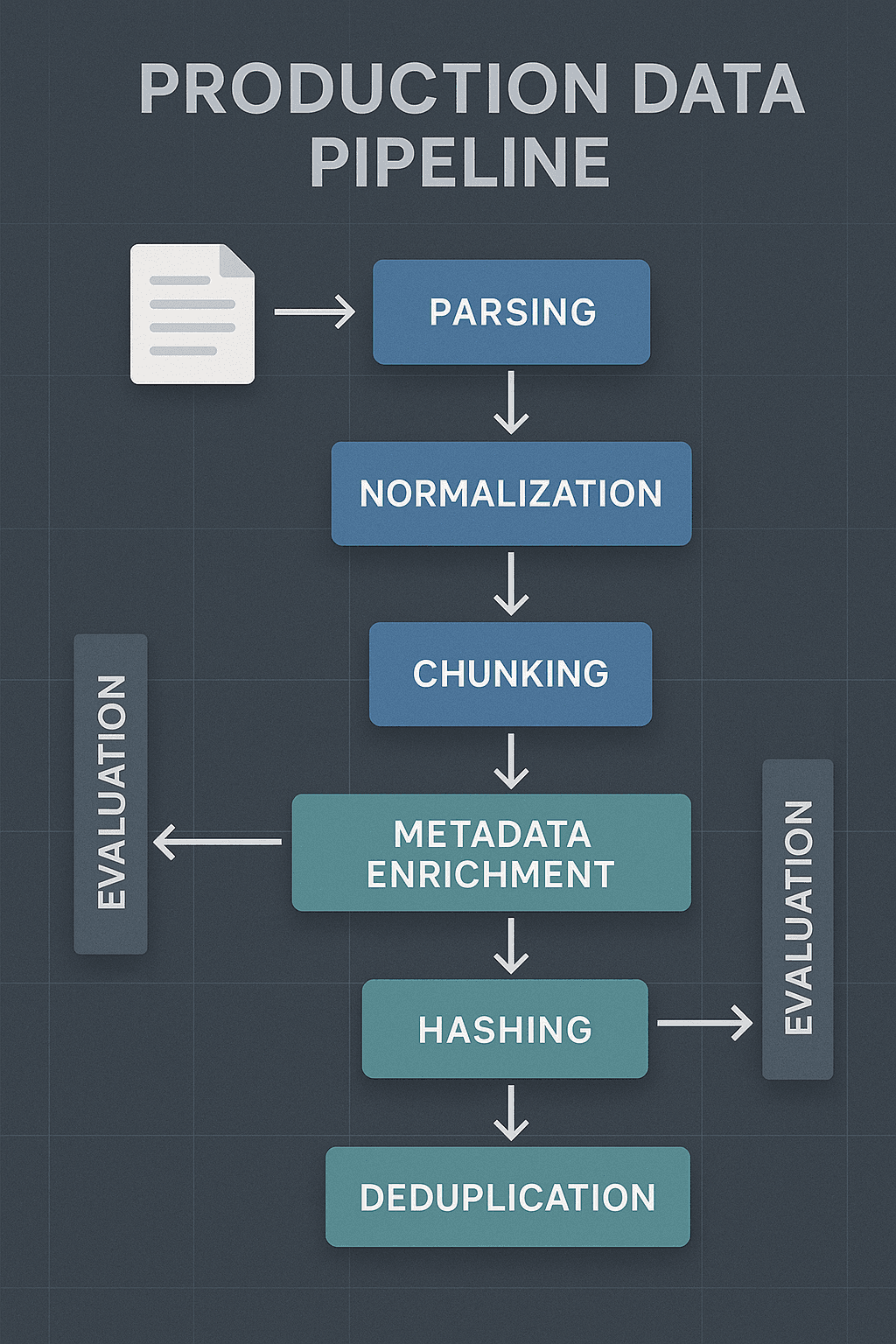
A team ships a RAG assistant for internal support. Early demos look great. The corpus is modest: policy PDFs, product docs, runbooks, engineering RFCs, and some exported Confluence pages. Retrieval metrics are acceptable, latency is fine, and users like that answers cite sources.
Three months later, the same team does a routine reingest after upgrading its PDF parser and tweaking chunk size from 800 to 600 tokens to improve answer grounding. Nothing else changes. No one expects drama.
But support agents start reporting weird behavior. Queries that used to return the exact troubleshooting runbook now retrieve a generic overview page. Citations point to slightly different paragraphs than before. A few high-value documents seem to have disappeared from retrieval entirely, even though they are still in the index. Offline embedding quality appears unchanged. End-to-end answer quality drops just enough that people lose trust.
The postmortem reveals something uncomfortable: the model did not regress first. The preprocessing pipeline did.
The PDF parser started emitting different line breaks and table cell order. Boilerplate headers that were previously stripped are now retained. The chunker now cuts sections mid-list instead of on heading boundaries. Metadata fields changed shape between sources, so filters no longer behave consistently. Duplicate content from mirrored systems got embedded twice under different IDs. Existing chunk IDs were derived from array position, so almost every chunk changed identity across reingest even when the underlying content was semantically the same. As a result, retrieval distribution shifted silently.
This is one of the most common production failures in RAG systems: retrieval instability caused by nondeterministic preprocessing. Teams spend months tuning models, prompts, rerankers, and vector DB settings while treating ingestion as plumbing. In practice, preprocessing is part of the model. If it changes, behavior changes.
This article is a production-focused guide to designing deterministic preprocessing pipelines for RAG so retrieval quality stays stable across reingests, parser upgrades, and releases. I’ll cover parser variability, canonicalization, chunk boundary strategy, table and code extraction, metadata design, deduplication, content hashing, lineage, regression testing, and rollout patterns that catch regressions before users do.
The pattern: retrieval quality is often dominated by ingestion consistency
In many teams, the first version of RAG preprocessing looks like this:
- Pull files from several systems.
- Extract text with a parser.
- Clean up obvious whitespace.
- Split into chunks by token count.
- Embed chunks.
- Store chunks in a vector index with some metadata.
This is enough to get a demo working. It is not enough to keep retrieval behavior stable in production.
The reason is simple: retrieval systems are highly sensitive to boundary decisions and identity decisions.
A retrieval index is not just “the content.” It is a specific decomposition of content into units, each with:
- a textual representation
- boundaries
- metadata
- identifiers
- lineage back to source
- an embedding generated from that exact representation
If any of those change, retrieval can change:
- Different newline handling changes embeddings.
- Different header/footer stripping changes lexical overlap and reranker scores.
- Different chunk boundaries change whether the answer-bearing sentence appears with the right context.
- Different metadata changes filtering and ranking.
- Different IDs break cached evals, annotations, and click histories.
- Different parser output for tables/code can destroy answerability for whole classes of queries.
The lesson: deterministic preprocessing is not a data engineering nice-to-have. It is a retrieval quality requirement.
Why the naive approach fails
1. Parsers are not stable abstractions
PDFs, DOCX, HTML, Markdown exports, PowerPoint, ticket dumps, wiki pages, and spreadsheet exports all carry structure differently. Parsing libraries make tradeoffs. Upgrading them can change:
- reading order
- handling of ligatures and Unicode normalization
- header/footer detection
- footnote placement
- table flattening
- code block detection
- list item grouping
- image OCR inclusion
- page break insertion
Two parser versions can both be “correct” yet produce meaningfully different text for embedding. If your pipeline treats parser output as canonical truth, you’ve made retrieval stability dependent on parser internals.
2. Chunking by token count alone destroys semantic boundaries
Fixed-size token chunking is attractive because it is easy and often good enough for small corpora. But in production, it creates subtle instability:
- a new disclaimer at the top of a doc shifts all later chunk boundaries
- parser-induced line break changes alter tokenization and boundary positions
- important list items or table rows get separated from section headings
- updates to one paragraph reflow chunk alignment for the rest of the document
This leads to cascading changes in chunk identity and retrieval behavior.
3. Metadata is often treated as an afterthought
Metadata usually starts as whatever happens to be available: source, title, maybe url. Over time, teams add department, product, acl, timestamp, and source-specific fields. Soon there are five versions of “document type,” three timestamp formats, inconsistent URL canonicalization, and filter logic that behaves differently by source.
In production, metadata is not decoration. It is a contract between ingestion, retrieval, permissions, evals, observability, and application logic.
4. Identity based on position is brittle
A depressingly common pattern is assigning chunk IDs like:
<document_id>_<chunk_number>
This seems fine until a parser upgrade inserts one extra paragraph near the top. Then every subsequent chunk number changes. Suddenly:
- the same content gets new IDs
- annotations and human judgments no longer join cleanly
- dedup logic breaks
- index diffing becomes noisy
- “what changed?” becomes impossible to answer
5. Silent regressions are easy to miss
Many teams evaluate only answer quality after indexing. But if the answer model is flexible, it can mask retrieval regressions for a while. You need preprocessing-level and retrieval-level regression checks, not just generation checks.
The better approach: design preprocessing as a deterministic, versioned compiler
The most useful mental model I’ve found is this: your preprocessing pipeline is a compiler from messy enterprise documents into retrieval units.
Compilers need deterministic semantics, explicit versions, reproducible outputs, and tests for behavior changes. So should RAG preprocessing.
A production-grade pipeline should have these properties:
- Deterministic: same input + same pipeline version => same canonical chunks and metadata
- Versioned: parser version, normalization rules, chunking logic, metadata schema, and embedding model are all explicit
- Composable: parsing, normalization, segmentation, enrichment, deduplication, and indexing are separate stages
- Diffable: you can compare outputs between pipeline versions in a meaningful way
- Lineage-aware: every chunk traces to exact source bytes and transformation steps
- Regression-tested: known documents and retrieval queries are used to detect changes before rollout
- Rollback-safe: old and new indexes can coexist during validation
Here is the architecture I recommend.
Reference architecture for deterministic RAG preprocessing
Stage 0: Source acquisition with immutable snapshots
For every source document, persist:
- raw bytes or raw export payload
- source system ID
- source URI
- retrieval timestamp
- ETag or source version if available
- ACL snapshot if relevant
- MIME type / file type
Key rule: downstream stages should work from an immutable snapshot, not a live source fetch. Otherwise, reprocessing is not reproducible.
Store a source_blob_hash over raw bytes using SHA-256. This is the root identity for lineage.
Stage 1: Parsing into an intermediate representation
Do not jump directly from parser output string to chunking. First parse into a document intermediate representation (IR), for example:
- document
- sections
- blocks
- paragraph
- heading
- list
- list_item
- table
- code_block
- quote
- image_with_ocr
- footnote
- blocks
- sections
Each block should carry:
- block type
- textual content
- source spans if available
- page number / slide number / section path
- parser confidence or extraction notes
- ordering index
Why this matters:
- You can normalize differently by block type.
- You can chunk by structure instead of blind token windows.
- You can preserve table and code semantics.
- You get stable hooks for testing parser changes.
If you support multiple parsers for a source type, define a common IR and adapters into it. That isolates parser variability.
Stage 2: Canonicalization and normalization
Normalization should be explicit, deterministic, and heavily tested. Typical steps:
- Unicode normalization, usually NFKC unless there is a reason not to
- whitespace normalization
- newline normalization
- dehyphenation for line-wrapped words where confidence is high
- removal or tagging of repeated headers/footers
- canonical bullet handling
- quote normalization
- URL canonicalization
- email / identifier canonical formatting where appropriate
- normalization of page number artifacts
- removal of invisible control chars
Important nuance: do not over-normalize.
You are not preparing text for a bag-of-words system. You are preserving semantics for embedding and citation. For example:
- keep casing if product names or code identifiers depend on it
- keep punctuation in code and commands
- preserve table column separation somehow
- preserve section hierarchy
A practical pattern is to maintain two related text views:
- Canonical retrieval text: normalized for stable embedding/retrieval
- Display text: closer to original formatting for citations/UI
The retrieval text should be deterministic and optimized for semantic consistency. The display text should preserve readability and trust.
Version your normalization ruleset explicitly, e.g. norm_v3.
Stage 3: Structural segmentation before chunking
Before token-based chunking, segment documents into semantically meaningful units using the IR:
- section boundaries from headings
- list boundaries
- table boundaries
- code block boundaries
- FAQ item boundaries
- slide boundaries for presentations
- issue/comment boundaries for ticketing systems
This step creates candidate segments that are structurally coherent. Then chunking operates within those segments.
This reduces the blast radius of small upstream changes. If a disclaimer appears at the top, it should not shift the chunking of every section downstream.
Stage 4: Deterministic chunking
Chunking should balance retrieval granularity, context completeness, latency, and cost. There is no universally correct size, but there are stable patterns.
A production chunker should use:
- structure-aware boundaries first
- token limits second
- deterministic overlap rules
- typed handling for tables and code
- stable chunk IDs based on content, not position alone
A robust algorithm often looks like this:
- Start with structural segments.
- If a segment exceeds target token size, split by substructure in order:
- paragraph boundaries
- list item boundaries
- sentence boundaries
- hard token cutoff as last resort
- Add overlap only within the same parent section.
- Preserve heading context by prefixing or attaching section path metadata.
- Never merge unrelated sections just to fill a target size.
For many enterprise corpora, a good starting range is:
- 400–800 tokens for prose-heavy docs
- smaller for FAQs or short policy clauses where atomicity matters
- specialized handling for code and tables
The key is not the exact number. The key is deterministic behavior and evaluation on your query set.
Stable chunk identity
Assign chunk IDs from canonicalized content plus structural lineage, for example:
chunk_id = sha256(document_logical_id + section_path + block_type + canonical_text + chunking_version)
This lets semantically unchanged chunks retain identity across reingests even if neighboring content changes.
You may still want a separate:
document_snapshot_idfor exact snapshot lineagechunk_instance_idfor a specific chunk in a specific ingestchunk_stable_idfor semantic identity across ingests
That distinction is worth making early.
Handling the hard parts: tables, code, and mixed-format content
The fastest way to wreck retrieval for high-value technical corpora is to flatten everything into plain paragraphs.
Tables
Tables are retrieval-critical in product docs, pricing docs, runbooks, compliance matrices, and support knowledge bases. Naive extraction often outputs them as scrambled text.
Better options, in increasing sophistication:
-
Delimited text rendering
- Convert to a stable markdown-like or TSV-like representation.
- Preserve header rows.
- Repeat headers in split table chunks.
-
Row-oriented chunks
- One chunk per table row or small row groups, plus schema context.
- Useful when queries target specific entries.
-
Hybrid representation
- Store both a table-level summary text and row-level retrieval units.
A practical row chunk might look like:
- table title
- section path
- columns:
Error Code | Meaning | Recommended Action - row:
E137 | Token expired | Refresh credentials and retry
This tends to retrieve better than a flattened paragraph because the schema is retained.
Key deterministic rules for tables:
- normalize column ordering
- preserve merged-cell semantics explicitly if possible
- carry table title/caption
- carry source page/section
- split large tables predictably
Code and commands
For engineering corpora, code blocks and shell commands are often the answer. Generic normalization can ruin them.
Recommendations:
- treat code blocks as first-class block types
- preserve indentation and punctuation in display text
- normalize line endings deterministically
- consider a code-specific retrieval text where comments and surrounding headings are attached
- chunk by function/class/example block rather than arbitrary token counts where possible
Useful metadata:
- language
- file path or pseudo-path
- symbol names if extractable
- surrounding section heading
In some cases, maintaining separate indexes or retrieval strategies for code and prose is worth it.
Mixed content and OCR
Scanned PDFs and slide decks introduce OCR noise. If OCR is used:
- record OCR engine and version
- record confidence metrics
- avoid mixing low-confidence OCR text into high-confidence text without flags
- consider separate retrieval weighting or exclusion thresholds
Nothing creates unstable retrieval faster than silently changing OCR engines and reembedding everything without measuring impact.
Metadata design that survives production
Metadata has to serve multiple systems at once:
- retrieval filters
- ACL enforcement
- ranking features
- observability
- experimentation
- lineage/debugging
- UI citations
Design a typed metadata schema with source-specific extensions, not a free-for-all.
Core document-level metadata
Recommended fields:
document_logical_id: stable ID for the logical document across versionsdocument_snapshot_id: ID for this exact source snapshotsource_system: e.g. confluence, sharepoint, github, zendesksource_urisource_pathtitledocument_typeowner_orgcreated_atupdated_atlanguageacl_principal_idsor reference to ACL objectsource_blob_hashparser_versionnormalization_versionchunking_versionembedding_model
Chunk-level metadata
Recommended fields:
chunk_stable_idchunk_instance_idparent_document_logical_idparent_document_snapshot_idsection_pathblock_types_presenttoken_countchar_countpage_rangetable_id/code_block_idif relevantcanonical_text_hashdisplay_text_hashlineage_transform_ids
Metadata design rules
-
Use canonical enums where possible
- not
docType,document_type, andtypeall at once
- not
-
Separate stable identity from mutable attributes
- title can change; logical ID should not
-
Avoid source leakage into retrieval contracts
- normalize source-specific fields into shared concepts
-
Version your schema
- retrieval and eval systems should know what schema version they are consuming
-
Keep filtering metadata compact
- large metadata blobs hurt index performance and complicate sync
Deduplication and near-duplicate control
Enterprise content is duplicated everywhere:
- the same policy in SharePoint and PDF export
- docs mirrored between public and internal portals
- release notes repeated in emails and wiki pages
- support articles cloned by region with small differences
Embedding all duplicates creates noisy retrieval, crowding top-k with similar chunks.
Exact deduplication
At minimum, deduplicate exact canonical text matches with:
canonical_text_hash- optionally scoped by ACL or source trust tier
Exact dedup can happen:
- within a document
- across documents in the same source
- across sources
Whether to collapse duplicates across sources depends on citation and permissions needs. Often the right answer is to group them behind a common content fingerprint while preserving multiple source references.
Near-duplicate handling
For near duplicates, use one or more of:
- MinHash / SimHash over canonical text
- embedding similarity clustering with caution
- template-aware normalization for repeated boilerplate
Do not over-collapse. Regional variants or version-specific docs may look similar but answer different questions.
A useful production pattern is:
- maintain a duplicate group ID
- choose a representative chunk for retrieval/ranking
- preserve alternate source references for citations and ACL-aware expansion
Content hashing and lineage: make every retrieval unit explainable
When retrieval shifts, you need to answer:
- Did source content change?
- Did parser output change?
- Did normalization change?
- Did chunking change?
- Did metadata or ACLs change?
- Did embeddings change?
You cannot answer these without lineage.
Hashes to keep
Recommended hashes:
source_blob_hash: raw source bytesparsed_ir_hash: canonical serialization of the parsed IRcanonical_document_text_hashcanonical_chunk_text_hashmetadata_projection_hash: hash over retrieval-relevant metadata fieldsembedding_input_hash: exact text sent for embedding plus embedding-model-prep version
These let you localize where change occurred.
Transformation log
For each document snapshot, persist a transformation log such as:
- acquired source snapshot
- parsed with parser X version Y
- normalized with ruleset Z
- segmented with segmenter A
- chunked with chunker B params C
- embedded with model M
- indexed into corpus build N
This can be an event log or materialized lineage table. The point is operational traceability.
Evaluation strategy: prevent silent retrieval regressions
This is where most teams are underinvested. You need evals specifically for preprocessing and retrieval stability.
Layer 1: Document transformation golden tests
Create a curated set of nasty documents:
- multi-column PDFs
- docs with repeated headers/footers
- large tables
- markdown with code fences
- docs with Unicode oddities
- OCR-heavy scans
- exported wiki pages with nested lists
For each document, store expected outputs at key stages:
- parser IR assertions
- canonical text assertions
- section path assertions
- chunk boundary assertions
- metadata assertions
Do not try to snapshot every byte of every output unless your pipeline is fully deterministic and compact. Instead assert the important invariants:
- number of top-level sections
- presence of key strings in the right block type
- table headers preserved
- code blocks not flattened
- stable chunk count within tolerance
- repeated footer removed
These tests catch parser and normalizer regressions early.
Layer 2: Index diff metrics between builds
When you produce a new corpus build, compare against the current build with metrics like:
- % of documents with changed
parsed_ir_hash - % of chunks retaining same
chunk_stable_id - chunk count delta by source and doc type
- token count distribution shifts
- duplicate rate changes
- metadata field null-rate changes
- ACL coverage changes
This is your ingestion diff dashboard. It should be reviewed before promotion.
Rules of thumb:
- big shifts concentrated in one source often indicate parser/source export issues
- broad shifts after a code change often indicate normalization/chunking instability
- null-rate spikes in metadata often break filters silently
Layer 3: Retrieval regression suite
Maintain a fixed query set with relevance judgments. At minimum:
- head queries from production
- failure cases from incidents
- curated edge cases for tables/code/ACL-sensitive retrieval
Measure:
- Recall@k
- MRR / nDCG
- citation exactness or source hit rate
- filtered retrieval correctness
- top-k diversity / duplicate crowding
Most importantly, compare old build vs new build on the same query set.
If possible, segment metrics by query class:
- fact lookup
- troubleshooting steps
- policy lookup
- code/config retrieval
- table lookup
- acronym resolution
Preprocessing regressions are often highly class-specific. Averages hide them.
Layer 4: End-to-end answer evals
Yes, do these too. But use them after retrieval evals, not instead of them.
Track:
- grounded answer correctness
- citation support rate
- abstention behavior when retrieval misses
- answer latency and cost
The answer model can compensate for some retrieval changes. That is exactly why preprocessing regressions can sneak through. Retrieval-level evals should gate rollout.
Model and tool tradeoffs in preprocessing-related choices
Even though this article is about preprocessing, model choices interact with pipeline design.
Embedding model sensitivity
Different embedding models react differently to formatting noise, code, and tables.
In practice:
- larger embedding models are often more robust to mild normalization inconsistencies, but cost more
- smaller models are cheaper and faster, but can be more sensitive to chunk formulation
- multilingual models may require more careful language metadata and normalization
- code-aware embedding models can help technical corpora, but may underperform on business prose if used universally
Recommendation: do not assume a stronger embedding model fixes bad preprocessing. It often masks it expensively.
Rerankers
Rerankers can rescue some coarse chunking errors, but they also depend on chunk formulation.
Tradeoff:
- Pros: better top-k ordering, especially for long or overlapping chunks
- Cons: extra latency/cost, can amplify duplicated or boilerplate-heavy chunks if preprocessing is weak
If you use reranking, test preprocessing variants with and without it. You want the ingestion pipeline to produce good candidates before reranking.
Parser choice
Parser selection is not just an accuracy question. It is a stability and operability question.
Evaluate parsers on:
- structural fidelity
- table extraction quality
- deterministic output across versions/platforms
- speed and cost
- failure modes and confidence signals
- ability to preserve source coordinates
For some teams, paying more for a parser with stronger table/layout handling is worth it because it reduces retrieval incidents downstream.
Cost and latency tradeoffs
Deterministic preprocessing sounds expensive. Sometimes it is. Usually it is cheaper than instability.
Where cost increases
- storing raw snapshots and lineage
- maintaining IR instead of plain text only
- running richer parsers or OCR
- computing build diffs and regression evals
- dual indexing during rollouts
Where cost decreases
- fewer unnecessary reembeds due to stable content hashing
- reduced duplicate embeddings and index bloat
- faster incident diagnosis
- lower support load from retrieval drift
- more predictable release cycles
A common win is incremental reprocessing:
- if
source_blob_hashunchanged, skip parse - if
parsed_ir_hashunchanged, skip normalization-sensitive downstream steps - if
canonical_chunk_text_hashunchanged, skip reembedding for that chunk
This can dramatically reduce ingest cost for large corpora.
Latency implications
At query time, better preprocessing often improves latency indirectly:
- better chunk quality means smaller
kcan work - fewer duplicates means less reranker waste
- better metadata means tighter filtering before expensive ranking
So while preprocessing adds offline complexity, it often pays back in online efficiency.
Implementation details that matter more than people expect
Deterministic serialization
If you hash IR or metadata, define a canonical serialization:
- sorted object keys
- normalized arrays where ordering should be stable
- explicit null handling
- fixed timestamp format
- explicit float formatting if needed
Without canonical serialization, your hashes lie.
Stable ordering rules
Whenever the parser or source does not guarantee order, define one:
- page, then y-position, then x-position for PDF blocks if applicable
- heading hierarchy before paragraph order in section reconstruction
- source-native ordering for ticket comments or wiki children
Underspecified ordering is a hidden source of nondeterminism.
Boilerplate handling
Header/footer stripping should be rule-based and observable, not magical. Keep:
- extracted candidates
- removal decision reason
- before/after examples in tests
If boilerplate removal gets aggressive, you will eventually delete meaningful repeated content.
Section path construction
Section path is one of the most useful retrieval features. Build it carefully.
Example:
Product Docs > Authentication > Token Refresh > Error Codes
Use it for:
- chunk context prefixing
- filtering
- UI breadcrumbs
- retrieval debugging
Keep the construction deterministic and source-agnostic where possible.
ACL propagation
If documents have permissions, ACL metadata must be propagated to every retrieval unit deterministically. A surprising number of production bugs come from chunk-level ACL drift after reprocessing.
Backfills and partial rebuilds
Do not mix chunks built with incompatible preprocessing versions in the same logical corpus unless you have a clear compatibility policy. Mixed-version indexes make evaluation noisy and debugging miserable.
A good rule is to stamp each chunk with a corpus_build_id and keep build membership explicit.
Rollout patterns that prevent user-visible regressions
1. Build new indexes side-by-side
Never overwrite the serving index blindly. Build corpus_build_n+1 alongside corpus_build_n.
Then run:
- ingestion diff checks
- retrieval regression suite
- selective human review on changed high-value queries
2. Shadow retrieval
For a period, issue production queries to both old and new indexes.
Compare:
- top-k overlap
- source hit changes
- score distribution shifts
- filter behavior
- answer support changes if generation is also shadowed
You do not need to expose the new results to users yet.
3. Progressive traffic shifting
If metrics look good, shift a small percentage of traffic to the new build. Monitor:
- clickthrough or citation-open behavior
- user dissatisfaction signals
- fallback/abstain rate
- support escalations
4. Fast rollback
Rollback should mean flipping build routing, not emergency reingestion. If rollback requires recomputing the index, your deployment model is too fragile.
A practical operating model for teams
If I were setting this up with an engineering team today, I would define four release artifacts:
-
Pipeline code version
- parser adapters, normalization logic, chunking logic
-
Schema version
- IR and metadata contracts
-
Corpus build ID
- a concrete indexed build from specific source snapshots and model versions
-
Eval report
- diff metrics, retrieval regressions, and rollout approval record
That lets you answer the key production question: “What exactly changed?”
I would also define ownership clearly:
- platform/data engineering owns reproducibility and lineage
- search/ML owns retrieval metrics and eval gates
- application team owns answer-level experience and rollback decisions
Without explicit ownership, ingestion drift sits in the gaps.
What to do first if your pipeline is already messy
Most teams do not get to start clean. If your RAG ingestion is already in production, here is the order I would tackle it.
Phase 1: Add observability before changing behavior
Implement immediately:
- raw snapshot storage
- source and chunk hashing
- parser/chunker/embedding version stamps
- build IDs
- retrieval diff reporting between ingests
Even before making preprocessing smarter, make it explainable.
Phase 2: Stabilize identity and metadata
Next:
- define logical document IDs
- move from positional chunk IDs to stable content-derived IDs
- standardize metadata schema and timestamps
- fix URL/path canonicalization
This makes every later improvement safer.
Phase 3: Introduce IR and structure-aware chunking
Then:
- parse into structured blocks
- preserve headings/tables/code
- chunk by structural boundaries
- add section path metadata
This usually yields the biggest retrieval quality improvement.
Phase 4: Add regression gates and side-by-side rollouts
Finally:
- golden document tests
- retrieval benchmark suite
- build comparison dashboard
- shadow and canary release process
At that point, you have a production system instead of a demo pipeline.
The core takeaways
RAG systems fail in production less often because the LLM got worse than because the retrieval substrate changed under it. Preprocessing is part of that substrate.
If you want retrieval quality to stay stable across reingests and releases:
- treat preprocessing as a deterministic, versioned compiler
- parse into an intermediate representation, not directly to plain text
- canonicalize text with explicit, tested rules
- chunk by structure first, token budget second
- handle tables and code as first-class content types
- design metadata as a typed contract, not incidental baggage
- use content hashes and lineage so every chunk is explainable
- deduplicate aggressively but carefully
- gate releases with transformation tests and retrieval regression evals
- deploy new corpus builds side-by-side and roll them out progressively
The most important mindset shift is this: a RAG index is not just a cache of documents. It is a built artifact with semantics. Build it the way you would build any critical production artifact: deterministically, observably, and with tests that catch regressions before customers do.
Teams that do this stop having mysterious “the assistant feels off this week” incidents. They can change parsers, upgrade embedding models, refine chunking, and add new content sources without losing trust. That is what surviving production actually looks like.