Counterfactual Evaluation for LLM Systems: Measuring Whether Retrieval, Routing, or Prompt Changes Actually Caused the Outcome
A team ships what looks like a modest improvement to their support copilot: a new retriever, a slightly stricter system prompt, and a routing rule that sends “refund” questions to a cheaper model unless confidence is low. Offline tests looked fine. A week later, customer satisfaction drops two points, tool-call retries spike, and human reviewers report more answers that are “plausible but wrong.”
The postmortem goes nowhere fast.
Retrieval engineers say the new index improved recall on their benchmark. The prompt team points out that the new template reduced policy violations in staging. Platform says latency got better, not worse. The routing team notes that the expensive fallback model was still available. Everyone has metrics showing their change was either neutral or positive in isolation. Nobody can say what actually caused the production outcome.
This is the normal failure mode for LLM systems.
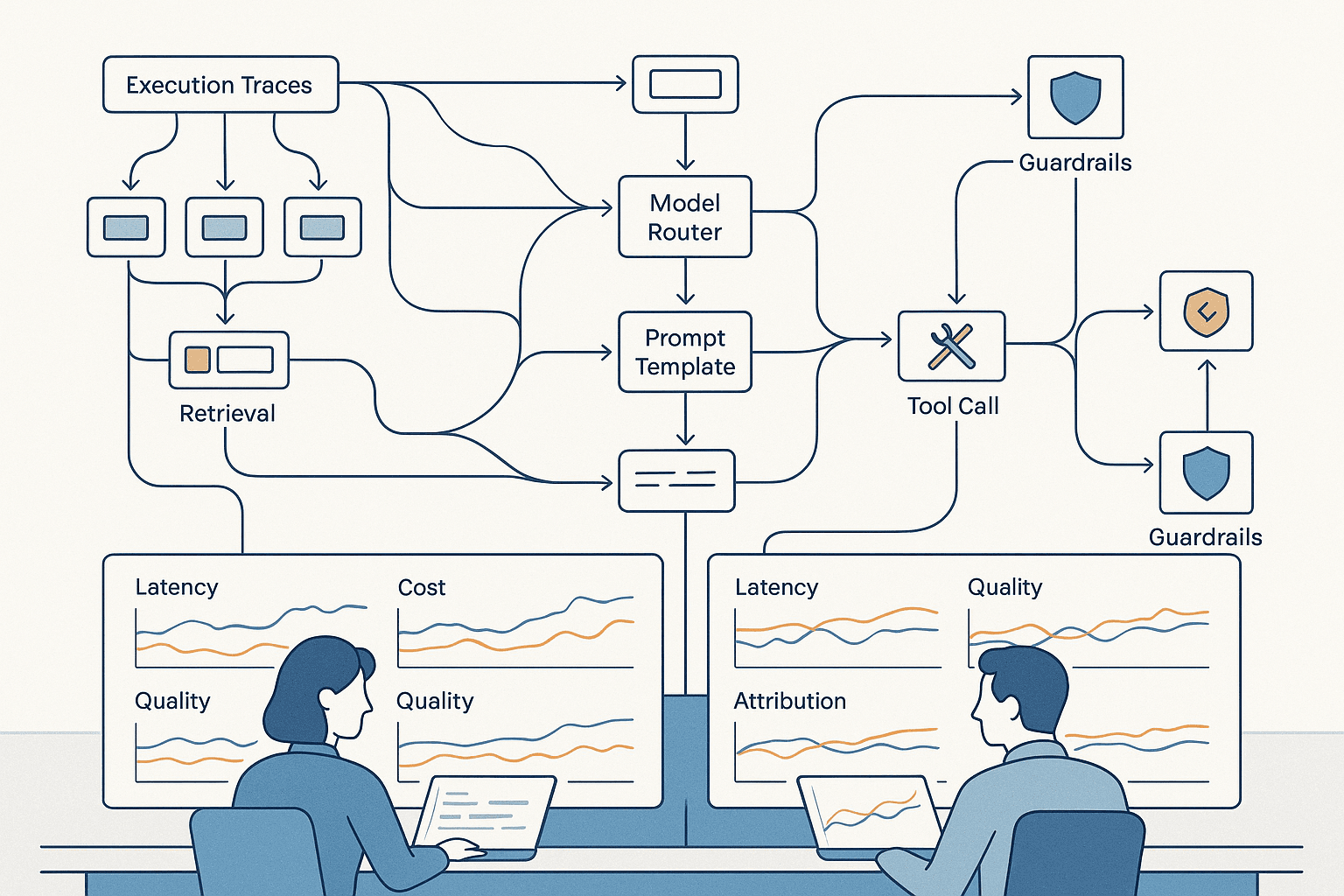
GenAI applications are not single-model products. They are decision pipelines: query rewriting, retrieval, reranking, prompt assembly, model routing, tool selection, tool execution, guardrails, and post-processing. When quality moves, teams often evaluate at the pipeline level and speculate at the component level. They know the outcome changed, but not whether retrieval, routing, prompt wording, tool policy, or guardrails caused it.
That gap is where teams burn months.
Counterfactual evaluation is the discipline of answering a harder but much more useful question than “did metrics move?” It asks: if we held everything else constant and changed only one decision, would the outcome have changed? In other words, what was the causal impact of this retrieval policy, reranker, prompt template, route, tool policy, or guardrail on the final user-visible result?
For production teams, this matters for three reasons:
- It prevents false confidence from aggregate A/B outcomes that mix multiple effects.
- It makes shipping safer by isolating regressions before rollout.
- It creates reusable evidence for where to invest: better retrieval, better routing, better prompts, or better tool policy.
This article is a practical guide to counterfactual evaluation for LLM systems. I’ll focus on what actually works in production: trace capture, intervention testing, replay harnesses, decision-level attribution, evaluation design, and the cost/latency tradeoffs of doing this continuously.
The pattern: most LLM regressions are attribution failures before they are model failures
In classic software, you can often map a defect to a specific code path. In LLM systems, the same bad final answer can emerge from many different upstream causes:
- Retrieval missed the right document.
- Retrieval found it, but reranking buried it.
- The prompt never exposed the key evidence.
- The route sent the request to a model too weak for the task.
- The model chose not to call a necessary tool.
- The tool returned the right result, but the answer synthesis ignored it.
- A guardrail stripped critical context.
- A refusal policy overfired.
- A query rewrite changed the user’s intent.
If you only look at the final response, these failures are observationally equivalent. They produce the same symptom: bad output.
This is why naive evaluation is so often misleading. Teams run an online experiment with several linked changes, observe a movement in win rate or task success, then attribute success or failure to the most salient component. That is storytelling, not measurement.
A production-grade evaluation system needs to capture the chain of decisions and enable controlled replay of alternative decisions. Think less “did version B beat version A?” and more “for this exact trace, what if the retriever had returned a different top-5? what if the router had selected a different model? what if the tool policy had forced lookup before answer generation?”
That’s the level where causal insight starts.
Why the naive approach fails
There are four common naive approaches.
1. End-to-end benchmark scores without execution traces
A benchmark says the new pipeline improved answer correctness from 71% to 74%. Useful, but incomplete. If the pipeline changed retrieval, prompt, and routing together, the benchmark cannot tell you which component contributed what. You get a top-line number but no operational guidance.
Worse, teams often change multiple hidden defaults at once: prompt instructions, retrieval chunk size, top-k, temperature, timeout policy, and fallback route. Then they compare “before” and “after” as if it were one intervention.
2. Component benchmarks disconnected from system behavior
The retriever team evaluates nDCG or recall@k on a labeled set and declares victory. The prompt team evaluates refusal compliance and brevity on another set. The router team optimizes cost under a synthetic workload. Each local metric can improve while the global system gets worse.
Why? Because component quality is mediated by downstream consumers.
A retriever that improves semantic diversity may lower answer quality if the prompt budget truncates the most decisive evidence. A stricter guardrail can reduce policy risk but increase tool retries, which introduces latency and abandonment. A cheaper model route can work on average but fail specifically when retrieval confidence is noisy.
The problem is not that component metrics are useless. It’s that they are not causal evidence for final outcome unless tested in the exact execution context.
3. Online A/B tests that confound multiple policy changes
A/B testing is still essential, but many teams use it too late and too broadly. By the time a policy is online, the blast radius is real. And if the treatment bundles a new retriever, reranker, and route policy, the result tells you the package effect, not the component effect.
That can be enough for shipping a product decision. It is not enough for learning how your system works.
4. LLM-as-judge without trace-aware rubrics
Automated judges are increasingly useful, but many teams ask the judge only about the final answer: “Which response is better?” Without access to retrieved evidence, tool outputs, policy constraints, and route context, a judge cannot tell whether a response was correct because of retrieval quality, despite retrieval quality, or in violation of the required behavior.
Judging the final output alone is often an attribution dead end.
What better looks like: a counterfactual evaluation architecture
A production-ready counterfactual eval stack has five layers:
- Full-fidelity trace capture
- Stable replay harness
- Intervention engine
- Decision-level attribution and metrics
- Targeted online validation
Let’s make this concrete.
Layer 1: full-fidelity trace capture
You cannot run counterfactuals on what you did not record.
For every request, capture a structured execution trace with at least:
- User input and session context
- Query rewrite outputs
- Retrieval inputs, corpus version, filters, top-k, scores, and returned document IDs
- Reranker inputs, scores, and ordering
- Prompt template version and fully rendered prompt segments
- Model selection decision, candidate models considered, route features, and confidence scores
- Tool policy decision, allowed tools, tool arguments, tool outputs, retries, timeouts
- Guardrail checks, transformations, and refusal reasons
- Final response and post-processing
- Latency and cost per stage
- Feature flags and policy versions
- Random seeds or deterministic decoding settings when possible
The key design choice: log semantic decisions, not just strings.
For example, don’t just log the final prompt blob. Also log the template ID, retrieved citation IDs inserted, truncation decisions, and prompt-budget allocator choices. Don’t just log “model=gpt-x”; log why the router chose it, what alternatives were scored, and what features drove that choice.
This is what makes later attribution possible.
A practical schema usually looks like a DAG rather than a flat log. Each node is a decision or action:
- retrieve_docs
- rerank_docs
- build_prompt
- choose_model
- call_tool
- validate_output
- compose_answer
Edges encode dependencies. Now you can replay only the subgraph affected by an intervention instead of rerunning the whole system blindly.
Storage tradeoff
Full prompt and tool-output capture can get expensive and raise privacy concerns. In practice:
- Store references to large artifacts with retention tiers.
- Redact or tokenize PII before durable storage.
- Keep exact retrieved document IDs and versions even if content retention is shortened.
- Preserve enough metadata to reconstruct prompts deterministically where policy permits.
If your trace capture is lossy, your counterfactuals will be approximate. Sometimes that is acceptable, but you should know when it is happening.
Layer 2: a stable replay harness
Replay is the engine of counterfactual evaluation. Given a historical trace, you want to re-execute the pipeline while changing exactly one policy or decision and holding the rest fixed as much as possible.
This sounds easy until you hit reality:
- Models drift or are versioned opaquely.
- External tools and APIs change.
- Retrieval corpora evolve.
- Prompt assembly depends on time-sensitive features.
- Guardrail models update.
- Non-deterministic decoding creates variance.
A robust replay harness therefore needs version pinning and environment freezing.
What to freeze
At minimum, pin:
- Model version or snapshot where supported
- Prompt template version
- Retrieval corpus snapshot or document IDs and content hashes
- Reranker version
- Tool implementation version
- Policy config and thresholds
- Judge version for evaluation
For external systems that cannot be pinned, record and optionally stub their outputs. For example, if a CRM tool result changed since the original trace, your replay harness should support “use recorded tool output” mode for pure routing/prompt interventions, and “refresh tool output” mode when evaluating tool policies under current truth.
That distinction matters.
If you are asking, “Did the new route cause the worse answer?” then you usually want recorded tool outputs so that external world changes do not contaminate the comparison. If you are asking, “Would a force-lookup policy improve accuracy under today’s tool backend?” then refreshed outputs may be appropriate.
Determinism strategy
Absolute determinism is often impossible with frontier APIs. Aim for bounded variance:
- Use temperature 0 or low-variance settings for replay where possible.
- Repeat replay N times for stochastic nodes and compare distributions, not single outcomes.
- Cache model outputs for unchanged branches.
- Use pairwise judges that compare original vs counterfactual outputs side by side.
In practice, teams often underestimate how much random generation noise can swamp small policy effects. If you are claiming a 1–2 point gain from a prompt change, replay variance can easily erase your confidence unless you replicate runs.
Layer 3: intervention testing
This is the heart of counterfactual evaluation: intervene on one variable while keeping the rest fixed.
The most useful interventions in LLM systems are usually these.
Retrieval interventions
Examples:
- Replace retrieved top-k with output from a candidate retriever.
- Hold retriever fixed and vary reranker only.
- Inject the oracle document set to estimate upper bound from perfect retrieval.
- Sweep chunk sizes or top-k while preserving downstream prompt budget.
This lets you answer questions like:
- Did answer quality drop because the new retriever missed key evidence?
- Is reranking the actual bottleneck?
- Are we already retrieval-saturated, meaning prompt/model quality matters more?
The oracle-doc intervention is especially valuable. If perfect retrieval only improves correctness by 2 points, do not spend the next quarter over-optimizing retrieval. Your bottleneck is downstream.
Prompt interventions
Examples:
- Swap prompt template version with all evidence and model route held constant.
- Remove a specific instruction block.
- Change citation formatting while preserving evidence set.
- Alter tool-use instructions without changing tool availability.
This isolates whether the prompt itself caused different reasoning, extraction, or policy behavior.
One important warning: prompt effects are interaction-heavy. A prompt that helps model A can hurt model B. A prompt that improves with high-quality retrieval can degrade under noisy retrieval. Always stratify prompt interventions by model route and retrieval confidence band.
Routing interventions
Examples:
- Replace chosen model with an alternative model, holding the rendered prompt fixed.
- Force expensive model on low-confidence cases only.
- Replay with route thresholds shifted but same candidate models.
- Compare router policy vs oracle router that picks the best model per example after the fact.
The oracle-router analysis tells you the maximum possible value of better routing. If your current router is within 1 point of oracle while saving 40% cost, stop tuning it obsessively. If the gap is 8 points, you likely have real routing headroom.
Tool policy interventions
Examples:
- Force tool call before answering.
- Forbid tool call and evaluate direct-answer behavior.
- Change retry policy, timeout budget, or argument planner.
- Swap tool-selection prompt while keeping tool outputs recorded.
This is where many production failures hide. Teams assume poor final answers mean the model is weak, when the actual issue is that the model skipped a needed lookup or the tool policy made calling too expensive in latency terms.
Guardrail interventions
Examples:
- Replay with guardrails disabled on a review-safe corpus.
- Compare strict vs permissive policy thresholds.
- Attribute refusals to classifier vs generator instruction.
- Evaluate content-transform guardrails separately from refusal guardrails.
A surprising amount of “model quality regression” is really overactive safety or compliance layers mutating requests, stripping context, or causing fallback behavior.
Layer 4: decision-level attribution
Once you can intervene, you need a way to attribute outcome differences to specific decisions.
A practical approach is incremental intervention analysis:
- Start from the original trace.
- Replace one decision or policy output.
- Replay downstream affected nodes only.
- Compare final outcome and intermediate metrics.
- Repeat across many traces.
For each decision type, calculate:
- Outcome lift: change in correctness, win rate, or task success
- Harm rate: fraction of cases worsened
- Benefit concentration: which slices gained
- Cost delta: tokens, API spend, tool cost
- Latency delta: p50/p95 by stage and overall
- Compliance delta: safety, policy, or citation adherence
You are not just asking whether an intervention helps on average. You are asking where, how much, and at what cost.
Shapley-style attribution: useful but often overkill
Some teams try to assign contribution across multiple interacting components using Shapley values or related cooperative game methods. This can be intellectually appealing: split final performance contribution among retrieval, routing, prompt, and tools.
In practice, exact Shapley analysis is expensive and often unstable in highly interactive pipelines. It can still be useful on a sampled subset for strategic insights, but for day-to-day production decisions, targeted one-factor and small-factor interventions usually provide better signal per dollar.
My recommendation:
- Use direct interventions for operational debugging.
- Use limited multi-factor designs for high-value interactions.
- Reserve formal contribution allocation for periodic deeper analysis, not continuous gating.
Layer 5: targeted online validation
Counterfactual evaluation is not a replacement for online experiments. It is how you decide what deserves an online experiment and how to de-risk it.
The best pattern is:
- Use offline counterfactual replay to identify likely causal wins and harms.
- Validate on slice-specific online traffic with guardrails.
- Expand rollout only after confirming the expected mechanism.
If offline replay says a new reranker helps only when retrieval score entropy is high, don’t launch it everywhere. Route it to that slice first. If prompt change benefits the expensive model but hurts the cheaper route, ship it conditionally or revise the prompt set.
This sounds obvious, but many teams still ship monolithic pipeline changes to all traffic because their evaluation stack cannot support targeted confidence.
A reference architecture for production teams
Here is a concrete architecture that works for many teams.
1. Online execution service
Responsibilities:
- Serve live requests
- Emit structured traces to an event bus
- Version every decision policy
- Record artifacts and references
2. Trace warehouse
Responsibilities:
- Store normalized traces keyed by request ID and session ID
- Join with business outcomes: CSAT, resolution rate, escalation, conversion, policy incidents
- Support slice definitions: domain, language, customer tier, route type, tool usage
A warehouse table should make it easy to query, for example:
“Show me all traces where the refund router picked model-cheap, retrieval confidence was below 0.4, no tool was called, and human review marked answer incorrect.”
3. Artifact registry
Responsibilities:
- Version prompt templates
- Snapshot retrievers/rerankers and corpora
- Track model aliases to concrete versions
- Store tool schemas and implementation versions
- Register guardrail policies
Without a serious artifact registry, replay will rot quickly.
4. Replay and intervention service
Responsibilities:
- Load historical traces
- Freeze unaffected nodes
- Apply intervention plan
- Recompute dependent nodes only
- Emit counterfactual traces and diffs
This service should understand your execution DAG. If you swap retrieval output, it must rebuild prompt assembly, possibly rerun route scoring if route features depend on retrieved evidence, and then rerun the model. If you swap only the final model while holding prompt fixed, it should not rerun retrieval.
5. Evaluation service
Responsibilities:
- Run task-specific metrics
- Run LLM judges with trace-aware rubrics
- Compare original vs counterfactual outputs
- Aggregate by slice
- Produce release reports
The evaluation service is where many teams underinvest. Generic “which answer is better?” prompts are not enough.
Your judge rubric should reflect the application. For a support assistant, ask separately:
- factual accuracy relative to retrieved/tool evidence
- actionability
- policy compliance
- appropriate tool use
- citation correctness
- refusal appropriateness
A response can be eloquent and still operationally wrong.
How to design good counterfactual evaluations
The method is only as good as the dataset and metrics.
Build a replay set from real production traces
Synthetic datasets are useful for coverage, but counterfactual evaluation shines on real traces because it preserves realistic distributions:
- noisy user inputs
- adversarial phrasing
- actual retrieval misses
- true routing edge cases
- realistic latency chains
A good replay set usually includes:
- random production sample
- high-value tasks
- recently regressed slices
- long-tail failures
- safety-sensitive examples
- examples requiring tools
- examples requiring multi-hop retrieval
Label a subset with high-quality human review. Use this as the calibration anchor for your automated judges.
Define outcome metrics at the right level
Common metrics:
- task success / resolved correctly
- factual correctness
- groundedness to retrieved/tool evidence
- citation precision
- appropriate refusal rate
- tool success rate
- unnecessary tool call rate
- latency p50/p95
- total cost per successful task
The key metric I recommend in production is often not raw quality alone, but quality-adjusted cost and quality-adjusted latency.
For example:
- Correct resolution per dollar
- Correct grounded answer per second
- Escalation-avoided success under policy compliance constraints
These composite views keep teams from “winning” quality at an unsustainable cost or “winning” efficiency while quietly harming task outcomes.
Stratify aggressively
Average effects hide the truth.
Always break results down by:
- route/model
- retrieval confidence band
- query type / intent
- tool required vs not required
- policy-sensitive vs normal
- language / locale
- session position
- customer or content domain
This is where counterfactual evaluation becomes genuinely actionable. Most interventions are not universally good. They are conditionally good.
Calibrate judges with human review
LLM judges are valuable for scaling replay analysis, but use them carefully:
- calibrate on a human-scored set
- measure judge agreement by slice
- prefer pairwise comparisons over absolute scores
- expose supporting evidence to the judge where appropriate
- separate rubric dimensions instead of one overall score
For retrieval interventions, I often give the judge:
- original user question
- retrieved evidence set
- final answer
- task rubric
Then ask whether the answer is supported by the evidence and whether a materially better answer was possible from the provided evidence. That helps separate retrieval failures from synthesis failures.
Example: diagnosing whether retrieval or routing caused a regression
Suppose your enterprise assistant regressed on “policy lookup” questions after a launch.
Observed symptom:
- Overall correctness down 4 points
- Cost down 18%
- Latency down 12%
Launch changes:
- New dense retriever
- New route policy sending medium-confidence queries to a cheaper model
- Prompt compression to fit more evidence in context
The naive conclusion might be: “The cheaper model caused the quality drop.”
Counterfactual evaluation would test this systematically.
Step 1: capture affected traces
Select a sample of policy-lookup traces from before and after launch, with labels for correctness and groundedness.
Step 2: run single-intervention replays
On post-launch traces, create these counterfactuals:
- A: old retriever + current reranker, prompt, route
- B: current retriever + old route
- C: current retriever + current route + old prompt compression
- D: oracle retrieval set + current downstream stack
- E: current retrieval + forced expensive model
Step 3: compare outcome changes
Imagine the results:
- A recovers 1 point
- B recovers 3.5 points
- C recovers 0.5 points
- D recovers 1.2 points
- E recovers 3.7 points
Interpretation:
- Retrieval matters somewhat, but even oracle retrieval only adds 1.2 points. Not the main bottleneck.
- Prompt compression has minor effect.
- Routing/model choice explains most of the regression.
Now stratify by retrieval confidence.
You might find:
- On high-confidence retrieval cases, cheap model is nearly tied.
- On low-confidence retrieval cases, expensive model wins by 9 points.
That leads to an actionable policy:
- keep cheaper route on high-confidence policy lookups
- force expensive route when retrieval confidence is low or evidence conflict is high
This is better than simply rolling back everything or arguing endlessly about whether retrieval “felt worse.”
Model, tool, and policy comparisons: what to compare and how
When comparing models or policies in counterfactual replay, use apples-to-apples setups.
Model comparisons
Compare models with:
- identical rendered prompt
- identical evidence set
- identical tool outputs when evaluating pure generation quality
- same decoding settings where possible
Then separately evaluate the interaction case where the route policy changes prompt formatting or tool policy by model. Otherwise you won’t know whether the gain came from model capability or surrounding scaffolding.
A practical decision table often includes:
- win rate vs baseline
- p95 latency
- token cost per request
- failure mode profile: hallucination, omission, unnecessary refusal, tool misuse
- sensitivity to noisy retrieval
- sensitivity to prompt length
A cheaper model that loses only 1 point on clean retrieval but 8 points on noisy retrieval may still be excellent if your router can detect the difference reliably. Without that slice-aware analysis, you will make bad route decisions.
Tool policy comparisons
For tool-using agents, compare:
- forced-tool vs optional-tool
- single-call vs multi-call policy
- aggressive retry vs conservative retry
- schema-rich tool descriptions vs terse descriptions
- planner model vs direct-call model
Track not just answer quality but:
- unnecessary tool call rate
- successful tool completion rate
- average tool latency
- compounded failure rate across tool chains
Many agent systems degrade because optional tool use feels cheaper until the model starts answering from memory when it should verify. Counterfactual replay will show when forcing a lookup pays for itself in reduced hallucination.
Guardrail comparisons
Compare guardrails on:
- true positive policy blocks
- false positive blocks
- context mutation rate
- downstream quality after transformation
- escalation burden
A guardrail that reduces policy incidents by 20% but increases false refusals on revenue-critical tasks may still be right, but you should know that exact tradeoff before rollout.
Cost and latency tradeoffs
Counterfactual evaluation is not free. The trick is to spend enough to learn causally without building an academic science project nobody uses.
Where the cost comes from
- replaying model generations
- replaying tool chains
- running LLM judges
- storing traces and artifacts
- human review for calibration
Practical ways to control cost
-
Use partial replay. Only rerun affected downstream nodes after an intervention.
-
Sample intelligently. Over-sample high-value or recently regressed slices instead of brute-force replaying everything.
-
Stage eval depth. Run cheap heuristic metrics first, then judge only contested or high-impact cases.
-
Cache unchanged outputs. If retrieval is unchanged, don’t recompute its descendants unnecessarily.
-
Use tiered judges. Small model judge for coarse filtering, stronger judge or human review for close calls.
-
Run periodic deep analyses. Do lightweight checks on every release and deeper counterfactual studies weekly or monthly.
Latency implications for shipping
You are not adding this to the online serving path. Counterfactual replay is mainly an offline and pre-release discipline, with some nearline diagnostics. The operational latency concern is not user-facing delay; it is developer feedback loop time.
If a replay study takes three days, nobody will use it in routine release decisions. Aim for:
- smoke counterfactual check in under an hour
- focused release eval in a few hours
- deep interaction study overnight
That usually means strong caching, good trace indexing, and ruthless prioritization of intervention types.
Implementation details teams usually learn the hard way
1. Version your prompts like code
Prompt names like “support_v7_final_final” are not enough. Store structured prompt templates, insertion rules, budget logic, and intended policy semantics. A one-line instruction change can interact with retrieval and tool use more than a model swap.
2. Capture negative space
Log not only what happened, but what options were available and rejected.
Examples:
- documents retrieved but truncated from the prompt
- candidate models scored by router but not selected
- tools available but not called
- guardrail checks passed but close to threshold
That information is gold for counterfactual attribution.
3. Don’t conflate exposure with causation
Seeing a useful document in top-20 retrieval does not mean the model effectively consumed it. If it was truncated out of prompt context or overshadowed by stronger distractors, it had no causal chance to help.
Evaluate at the decision boundary that matters: surfaced to reranker, passed to prompt, attended by the model, used in final answer. In practice we infer rather than observe attention utility, but prompt inclusion and citation usage are still stronger evidence than raw retrieval presence.
4. Build slice libraries from incidents
Every major incident should produce reusable slice definitions for future replay:
- “refund requests with ambiguous merchant names”
- “policy lookups requiring latest document revision”
- “multi-tool CRM + billing chain under timeout pressure”
This makes your evaluation stack progressively smarter over time.
5. Keep an oracle mindset
For each layer, estimate the upper bound from perfection:
- oracle retrieval
- oracle router
- oracle tool policy
- oracle guardrail threshold on labeled data
Upper bounds tell you where optimization still matters. Without them, teams often optimize what is measurable rather than what is limiting.
Common pitfalls
Pitfall 1: replaying with today’s world when you needed historical isolation
If your goal is causal attribution of a past regression, don’t let today’s corpus, tool outputs, or model aliases leak into replay. You’ll measure a different question.
Pitfall 2: claiming causality from one-factor replay when strong interactions exist
If prompt changes are known to behave differently by model family, test the interaction. One-factor analysis is a first pass, not the final word.
Pitfall 3: overtrusting automated judges
A judge can be consistent and still wrong in a systematic way. Calibrate, audit, and refresh your human anchor set.
Pitfall 4: optimizing offline gains that don’t matter to business outcomes
A retrieval tweak that improves judged groundedness on replay but does not change escalation rate or task completion may not deserve priority. Join traces to real outcome data.
Pitfall 5: making the platform too heavy
If counterfactual eval requires a specialized team and a two-week queue, product teams will bypass it. Provide templates for common interventions and standard release reports.
A lightweight rollout plan
If you don’t have this stack today, don’t try to build the perfect causal lab in one quarter. Start with the smallest useful system.
Phase 1: trace capture and release discipline
- version prompts, routes, retrieval config, and tools
- capture structured traces
- forbid bundling multiple unrelated changes without flags
- define a replay dataset from production traces
Phase 2: deterministic replay for top use cases
- pin artifact versions
- stub external tools with recorded outputs
- support retrieval, prompt, and routing interventions
- build pairwise judges with human calibration
Phase 3: decision-level attribution
- compute intervention lift by slice
- estimate oracle upper bounds
- produce release scorecards with quality/cost/latency deltas
Phase 4: continuous causal QA
- auto-run replay on every candidate prompt, route, or retrieval change
- gate launches on regression thresholds for critical slices
- feed incident slices back into the replay set
This phased approach is how you get adoption. Teams trust systems that help them make one better shipping decision this week, not systems that promise perfect causal inference next year.
What good release reporting looks like
A strong release report for an LLM policy change should answer:
- What exact decision changed?
- On which trace slices was it replayed?
- Holding other factors fixed, what was the quality lift/harm?
- Where were the gains concentrated?
- Where did it regress?
- What was the cost and latency delta?
- What is the estimated upper bound remaining in this layer?
- What online experiment, if any, is justified next?
Example summary:
- Intervention: route threshold for cheap model from 0.72 to 0.81 on policy lookup tasks
- Offline replay: +2.9 correctness on low-retrieval-confidence slice, -0.1 elsewhere
- Cost delta: +7%
- Latency delta: +90 ms p95
- Safety/compliance: neutral
- Oracle router gap after change: 1.3 points
- Recommendation: ship to low-confidence slice only, monitor escalation rate and p95
That is a much higher quality operational decision than “the expensive model seems better.”
The takeaway
Most teams do not have a model quality problem so much as an attribution problem. Their pipelines changed, outcomes moved, and they lack the machinery to tell which decision actually caused the shift.
Counterfactual evaluation fixes that by turning opaque end-to-end behavior into testable interventions on real execution traces. With structured trace capture, a stable replay harness, decision-level interventions, trace-aware judges, and slice-based reporting, you can isolate the causal impact of retrieval, reranking, prompt templates, routes, tool policies, and guardrails.
The payoff is not academic purity. It is safer shipping.
You stop rolling back good components because they were bundled with bad ones. You stop overinvesting in retrieval when routing is the bottleneck. You stop debating whether prompt wording or tool policy caused the regression because you can replay both and measure their effect. And you build a release process that reflects how LLM systems actually work: as interacting policies, not monolithic models.
If you only do one thing after reading this, do this: start capturing traces at the decision level and build a replay harness that can swap one policy at a time. That single capability will improve the quality of your evaluations, your postmortems, and your shipping decisions more than another month of benchmark tweaking.
Because in production, the important question is rarely “did quality change?”
It is: “what exactly caused it, and should we ship anyway?”