Choosing Freshness SLAs for Enterprise RAG: Designing Sync, Reindexing, and Staleness Budgets by Use Case
A team ships an internal RAG assistant for policy, support, and sales enablement. The demo is excellent. Answers are grounded, citations look clean, and retrieval quality in staging is good enough that people stop worrying about hallucinations and start worrying about rollout.
Then production happens.
A sales rep asks whether a customer can use a just-announced pricing exception. The assistant cites last week’s price book. A support agent asks about a security feature that was renamed yesterday; the answer references the previous control name and points to retired documentation. HR updates a leave policy in the source system, but employees keep getting the old eligibility rules for two days because the nightly sync has not run. Legal notices an assistant answer quoting a superseded contract clause because the system retrieved a cached chunk from an old document version still sitting in the vector index.
Nothing is “wrong” in the usual RAG sense. Retrieval worked. Chunking worked. The model summarized faithfully. The system failed because freshness was treated as an implementation detail instead of a product requirement.
That is the real production lesson: in enterprise RAG, correctness is often bounded less by model intelligence than by how quickly your system reflects changing knowledge. Freshness is not a binary property where data is either current or stale. It is a service-level design problem. Different knowledge domains tolerate different delays, different failure modes, and different mitigation strategies. A stale cafeteria menu is annoying. A stale refund policy is expensive. A stale compliance rule is a control failure.
So the right question is not “How do we make indexing real time?” The right question is “What freshness SLA does each use case require, what staleness can the business tolerate, and what architecture is justified by that risk?”
This article is a practical guide to answering that question. I’ll cover how to classify content by volatility and business risk, define freshness SLAs and staleness budgets, choose between batch, event-driven, and hybrid sync models, design ingestion and reindexing pipelines, invalidate caches safely, enforce retrieval policies that respect freshness, and instrument the system so you know when you are serving outdated answers. I’ll also be blunt about the tradeoff many teams eventually discover: real-time indexing is expensive, operationally noisy, and often unnecessary for most of the corpus. The goal is not maximal freshness everywhere. The goal is the right freshness in the right places.
The pattern behind freshness failures
Most enterprise RAG systems start with a simple architecture:
- Pull documents from source systems on a schedule.
- Parse and chunk them.
- Generate embeddings.
- Upsert chunks into a vector store.
- Retrieve top-k chunks at query time.
- Let the LLM answer with citations.
This works until users assume the assistant reflects reality faster than the pipeline actually does.
Freshness failures usually come from one or more of these patterns:
- Source-to-index lag: a document changed, but the sync has not picked it up.
- Index-to-retrieval lag: the source was reindexed, but query-serving replicas or caches still return the old version.
- Partial update visibility: some chunks of a document are updated and others are not, so retrieval sees a mixed version.
- Delete lag: a document was revoked, retired, or permissioned differently, but old chunks remain retrievable.
- Cache incoherence: answer caches, retrieval caches, reranker caches, or application-side memoization outlive the underlying document version.
- Permission freshness lag: the text is current, but ACL changes have not propagated, creating an even worse problem than stale content.
- Semantic drift masked as freshness: the document technically exists, but terms, ownership, or surrounding policies changed, and the old chunks no longer represent the current state.
The common root cause is that teams define quality metrics like answer helpfulness, retrieval precision, and hallucination rate, but they do not define temporal correctness. The system may be highly accurate with respect to yesterday’s corpus.
Why the naive approach fails
When teams first recognize freshness problems, they usually reach for one of three simplistic fixes.
Naive fix 1: “Let’s just reindex everything more often”
This seems safe but usually collapses under cost and operational load.
If your corpus is millions of chunks, full re-embedding on every sync cycle is wasteful. Even if your vector database can absorb the writes, your embedding bill rises quickly, and your ingestion pipeline becomes the bottleneck. More importantly, broad reindex frequency does not solve targeted latency for high-risk documents. Reindexing everything every hour still leaves a 59-minute worst-case lag.
Naive fix 2: “Let’s make the whole thing event-driven and real time”
This is the opposite overcorrection. Real-time pipelines sound elegant, but source systems are messy. Many enterprise systems do not emit reliable change events. Some emit duplicate or out-of-order events. Some expose metadata changes but not content deltas. Some systems can notify that “something changed” but still require a pull-based fetch to reconcile state.
Even when events are available, end-to-end real time means:
- idempotent consumers
- retry-safe parsers
- version-aware chunk replacement
- fast embedding capacity
- index write QoS controls
- cache invalidation hooks
- serving consistency guarantees
- observability for event lag and drop rates
That may be justified for legal, policy, or transactional content. It is overkill for wikis that change twice a month.
Naive fix 3: “Let’s trust the model to recognize stale context”
LLMs are not reliable freshness detectors. They cannot consistently infer that a cited source is outdated unless you explicitly provide temporal metadata and decision rules. Even then, model judgment is not a substitute for system guarantees. If the latest document version is absent from retrieval, the model cannot summon it.
The deeper issue is that freshness is not a single knob. It is a portfolio decision across use cases, content classes, update paths, and failure costs.
Start with use-case-driven freshness design
The cleanest way to make freshness decisions is to classify each RAG use case along two dimensions:
- Knowledge volatility: how often does the underlying information change?
- Business risk of staleness: what is the impact if the assistant answers using outdated information?
This creates a practical prioritization matrix.
Low volatility, low risk
Examples:
- office location guides
- historical onboarding docs
- brand background
- product architecture overviews that change quarterly
Typical freshness SLA:
- 24 hours to 7 days
Recommended sync model:
- batch
Notes:
- Nightly or twice-daily sync is usually enough.
- Use document version metadata and simple cache TTLs.
- Do not overbuild.
High volatility, low-to-medium risk
Examples:
- engineering runbooks
- support macros
- internal release notes
- sales battlecards
Typical freshness SLA:
- 15 minutes to 4 hours
Recommended sync model:
- hybrid: periodic batch plus targeted event-driven updates for hot collections
Notes:
- Incremental change detection matters more than full real-time indexing.
- You may want stronger recency ranking during launches or incidents.
Low volatility, high risk
Examples:
- compliance manuals
- approved contract templates
- security controls documentation
- HR policy handbooks
Typical freshness SLA:
- 1 hour to 24 hours depending on governance and publication process
Recommended sync model:
- controlled publication workflow plus guaranteed reindex on approval event
Notes:
- Volatility may be low, but every update matters.
- Strong versioning, revocation, and audit trails are more important than raw indexing speed.
High volatility, high risk
Examples:
- pricing exceptions
- refund policies during active policy changes
- outage communications
- regulated operational procedures
- entitlement rules tied to active contracts
Typical freshness SLA:
- seconds to 15 minutes
Recommended sync model:
- event-driven with reconciliation batch backstop
Notes:
- Use explicit freshness gating at retrieval and answer time.
- Consider source-of-truth APIs at query time rather than relying purely on indexed documents.
This classification step seems basic, but it prevents a lot of bad architecture. Most corpora do not deserve the same ingestion pipeline.
Define freshness SLAs and staleness budgets
A freshness SLA should not just say “near real time.” It needs measurable timestamps and explicit budget boundaries.
A good freshness SLA usually defines:
- Source change timestamp: when the authoritative system committed a content or metadata change
- Visibility timestamp: when the updated content became retrievable in production for authorized users
- Freshness lag: visibility timestamp minus source change timestamp
- Percentile objective: for example, 95% of pricing policy changes visible within 5 minutes
- Maximum lag: absolute worst case allowed before an alert or fail-safe kicks in
- Scope: content classes, connectors, and user journeys the SLA applies to
A staleness budget goes one step further. It defines how much outdatedness the business will tolerate before system behavior must change.
Examples:
- “Support knowledge articles can be up to 4 hours old for standard tickets, but billing articles must be under 30 minutes old.”
- “HR policies older than 24 hours are acceptable for search, but not for direct-answer mode. If freshness cannot be verified, force citation-only output.”
- “Pricing guidance older than 10 minutes cannot be used to generate customer-facing recommendations; route to source API or human confirmation.”
The point of a staleness budget is to connect architecture to runtime policy. Freshness is not just a backend metric; it changes what the assistant is allowed to do.
A reference architecture for freshness-aware enterprise RAG
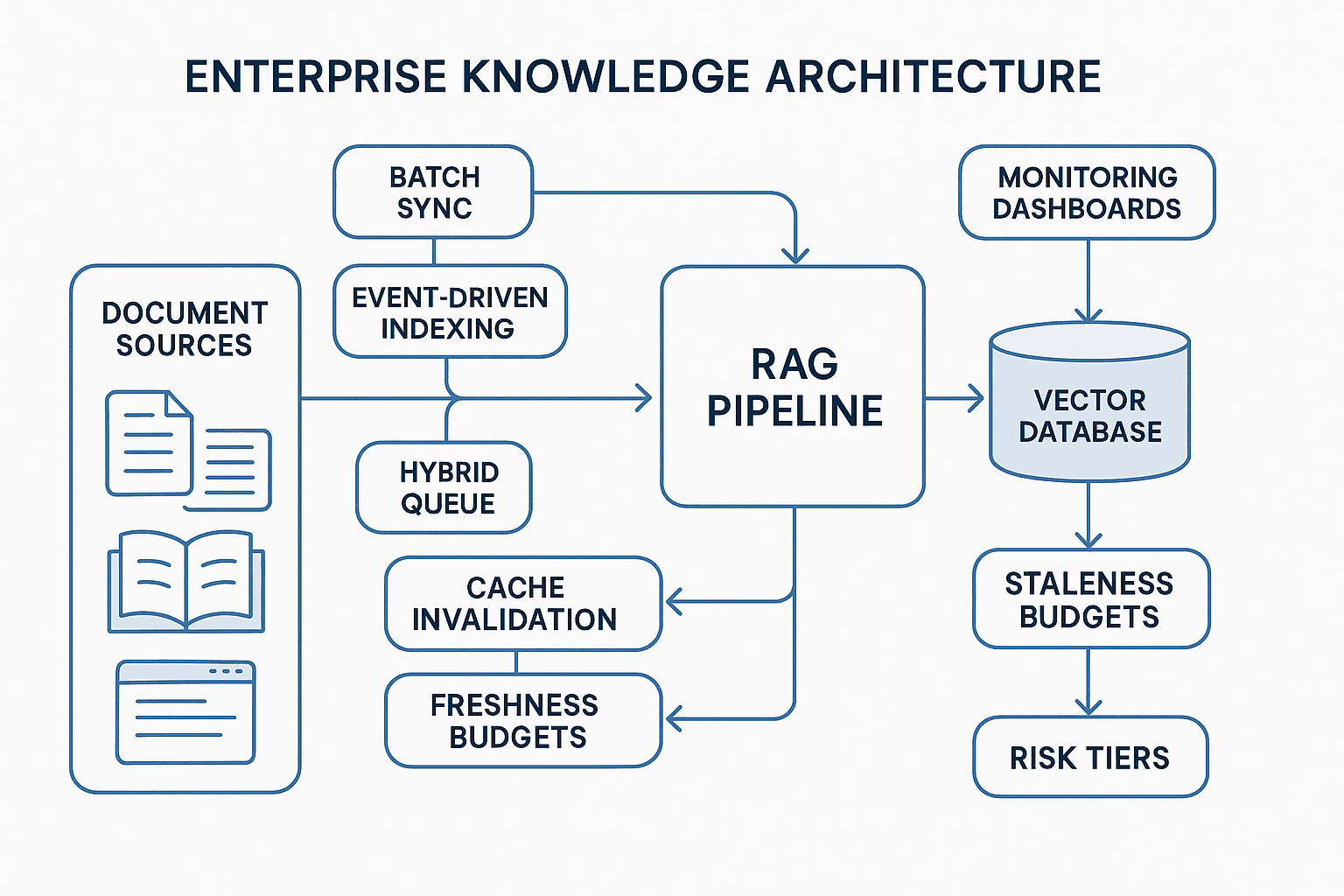
A production design that works well for most teams separates the system into six layers:
- Source connectors
- Change detection and ingestion orchestration
- Document normalization and versioning
- Chunking, embedding, and indexing
- Serving-time retrieval and freshness enforcement
- Observability, backfills, and reconciliation
Let’s walk through each.
1) Source connectors: treat every source as a different reliability profile
Enterprise content rarely comes from one clean CMS. You have SharePoint, Confluence, Google Drive, Salesforce Knowledge, Zendesk, Git repositories, internal policy systems, contract repositories, ticketing systems, and custom line-of-business apps.
Each source differs in:
- event support
- timestamp quality
- version history fidelity
- ACL model
- rate limits
- export APIs
- document formats
- deletion semantics
Do not hide these differences under a fake abstraction too early. Model them explicitly.
A connector registry should track, per source:
- supports webhooks/events: yes/no
- trustworthy
updated_at: yes/no - content hash available: yes/no
- ACL delta support: yes/no
- full snapshot feasible: yes/no
- expected update volume
- freshness tier mapping
This lets you choose ingestion behavior by source rather than pretending every connector can support the same SLA.
2) Change detection: batch, event-driven, and hybrid models
Batch sync
Best for low-volatility or low-risk collections.
Mechanics:
- periodic crawl using
updated_atwatermark or full listing - compare version IDs or content hashes
- enqueue changed documents for processing
Advantages:
- operationally simple
- easy to reason about
- naturally supports reconciliation
Disadvantages:
- worst-case lag tied to schedule interval
- can be expensive for large listings
- misses urgency differences across collections
Event-driven sync
Best for high-risk, high-volatility domains.
Mechanics:
- source emits webhook, CDC event, or message bus update
- event lands in durable queue
- consumer fetches latest full document state
- document is normalized, versioned, and indexed
- serving caches invalidated by doc ID/version
Advantages:
- low median and tail freshness lag
- efficient updates for hot documents
- aligns with business-triggered changes
Disadvantages:
- source event quality is often poor
- handling duplicates, out-of-order delivery, and missed events is mandatory
- more moving parts and harder incident response
Hybrid sync
This is the right default for many enterprises.
Mechanics:
- event-driven updates for selected high-priority sources or collections
- scheduled incremental batch for everything else
- periodic full reconciliation to detect missed events, parse failures, or delete drift
Advantages:
- good freshness where it matters
- bounded complexity
- operational safety net
Disadvantages:
- more policy logic
- requires tiering discipline
In practice, hybrid beats ideology. It gives you event-driven responsiveness for a subset of the corpus without forcing every connector into a real-time operating model.
3) Versioning: never think of documents as mutable blobs
Freshness bugs often come from treating a document as “the current text” rather than a versioned entity.
Your normalized document record should include at minimum:
source_iddocument_idversion_idor source revision tokensource_updated_atingested_atnormalized_hashacl_versionpublication_stateif applicablefreshness_tiersupersedes_version_idis_deleted/is_revoked
Each chunk should carry:
document_idversion_idchunk_idchunk_hashsource_updated_atindexed_atttlor freshness eligibility metadata if used- ACL metadata or pointer
Why so much metadata? Because reindexing is not enough. At serving time, you need to know whether all retrieved chunks belong to the latest visible version, whether a document was revoked, and whether an answer cache entry predates the current version.
The easiest safe pattern is append new version, then atomically switch active pointers, rather than mutate chunks in place with no serving boundary. This avoids partial update visibility.
For example:
- Parse new version.
- Generate all new chunks and embeddings.
- Upsert to index with new
version_idbut keep old version active. - When chunk count and integrity checks pass, flip a
current_versionpointer in serving metadata. - Retire old version asynchronously.
That one design decision prevents a lot of mixed-version retrieval.
4) Reindexing strategy: distinguish delta updates from full rebuilds
A major cost mistake is re-embedding too much.
In most enterprise setups, a cost-efficient indexing strategy has three levels:
Metadata-only update
Use when:
- title changed
- ACL changed
- tags changed
- publication state changed
- timestamps updated without content changes
Actions:
- update serving metadata and filters
- no re-chunking or embedding needed unless metadata affects retrieval text
Partial or full document re-embedding
Use when:
- content changed materially
- tables or sections changed
- parser output changed
Actions:
- recompute normalized text/hash
- if chunk-level diffing is reliable, only re-embed affected chunks
- otherwise re-embed whole document version
Collection backfill or index rebuild
Use when:
- embedding model changed
- chunking strategy changed
- parser logic improved materially
- metadata schema changed for ranking/filtering
Actions:
- asynchronous backfill
- dual-write or dual-read during migration if needed
Chunk-level diffing can save money, but it is operationally tricky. If chunk boundaries are unstable, a small edit can shift many downstream chunks. Some teams get better total economics by re-embedding the whole document when a version changes, while using source tiering to limit the number of documents requiring frequent updates.
Cost tradeoffs
Suppose you have 5 million chunks and pay for embedding generation plus vector write cost. If you re-embed 100% of the corpus daily, your spend and write load may dominate total RAG cost. If only 2% of documents change daily, reliable change detection is far more valuable than optimizing LLM inference by a few percent.
Freshness architecture is often a bigger cost lever than model choice.
5) Retrieval policies should incorporate freshness, not just similarity
Many teams do all the freshness work in ingestion and then ignore it at query time. That leaves the system vulnerable when an update is delayed or incomplete.
A retrieval stack for freshness-sensitive applications should consider:
Freshness-aware ranking
Include recency and version validity in ranking features, not just cosine similarity and BM25. Depending on use case, a slightly less similar but newer document may be preferable.
Typical ranking features:
- semantic score
- lexical score
- source authority weight
source_updated_atrecency- document publication state
- freshness tier compatibility with request
- user/tenant ACL match
Freshness filters
For some intents, retrieval should exclude documents older than a threshold.
Examples:
- pricing answers must use documents updated within 10 minutes or marked as approved current policy
- incident communications must prefer “active incident” collections
- benefits queries during open enrollment may restrict to this cycle’s docs
Query-time source fallback
For very high-risk workflows, the answer should not rely exclusively on indexed documents.
Examples:
- pricing or entitlement lookup from transactional API
- order status from operational database
- current incident status from service status API
In those cases, RAG should provide explanation and policy context around real-time API data, not replace the API as source of truth.
Answer-mode degradation based on freshness confidence
If freshness cannot be guaranteed, change output behavior.
For example:
- from “direct answer” to “answer with explicit freshness warning”
- from “final recommendation” to “here are the latest cited sources”
- from autonomous agent action to human approval required
This is where staleness budgets become product behavior.
Cache invalidation: the hardest part is still the hardest part
Freshness projects often fail because the index is updated correctly but caches continue serving old material.
In enterprise RAG, you may have several caches:
- raw source fetch cache
- parse result cache
- embedding cache
- retrieval result cache
- reranker cache
- answer cache
- application/session cache
Each cache needs a defined invalidation strategy.
Good default pattern
Key caches by a version-aware identity whenever possible:
- retrieval cache key includes query fingerprint + active corpus revision or collection revision
- answer cache key includes query fingerprint + relevant document version set hash
- parse cache key includes source document version ID or content hash
- embedding cache key includes chunk hash + embedding model version
If you cannot key by version, keep TTLs short for high-risk domains.
Collection revision counters
A useful operational trick is maintaining a revision counter per collection or freshness tier. When a relevant document changes, increment the collection revision. Any cache keyed on that revision automatically invalidates without scanning every dependent entry.
Delete and revoke behavior
The most dangerous stale-data case is not “old answer,” it is “answer from content that should no longer be visible.”
Revocation should be treated differently from normal updates:
- high-priority queue
- immediate serving filter update
- cache purge by document ID and ACL domain
- audit log entry
- reconciliation check to verify the doc is absent from retrieval paths
If your retrieval system cannot guarantee delete propagation quickly, you need a compensating control at serving time, such as an allowlist of currently active document versions or a post-retrieval metadata validation step.
Monitoring freshness violations like a real SRE problem
Freshness is an SLO problem. Instrument it that way.
At minimum, track these timestamps per document version:
- source update time
- connector observed time
- ingest queue enqueue time
- processing start and end times
- index write complete time
- serving-visible time
- cache invalidation complete time if measurable
From these, derive metrics such as:
- source-to-observed lag
- observed-to-indexed lag
- indexed-to-serving-visible lag
- end-to-end freshness lag
- stale retrieval rate
- stale answer rate
- revocation lag
- event drop/reconciliation recovery rate
Useful dashboards
- freshness lag percentiles by source
- freshness lag percentiles by freshness tier
- queue depth and age for ingestion jobs
- parse/embedding failure rates by connector
- percentage of corpus with unknown freshness state
- documents with mixed-version chunk counts
- revocation backlog and maximum revoke lag
Freshness violation alerts
Alerting should reflect business priority.
Examples:
- P1: high-risk tier p95 freshness lag > 10 minutes for 15 minutes
- P1: any revoked document retrievable after 5 minutes
- P2: event-driven connector reconciliation mismatch > 0.5%
- P2: answer cache hit rate on stale revisions exceeds threshold
- P3: low-risk nightly batch misses window
Synthetic probes
One of the best techniques is to publish sentinel updates and test whether they become retrievable inside SLA. For example, modify a canary document with a unique token and measure when the token appears in production retrieval. Do this per source and per tier.
It is far better than trusting pipeline logs alone.
Evaluation strategy: freshness needs its own evals
Most RAG eval suites measure relevance, groundedness, and answer quality. Add temporal evals.
1) Corpus freshness eval
Goal: verify that changed documents become retrievable within SLA.
Method:
- maintain a test set of documents across sources and tiers
- apply controlled updates with known timestamps
- run repeated retrieval probes
- record time until latest version dominates top-k results
Metrics:
- p50/p95/p99 time-to-visible
- percent of updates visible within SLA
- percent of mixed-version retrievals
2) Stale-answer eval
Goal: measure whether users would receive outdated answers during update windows.
Method:
- create before/after document versions with materially different answers
- issue use-case-specific questions across the transition window
- score whether the system answers with the latest truth, old truth, uncertainty, or no answer
Metrics:
- stale answer rate
- safe abstain rate under freshness uncertainty
- warning compliance rate
3) Revocation eval
Goal: ensure deleted or superseded content disappears from the answer path quickly.
Method:
- revoke access to documents or replace with updated policy
- probe retrieval and answer generation with known queries
Metrics:
- revoke p95 propagation time
- retrievability of revoked chunks after SLA
- ACL mismatch rate
4) Ranking eval with freshness features
Goal: verify freshness-aware ranking improves outcomes without hurting relevance unnecessarily.
Method:
- compare baseline retrieval vs retrieval with recency/freshness scoring
- use queries where newest doc should win and queries where older canonical doc should still win
Metrics:
- NDCG by query class
- stale top-1 rate
- relevance regression on stable knowledge
5) Cost-latency-freshness tradeoff eval
Goal: choose architecture rationally.
Method:
- simulate or measure sync interval, event throughput, embedding concurrency, cache TTLs
- estimate infrastructure and model costs at different SLAs
Metrics:
- monthly cost per freshness tier
- ingest CPU/GPU utilization
- p95 indexing latency
- percent of value-bearing queries protected by stricter SLA
This last evaluation matters because teams often optimize freshness globally when the real business value is concentrated in 10% of queries.
Model and tool choices: where they matter and where they don’t
Freshness architecture is mostly a systems problem, but tool choices still affect outcomes.
Embedding models
Considerations:
- embedding cost per chunk
- throughput under bursty updates
- multilingual support
- stability across document revisions
- vector dimension and index write cost
Tradeoff:
A very high-quality expensive embedding model may be justified for query-serving quality but painful for frequent reindexing on hot corpora. Some teams split tiers: premium embeddings for high-value collections, cheaper embeddings or slower batch processing for long-tail knowledge.
Vector databases
Considerations:
- write throughput
- update/delete propagation latency
- filtering support on version and ACL metadata
- consistency model for reads after writes
- namespace or collection isolation
Freshness-sensitive use cases benefit from stores with reliable metadata filters, version-aware deletes, and predictable read-after-write characteristics. If your store has slow delete compaction or eventual visibility under load, you need serving-side safeguards.
Rerankers
Rerankers can help freshness if you include temporal and authority metadata in the candidate features or prompt. But they cannot rescue missing or revoked documents. Use them to improve selection among available candidates, not to substitute for ingestion correctness.
LLMs
The generator model matters less than people think for freshness. What helps:
- explicit instruction to prefer latest approved sources
- visibility into source timestamps and approval state
- ability to abstain when source freshness is uncertain
- concise answer generation to reduce outdated synthesis across multiple docs
What does not help enough:
- expecting the model to infer policy supersession without metadata
- expecting “reasoning strength” to compensate for stale retrieval
Implementation details that save pain later
A few battle-tested implementation choices make a disproportionate difference.
Use source-of-truth timestamps carefully
Many enterprise APIs update updated_at for permission changes, comments, or metadata edits unrelated to answer content. Others fail to update it for embedded attachments or nested table changes. If you rely blindly on timestamps, you either over-index or miss critical updates.
Use a hierarchy:
- source revision ID if trustworthy
- content hash on normalized text
- raw
updated_atonly as a listing optimization, not a correctness guarantee
Make ingestion idempotent
Every processing stage should be safe to retry. Event-driven systems will redeliver. Batch scans will rediscover documents. A document-version key should make duplicate work harmless.
Separate publication from indexing for governed content
For high-risk policies, do not expose draft or half-approved updates just because a source file changed. Introduce a publication state that controls retrieval eligibility. Sometimes the right freshness SLA is “visible within 10 minutes of approval,” not “within 10 minutes of any edit.”
Build a reconciliation loop
No matter how event-driven your architecture is, run periodic reconciliation:
- compare source listing to indexed state
- detect missing docs, missing versions, and stale ACLs
- verify active version pointers
- find orphaned chunks from deleted documents
This is your recovery mechanism from connector bugs and dropped events.
Track freshness at collection and answer levels
A single answer may draw from multiple documents with different ages. Expose answer-level freshness metadata such as:
- newest source cited
- oldest source cited
- confidence that all cited docs are within policy
- freshness policy used for this answer
This helps both UX and debugging.
Don’t let old chunks linger without serving controls
Physical deletion from vector stores can be asynchronous. During that window, retrieval may still surface old chunks. A robust pattern is to maintain a serving-time allowlist of active document_id + version_id pairs in a fast metadata store. Post-retrieval, filter candidates against this allowlist before prompt assembly.
It adds one more check, but it is a very effective hedge against eventual-consistency surprises.
A practical decision framework for choosing sync models
Here is a simple framework I use with teams.
For each corpus or collection, score 1 to 5 on:
- update frequency
- staleness impact
- revocation sensitivity
- source event quality
- source API reliability
- query volume
- user trust sensitivity
Then map to architecture:
Score profile A: low risk / weak source signals
- nightly or twice-daily batch
- watermark-based incremental listing
- document-hash change detection
- 24h+ staleness budget
- standard cache TTLs
Score profile B: moderate risk / moderate volatility
- hourly incremental batch
- optional event acceleration for selected folders/spaces
- metadata-driven cache revisioning
- 1h to 4h staleness budget
- recency-aware ranking
Score profile C: high risk / good source signals
- event-driven indexing with queue and retries
- active version switching
- immediate cache invalidation
- query-time freshness filters
- reconciliation every few hours
- 5m to 30m staleness budget
Score profile D: very high risk / transactional truth exists elsewhere
- use source API at query time for critical fields
- RAG only for explanatory context and policy interpretation
- event-driven updates for reference docs
- strict answer gating and human confirmation paths
- seconds to minutes effective freshness budget
This framework steers teams away from using document indexing to solve problems better handled by online systems.
When not to chase real-time indexing
A lot of wasted effort comes from treating “real time” as maturity.
Do not build low-latency event-driven indexing when:
- the corpus changes infrequently
- the cost of stale answers is minor
- the source system emits unreliable events you cannot trust
- document parsing dominates latency anyway
- users are mostly doing exploratory search, not operational decision-making
- the team lacks on-call maturity for distributed ingestion systems
Nightly or hourly sync with solid versioning, good evaluation, and explicit freshness UX is often the right answer.
The anti-pattern is spending six months on webhooks and queues for a wiki nobody updates, while pricing or legal workflows still use stale exports.
When to go beyond indexed documents entirely
There is another important boundary: some “freshness” requirements are really online data requirements.
Examples:
- current account balance
- shipment status
- feature entitlement for a specific customer
- open incident state
- latest negotiated contract term for a live account
These should usually come from transactional services or federated query layers at runtime. You can still use RAG to explain policy, summarize the operational data, and cite the relevant reference materials. But if the question’s correctness depends on live state, no indexing pipeline will beat calling the system of record.
A useful rule of thumb:
- If the answer is fundamentally a lookup on mutable business state, prefer tools/APIs.
- If the answer is interpretation of reference knowledge, RAG is appropriate.
- If it is both, combine them.
Organizational design matters too
Freshness SLAs fail when ownership is vague.
Be explicit about:
- who owns connector reliability
- who owns source publishing standards
- who owns freshness tier classification
- who approves staleness budgets for each business workflow
- who is paged for freshness violations in high-risk tiers
A RAG platform team can build the machinery, but domain owners need to classify content and sign off on acceptable lag. Engineering should not guess whether stale compliance content is acceptable for 4 hours.
A rollout plan that works in practice
If you are early, do not start by redesigning the whole ingestion platform. Roll out freshness design incrementally.
Phase 1: measure current state
- add timestamps across the ingestion path
- compute end-to-end lag by source
- identify high-query and high-risk collections
- measure stale-answer incidents qualitatively
Phase 2: define tiers and budgets
- classify corpora by volatility and risk
- assign target p95 lag and max lag
- define runtime behavior when freshness cannot be met
Phase 3: harden versioning and cache invalidation
- add version IDs and active-version pointers
- make answer/retrieval caches revision-aware
- implement revoke path and audit logging
Phase 4: selectively add event-driven updates
- only for top-priority collections
- keep batch reconciliation in place
- instrument event quality and fallback behavior
Phase 5: add temporal evals and synthetic probes
- automate canary updates
- add stale-answer benchmarks
- gate launches on freshness SLOs for protected workflows
This sequence usually delivers most of the value without an expensive rewrite.
The key takeaways
Freshness in enterprise RAG is not a universal requirement for instant indexing. It is a risk-management problem.
The systems that hold up in production do a few things consistently:
- classify content by volatility and business impact
- define explicit freshness SLAs and staleness budgets
- use batch, event-driven, or hybrid sync based on use case, not ideology
- version documents and chunks so serving never sees ambiguous state
- separate publication, indexing, revocation, and cache invalidation concerns
- incorporate freshness into retrieval and answer policies
- measure freshness with dedicated evals and SLO instrumentation
- avoid using indexed documents where live APIs are the real answer
If you remember one thing, make it this: the goal is not “real time RAG.” The goal is trustworthy answers at the freshness level each workflow actually needs.
That usually means accepting that some parts of the corpus can be a day old, some must be minutes old, and some should not come from RAG alone at all.
Once you design around that reality, freshness stops being an endless indexing project and becomes what it should have been from the start: a product contract backed by architecture.