Choosing Between Long-Context Models and Retrieval Pipelines: A Production Decision Framework
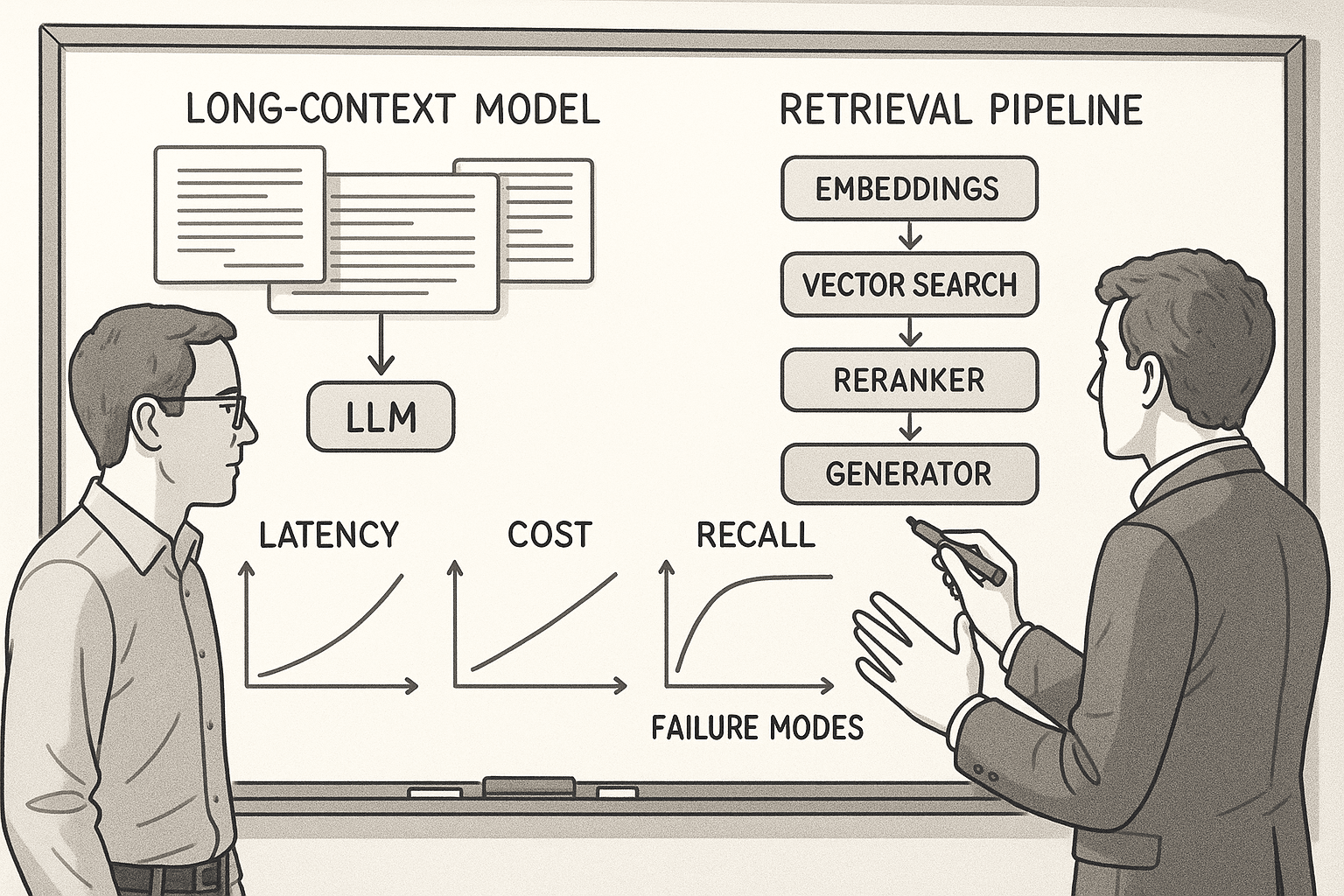
Most teams don’t decide between long-context models and retrieval pipelines in a conference room with a neat requirements document. They decide after something breaks.
A support automation team ships a prototype that works beautifully in demos because the model can ingest a 300-page product manual, a few policy docs, and the latest support ticket thread in one prompt. For a month, everyone believes the problem is solved. Then real traffic shows up. The manual changes weekly. The ticket thread includes screenshots OCR’d into noisy text. Customers ask questions whose answers live in one line of a release note from eight months ago. Prompt sizes balloon. Latency spikes. Costs drift upward. Worse, the model starts missing small but critical facts hidden in the middle of giant contexts.
At the same time, another team goes all-in on retrieval-augmented generation. They build ingestion jobs, embeddings, chunking logic, metadata filters, a vector index, BM25 fallback, and a reranker. Their architecture looks sophisticated and scalable. But they discover a different class of failures: the right document exists, but chunking separated the answer from the table it depends on; retrieval misses rare identifiers; metadata is incomplete; the embedding model fails on code snippets; and when recall fails, the generator confidently improvises.
Both teams conclude, incorrectly, that the other architecture must be better.
The real production question is not “long context or RAG?” It is: what is the shape of the evidence your system needs, where does failure come from, and what is the cheapest architecture that reliably gets the right evidence in front of the model?
That sounds obvious, but many production systems still choose architecture by trend cycle. When context windows expand, teams assume retrieval is obsolete. When retrieval tooling matures, teams assume every application needs a multi-stage search stack. In practice, both are useful. Both fail in predictable ways. And the best production systems often use a mixed architecture that is boring in the middle and sharp at the edges.
This article lays out a practical decision framework for choosing between long-context-first, retrieval-first, and hybrid systems. I’ll focus on workload shape, evidence locality, recall risk, latency and cost, packing failure modes, evaluation strategy, and migration patterns that work in production.
The first principle: optimize evidence delivery, not model exposure
A lot of design confusion disappears if you frame the system’s job correctly.
The job is not to let the model “see as much as possible.” The job is to deliver the minimal sufficient evidence needed to produce a correct answer, with acceptable latency, cost, and operational complexity.
That distinction matters because long context and retrieval optimize different parts of the evidence delivery problem.
Long-context systems are strongest when:
- relevant evidence is broad, diffuse, or hard to isolate ahead of time
- answer quality benefits from preserving document order and surrounding context
- the task depends on cross-document reasoning over many possibly relevant passages
- recall loss from retrieval is more dangerous than passing extra text
- corpus size is bounded enough that brute-force inclusion is operationally tolerable
Retrieval pipelines are strongest when:
- relevant evidence is sparse relative to corpus size
- the answer usually depends on a small number of passages
- corpora change frequently and must be indexed incrementally
- you need explainable source selection and controllable context budgets
- cost and latency matter at scale
This sounds like a simple tradeoff between “include everything” and “search first,” but production behavior is subtler.
Long context is not free recall. Models do not attend uniformly across giant prompts. Retrieval is not guaranteed precision. Search stacks often miss evidence for reasons teams don’t measure until late. The decision depends on workload shape.
Start with workload shape, not architecture preference
In practice, I’ve found five workload questions determine most of the architecture choice.
1. How local is the evidence?
If most questions can be answered from one or two compact passages, retrieval has a natural advantage. The system should spend tokens on reasoning and response quality, not on hauling irrelevant text into the prompt.
If answers depend on evidence spread across many sections of a long report, contract set, or notebook session, long context starts to look attractive. Retrieval can fetch several chunks, but it may destroy the narrative or structural relationship between them.
Examples:
- High locality: “What is the refund deadline for enterprise annual plans?” Usually one clause, one doc.
- Medium locality: “Compare Q2 and Q3 guidance changes for Europe.” Likely multiple passages from earnings materials.
- Low locality / distributed evidence: “Identify inconsistencies between this vendor agreement, our procurement policy, and the exception approved in email.” Evidence spans formats and documents.
2. How predictable is the evidence type?
If the answer almost always lives in product docs, policy pages, or a known table, retrieval can be heavily optimized.
If evidence may come from transcripts, tickets, code, spreadsheets, PDFs, logs, or prior conversation state, search quality often becomes uneven. Long context may be a simpler first move when the candidate set is small enough.
3. What is the recall penalty?
Some applications can tolerate occasional misses. Others cannot.
If the system answers a marketing research question and misses one supporting note, the output may still be usable. If the system answers a compliance or support question and omits the one line that changes the policy, retrieval misses become severe.
This is why many teams underestimate recall risk. They compare average answer quality in offline tests rather than tail failures where missing evidence flips correctness.
4. How large is the candidate corpus per query?
The right unit is not total enterprise corpus size. It is candidate corpus size per query after any obvious scoping.
A team may say, “We have ten million documents, so long context is impossible.” But per query, the user may already narrow the search to a single account, deal room, or project folder containing only a few hundred pages. Conversely, a small overall corpus may still be difficult if each query potentially touches all of it.
5. What are your throughput and SLO constraints?
A prototype that sends 200k tokens into a large model can look great in an internal test with five users. It looks very different when supporting 50 requests per second with a p95 under three seconds.
Architecture choices that are acceptable at low volume become financially or operationally unstable at scale.
Why the naive long-context approach fails
The naive long-context approach is simple: put all relevant materials into the prompt and let the model figure it out.
Sometimes this works surprisingly well. That’s why it keeps coming back.
But in production, several failure modes show up quickly.
1. Attention is not the same as reliable retrieval
Even if a model accepts a giant context window, that does not mean it can consistently locate and use the right evidence buried inside it. Models often show position sensitivity, reduced performance on middle sections, and difficulty integrating small but critical details when surrounded by lots of distractors.
This means a 100k-token prompt may technically “fit” while still underperforming a smaller prompt with better evidence selection.
The practical mistake is treating context window size as equivalent to usable working set size.
2. Context packing creates silent dilution
As teams add more documents, they often include:
- near-duplicate chunks
- stale versions of docs
- overly large chunks with mixed topics
- irrelevant sections “just in case”
- OCR noise and boilerplate
Each one consumes budget and increases distractor mass. The model now has more places to anchor on the wrong thing.
This is one of the most common production regressions: adding more context lowers answer quality, even though intuition says it should help.
3. Costs rise nonlinearly at the application level
The raw token price is only part of it. Long-context systems also increase:
- serialization and transport overhead
- preprocessing time
- queueing under load
- cache miss penalties when prompts differ slightly
- failure blast radius when one request becomes huge
A design that is acceptable at 10 requests per minute becomes painful at 1,000 requests per minute.
4. Updates become awkward
If your answer quality depends on stuffing whole source sets into prompts, keeping content fresh can mean rebuilding large prompt assemblies often. Retrieval systems externalize freshness into indexing. Long-context-only systems tend to entangle freshness with prompt construction.
5. Auditing becomes harder than expected
It feels like long-context systems should be more auditable because “the model saw everything.” In practice, they can be less auditable because you often don’t know which portion of a giant prompt actually drove the answer unless you add explicit citation and attribution mechanisms.
Why the naive retrieval approach fails
Retrieval advocates make symmetrical mistakes.
The naive retrieval approach is: chunk docs, embed them, run vector search, pass top-k chunks to the model.
That can work, but only when the data shape cooperates.
1. Chunking breaks the evidence unit
Many answers are not contained in semantically neat paragraphs. They depend on:
- table rows plus footnotes
- code plus comments
- headers plus subordinate bullets
- definitions established earlier in the document
- image captions or appendix references
Naive chunking often separates these units. The retriever may find half the evidence, which is often worse than finding none because it creates a plausible but wrong answer.
2. Embeddings are not universal search magic
Embedding retrieval often degrades on:
- exact identifiers, SKUs, invoice numbers
- highly domain-specific abbreviations
- code and stack traces
- rare terms unseen in embedding training
- negation and policy exception language
This is why production systems frequently need hybrid lexical + semantic retrieval, metadata filtering, or specialized indexes.
3. Recall failures are under-instrumented
Most teams track generation quality and maybe retrieval precision at top-k. They do not track whether the gold evidence was even retrievable under realistic chunking and filtering.
If the answer is wrong because the evidence never made it to the model, tuning prompts or changing the generator is wasted effort.
4. Multi-hop reasoning over fragmented chunks is brittle
RAG works best when a small set of chunks independently supports the answer. It struggles more when the system must combine many weak signals spread across a document collection. You can raise top-k, add a reranker, or run iterative retrieval, but complexity grows and tail latency follows.
5. Operational complexity is real
A proper production retrieval stack is not just vector search. It is:
- ingestion and parsing
- versioning and deletion handling
- chunking strategy
- embedding generation
- indexing and sharding
- metadata schema
- lexical fallback
- reranking
- source attribution
- monitoring and reindex migrations
That complexity is worth it for the right workloads, but teams should admit the cost honestly.
A better decision framework: pick by evidence geometry
The most useful mental model I’ve found is evidence geometry.
Ask four questions:
- How much text is in the query’s candidate set?
- What fraction is likely relevant?
- Is relevance concentrated or dispersed?
- How catastrophic is a missed passage?
From that, you can place workloads into three broad zones.
Zone 1: Long-context-first
Use long context as the primary mechanism when:
- candidate set per query is bounded and modest after scoping
- relevant evidence may be widely distributed
- preserving order and structure matters
- retrieval miss risk is more harmful than distractor cost
- you need a simpler system quickly
Typical examples:
- analysis of one long contract, report, or transcript set
- coding assistants over the currently open repo subset or PR diff
- meeting synthesis across a bounded set of recent artifacts
- due diligence review within a deal room already narrowed by the user
This is not “throw in everything forever.” It is long-context-first within a scoped candidate set.
Zone 2: Retrieval-first
Use retrieval as the primary mechanism when:
- corpus is large relative to answer evidence
- answers usually come from a few passages
- users ask many repeated lookup-style questions
- freshness and scale matter
- latency and cost budgets are tight
Typical examples:
- support knowledge assistants over large doc portals
- enterprise policy Q&A
- developer doc copilots over broad product documentation
- customer success assistants over many account records
Zone 3: Hybrid
Use mixed designs when:
- retrieval can shrink the candidate set substantially
- final reasoning benefits from larger retained context
- evidence is partly local and partly distributed
- tail queries are difficult and need adaptive escalation
Typical examples:
- legal review across many documents where a shortlist can be retrieved first, then packed into a long-context synthesis prompt
- incident analysis where logs are filtered or retrieved, then a longer context is used for timeline reconstruction
- analytics copilots where schema docs and relevant query history are retrieved, then included alongside a broader working set
For many teams, hybrid ends up being the steady-state production answer.
The architecture patterns that actually work
Let’s make this concrete.
Pattern A: Long-context-first with guardrails
Architecture:
- User query arrives.
- Lightweight scoping selects the candidate artifact set.
- Documents are normalized, deduplicated, and packed with structural markers.
- A long-context model answers with citations.
- If confidence is low or prompt budget is exceeded, route to retrieval-assisted fallback.
Key implementation details:
- Scope first using user/session metadata, folder, account, time range, or workflow state.
- Normalize aggressively: remove boilerplate, duplicate headers, legal footers, OCR junk.
- Preserve structure: include section titles, page numbers, and source IDs.
- Pack by semantic hierarchy, not raw concatenation.
- Require citations to source spans.
- Add escalation rules when candidate set exceeds prompt budget or answer support is weak.
When this pattern works, it can be dramatically simpler than building retrieval infrastructure too early.
Pattern B: Retrieval-first with reranking and grounded generation
Architecture:
- User query arrives.
- Query rewriting or decomposition optionally expands search terms.
- Hybrid retrieval runs: lexical + semantic + metadata filters.
- A reranker selects the best passages.
- Context packing assembles a compact evidence set.
- Generator answers with source grounding and abstention behavior.
Key implementation details:
- Use hybrid retrieval, not embeddings alone, for production workloads with identifiers and exact terms.
- Add metadata filtering early to narrow domains.
- Rerank top 20–100 candidates down to a small answer set.
- Tune chunk size and overlap by document type, not globally.
- Store document structure links so adjacent or parent chunks can be reattached when needed.
- Ensure the generator can say insufficient evidence rather than guess.
This pattern is the workhorse for scalable knowledge systems.
Pattern C: Retrieval to shortlist, long context to reason
Architecture:
- User query arrives.
- Retrieve candidate documents or chunk groups.
- Expand around selected hits to recover structural neighborhoods.
- Assemble a larger long-context prompt from the shortlisted evidence.
- Run synthesis, comparison, or multi-document reasoning.
This pattern is ideal when top-k chunks alone are too fragmented, but full corpus inclusion is wasteful.
A practical variant is two-stage packing:
- Stage 1 retrieves 20–50 candidate evidence units.
- Stage 2 groups them by source and expands to surrounding sections.
- Final prompt includes fewer sources, but richer local context from each.
That often beats both naive top-k RAG and brute-force long context.
Cost and latency: the tradeoff teams mis-estimate
A common anti-pattern is comparing architectures only by answer accuracy on a small eval set, then discovering later that the “best” system is economically unusable.
You need to model cost and latency per successful answer.
Long-context cost profile
Strengths:
- simpler pipeline
- fewer moving parts
- less retrieval engineering initially
Weaknesses:
- high prompt token cost
- potentially higher tail latency
- poor scaling when candidate sets drift upward
- vulnerable to prompt variance
Long context is often attractive when query volume is moderate and each request is high value, such as legal analysis, internal strategy synthesis, or specialized research.
Retrieval cost profile
Strengths:
- low token usage per request
- better scaling with large corpora
- controllable prompt budgets
- lower model tier may suffice once evidence is precise
Weaknesses:
- index build and maintenance costs
- extra retrieval/rerank latency
- engineering burden and on-call surface area
Retrieval wins economically when traffic is high, answers are localized, and the corpus is much larger than what should fit in prompt context.
Hybrid cost profile
Strengths:
- can reserve expensive long-context inference for hard cases
- retrieval reduces average-case cost
- allows adaptive quality tiers
Weaknesses:
- more orchestration logic
- more failure modes unless routing is well evaluated
In production, hybrid systems often minimize total cost because they avoid paying long-context prices on easy queries while preserving a path for hard distributed-evidence tasks.
Model choice is downstream of architecture choice
Teams often ask, “Which model should we use?” too early.
The more useful question is: what capabilities does the architecture require from the model?
For long-context-first systems, prioritize:
- strong long-context retention, especially for mid-context evidence
- citation-following behavior
- stable performance with structured prompts
- acceptable throughput at high token counts
For retrieval-first systems, prioritize:
- grounded answering from compact context
- strong instruction adherence around abstention and citation
- good performance on partial evidence without overconfident guessing
- lower cost per generation since retrieval does the narrowing
For reranking and query rewriting, consider smaller models
Not every step needs a frontier model. Query rewriting, metadata extraction, chunk labeling, and confidence gating can often run on smaller, cheaper models. The expensive model should be reserved for the step where its reasoning quality matters.
That sounds obvious, but many production stacks waste budget by using the same large model for every stage.
Evaluation methodology: test the architecture, not just the answer
This is where most teams make poor decisions.
If you only compare final answer quality, you cannot tell whether long context or retrieval is failing for structural reasons.
A proper eval suite should separate at least four layers.
1. Evidence availability eval
Question: does the source corpus actually contain the answer, and where?
Build a labeled set with:
- query
- gold answer
- supporting source spans or docs
- difficulty tags: exact lookup, aggregation, comparison, exception handling, multi-hop
Without source-span annotation, debugging is guesswork.
2. Retrieval recall eval
Question: given the query and index design, can the system retrieve the gold evidence?
Metrics:
- recall@k for gold chunk/document
- filtered recall by query type
- recall under metadata constraints
- recall for exact identifiers, tables, policy exceptions, and long-tail terminology
This tells you whether retrieval architecture is even viable.
3. Context packing eval
Question: once evidence is retrieved or selected, does the packed prompt preserve what the generator needs?
Metrics and checks:
- percent of packed contexts containing complete evidence unit
- duplication rate
- distractor ratio
- source neighborhood preservation
- answer performance as context size increases
This is the hidden battleground in both long-context and RAG systems.
4. Grounded answer eval
Question: does the model produce the correct answer and support it with valid evidence?
Metrics:
- exactness or rubric score
- citation correctness
- unsupported claim rate
- abstention quality when evidence is missing
- calibration of confidence vs correctness
Add scenario tests for tail risk
Don’t stop at random samples. Deliberately include:
- stale-vs-current document conflicts
- duplicate policy versions
- answer hidden in table footnote
- question requiring a negated condition
- long document with one tiny relevant sentence in the middle
- code or log identifiers
- cross-document contradiction resolution
These are the cases that determine whether the architecture survives production.
Context packing is its own discipline
Teams talk a lot about models and retrieval, but context packing is usually where answer quality is won or lost.
Here are the packing mistakes I see repeatedly.
Failure mode 1: top-k chunk dumping
Passing the top 10 chunks exactly as retrieved often creates a fragmented, repetitive prompt with missing structural links.
Better approach:
- group hits by document
- attach neighboring chunks or parent sections
- collapse near-duplicates
- preserve source order within each document
- cap per-source contribution to reduce overrepresentation
Failure mode 2: ignoring document hierarchy
Documents are not bags of paragraphs. Headers, subsection boundaries, appendix references, and table associations matter.
Better approach:
Represent chunks with hierarchy metadata and rehydrate context around a hit based on document structure.
Failure mode 3: over-packing “for safety”
Adding more evidence candidates often lowers signal-to-noise ratio.
Better approach:
Use budgeted evidence assembly with explicit marginal utility tests. Measure answer quality at different token budgets, not just maximum budget.
Failure mode 4: stale and duplicate source contamination
If the system includes both old and new versions without clear precedence, models often blend them.
Better approach:
Version documents explicitly, prefer current by default, and expose supersession relationships in retrieval and prompt construction.
Migration patterns for real teams
Most organizations are not choosing architecture from scratch. They are evolving from a prototype.
Migration 1: From long-context prototype to scalable retrieval
This is common.
You started by packing everything because it was fast to build. It worked. Then usage grew.
Practical migration path:
- Keep the long-context system as baseline.
- Instrument source usage and prompt composition.
- Identify repeated high-locality queries.
- Introduce retrieval only for those paths.
- Compare cost per correct answer and p95 latency.
- Expand retrieval coverage gradually.
- Keep long-context fallback for hard distributed-evidence cases.
This lowers migration risk because you preserve a working path while selectively adding retrieval where it buys efficiency.
Migration 2: From brittle RAG to retrieval-plus-synthesis
Also common.
You built a retrieval stack, but users ask comparative or cross-document questions that top-k chunks cannot support well.
Practical migration path:
- Keep retrieval for narrowing.
- Add chunk grouping and structural expansion.
- Introduce a larger synthesis window over shortlisted evidence.
- Route only complex query classes to this path.
- Evaluate tail latency and quality uplift.
This often fixes “RAG feels shallow” complaints without abandoning retrieval.
Migration 3: Mixed architecture with adaptive routing
The mature pattern is usually query-aware routing.
For example:
- exact lookup or policy question -> retrieval-first
- summarize selected file set -> long-context-first
- compare multiple artifacts -> retrieval shortlist + long-context synthesis
- low-confidence retrieval -> escalate to broader retrieval or long-context fallback
Adaptive routing is powerful, but only if you evaluate the router itself. A mediocre router can erase the gains of a good architecture.
A practical routing heuristic
If you need a simple production starting point, use a heuristic router before training anything fancy.
Route toward retrieval-first when:
- query seeks a specific fact, clause, or definition
- candidate corpus is large
- exact terms or identifiers are present
- similar questions repeat frequently
Route toward long-context-first when:
- user explicitly selects a bounded artifact set
- task is summarization, review, comparison, or synthesis
- relevance is likely broad within selected materials
- preserving chronology or structure matters
Route toward hybrid when:
- query asks for inconsistencies, comparisons, or cause analysis across sources
- retrieval can shortlist, but final reasoning needs richer neighborhoods
- prior runs show retrieval recall is decent but answer completeness is weak
This is not perfect, but it is enough to get a useful first production split.
Common decision mistakes
Let me be blunt about the mistakes I see most often.
“Our model has a million-token window, so RAG is dead.”
No. Large windows reduce the need for retrieval in some bounded tasks. They do not remove the need for selective evidence delivery at scale.
“Retrieval is always cheaper.”
Not always. For narrow, high-value workflows over bounded document sets, retrieval infrastructure can cost more to build and maintain than the token savings justify.
“If answer quality is poor, we need a better model.”
Often false. Many failures are retrieval recall failures or context packing failures, not generation failures.
“We’ll just increase top-k.”
That frequently increases distractors and degrades the generator.
“We can evaluate this with a benchmark.”
Only partially. Generic benchmarks rarely reflect your document structure, metadata quality, stale-version problems, or long-tail terminology.
The production decision framework
If I had to compress this into a decision checklist for an engineering leader, it would look like this.
Choose long-context-first if:
- per-query candidate sets are naturally bounded
- evidence is distributed and hard to pre-isolate
- preserving source structure matters
- recall misses are costly
- traffic volume and token economics are acceptable
- you need to ship quickly with less infrastructure
Choose retrieval-first if:
- corpus is large and evidence is sparse
- answers are typically supported by a few passages
- freshness and scale matter
- you need lower cost and latency at volume
- you can invest in ingestion, indexing, and evals
Choose hybrid if:
- retrieval can reduce the search space materially
- final task requires cross-passage or cross-document synthesis
- easy and hard query classes differ significantly
- you want efficient average-case behavior with a stronger fallback path
Then validate the choice with:
- retrieval recall on gold evidence
- answer correctness with citations
- cost per correct answer
- p50/p95 latency
- failure analysis on tail scenarios
That last point matters. Don’t ask only “which system scores better?” Ask “how does each system fail, and can we tolerate that failure mode?”
My default recommendation for most teams
For most production teams, I would not start with the most elaborate retrieval stack, and I would not blindly trust giant context windows either.
I would start with this sequence:
- Scope the candidate set as aggressively as product UX allows.
- Try a long-context baseline on that scoped set.
- Build evals with gold evidence spans.
- Measure where failures come from: recall, packing, or reasoning.
- Add retrieval where candidate sets are too large or query locality is high.
- Use hybrid synthesis for multi-document reasoning tasks.
- Keep architecture adaptive rather than ideological.
This sequence works because it aligns engineering effort with actual failure modes.
Long context is best viewed as a tool for reducing preselection burden inside a bounded workspace. Retrieval is best viewed as a tool for shrinking a large search space to a manageable evidence set. Hybrid systems connect the two: retrieve to cut the problem down, then spend context budget where it improves reasoning.
That is the production mindset.
Not “Which paradigm wins?”
But “What is the minimum machinery required to reliably put the right evidence in front of the model for this workload?”
If you answer that honestly, the architecture decision becomes much less philosophical and much more operational.
And in production, operational usually wins.