Canary Releases for GenAI Systems: Shipping Prompt, Retrieval, and Routing Changes Without Full-Blast Regressions
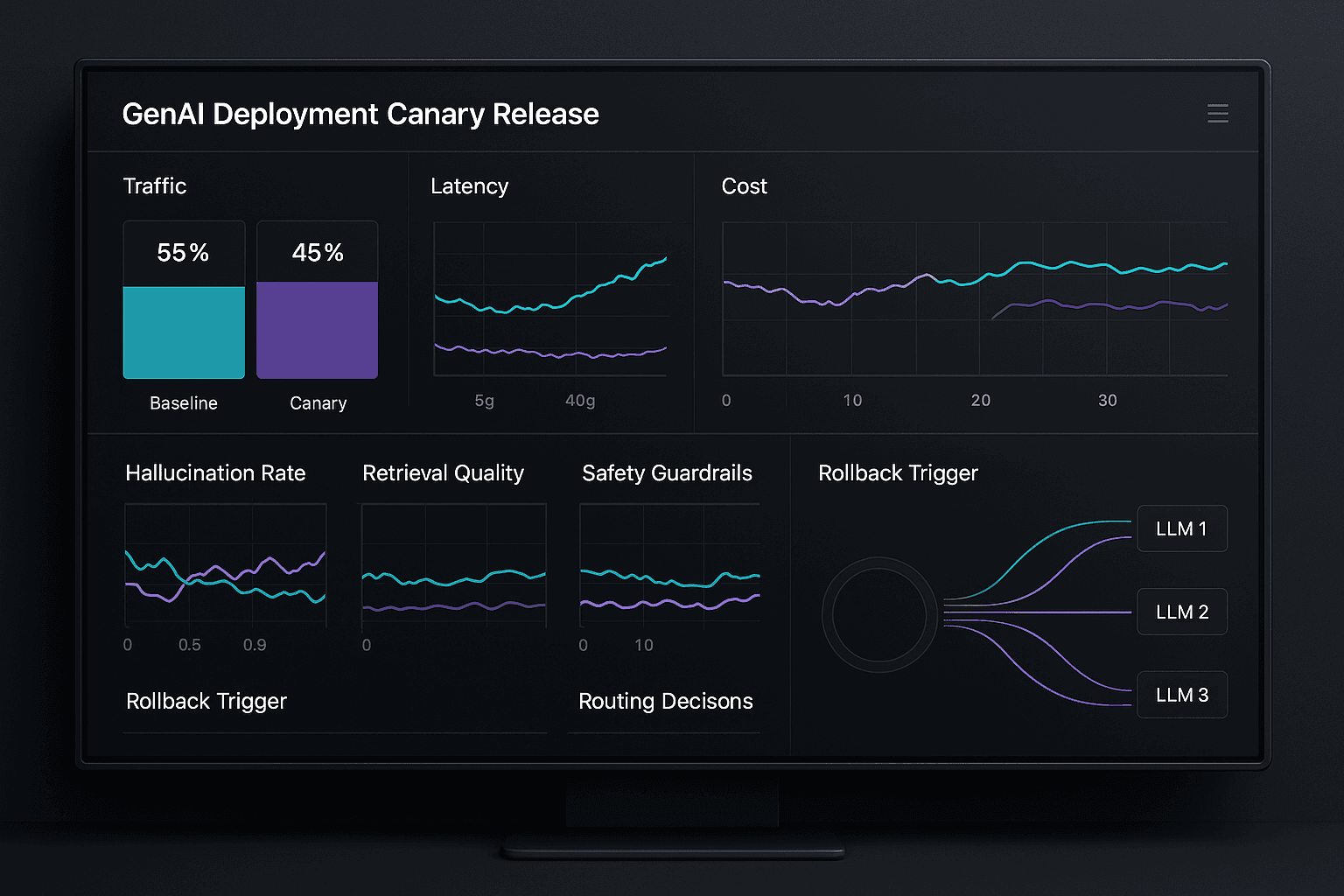
A team ships what looks like a tiny change on a Tuesday morning: a prompt edit to reduce verbosity, a retriever refresh to pick up newer documents, a reranker swap that looked better on an offline benchmark, or a routing rule that sends “easy” questions to a cheaper model. By lunch, support tickets start trickling in. Answers are shorter, yes, but now they omit critical caveats. Retrieval is fresher, but citation grounding quietly dropped because chunk IDs changed. The cheaper route works for simple questions, except the classifier defining “simple” was overconfident and started misrouting edge cases. Nothing is fully down. P95 latency is still acceptable. Error rates in the traditional sense are flat. Your normal canary dashboard says the release looks fine.
This is why GenAI releases are dangerous in a way many application teams underestimate. The failure mode is often not a crash, a 500, or a CPU spike. It is a semantic regression: lower answer quality, worse faithfulness, subtle safety drift, hidden tenant-specific breakage, or a cost explosion caused by longer contexts and retries. Standard app canaries catch infrastructure regressions well. They are much weaker at catching “the system still responds, but it responds worse.”
If you run retrieval-augmented generation, agents, model routing, or prompt-driven behavior in production, you need a canary strategy designed for stochastic systems where quality is partly latent, partly delayed, and highly dependent on the distribution of user tasks. That means more than exposing 5% of traffic and watching error rate and latency. You need release units that map to GenAI components, segmented traffic, shadow execution, quality-aware online metrics, rollback rules that include semantic signals, and a deliberate bridge between offline evals and online exposure.
The practical goal is simple: make it safe to ship prompt, retrieval, reranker, model, and routing changes frequently without betting the whole product on every release.
The pattern: most GenAI regressions are partial, delayed, and distribution-specific
Engineering leaders often import canary practices from classic web systems: deploy a new version to a small percentage of requests, compare core service metrics, then ramp if healthy. That remains necessary, but for GenAI it is nowhere near sufficient.
Three patterns show up repeatedly in production incidents.
First, regressions are often partial. A prompt tweak might improve summarization while harming compliance-oriented answers. A new embedding model may boost retrieval recall on newly ingested content while hurting code search. A reranker swap might do better on short queries but worse on multi-hop questions. The average metric can look flat while a high-value slice collapses.
Second, regressions are often delayed or weakly labeled. You may not know an answer was bad until a user rephrases the question, abandons, escalates to support, downvotes, or a downstream workflow fails. Many quality signals arrive minutes or hours later, if they arrive at all.
Third, regressions are distribution-specific. A model upgrade may work well in English but fail on mixed-language enterprise content. A retrieval change may hurt one tenant whose documents are full of tables and OCR artifacts. A routing policy may be harmless for novice users and harmful for power users who issue complex requests. If your canary population is not segmented intelligently, you can “pass” the canary and still break important customers.
These patterns explain why GenAI canaries require a broader concept of health than traditional deployment pipelines. The object you are releasing is not just a binary or container image. It may be any of the following:
- A system prompt or response policy
- A tool-use instruction set
- A retriever configuration
- An embedding model
- A chunking strategy
- A reranker model
- A grounding/citation formatter
- A primary generation model
- A routing classifier or policy
- A safety model or refusal policy
- A context window packing heuristic
- A cache policy
Each of these has a different blast radius and a different ideal release strategy.
Why the naive approach fails
The naive approach is usually some combination of the following:
- “We tested on a benchmark and it looked better.”
- “We put 5% of production traffic on the new version.”
- “Latency and error rate stayed within threshold.”
- “No one complained in the first hour.”
That sounds reasonable until you examine what these signals miss.
Offline gains do not guarantee online wins
Offline evals are essential, but they are selective and frozen. They reflect what you thought mattered when you built them. Production traffic contains interaction effects your benchmark does not. Prompt changes interact with retrieval quality. Routing changes interact with tenant data shape. A model that scores higher on a curated eval may do worse under real tool latency, context truncation, or adversarial user behavior.
A common example is a retriever change that improves top-k relevance offline. In production, the new retriever returns longer chunks, which increases prompt token count, forces more aggressive truncation, and reduces answer faithfulness because the model loses the most relevant evidence from the tail. Offline retrieval metrics improved. End-to-end answer quality fell.
Traditional canary metrics are too coarse
If you only monitor 5xx rate, timeout rate, CPU, token throughput, and overall latency, you will catch service breakage but not quality drift. GenAI failures are often “valid” outputs that are wrong, overconfident, unsafe, insufficiently grounded, or in the wrong format for downstream consumers.
A prompt change can increase answer rate and reduce refusals while also increasing hallucinations. A routing policy can cut cost 30% while reducing first-pass success on complex tasks by 10%. Standard canary dashboards tend to call both of those a success unless you instrument better signals.
Random 5% traffic is not representative enough
Many organizations canary by taking a random slice of requests. That is better than nothing, but in GenAI the most important differences often occur across tenants, query classes, languages, user cohorts, and task types. If your random sample underrepresents high-complexity enterprise queries, regulated workflows, multilingual users, or long-context requests, your canary may bless a release that harms your most valuable traffic.
“Canary the whole system” hides the source of regression
When prompt, retriever, reranker, and model changes are bundled into one release, any regression becomes hard to diagnose. Was the issue lower recall? Overaggressive reranking? A prompt that stopped asking for citations? A routing rule that sent the request to a smaller model? Without component-level release discipline, rollback becomes guesswork.
Full exposure is often the first real eval
Teams sometimes skip shadow runs and partial exposure because they want signal faster. The result is that the first meaningful online evaluation happens when users are already affected. For systems with high semantic risk, that is too late.
A better approach: component-aware canaries with shadowing, segmentation, and online semantic guardrails
The more reliable pattern is to treat GenAI releases as a progression through increasingly realistic environments, with explicit semantics-aware checks at each stage.
At a high level:
- Pre-release offline evals establish whether the candidate is promising enough to test online.
- Shadow execution runs the candidate on real traffic without affecting user-visible behavior.
- Partial exposure canary gives a controlled slice of users the candidate output.
- Segmented ramp-up expands traffic by cohort, tenant, and task class rather than only by percentage.
- Online guardrail metrics track quality, grounding, safety, latency, and cost in near real time.
- Rollback rules are explicit and automated where possible.
- Post-ramp holdout monitoring keeps a baseline population to detect drift after “success.”
This sounds elaborate, but it becomes manageable if you standardize the release unit and observability model.
The architecture: release planes for prompt, retrieval, model, and routing
The cleanest way to reason about canaries is to separate your GenAI stack into release planes.
1. Prompt/instruction plane
This includes system prompts, developer prompts, tool instructions, output schema guidance, citation requirements, refusal policies, and response style constraints.
Typical regressions: verbosity drift, citation omission, over-refusal, under-refusal, formatting breakage, weaker tool selection, hidden prompt injection susceptibility.
Recommended canary style: shadow plus partial exposure, because prompt changes can materially alter user-visible behavior even when infrastructure metrics are unchanged.
2. Retrieval plane
This includes chunking, indexing, embedding model, metadata filters, top-k settings, hybrid search weights, freshness windows, and document preprocessing.
Typical regressions: lower recall on specific content classes, irrelevant retrievals, longer contexts, stale/freshness tradeoffs, broken citations due to chunk identity changes.
Recommended canary style: shadow first, often with side-by-side retrieval traces stored for analysis before any visible rollout.
3. Reranking/grounding plane
This includes cross-encoder rerankers, passage selection rules, citation grounding thresholds, and context packing heuristics.
Typical regressions: answer looks fluent but is grounded in weaker evidence, long-tail latency spikes, lower diversity of evidence, increased token cost if more passages survive selection.
Recommended canary style: shadow plus narrow exposure on selected tenants or query classes.
4. Model plane
This includes primary LLM swaps, version upgrades, provider changes, decoding parameter changes, and fallback hierarchies.
Typical regressions: quality shifts on specific tasks, style changes, tool-use inconsistency, latency/cost movement, safety behavior drift, output schema adherence changes.
Recommended canary style: shadow first unless the change is trivial and low-risk; then partial exposure with tight rollback.
5. Routing plane
This includes task classifiers, policy rules, cost-aware routing, fallback conditions, model selection thresholds, and tenant-specific routing.
Typical regressions: misclassified task difficulty, cost savings that mask quality loss, pathological loops between fallback layers, uneven effects across cohorts.
Recommended canary style: shadow almost always first, because routing changes alter many requests at once and can create nonlinear interactions.
Thinking in release planes matters because each plane benefits from different instrumentation and blast-radius controls.
Shadow vs partial exposure: when to use each
Teams often talk about canaries as if there is just one mode of progressive delivery. In practice, GenAI systems need at least two: shadow and partial exposure.
Shadow execution
In shadow mode, production requests are duplicated to the candidate path, but users still receive the baseline answer. You record the candidate’s retrieval set, model output, tool calls, latency, token usage, safety decisions, and structured evaluation signals.
Use shadow when:
- The change is high risk or hard to rollback quickly
- User-visible degradation would be costly
- You need semantic comparison before exposure
- The component affects many downstream behaviors, like routing or retrieval
Shadow’s main weakness is that you do not observe actual user interaction with the candidate output. You can estimate quality, but you cannot directly measure whether users are more satisfied, whether they need follow-up turns, or whether the answer is operationally useful.
Partial exposure
In partial exposure, a subset of users receives candidate outputs. This is the only way to measure true online utility, but it must be guarded carefully.
Use partial exposure when:
- Shadow metrics are acceptable
- The release has a user-visible upside you need to validate
- You have enough online safeguards and rollback readiness
A good pattern is shadow first, then partial exposure, not as ceremony but because it catches glaring semantic issues before users bear the cost.
Traffic shaping: percentage alone is not enough
The most common mistake in GenAI canaries is shaping traffic by raw percentage only. Better traffic shaping is multi-dimensional.
Segment by tenant
Large tenants often have distinct content structure, prompt patterns, compliance needs, and business importance. A retriever change that is neutral globally may be catastrophic for a tenant with scanned PDFs, complex metadata filters, or multilingual documentation.
Start with:
- Internal tenant
- Design partner tenants
- Low-risk external tenants
- High-value or regulated tenants only after stronger confidence
Segment by task type
Define request classes such as:
- General Q&A
- Search-grounded answering n- Summarization
- Multi-document synthesis
- Code generation/explanation
- Workflow/action agent requests
- Compliance or policy questions
A routing policy or prompt canary should be evaluated within these classes, not only across all traffic.
Segment by complexity
GenAI quality often breaks first on hard requests. Build lightweight complexity indicators such as:
- Query length
- Number of retrieved documents
- Need for tool use
- Historical multi-turn rate for similar requests
- Presence of tables/code/multilingual content
If the canary only sees easy traffic, you are learning very little.
Segment by language and region
Model and retrieval changes frequently show language-specific behavior. Do not assume English results generalize.
Segment by risk tier
If some use cases are customer-support suggestions and others produce regulated content or external customer-facing answers, those should have different release policies.
In practice, your canary controller should support policies like: “Expose the new reranker to 10% of internal Q&A traffic, 5% of low-risk enterprise search tenants, 0% of regulated tenants, and shadow-only for multilingual traffic until citation grounding holds.”
That is much more useful than “roll out to 5% globally.”
What to measure online: guardrails standard app canaries miss
This is the core difference between GenAI canaries and standard service canaries. You need online metrics that approximate semantic quality, grounding, safety, and usefulness.
No single metric is sufficient. Build a layered set.
Infrastructure metrics
Still necessary:
- Request success/error rate
- P50/P95/P99 latency
- Timeout rate
- Token input/output counts
- Cost per request
- Tool call failure rate
- Cache hit rate
These catch hard failures and efficiency regressions.
Retrieval metrics
For RAG systems, track:
- Retrieval hit rate against known-at-answer evidence when available
- Average retrieved chunk relevance score
- Diversity of sources
- Context token footprint
- Citation coverage rate
- Broken citation/reference rate
- Freshness rate for time-sensitive corpora
In shadow mode, compare baseline and canary retrieval sets directly. How much overlap exists? Did the canary retrieve fewer gold-like passages? Did context length increase materially?
Generation quality proxies
Production rarely gives you perfect labels, so use high-signal proxies:
- User rephrase rate within session
- Follow-up clarification rate
- Regenerate/retry rate
- Copy/export/share rate where relevant
- Workflow completion rate
- Human escalation rate
- Downvote/thumbs-down rate
- Time-to-success for task completion
These are imperfect but useful, especially when segmented.
Grounding and faithfulness signals
For grounded systems, these matter more than generic thumbs up/down:
- Claim-citation alignment score via LLM judge or heuristic checker
- Unsupported-claim rate on sampled traffic
- Answer spans traceable to retrieved evidence
- Refusal rate when retrieval confidence is low
- Hallucination sentinel rate from targeted probes
A practical pattern is to run an asynchronous judge model on a statistically significant sample of canary and baseline outputs. You are not using the judge as absolute truth. You are using it comparatively to detect drift.
Safety and policy metrics
Track:
- Refusal/allow rate by policy category
- Sensitive data leakage indicators
- Prompt injection susceptibility on monitored slices
- Toxicity/abuse classifier scores where relevant
- Tool misuse rate
- Policy override attempts
A model upgrade that improves general helpfulness but weakens refusal consistency may pass product metrics while creating compliance risk.
Structured output adherence
If outputs feed downstream systems, monitor:
- JSON/schema validity rate
- Required field completeness
- Parsing failure rate
- Tool argument correctness rate
- Retry-on-parse-failure rate
This is a common hidden regression in model swaps.
Evaluation strategy: connect offline, shadow, and online
A safe release process is really an evaluation pipeline with progressively better realism.
Stage 1: Offline candidate qualification
Before any online traffic, the candidate should clear offline gates tailored to the change.
For example:
- Prompt change: schema adherence, answer style constraints, hallucination checks on a curated regression suite
- Retriever change: top-k recall, MRR/NDCG on labeled queries, citation stability, context length distribution
- Reranker swap: relevance improvement, latency budget impact, long-tail performance
- Model upgrade: task-specific answer quality, tool-use accuracy, multilingual performance, cost/latency profile
- Routing policy: offline routing confusion matrix, quality-cost frontier simulation, fallback loop detection
Do not rely on a single benchmark. Maintain a regression suite made from production incidents, support escalations, adversarial cases, and tenant-specific exemplars.
Stage 2: Shadow comparison on live traffic
Here you compare baseline and candidate on the same requests.
Collect:
- Input features and segment labels
- Retrieved documents and scores
- Prompt/context length
- Model/tool traces
- Output text or structured response
- Safety decisions
- Cost and latency
- Asynchronous judge scores on samples
The key is paired comparison. GenAI systems are noisy, and comparing aggregate canary traffic against aggregate baseline traffic can be misleading if the query mix differs.
Stage 3: Partial exposure with explicit hypotheses
Do not start partial exposure with “let’s see what happens.” Define hypotheses such as:
- The new reranker improves citation alignment by at least 3% on multi-document Q&A
- The new routing policy reduces cost per request 20% with no more than 1% drop in workflow completion
- The prompt update reduces unnecessary verbosity without increasing follow-up clarification rate
Then define stop conditions and success criteria before rollout.
Stage 4: Holdout after general rollout
Even after the canary “passes,” keep a small baseline holdout or periodic replay set. Why? Because traffic distributions drift, corpora change, providers silently update behavior, and a release that looked fine on day one can degrade over a week.
For GenAI systems, post-launch drift detection is not optional.
Implementation details: a practical canary control plane
A production-ready canary setup for GenAI usually needs five core capabilities.
1. Version every decision-making artifact
Most teams version code but not prompts, retriever configs, chunkers, routing policies, or model parameter bundles. That makes rollback sloppy.
Every request trace should record at least:
- Prompt version
- Retriever version/config
- Embedding model version
- Reranker version
- Generation model version
- Routing policy version
- Safety policy version
- Feature flags applied
If you cannot answer “which exact prompt and retriever combination produced this bad output?” your release process is underpowered.
2. Build a request trace schema that supports side-by-side comparison
Your observability layer should let you compare baseline vs candidate for the same request. Useful fields include:
- Request ID and tenant ID
- Segment labels
- User-visible task type
- Input text and normalized features
- Baseline path decisions
- Canary path decisions
- Retrieval sets and scores
- Prompt/context token counts
- Output text and citations
- Judge scores and safety flags
- User interaction outcomes
- Cost and latency
This does not have to be expensive for every request if you sample thoughtfully, but without paired traceability, semantic debugging is painful.
3. Separate exposure policy from application logic
Do not bury canary logic inside random service code branches. Use a release controller or policy layer that decides:
- Which requests are shadowed
- Which requests are partially exposed
- Which tenants or segments are eligible
- Which baseline and candidate variants are compared
- Ramp percentage by segment
- Immediate kill-switch behavior
This reduces accidental blast radius and makes canaries auditable.
4. Use asynchronous evaluation for semantic metrics
Many quality checks are too expensive or slow to run inline. Run them asynchronously on sampled traffic.
Typical asynchronous jobs:
- LLM-as-judge comparison of baseline vs canary
- Citation grounding verification
- Safety review on sampled outputs
- Retrieval relevance estimation
- Structured output validation for downstream traces
A practical pattern is to define fast inline guardrails and richer asynchronous evaluators. Inline guardrails protect users now; asynchronous evaluators tell you whether to ramp or roll back.
5. Automate rollback, but only on robust signals
You do want automation, but not on flimsy metrics that flap with noise. Good rollback triggers usually combine multiple signals, such as:
- Latency or timeout regression beyond threshold
- Cost per request increase beyond threshold
- Schema validity drops beyond threshold
- Citation alignment falls beyond threshold on judge-scored samples
- User dissatisfaction proxy rises beyond threshold in a protected segment
- Safety violation rate exceeds threshold
You can automate immediate rollback on hard failures and use on-call approval for softer semantic regressions unless the signal is very strong.
Rollback triggers that actually work
Rollback policy is where theory meets operational reality. If the threshold is too loose, users absorb avoidable harm. If it is too sensitive, you thrash and stop shipping.
A practical approach is to define three classes of triggers.
Hard-stop triggers
Immediate automatic rollback or exposure freeze:
- Significant increase in 5xx/timeouts
- Severe latency breach
- Structured output validity collapse
- Safety classifier breach above critical threshold
- Tool-call runaway or cost spike beyond hard limit
Quality-stop triggers
Freeze ramp and investigate, often with rollback if sustained:
- Significant rise in unsupported-claim rate
- Citation coverage drop in grounded tasks
- Increase in user rephrase/escalation on high-value segments
- Workflow completion drop beyond agreed margin
- Retrieval recall proxy degradation in sampled judged requests
Segment-specific stop triggers
Continue globally but disable for affected slices:
- One tenant experiences citation breakage due to document format
- One language shows elevated hallucination rate
- One task class sees reduced schema adherence
This is where segmented canaries pay off. Not every regression requires a full global rollback. Sometimes the right answer is “disable the canary for legal-document tenants and continue evaluating elsewhere.”
Model and tool comparisons: what changes usually need the strictest canaries?
Not all GenAI changes deserve the same caution. Here is the practitioner view.
Prompt changes
These seem low cost and highly reversible, which makes teams cavalier. In reality, they are among the easiest ways to create subtle regressions. Prompts affect tone, completeness, tool behavior, citation habits, and refusal posture.
Canary strictness: medium to high
If the prompt governs a critical workflow, treat it with the same seriousness as a model change.
Retriever and embedding changes
These often require stricter canaries than teams expect because retrieval failures can be silent. The model still answers. It just answers from worse evidence.
Canary strictness: high
Always shadow retrieval changes first if possible.
Reranker swaps
Rerankers can offer quality gains but frequently add latency and can overfit to one query style.
Canary strictness: high
Monitor long-tail latency and grounding, not just top-line answer quality.
Primary model upgrades
These are obvious risk points, but teams usually at least respect them. The hidden issue is not just quality; it is behavior contract changes: schema adherence, citation style, refusal norms, and tool-use sequencing.
Canary strictness: high
Shadow plus partial exposure is usually justified.
Routing policy changes
These deserve the strictest treatment because they can multiply risk. A bad route can downgrade thousands of requests while masking itself behind average cost improvements.
Canary strictness: very high
Require paired shadow analysis, segment-specific hypotheses, and conservative initial exposure.
Cost and latency tradeoffs: safe releases are not free
The most common objection to robust GenAI canaries is cost. Shadowing doubles some inference or retrieval work. Judge models add more spend. Rich tracing and asynchronous eval add storage and pipeline complexity.
That objection is real. But compare it to the cost of a semantic regression hitting major customers.
Still, you should design the system efficiently.
Where cost goes
- Shadow inference on live traffic
- Duplicate retrieval/reranking paths
- Judge model scoring
- Storing larger traces
- More engineering complexity in release tooling
Cost-control tactics
- Shadow only eligible segments, not all traffic
- Sample judge evaluations rather than scoring everything
- Use a smaller judge model for broad screening and a stronger one for escalations
- Store compact retrieval fingerprints for most requests and full traces for a sample
- Limit shadow duration once confidence is high
- Use replayed production corpora for some comparisons before live shadowing
Latency-control tactics
- Keep shadow execution fully asynchronous from user response path
- Separate online guardrails from offline or asynchronous semantic checks
- Put strict latency budgets on rerankers and judge calls
- Use timeouts and baseline fallback when candidate path exceeds budget
A useful operating principle is this: inline checks should protect the user experience; asynchronous checks should protect the release decision. If you mix these indiscriminately, you either slow the product too much or release too blindly.
A concrete release playbook
Here is a battle-tested sequence for a nontrivial GenAI change, such as swapping a reranker and updating the routing rule that decides when to use it.
Step 1: Define the release unit
Do not bundle unrelated changes. The release unit might be:
- Reranker v3 replacing v2 for enterprise document Q&A
- Routing policy v5 sending only complex multi-doc queries to reranker v3
That is understandable and diagnosable.
Step 2: Set hypotheses and budgets
Example:
- Improve citation alignment by 4% on enterprise Q&A
- Add no more than 150 ms to P95 latency
- Increase cost per request by no more than 8%
- No more than 1% drop in schema-valid answers
Step 3: Clear offline gates
Run labeled evals, regression suites, and cost/latency simulation.
Step 4: Run shadow on internal and partner tenants
Compare:
- Retrieval/reranking traces
- Judge-scored grounding
- Context lengths
- Answer completeness
- Segment-specific latency and cost
Step 5: Partial exposure to low-risk segments
Expose 1% to internal and selected low-risk external traffic. Not global 1%; curated 1%.
Step 6: Review online guardrails daily or continuously
Look for:
- Rising rephrase rate
- Grounding drift in sampled judged outputs
- Tenant-specific anomalies
- Cost blowups on long-context requests
Step 7: Ramp by segment, not only by percentage
For example:
- 1% internal + low-risk external
- 10% of English enterprise search
- 25% of non-regulated tenants
- Hold multilingual and regulated traffic at shadow-only
Step 8: Keep baseline holdout after full rollout
Maintain enough traffic on the old path to compare and detect post-launch drift for a period.
Failure analysis examples
To make this concrete, here are examples of the kinds of regressions a good GenAI canary catches.
Example 1: Prompt compression creates legal risk
A team shortens responses by editing the system prompt: “Be concise and avoid unnecessary disclaimers.” Average answer quality scores in offline review improve. In partial exposure, user satisfaction looks flat. But the canary includes a policy metric tracking omission of required compliance caveats for certain regulated answer classes. That metric drops sharply for one tenant segment. Rollout is frozen before broad exposure.
What standard canary would have missed: no infra issue, no obvious error rate change, and maybe no immediate thumbs-down spike.
Example 2: New embeddings improve recall but increase hallucination
A new embedding model retrieves semantically broader passages. Offline retrieval metrics improve. In shadow, the canary shows longer average context and lower claim-citation alignment on sampled judged outputs because tangential passages crowd out the most relevant evidence. The team adjusts chunking and top-k before exposing users.
What standard canary would have missed: answers still look fluent and latency may be similar.
Example 3: Cost-saving router harms power users
A routing policy sends short queries to a smaller model. Aggregate cost drops 35% and average satisfaction barely moves. But segmented analysis shows expert users asking terse but complex domain questions now rephrase far more often and escalate to human support. The router’s “short query = easy task” heuristic was wrong. The canary is disabled for that cohort.
What standard canary would have missed: top-line metrics would have looked like a clear win.
The operational habits that matter most
After teams implement the mechanics, the success of GenAI canaries often comes down to a handful of habits.
Treat semantic regressions like real incidents
If users are getting worse answers, that is not a soft issue. It deserves root-cause analysis, dashboards, and postmortems just like downtime does.
Build regression suites from real failures
The best eval cases come from actual support tickets, failed workflows, prompt injections, bad citations, tenant quirks, and misroutes. Every incident should improve the next canary.
Keep a stable baseline
When everything changes at once, nothing is diagnosable. Preserve stable comparison paths and avoid stacking multiple risky GenAI changes in one release unless absolutely necessary.
Do not overtrust judges
LLM-as-judge is useful for comparative signal, especially at scale, but it is not ground truth. Calibrate judge scores against human review, especially for high-stakes tasks. Use judges to triage and detect drift, not to replace thinking.
Make segment ownership explicit
Someone should know which tenants, languages, workflows, and regulated slices are protected and how they are represented in canaries. “Random sample” is not ownership.
Takeaways
Canary releases for GenAI systems are not just smaller rollouts of the same old deployment process. They require a different definition of regression. The dangerous failures are often semantic, segment-specific, and delayed. The system is still up. Users are simply getting worse outputs.
The teams that ship safely do a few things consistently. They version prompts, retrievers, rerankers, models, and routing policies as first-class release artifacts. They qualify candidates offline, shadow them on live traffic, and only then expose selected user segments. They track grounding, safety, usefulness, and structured-output health alongside latency and cost. They ramp by tenant and task class, not only by percentage. And they define rollback rules that include semantic quality triggers, not just infrastructure alarms.
If you adopt only one mindset shift, make it this: for GenAI, a canary is not primarily a traffic-management mechanism. It is an evaluation system attached to a release mechanism. The traffic controls are there to contain blast radius. The real work is detecting the kinds of quality regressions your standard dashboards were never built to see.
That is what lets you ship prompt variants, retrieval updates, reranker swaps, model upgrades, and routing policy changes frequently—without learning about regressions from your biggest customers first.