Calibrating Confidence in Production GenAI: When LLM Systems Should Answer, Abstain, or Ask Clarifying Questions
A support automation team I worked with had what looked like a healthy launch. Their internal assistant answered thousands of employee questions a day, deflecting tickets and producing nice demo clips. The model was fluent, helpful, and fast enough. Then the escalations started.
The failures were not dramatic model meltdowns. They were ordinary, plausible, expensive mistakes. A policy question about parental leave was answered from an outdated document because retrieval pulled the wrong version. A finance workflow assistant confidently told a manager that a purchase approval could be retroactively fixed, which was only true in one business unit. An IT helper executed the right tool against the wrong environment because the user asked an underspecified question and the system never pushed back.
Every postmortem landed in the same neighborhood: the system should not have answered as directly as it did. In some cases it should have abstained and routed to a human or asked the user to pick among interpretations. In others it had enough context to answer, but only with caveats and citations. The issue was not just model quality. It was decision policy.
That is the uncomfortable production truth about GenAI systems: usefulness is not mostly about making the model answer more often. It is about deciding when the system should answer, when it should ask clarifying questions, and when it should abstain or defer.
Teams often treat this as prompt engineering. Add “if uncertain, say you’re not sure” and hope the model behaves. That works in toy examples and fails in live workflows because uncertainty is not a single model-internal feeling. In production, uncertainty comes from multiple layers:
- The user request may be ambiguous.
- Retrieval may have weak or conflicting evidence.
- The tool plan may be underspecified or risky.
- The model may generate an answer unsupported by the retrieved context.
- The workflow may be high-risk enough that “probably right” is not acceptable.
If you want confidence calibration that survives contact with real traffic, you need an architecture that measures uncertainty across the stack, a policy layer that maps those signals into answer/ask/defer decisions, and an evaluation loop that tunes thresholds by business risk rather than model vibes.
This article lays out a practical approach.
The pattern behind false confidence
Most production LLM incidents that look like hallucination are actually a mixture of five patterns.
1. Ambiguity masked as certainty
Users regularly ask underspecified questions that sound specific enough to answer:
- “Can I expense this?”
- “Reset the database for staging.”
- “What’s our retention policy?”
- “Summarize the contract changes.”
Each of those can have multiple valid interpretations depending on country, business unit, environment, system, contract version, or policy exception. A base model is rewarded to be helpful and complete, so it often picks one interpretation and proceeds. The failure is not lack of intelligence. It is a missing gate for ambiguity.
2. Retrieval coverage gaps
RAG systems frequently surface top-k documents that are relevant enough to look convincing but not sufficient to support the answer. Teams look at a few examples where the right doc appears in the top 3 and conclude retrieval is working. But production traffic includes edge cases:
- the newest document has not been indexed yet
- synonyms do not match query terms
- permission filtering removes the key evidence
- document chunking splits the answer across boundaries
- conflicting documents are both retrieved without recency or authority resolution
When the system answers anyway, users experience false confidence, not just inaccuracy.
3. Tool success mistaken for task success
Agents call tools, receive valid JSON, and the orchestration layer marks the step as successful. But tool execution success is not the same as achieving the user’s intent correctly. Consider:
- The CRM lookup succeeded, but on the wrong customer because entity resolution was weak.
- The SQL query ran, but against the wrong date range.
- The code assistant created a pull request, but from an incorrect interpretation of the requested fix.
Naive agent stacks tend to count successful calls and fluent summaries as confidence. In practice, confidence should depend on whether the system resolved intent, not whether APIs returned 200.
4. Unsupported synthesis
Even with good retrieval, models can over-synthesize. They combine multiple snippets, infer a policy, and output a stronger claim than the evidence warrants. This is especially common when users ask comparative or prescriptive questions:
- “Which option is best?”
- “What changed and why?”
- “What should I do next?”
The answer is often useful but partially unsupported. Without a support check, the system sounds more certain than its evidence base.
5. Uniform thresholds across unequal risk
A common anti-pattern is one confidence threshold for all interactions. But the right policy for a creative drafting assistant is wrong for a medical coding copilot, and both are wrong for an infrastructure automation bot.
Confidence is only meaningful relative to consequence. If the cost of a wrong answer is low and the cost of interruption is high, you should answer more often. If the cost of a wrong action is high, you should ask or defer aggressively.
This sounds obvious, but many systems are tuned globally because that is easier than modeling workflow-specific risk.
Why the naive approach fails
The naive approach usually looks like this:
- Add a system prompt: “Only answer if you are confident. Otherwise say you don’t know.”
- Maybe ask the model for a confidence score from 1 to 10.
- If using RAG, require at least one retrieved document.
- Ship.
There are four reasons this breaks down.
Self-reported confidence is weak supervision
LLMs can produce confidence-like language, but their self-estimated certainty is not a reliable calibrated probability. A model may say “I’m highly confident” because the completion is linguistically easy, not because the evidence is strong. Conversely, it may hedge on a correct answer because the prompt style encourages caution.
You can use model self-assessment as one signal, but not as the signal.
Single-signal gating misses where uncertainty originates
If your only gate is generation confidence, you miss ambiguity in the input, sparse evidence in retrieval, and risk in tool execution. By the time the model is composing an answer, some mistakes are already baked in.
Prompt-only policies are brittle under distribution shift
Prompts that work on your benchmark set often fail on long-tail real traffic: multilingual questions, malformed inputs, users referring to prior hidden context, documents with contradictory updates, or novel tool errors. Prompting helps behavior, but production confidence needs measurable features and threshold tuning.
Abstention without UX is just failure in nicer words
Some teams react to overconfident wrong answers by making the assistant abstain more often. This reduces bad outputs but tanks task completion because the system says “I’m not sure” too early and too often. In many cases the right move is not to abstain; it is to ask one targeted clarifying question that resolves ambiguity cheaply.
That is the key production framing: answer vs ask vs defer is a policy optimization problem, not just a hallucination problem.
A better approach: confidence as a multi-stage decision policy
A robust design separates three things:
- Signals: measurable indicators of uncertainty and support from input, retrieval, tools, and generation.
- Policy: logic or learned thresholds that convert signals into one of three actions: answer, ask clarify, or defer/abstain.
- Evaluation: offline and online measurement to calibrate those thresholds by workflow and risk class.
The architecture does not have to be exotic. In many teams, a practical implementation is a layered controller around an LLM, not a giant autonomous agent.
Reference architecture
A production-grade confidence stack often looks like this:
-
Intent and ambiguity detector
- Classify task type.
- Extract key slots or entities required for completion.
- Estimate whether the request is underspecified.
-
Retrieval and evidence assessor
- Retrieve candidate documents.
- Score evidence quality: relevance, authority, freshness, agreement, permission completeness, and coverage of required fields.
-
Tool planner and execution risk scorer
- Determine whether tools are needed.
- Estimate action risk and whether parameters are sufficiently grounded.
- Execute low-risk or read-only tools automatically; gate high-risk actions.
-
Answer synthesizer with support checks
- Generate an answer constrained by evidence and tool outputs.
- Check whether claims are attributable to retrieved evidence or tool results.
-
Decision policy layer
- Choose among:
- direct answer
- answer with caveats/citations
- ask clarifying question
- abstain/defer to human/system of record
- Choose among:
-
Observability and feedback capture
- Log signals, decisions, user follow-up patterns, overrides, and eventual correctness labels.
The important design principle is that confidence is assembled, not guessed.
The three decisions: answer, ask, or defer
The hardest product decision is not whether to use confidence scoring. It is defining exactly what each outcome means.
1. Answer
The system should answer when:
- intent is understood with sufficient specificity
- required evidence is available and authoritative
- tool results are successful and correctly grounded
- the expected risk of being wrong is below the allowed threshold
This does not always mean a plain definitive response. In medium-confidence cases, “answer” may mean:
- include citations
- state assumptions
- provide a bounded recommendation rather than a universal claim
- require confirmation before executing any action
In production, “answer” should be a family of response modes, not one thing.
2. Ask a clarifying question
This is underused and often the highest-leverage path.
The system should ask a clarifying question when:
- one or two missing pieces of information would unlock a high-confidence answer
- multiple interpretations are plausible and materially change the outcome
- the user’s request refers to entities, environments, or time ranges that need disambiguation
- the tool action is safe only after resolving a specific ambiguity
Examples:
- “Do you mean the US parental leave policy or the global mobility policy?”
- “Should I use staging-us or staging-eu?”
- “Which contract version do you want compared: redline v3 or the signed copy?”
- “Are you asking whether this expense is reimbursable under travel policy, or whether it requires manager approval?”
A good clarifying question is targeted, finite, and decision-relevant. Bad clarification UX asks users to restate the whole problem.
3. Defer or abstain
The system should defer when:
- the evidence base is weak or contradictory in ways the system cannot resolve
- the request is outside policy or authority boundaries
- action risk is too high for the available confidence
- the system lacks permissions, context, or up-to-date data
- human judgment is required by design
Good abstention is specific:
- explain what is missing
- point to the system of record or human route
- preserve gathered context so the user does not start over
“I don’t know” is a poor production abstention. “I found two conflicting policy versions and can’t determine which is current; I’ve linked both and routed this to HR ops” is much better.
What signals actually help in production
Here is a practical set of signals, grouped by layer.
Input and task signals
These estimate whether the request is answerable as stated.
- Intent confidence: probability across supported task classes.
- Slot completeness: whether required fields are present for the task.
- Ambiguity score: number of plausible interpretations above a threshold.
- Context dependence: whether the prompt relies on missing prior state or attachments.
- Policy scope: whether the request belongs to a domain where the assistant is authorized.
- User phrasing cues: vague references like “this,” “that environment,” “latest contract,” or “can I do this?” often correlate with missing parameters.
Implementation detail: this can be a small classifier, a structured extraction prompt, or a lightweight model that emits task type plus required slots. In higher-volume systems, using a cheaper model for this first pass often materially reduces cost.
Retrieval signals
These estimate whether the evidence is sufficient and trustworthy.
- Top-k relevance scores: useful but not enough alone.
- Margin between top candidates: low margin can indicate ambiguity.
- Authority score: document source trust level, ownership, and governance status.
- Freshness/recency: age of evidence relative to the query domain.
- Coverage: whether retrieved chunks cover all required aspects of the question.
- Agreement/conflict: whether top documents support the same answer or contradict each other.
- Permission completeness: whether permission filtering may have hidden key docs.
- Version resolution: whether the system retrieved the latest approved version.
- Retrieval stability: whether small query paraphrases retrieve substantially different evidence sets.
A strong production pattern is to compute a domain-specific “evidence sufficiency” score, not just use vector similarity.
Tooling signals
These estimate whether tool-mediated tasks are grounded and safe.
- Tool selection confidence: whether the chosen tool is appropriate for the task.
- Parameter grounding: whether tool arguments are directly supported by user input or retrieved context.
- Execution success: API/tool call status and schema validity.
- Outcome plausibility: whether the result is consistent with prior state and business constraints.
- Action reversibility: whether errors can be rolled back.
- Blast radius: number of users/systems/resources affected.
- Need for confirmation: whether human confirmation should be required before side effects.
For action-taking systems, reversibility and blast radius matter as much as model uncertainty.
Generation and answer-support signals
These estimate whether the final response is appropriately grounded.
- Attribution coverage: fraction of substantive claims linked to evidence.
- Support strength: whether evidence explicitly states the answer vs requiring inference.
- Hedging mismatch: strong claims with weak support should be penalized.
- Consistency checks: compare answer against extracted evidence summary or structured facts.
- Self-critique or verifier score: a second-pass model checks for unsupported claims or missing caveats.
- Counterfactual challenge: ask a verifier to find the best contrary interpretation using the same evidence.
These checks are especially useful for synthesized answers over multiple documents.
Converting signals into policy
Once you have signals, you need a policy. The simplest workable version is rules plus thresholds by task class.
A practical policy matrix
For each workflow, define:
- Risk tier: low, medium, high, critical
- Permitted actions: answer, answer-with-citations, ask clarify, defer, execute with confirmation, auto-execute
- Minimum evidence sufficiency threshold
- Maximum ambiguity tolerated before clarification
- Tool action requirements: confirmation, dual validation, human review
Example:
Low-risk knowledge Q&A
Examples: internal documentation lookup, coding syntax help, meeting note summarization.
- Answer if evidence sufficiency is moderate and ambiguity is low.
- Ask clarify if two or more interpretations materially differ.
- Defer only when no relevant evidence exists.
- Optimize for completion rate and speed.
Medium-risk business operations
Examples: finance policy guidance, HR workflows, sales operations support.
- Answer with citations if evidence is strong and current.
- Ask clarify aggressively on country/entity/time-scope ambiguity.
- Defer on conflicting evidence or outdated docs.
- Optimize for correctness with acceptable interruption.
High-risk operational actions
Examples: infrastructure changes, account access, pricing changes, legal summaries used for decisions.
- Read-only answers allowed with strong grounding.
- Ask clarify on any missing action parameter.
- Require confirmation and often human approval for side effects.
- Defer if evidence or parameter grounding is incomplete.
- Optimize for minimizing false confidence and wrong actions.
Score fusion: rules first, learned later
Many teams ask whether they should train a confidence model. Eventually, maybe. But rules plus thresholded scores usually get you surprisingly far if the signals are meaningful.
A practical first version:
- If required slots missing and one question can resolve them: ask clarify.
- Else if evidence sufficiency below threshold: defer.
- Else if evidence conflict above threshold: defer or answer with caveat, depending on risk tier.
- Else if tool action risk high and parameter grounding incomplete: ask clarify or defer.
- Else if answer support check fails: defer.
- Else: answer.
Later, you can learn a policy model from labeled outcomes. But do not skip interpretable rules in early production. They are easier to debug, safer to tune, and often preferred by stakeholders in regulated or high-risk contexts.
Calibration with evals, not intuition
This is where most confidence strategies fail. Teams define thresholds based on examples they remember, then wonder why the live system either over-answers or becomes annoyingly cautious.
Confidence policy needs its own evaluation set and metrics.
Build a decision eval set
Do not only label final answer correctness. Label the appropriate action for each request:
- answer
- answer with caveat/citation
- ask clarifying question
- defer/abstain
For each sample, also label:
- task class
- risk tier
- whether required info is missing
- whether retrieval contains sufficient evidence
- whether evidence conflicts
- whether a tool action would be safe
- eventual correctness / business outcome if known
This dataset should include real traffic, especially near misses and escalations. Synthetic data can help fill sparse classes, but policy calibration requires live-distribution examples.
Metrics that matter
Use metrics aligned to policy quality, not only answer accuracy.
1. False confident answer rate
Among cases where the system answered, how often was answering the wrong decision or the answer materially wrong?
This is usually the north-star risk metric.
2. Unnecessary abstention rate
Among cases where the system could have answered correctly, how often did it ask or defer?
This captures over-caution and lost utility.
3. Clarification efficiency
When the system asks a clarifying question:
- what fraction of cases become answerable after one turn?
- how often does the question actually reduce ambiguity?
- how often do users abandon?
If clarification does not improve resolution, it is just friction.
4. Task completion rate by workflow
Measure end-to-end completion, not just first-turn behavior. A system that abstains safely but sends completion from 78% to 41% may not be viable.
5. Risk-weighted error rate
Weight errors by business impact. One bad infrastructure action may matter more than 500 slightly unhelpful doc answers.
6. Calibration curves for decision scores
If you produce a confidence or sufficiency score, plot predicted vs observed correctness or appropriateness. Good calibration matters more than raw separability because the business will set thresholds on these scores.
Threshold tuning by workflow risk
The right threshold is an economic decision.
A useful framing is expected cost:
Expected cost = P(wrong answer) × cost_of_wrong + P(clarification) × cost_of_interrupt + P(defer) × cost_of_handoff + latency_cost + model/tool_cost
For low-risk workflows, the cost_of_interrupt may exceed the cost_of_wrong, so thresholds should be looser. For high-risk action systems, cost_of_wrong dominates, so thresholds should be strict.
This is why one global “confidence > 0.8” threshold is almost always wrong.
Online tuning
After offline tuning, validate online with controlled experiments.
Good A/B tests here compare policy variants, not just prompts:
- stricter evidence sufficiency threshold
- more aggressive clarification on missing slots
- confirmation required for medium-risk actions vs only high-risk
- answer-with-citation vs direct answer in borderline cases
Track not only satisfaction but escalations, reversals, human overrides, and downstream incident metrics.
Model and tool choices: where to spend quality budget
Not every layer needs your most expensive model.
Pattern that works well
- Cheap/fast model or classifier for intent detection, slot extraction, ambiguity checks, and query rewriting.
- Strong embedding + retrieval stack for evidence quality.
- Medium to strong generation model for final synthesis in complex domains.
- Verifier model only on borderline or high-risk cases.
This tiered design often improves both cost and calibration because you spend expensive inference on decisions where it matters.
Cost and latency tradeoffs
A common concern is that adding verification and policy checks hurts responsiveness. It can, if you serially run everything on every request.
Use selective escalation:
- Run lightweight gating first.
- If the request is low-risk and signals are strong, answer directly.
- Only invoke second-pass verification when evidence is weak, synthesis is complex, or action risk is high.
- Parallelize retrieval, slot extraction, and some classifiers when possible.
In practice, a 150–400 ms ambiguity and retrieval-quality pass can prevent far costlier incidents. For high-volume systems, this is usually worth it.
Comparing strategies
Prompt-only uncertainty handling
- Lowest implementation cost
- Fastest to ship
- Weakest calibration
- Best for prototypes, not high-stakes production
Rules on top of RAG and tools
- Moderate implementation cost
- Strong practical control
- Interpretable and debuggable
- Good default for most enterprise systems
Learned confidence policy
- Highest upfront effort
- Can outperform rules at scale
- Requires labeled data and drift monitoring
- Worth it when request volume and workflow diversity justify it
For many teams, rules + targeted verifier checks are the sweet spot.
UX patterns for clarification that do not annoy users
Asking clarification is only valuable if it is fast and precise.
Pattern 1: Present constrained options
Instead of open-ended questions, offer likely interpretations.
Bad:
- “Can you clarify your request?”
Better:
- “Do you want the US policy, the Canada policy, or the global overview?”
This reduces cognitive load and improves structured follow-up.
Pattern 2: Ask for the smallest missing field
Do not ask for everything. Ask for the one parameter blocking progress.
- “Which environment should I use: staging or production?”
- “What date range should I use for the report?”
Pattern 3: Explain why the clarification matters
Users are more likely to respond when they understand the consequence.
- “I need the business unit because approval rules differ across entities.”
Pattern 4: Carry forward context
If the system later defers to a human, include the user’s original request, retrieved evidence, and the unresolved ambiguity. Do not force the user to repeat themselves.
Pattern 5: Differentiate clarification from confirmation
These are not the same.
- Clarification resolves ambiguity before reasoning or acting.
- Confirmation checks user intent before side effects, even when the system understands the request.
Example:
- Clarification: “Did you mean the EU staging cluster?”
- Confirmation: “I’m ready to restart 3 pods in staging-eu. Proceed?”
Mixing these up creates either unsafe systems or unnecessary friction.
Implementation details that matter more than people expect
1. Make evidence authority explicit
Do not rely purely on similarity search. Add metadata for source type, owner, approval status, effective date, and jurisdiction. Then use these in ranking and policy.
A policy document from HR ops last updated yesterday should outrank a copied wiki note from two years ago, even if the text similarity is slightly lower.
2. Model slot completeness per workflow
Each task class should define required and optional fields.
Examples:
- Policy guidance: country, employee type, policy date
- Infra action: environment, service, action, rollback plan
- CRM query: customer identity, account scope, time range
Once these slots are formalized, ambiguity handling becomes much easier.
3. Distinguish informational from action confidence
Teams often use one confidence score for both answering and acting. That is dangerous.
A system may be confident enough to explain what a restart command does but not confident enough to execute it. Keep separate thresholds and possibly separate pipelines.
4. Use structured intermediate representations
Before final generation, produce a structured state object like:
- task_type
- required_slots_present
- ambiguity_candidates
- evidence_sources
- evidence_sufficiency_score
- conflict_detected
- tool_plan
- tool_risk_tier
- answerability_decision
This makes debugging significantly easier than trying to infer why a free-form answer happened.
5. Log the “why” behind the decision
For each answer/ask/defer event, log the top contributing reasons:
- missing environment slot
- conflicting policy versions
- low retrieval coverage
- unsupported recommendation claim
- high-risk action lacking confirmation
Without this, your observability data will show outcomes but not causes.
6. Add post-answer feedback loops
Useful signals include:
- user rephrased immediately after answer
- user clicked citations
- user escalated to a human
- human overrode the recommendation
- tool action was reversed
- downstream correction appeared in ticketing or audit logs
These are weak labels, but they are extremely valuable for tuning thresholds.
Observability: how to reduce false confidence without crushing completion
You cannot improve what you do not instrument. For confidence systems, observability should answer three questions:
- Where is uncertainty entering the pipeline?
- Which policies are causing bad answers vs unnecessary friction?
- How do these tradeoffs vary by workflow, user segment, and data source?
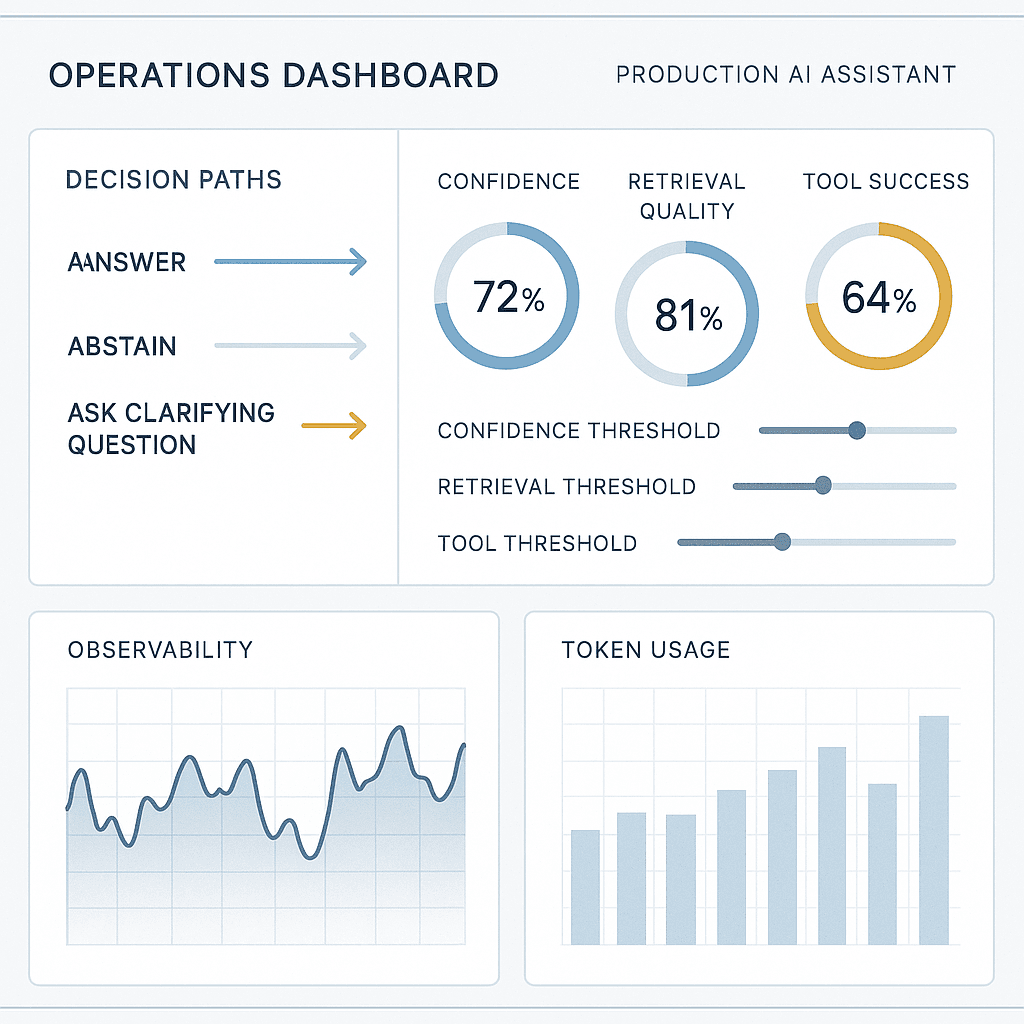
A dashboard I recommend
At minimum, break down by task class and risk tier:
- answer / ask / defer rates
- false confident answer rate
- unnecessary abstention rate
- clarification-to-resolution rate
- retrieval insufficiency rate
- conflicting evidence rate
- tool parameter grounding failures
- action confirmation acceptance and reversal rates
- median and p95 latency by path
- cost per resolved task
The most useful view is often not overall averages. It is the slice where policy underperforms:
- one business unit with stale documents
- one tool integration with high parameter ambiguity
- one workflow where clarification causes abandonment
Watch for drift
Confidence policies drift because the world changes:
- documents get updated
- new product names appear
- tool schemas change
- user behavior shifts
- new workflow types enter traffic
Re-run calibration evals regularly and create drift alerts on retrieval quality, abstention spikes, and decision-score distribution changes.
Sample incidents worth alerting on
- sudden increase in direct answers with no citations in a citation-required workflow
- growing share of high-risk actions reaching confirmation without full slot completeness
- tool success steady, but human reversals rising
- retrieval relevance stable, but evidence conflict increasing after policy updates
These are classic early warnings that the assistant still looks healthy in aggregate while confidence calibration is degrading.
A concrete rollout plan
If your team has no current confidence policy, here is a practical sequence.
Phase 1: Establish workflow taxonomy and risk tiers
List your top workflows and assign risk:
- low-risk informational
- medium-risk operational guidance
- high-risk action or decision support
Do not overcomplicate this. The key is that thresholds will differ.
Phase 2: Define required slots and evidence rules per workflow
For each workflow, specify:
- what must be known before answering or acting
- acceptable evidence sources
- whether citations are required
- when conflicts force deferral
- whether confirmation or human review is mandatory
Phase 3: Implement lightweight ask/defer gates
Start with simple, auditable rules:
- missing required slot => ask
- conflicting authoritative sources => defer
- low evidence sufficiency => defer
- action risk high + incomplete grounding => ask or defer
This alone often removes the most expensive failures.
Phase 4: Add support checks and verifier passes for borderline cases
Use a verifier model or consistency check where synthesis risk is high, not everywhere.
Phase 5: Build a decision eval set and tune thresholds
Label real examples. Tune by workflow. Resist the temptation to optimize only for fewer bad answers; include task completion and clarification efficiency.
Phase 6: Instrument and iterate
Monitor where users get stuck, where humans override, and which domains trigger the most deferrals. Improve retrieval, metadata, and slot extraction before endlessly tweaking prompts.
The main takeaway
Production confidence is not a personality trait of the model. It is a systems property.
If your GenAI assistant is too confident, the fix is rarely just “use a better model” or “tell it to be cautious.” You need a decision policy that treats uncertainty as multi-stage and workflow-specific. The system should answer when intent is clear and evidence is sufficient, ask clarifying questions when a small missing piece can unlock a safe answer, and defer when the evidence, authority, or risk profile does not justify action.
The teams that get this right do a few things consistently:
- they model ambiguity explicitly instead of hoping the LLM asks when needed
- they score evidence sufficiency, not just retrieval similarity
- they separate informational confidence from action confidence
- they tune thresholds by business risk, not globally
- they evaluate answer/ask/defer decisions directly
- they instrument false confidence and unnecessary abstention as first-class metrics
That is how you reduce false confidence without turning the assistant into a timid help bot that never finishes anything.
In other words: do not ask whether your LLM is confident. Ask whether your system has earned the right to answer.