Building an LLM-as-Judge Program That Doesn’t Corrupt Your Evals
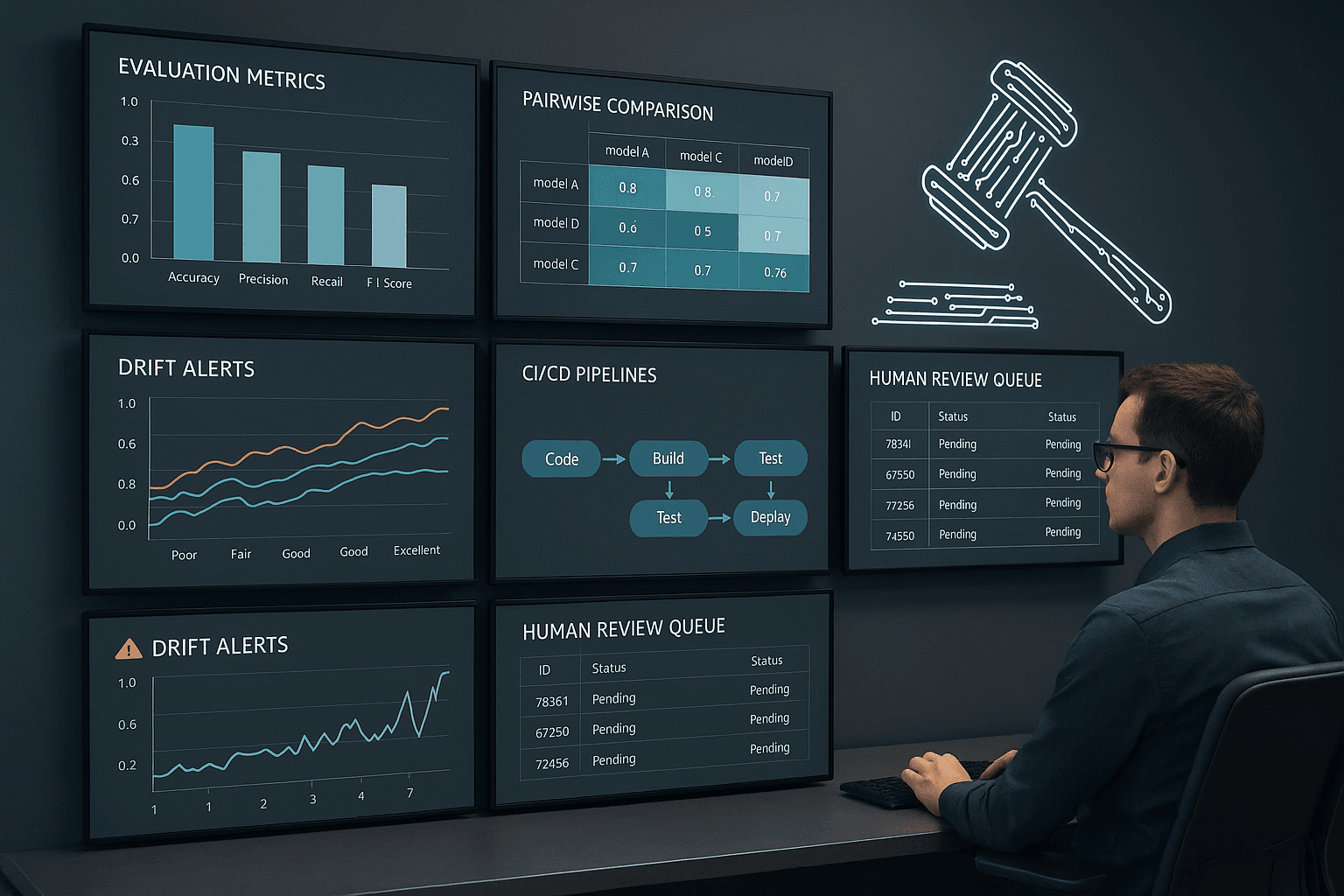
A team I worked with had what looked like a mature GenAI evaluation stack. They had hundreds of test cases, nightly runs, score thresholds in CI, and a clean dashboard that showed their assistant improving release after release. The evaluation program was fast, cheap, and almost entirely automated. Leadership loved it.
Then they shipped a new version to customers.
Within a week, support tickets spiked. Users complained that the assistant had become more verbose, more hedged, and less useful on operational questions. Internal evals had shown a clear win. Production told a different story.
The root cause was not that their generation model got worse in a simple sense. The problem was that their judge got misaligned with the product objective. Over time, the team had tuned prompts and post-processing to score well against a model-based grader that preferred long, polished answers with explicit caveats. The judge also had access to reference answers that leaked the “right shape” of a response. As the team optimized toward the eval harness, they were not improving the product. They were improving their ability to please the judge.
That is the central risk of LLM-as-judge programs: they can create an illusion of rigor while quietly corrupting the feedback loop that drives model and product decisions.
Used well, model-based judges are one of the most useful tools in a production GenAI stack. They let you evaluate at a scale humans cannot sustain, cover nuanced criteria beyond exact match, and detect regressions quickly enough to matter in CI/CD. Used badly, they create hidden bias, amplify leakage, mask brittleness, and give teams false confidence.
This article is a practitioner’s guide to building an LLM-as-judge program that helps rather than harms. I’ll walk through the failure modes, why naive implementations fail, and the architecture, calibration, validation, and governance patterns that make these systems trustworthy enough to use in production decisions.
The pattern: when the judge becomes the target
If you spend enough time around evaluation systems, you see the same pattern repeatedly.
- The team starts with a sensible goal: automate evaluation because human review is too slow and expensive.
- They choose a strong foundation model as judge and write a rubric prompt.
- They run historical examples through it and get plausibly good results.
- They add thresholds to release gates and start comparing candidate systems.
- Engineers learn, implicitly or explicitly, what kinds of responses score well.
- The generation system drifts toward optimizing for the judge.
- The judge’s preferences become the real product spec, whether anyone intended that or not.
This is not unique to LLMs. Goodhart’s law has been haunting metrics for decades: when a measure becomes a target, it ceases to be a good measure. LLM-as-judge just accelerates the cycle because the metric itself is adaptive, high-dimensional, and often opaque.
There are several distinct failure modes hiding underneath that pattern.
First, rubric ambiguity. Teams ask the judge to score “quality,” “helpfulness,” or “correctness” on a 1–5 scale without defining what those words mean in the operational context. The judge fills in the gaps using broad internet priors, provider-tuned stylistic preferences, and prompt artifacts.
Second, reference leakage. The judge sees a gold answer, retrieval context, chain-of-thought style rationale, or metadata that makes the task easier than it would be for a user or a human reviewer. The system under test is graded against information the end user never sees.
Third, same-model bias. The candidate model and the judge are from the same family, or the same provider, and share stylistic priors. The judge systematically favors outputs that “sound like itself.”
Fourth, scalar score collapse. Rich, multidimensional output quality gets compressed into a single number that is noisy, hard to interpret, and easy to game.
Fifth, dataset contamination and benchmark overfitting. Over time, examples from incidents, customer data, and prompt experiments seep into the test suite in ways that make it less representative or less independent.
Sixth, judge drift. The judge model itself changes, whether because the provider updates the model behind a stable API name or because your prompt and orchestration evolve. Suddenly historical comparability is broken.
Seventh, lack of human arbitration. The team stops looking at disagreements because the automation appears to work. Edge cases, policy errors, and domain-specific nuances accumulate unnoticed.
Most teams know these risks in the abstract. The mistake is thinking they are manageable with a better prompt alone. They are not. You need an evaluation program, not just an evaluator.
Why the naive approach fails
The default implementation pattern usually looks something like this:
- Take a set of prompts and expected answers.
- Ask the system under test for outputs.
- Send prompt, output, and expected answer to a powerful model.
- Ask for a 1–10 score and brief justification.
- Average the scores.
- Ship if the average beats baseline by X points.
This fails for three structural reasons.
The first is that numeric ratings from LLM judges are often less stable than teams assume. A 7 versus an 8 may not mean anything reproducible. Small prompt changes, answer ordering, verbosity, and random seed effects can shift scalar scores enough to swamp the actual improvement signal. If you are making release decisions based on tiny deltas in average score, you are often measuring judge noise.
The second is that most product quality criteria are not naturally scalar. Consider a customer-support assistant. You probably care about factual accuracy, policy adherence, actionability, brevity, tone, refusal behavior, and maybe whether the answer avoids escalating unnecessarily. One scalar number collapses all of that and hides tradeoffs. A model that improves tone while slightly worsening accuracy can look like a net win. Whether that is acceptable depends on product risk, not arithmetic.
The third is that the judge is itself a model with blind spots and incentives. If you do not calibrate it against human labels, probe for bias, and monitor it over time, you are just outsourcing subjectivity to another black box.
A subtle but important issue is that naive judge prompts often ask for absolute truth assessment on tasks the judge cannot actually verify. For example, a judge scoring an answer to a domain-specific operational runbook question may confidently reward a plausible-sounding but wrong output because it lacks access to the authoritative source or the expertise to notice the error. You do not solve that by making the judge “smarter.” You solve it by changing the task: evaluate groundedness against provided evidence, or route the example to a domain-specific checker or human reviewer.
Another common failure is mixing evaluation functions. Teams use one judge for everything: correctness, style, safety, policy, retrieval quality, and user satisfaction. In practice, different criteria need different mechanisms. Some are best handled by deterministic checks. Some need retrieval-grounded verification. Some are better as pairwise preference judgments. Some need specialist human review. Treating all of them as “let’s ask GPT for a score” is how you get fragile evals.
A better approach: build an evaluation architecture, not a single judge
The production pattern that works is a layered evaluation architecture with explicit separation between:
- What you are trying to measure
- What evidence the evaluator gets to see
- Which evaluator type is appropriate
- How evaluator performance is calibrated
- How results are aggregated into release decisions
- How drift and disagreement are surfaced for human review
At a high level, your LLM-as-judge program should look like this:
- Define quality dimensions as operational rubrics.
- Build versioned evaluation datasets segmented by task and risk.
- Use the cheapest reliable evaluator per dimension.
- Prefer pairwise or categorical judgments over unconstrained scalar scoring where possible.
- Calibrate judges against human-labeled anchor sets.
- Validate with multiple judges or judge families on high-impact decisions.
- Monitor disagreement, drift, and confidence over time.
- Keep humans in the loop for adjudication, sampling, and rubric updates.
- Treat judge prompts, models, thresholds, and datasets as versioned production assets.
That sounds heavy, but it is much cheaper than shipping against corrupted evals.
Rubric design: make quality measurable in product terms
The single biggest improvement most teams can make is to stop asking the judge for generic quality ratings.
A good rubric is operational. It defines observable criteria tied to user and business outcomes. It also constrains the judge to the evidence it should use.
Bad rubric:
- Rate the response from 1 to 10 based on quality and helpfulness.
Better rubric:
- Accuracy: Does the response make claims supported by the provided source documents or known policy? Mark pass/fail.
- Task completion: Does it answer the user’s explicit question? Mark full/partial/fail.
- Actionability: Does it provide the next concrete step when one is appropriate? Mark yes/no.
- Brevity: Is it no longer than necessary to complete the task? Mark good/too long/too short.
- Policy adherence: Does it comply with support policy section X? Mark pass/fail.
- Tone: Is it professional and non-defensive? Mark acceptable/unacceptable.
Notice a few patterns here.
First, use categorical labels where possible. Categories are easier to calibrate, easier to interpret, and often more stable than 1–10 scales.
Second, isolate dimensions. If a response is highly actionable but inaccurate, you want to know that explicitly.
Third, define when the judge should abstain. If the evidence is insufficient to determine accuracy, the judge should return “cannot assess,” not hallucinate confidence.
Fourth, include examples. Few-shot examples are not just for performance; they are part of the rubric specification. Include positive, borderline, and negative examples from your domain.
In high-stakes domains, I strongly recommend designing rubrics with a policy owner or domain expert present. Engineers often create criteria that are legible to models but not aligned to actual business risk. For example, in a medical triage assistant, “empathetic tone” matters, but factual safety and escalation correctness matter much more. Your rubric weights need to reflect that.
Pairwise vs scalar scoring: default to comparisons for model selection
If you are comparing system A versus system B, pairwise judgments are usually more robust than independent scalar scores.
Instead of asking:
- Score output A from 1–10.
- Score output B from 1–10.
Ask:
- Which output better satisfies the rubric for this specific task?
- Options: A better, B better, tie, both bad.
- Provide criterion-level reasons.
Why this works better:
- Relative judgments are easier for both humans and models than absolute scoring.
- Pairwise comparisons reduce calibration issues around arbitrary numeric scales.
- They better reflect real product decisions, which are often “is candidate better than baseline?”
- They can be aggregated into win rates with confidence intervals.
There are caveats. Pairwise judgments can still suffer from position bias, verbosity bias, and style bias. You should mitigate these by randomizing answer order, stripping identifying artifacts, and instructing the judge not to reward verbosity unless it improves the specified criterion.
For release gating, I like a pattern like this:
- Use pairwise judgments for candidate-versus-baseline comparisons on representative test slices.
- Compute win rate, loss rate, tie rate, and criterion-level deltas.
- Require non-inferiority on critical slices and a minimum win margin on target slices.
- Use scalar or categorical metrics only for dimensions where absolute thresholds matter, such as policy pass rate or factual grounding rate.
This is much harder to game than “average score increased from 7.6 to 7.9.”
Judge calibration: prove the judge tracks humans before trusting it
An LLM judge is not validated because it sounds reasonable. It is validated when it agrees sufficiently with trained human reviewers on representative data for the specific decision you want to automate.
The calibration process should be explicit.
Start with an anchor set:
- A stratified sample of examples covering common cases, edge cases, known failure modes, and task/risk segments.
- Human labels from at least two reviewers for each criterion.
- Adjudicated consensus labels for disagreements.
Then evaluate the judge against this set.
What to measure:
- Agreement with consensus labels per criterion
- Inter-rater agreement versus human-human agreement baseline
- Confusion matrix by label category
- False pass and false fail rates, especially on high-risk criteria
- Stability across repeated runs and prompt variants
- Sensitivity to answer order and formatting
You do not need the judge to be perfect. You need to know where it is reliable enough and where it is not.
A practical rule: do not use a judge autonomously for a criterion if its false pass rate on that criterion is operationally unacceptable. For example, if your safety or policy judge misses too many violations, it cannot be the final gate. It can still be a triage tool.
Calibration should also include adversarial probing.
Try examples that tempt common judge biases:
- Long but wrong answers
- Fluent paraphrases of incorrect content
- Correct but terse answers
- Answers with hedging language
- Outputs that match the expected style but miss the key constraint
- Reference answers that are themselves imperfect or overly specific
You want to discover whether the judge is rewarding style over substance, exactness over acceptable variation, or references over user utility.
Cross-model validation: never let one judge define reality alone
For important decisions, use more than one judge signal.
This does not mean you need an expensive ensemble for every example. It means you should avoid single-point epistemic failure.
Useful validation patterns include:
-
Judge family diversity Use judges from different model families or providers for periodic cross-checks. If one model family consistently rates your outputs higher, you may have same-family bias.
-
Escalation on disagreement Use a primary judge for routine scoring. If a secondary judge disagrees on a critical criterion, escalate to human review.
-
Cross-method validation Compare LLM judge outcomes with deterministic metrics, retrieval-grounded checks, business KPIs, and human spot checks. If your judge says quality improved but escalation rate or customer satisfaction worsens, investigate immediately.
-
Shadow judging Before replacing a human-heavy eval flow, run the judge in shadow mode for several weeks. Compare decisions and analyze mismatches before changing release gates.
The cost tradeoff here is manageable if you are selective. A common production setup is:
- Cheap primary judge on all examples
- More expensive secondary judge on a sampled subset and all critical failures/disagreements
- Human adjudication on a much smaller queue of high-risk or uncertain cases
This gives you broad coverage without paying premium-model prices for every eval.
Model and tool choices: use the least powerful evaluator that is good enough
Not every evaluation task needs a frontier LLM. In fact, using one everywhere is often wasteful and can reduce transparency.
A pragmatic evaluator stack often includes:
Deterministic checks Best for format compliance, required fields, schema validity, citation presence, tool-call correctness, exact policy strings, banned content lists, latency thresholds, token limits, and other objective constraints.
Embedding or lexical similarity methods Useful as weak signals for retrieval relevance, duplicate detection, semantic clustering, and dataset maintenance. Usually not sufficient for final quality judgments.
Task-specific classifiers or small models Good for narrow moderation classes, routing verification, language identification, PII presence, or other well-defined classifications. Often cheaper and more stable than general LLM judges.
LLM judges Best for nuanced, rubric-based assessments of groundedness, completeness, preference, or policy interpretation where deterministic methods are insufficient.
Human review Required for rubric design, calibration, edge cases, policy changes, and any high-risk criterion where automation remains unreliable.
The selection principle is simple: use the cheapest reliable mechanism per criterion.
For example, evaluating a RAG customer support agent might look like this:
- Retrieval recall proxy: deterministic/IR metric against annotated supporting documents
- Citation format compliance: deterministic
- Groundedness to provided context: LLM judge
- Policy adherence: LLM judge plus deterministic rule checks for specific constraints
- Final answer preference versus baseline: pairwise LLM judge
- Safety-sensitive subset: human adjudication sample
This architecture is more robust and usually cheaper than sending everything to a premium model for a single holistic score.
Operational architecture: what this looks like in production
Here is a practical reference architecture.
Data layer
- Versioned evaluation datasets
- Segmentation tags: task type, customer tier, risk level, locale, domain, incident class
- Anchor set with human consensus labels
- Holdout set not used for prompt or system tuning
- Failure library sourced from production incidents and support escalations
Execution layer
- System-under-test runner that captures prompt, context, tools, and output artifacts
- Evaluator orchestrator that runs deterministic checks, LLM judges, and optional secondary judges
- Randomization logic for pairwise answer ordering
- Caching for repeat judge calls where inputs are identical
- Rate limit and retry handling with audit logs
Evaluation layer
- Criterion-level scoring, abstentions, rationales, and metadata
- Pairwise aggregation into win/loss/tie rates
- Confidence intervals or bootstrap estimates for deltas
- Per-slice dashboards, not just global averages
Governance layer
- Human adjudication queue for disagreements, critical failures, and sampled audit cases
- Judge performance monitoring against anchor set
- Version registry for judge model, prompt, rubric, and thresholds
- Approval workflow for changing eval definitions
CI/CD integration
- Fast smoke evals on every change
- Broader nightly or pre-release suites
- Slice-specific gates, especially for critical tasks
- Automatic regression ticketing with linked examples and judge rationales
If you only implement one dashboard, make it slice-based. Global metrics hide too much. A 2-point improvement overall can mask a severe regression in enterprise-policy queries or a specific locale.
Implementation details that matter more than people think
- Separate optimization and audit sets
If teams repeatedly tune prompts or system behavior against the same eval set, they will overfit. Maintain:
- A development set used for iteration
- A locked audit/holdout set used for release confidence
- A rolling production sample for realism and drift detection
Treat the holdout set seriously. Access should be controlled, and additions should be versioned.
- Control judge visibility
Give the judge only the information it should legitimately use.
For groundedness tasks, provide source documents and ask whether claims are supported by them. Do not also provide a canonical answer unless the task is specifically reference-based comparison. For user-satisfaction preference, do not leak internal metadata that would reveal which answer is baseline.
- Randomize and blind pairwise comparisons
Randomize answer order. Remove formatting cues, model signatures, and unnecessary metadata. Otherwise, position bias and brand/style bias will contaminate outcomes.
- Capture judge rationales, but do not confuse them with truth
Rationales are useful for debugging and human review queues. They are not proof that the judgment is correct. Store them, analyze them, but validate decisions against labels and outcomes.
- Track abstention and uncertainty explicitly
A mature judge program includes “cannot assess” and escalation pathways. Forcing every example into a score creates false confidence.
- Version everything
Version:
- Judge model identifier
- Prompt template
- Rubric definition
- Few-shot examples
- Thresholds
- Dataset versions
- Aggregation rules
If any of these change, treat score comparability cautiously. This is especially important when API providers silently improve or modify model behavior over time.
- Use statistical thinking, not just point estimates
For pairwise win rates or pass-rate deltas, report confidence intervals. On small eval slices, apparent gains are often noise. If you do not have enough samples to detect the effect size you care about, your gate is theater.
- Build failure taxonomies
When a judge flags failures, map them into categories: hallucination, policy violation, retrieval miss, unnecessary refusal, verbosity, tool misuse, tone issue, and so on. Over time, this lets you see whether a candidate is improving the problem you actually need fixed.
Drift monitoring: judges drift too
Teams usually monitor generation quality drift but forget that the judge can drift independently.
Judge drift comes from several sources:
- Provider model updates under a stable name
- Prompt template changes
- Different few-shot examples
- New dataset composition
- Upstream context formatting changes
You need separate monitoring for evaluator health.
A practical drift regimen:
- Re-run the anchor set on a schedule and compare agreement metrics over time.
- Keep a frozen canary subset for longitudinal comparability.
- Alert on changes in score distribution, pass rates, abstention rates, and pairwise preferences that are not explained by system changes.
- Track disagreement rates between primary and secondary judges.
- Audit a random sample of “easy passes” because silent false positives are more dangerous than visible disagreements.
If your judge’s behavior changes materially, freeze release gates until you understand why. Otherwise, you are comparing apples to different apples every week.
Human adjudication: not a backup, a core part of the system
There is a strong temptation to view human review as temporary scaffolding until the judges are good enough. In production, that mindset is a mistake.
Human adjudication serves at least five ongoing functions:
- Resolving judge disagreement or uncertainty
- Reviewing high-risk slices and policy-sensitive examples
- Detecting new failure modes not represented in rubrics
- Updating rubrics when product objectives or policies change
- Measuring whether the judge still tracks expert judgment
The trick is to use humans surgically.
A typical queue design:
- All critical-criterion disagreements between judges
- All judge abstentions on critical slices
- Random sample of auto-passed examples for audit
- Random sample of production interactions each week
- Any examples linked to customer complaints or incidents
If you can afford only one human-review investment, spend it on adjudicated anchor data. That dataset is the foundation for calibration, monitoring, and trust.
CI/CD and release gating: operationalize with care
LLM judges are useful in CI/CD, but only if you match gate strictness to test reliability and business risk.
A pattern that works well:
Tier 1: pre-merge smoke checks
Run fast, cheap, high-signal checks:
- Deterministic schema/format/tool tests
- Small targeted eval slice with primary judge
- Critical regression tests from recent incidents
Goal: catch obvious breakage quickly, not certify release quality.
Tier 2: nightly broader evals
Run larger slice coverage:
- Pairwise candidate vs baseline on key task families
- Criterion-level pass rates
- Secondary judge on a sample or on critical cases
- Trend dashboards by slice
Goal: identify emerging regressions and improvements with enough data to matter.
Tier 3: pre-release audit
Run the locked holdout and risk-heavy slices:
- Human review on sampled disagreements and critical criteria
- Cross-model validation
- Statistical significance or non-inferiority checks
- Sign-off from product/policy owners where relevant
Goal: make a release decision with known uncertainty and explicit risk tradeoffs.
Release gates should be multidimensional. For example:
- No regression in factual grounding pass rate on enterprise-policy slice
- No increase in severe safety/policy failures
- Pairwise win rate of at least 55% on target support tasks with 95% CI excluding major regression
- Latency and cost within budget
This is more complex than one average score threshold, but it aligns with how products actually succeed or fail.
Cost and latency tradeoffs
A serious LLM-as-judge program can get expensive if you let it. The main levers are scope, judge choice, and escalation design.
Where cost goes:
- Evaluating every sample with premium models
- Running multiple judges redundantly
- Sending long contexts and reference documents to judges
- Re-scoring unchanged examples without caching
- Using judges for checks that should be deterministic
How to control it:
- Use smaller or cheaper judges for routine criteria once calibrated
- Reserve premium judges for high-risk slices, disagreements, or audits
- Summarize or chunk evidence before judging where safe
- Cache exact-input evaluations aggressively
- Evaluate on representative slices rather than every conceivable prompt every commit
- Separate fast CI gates from slower audit suites
Latency matters too, especially if you want evals in developer workflows. If a full run takes hours, people stop looking at it. I prefer a layered design where pre-merge checks complete in minutes, nightly runs provide broader signal, and pre-release audits do the heavy work.
One honest tradeoff: the most trustworthy judge programs are not the cheapest or fastest. But they are still usually far cheaper than relying on manual review for everything, and far less risky than shipping based on unvalidated automated scores.
A concrete rollout plan
If your team has no formal LLM-judge program today, here is a practical sequence.
Phase 1: establish the foundation
- Identify 3–5 critical task slices and failure modes.
- Write criterion-level rubrics with domain stakeholders.
- Build an anchor set of 100–300 examples with human consensus labels.
- Implement deterministic checks for objective criteria.
- Add a primary LLM judge for one or two nuanced criteria only.
Phase 2: validate and constrain
- Measure judge-human agreement and error modes.
- Replace scalar scoring with pairwise judgments for model comparisons.
- Add abstain behavior and human escalation rules.
- Create a locked holdout set.
- Start slice-based dashboards.
Phase 3: operationalize
- Integrate fast checks into CI and broader runs nightly.
- Add secondary judge validation for critical slices.
- Version prompts, models, datasets, and thresholds.
- Build adjudication queue workflows.
- Add drift monitoring on anchor and canary sets.
Phase 4: govern and improve
- Review rubric relevance monthly or after product/policy changes.
- Expand the failure library from incidents and customer feedback.
- Correlate judge metrics with business outcomes such as CSAT, containment, escalation rate, or resolution quality.
- Retire metrics that do not predict outcomes.
That last point matters. The point of evals is not to have evals. The point is to improve the product. If a judge metric does not correlate with what users and the business actually care about, it should lose decision authority.
What good looks like
A healthy LLM-as-judge program has a few unmistakable properties.
- Teams can explain exactly what each metric means and why it matters.
- Judges are calibrated against human labels, not trusted by vibes.
- Critical decisions do not rely on one scalar score from one model.
- The system distinguishes between dimensions like correctness, policy, and style.
- Holdout data and anchor sets are protected and versioned.
- Drift in judges is monitored separately from drift in generation models.
- Human adjudication remains active and targeted.
- Evals are slice-aware and tied to business risk.
- Passing the eval does not require learning one judge’s favorite writing style.
That last one is worth repeating. When you look at outputs from a model that “won” your evals, they should look more useful to users, not just more legible to a grader.
Takeaways
LLM-as-judge is powerful because it gives you scalable evaluation for nuanced GenAI behavior. It is dangerous because the judge can quietly become the target, contaminating the optimization loop.
The way through is to treat judging as a production system with architecture, calibration, governance, and human oversight.
In practice, that means:
- Use operational rubrics, not vague quality scores.
- Prefer pairwise comparisons for model selection.
- Break quality into criterion-level judgments.
- Calibrate judges against human consensus data.
- Validate across model families and methods.
- Monitor judge drift as a first-class risk.
- Keep humans in the loop for adjudication and rubric evolution.
- Version everything and gate releases on multidimensional evidence.
If you do this well, LLM judges become what they should be: fast, scalable instruments that help your team find signal sooner.
If you do it poorly, they become a confidence machine that rewards the wrong things.
Production GenAI teams do not need more confidence. They need better feedback loops. That is the standard an LLM-as-judge program should meet.