Auditing Hidden Prompt State in Production LLM Systems: Managing System Prompts, Middleware, and Tool Scaffolding Drift
A team ships a customer support copilot that has been stable for weeks. Escalation rates are down, handle times are improving, and everyone is finally sleeping again. Then, over the course of three days, the copilot starts refusing perfectly safe refund requests, calling the wrong internal tool for order lookups, and producing oddly repetitive explanations in one specific geography. No model version changed. No application code changed in the request handler. Their retrieval index is intact. Latency and token usage moved only slightly.
What changed was the thing almost nobody had made observable: the hidden prompt state.
A framework upgrade inserted a new tool-use preamble. A middleware layer started appending a terse compliance footer for EU users. A product team edited the global system prompt to reduce verbosity. Meanwhile, a safety overlay service changed its refusal policy language, and an agent library upgraded its scratchpad formatting. The final prompt seen by the model was materially different from what anyone thought was in production.
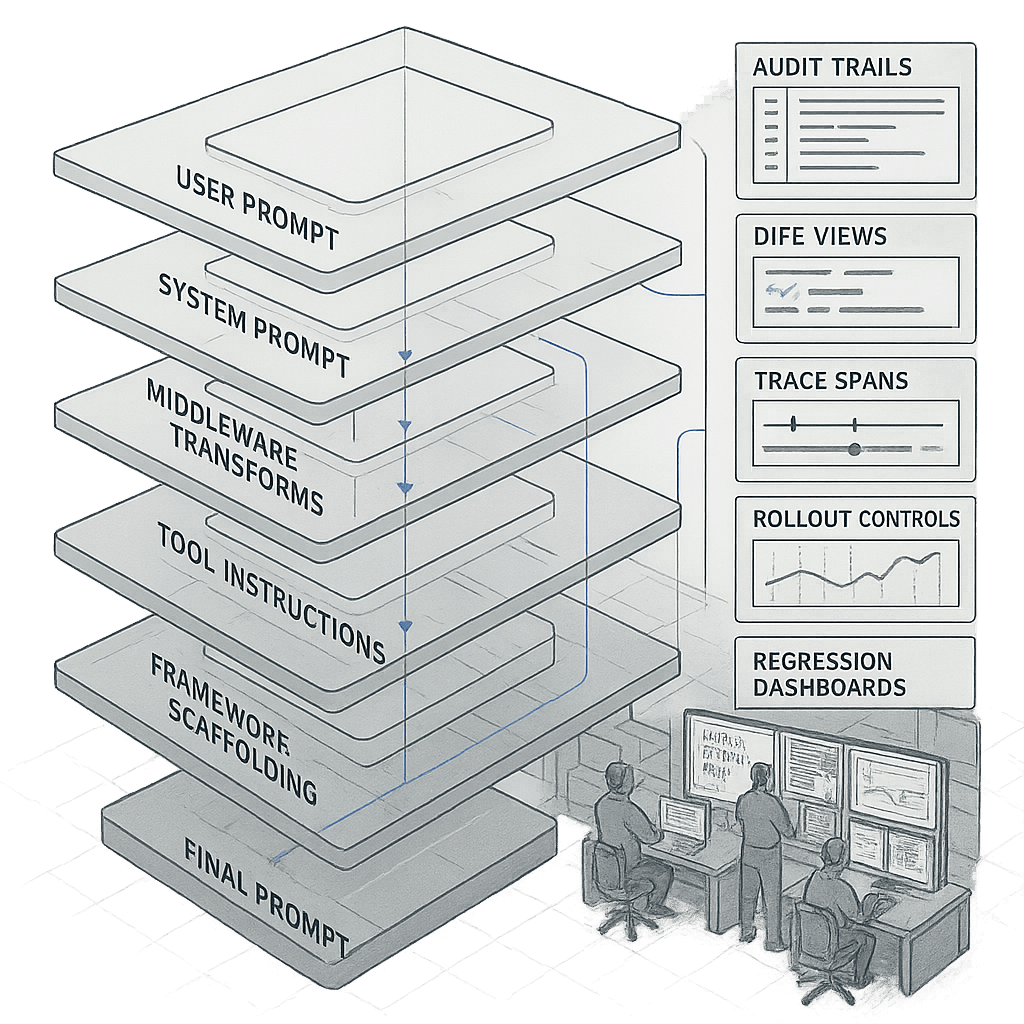
This is one of the most common classes of failures in production LLM systems, and it is still under-instrumented. Teams obsess over model IDs, retrieval quality, and user prompts, but the model does not execute any of those in isolation. It executes the fully assembled prompt state after every hidden layer has mutated it: system prompts, role messages, middleware transforms, tool schemas, framework-generated instructions, memory summaries, policy overlays, locale-specific inserts, and orchestration scaffolding. If you cannot reconstruct that exact state for a request, you cannot reliably debug behavior drift, assign blame, or run trustworthy regressions.
This article is a practical guide to auditing hidden prompt state in production. I will focus on the systems problem rather than prompt-writing aesthetics: how to make hidden prompt assembly observable, governable, testable, and safe to change. The goal is not just “log the prompt.” The goal is to build prompt lineage, diffing, trace capture, regression testing, blame isolation, and rollout controls so that silent behavior changes become visible before they become incidents.
The pattern: hidden prompt state is a distributed configuration system
Most production teams start with a mental model that looks roughly like this:
- User sends a message.
- Application inserts a system prompt.
- Model returns an answer.
That model stops being true almost immediately after you add tools, safety, personalization, and orchestration. In practice, the final prompt is usually assembled from many sources:
- Base system prompt owned by product or ML team
- Runtime safety or policy overlays
- Locale or regulatory inserts
- Retrieval instructions and citation formatting rules
- Tool schemas and tool-use conventions
- Agent scratchpad / chain-of-thought placeholders / hidden reasoning delimiters
- Framework-generated scaffolding for function calling or JSON mode
- Conversation summaries or memory compression outputs
- Tenant-specific branding or tone instructions
- Experiment flags and prompt A/B variants
- Middleware rewriting of user input or role ordering
- Post-processing instructions injected after routing decisions
The result is effectively a distributed configuration system with poor source control discipline. Each layer may be “small,” but all layers compose into the instruction surface the model actually sees. Worse, these layers are often owned by different teams, deployed on different cadences, and generated dynamically by code paths that are not obvious during incident response.
That is why prompt drift feels mysterious. Nobody changed “the prompt” because there is no single prompt. There is a prompt assembly pipeline.
Once you recognize the pattern, the engineering response becomes clearer: treat hidden prompt state as a first-class production artifact with lineage, versioning, auditability, and rollback.
Why the naive approach fails
The naive approach usually takes one of four forms.
1. Logging only the user-visible prompt
Teams often log the user message and maybe a top-level system prompt string. That misses:
- Framework-added tool instructions
- Dynamic middleware inserts
- Tool schema serialization differences
- Memory summaries and retrieved snippets
- Safety overlays and policy routing branches
- Role ordering and delimiters
- Hidden assistant messages used for planning or repair
When behavior changes, those “invisible” fields are exactly where the problem tends to be.
2. Versioning prompt templates but not rendered prompts
A Git repo with prompt files is useful, but insufficient. Production behavior depends on rendered state at request time:
- Which template version was used
- Which middleware path fired
- Which tools were available
- How arguments were described
- Which locale or tenant overlays applied
- Which model-specific adapter serialized the request
A prompt template commit hash cannot explain the final payload unless you capture the whole assembly graph.
3. Treating framework abstractions as trustworthy and stable
Frameworks save time, but they often inject hidden instructions. Agent libraries frequently add:
- Tool-choice guidance
- Retry instructions
- JSON formatting constraints
- Internal scratchpad wrappers
- Model-specific compatibility shims
These abstractions can change across library versions or even configuration flags. If you do not inspect the exact request payload sent to the model provider, you are taking behavior on faith.
4. Testing on happy paths only
A few spot checks in staging are not enough. Prompt state failures often emerge only under combinations of conditions:
- Long conversations after summarization kicks in
- A specific locale or compliance regime
- A tenant with custom tool access
- Fallback from one model to another
- Partial tool failures that trigger repair prompts
- Retrieval misses that activate special policy text
The naive test strategy does not exercise the assembly branches that matter.
Better approach: prompt assembly as a traced, versioned supply chain
The more robust mental model is this: every LLM request has a prompt supply chain. Your job is to capture provenance from source fragments to final model payload, then make that provenance queryable and testable.
A production-ready architecture has six capabilities:
- Canonical prompt assembly graph
- Trace capture of intermediate and final states
- Prompt lineage and diffing
- Regression testing against frozen prompt artifacts
- Blame isolation across layers
- Rollout controls and prompt change governance
Let’s make that concrete.
A reference architecture for hidden prompt state observability
At a high level, the request path should look like this:
textUser Request
  -> Request Router
  -> Prompt Assembly Pipeline
      -> base system prompt resolver
      -> tenant/locale policy overlay
      -> retrieval instructions + snippets
      -> memory summarizer insert
      -> tool registry serialization
      -> framework scaffolding adapter
      -> model-provider payload renderer
  -> Final Prompt Snapshot + Metadata
  -> Model Call
  -> Tool Calls / Agent Loop
  -> Response Post-Processing
  -> Trace Sink + Eval Pipeline
The crucial design decision is that prompt assembly is explicit and instrumented, not incidental and spread across convenience wrappers.
1. Canonical prompt intermediate representation
Before provider-specific rendering, create a canonical intermediate representation (IR) for prompt state. For example:
json{
  "request_id": "req_123",
  "model_target": "gpt-4.1",
  "conversation_id": "conv_456",
  "fragments": [
    {
      "id": "frag_sys_base_v19",
      "type": "system",
      "source": "git:prompts/support/system.md@a1b2c3",
      "owner": "support-ml",
      "priority": 100,
      "content": "You are a support copilot..."
    },
    {
      "id": "frag_policy_eu_refund_v4",
      "type": "policy_overlay",
      "source": "policy-service:ruleset-8841",
      "owner": "trust-and-safety",
      "priority": 90,
      "content": "For EU refund requests, disclose..."
    },
    {
      "id": "frag_tool_orders_v12",
      "type": "tool_schema",
      "source": "tool-registry@12",
      "owner": "platform",
      "priority": 80,
      "content": {
        "name": "lookup_order",
        "description": "Find an order by ID or email..."
      }
    }
  ],
  "rendering_rules": {
    "role_order": ["system", "developer", "user", "assistant", "tool"],
    "tool_serialization": "provider_openai_functions_v3",
    "json_mode": false
  }
}
This IR gives you something stable to diff even if you later switch providers or frameworks.
2. Provider payload snapshots
You also need the exact payload delivered to the model API. The canonical IR is not enough because rendering adapters matter. Different adapters can change:
- Role mapping
- Tool schema formatting
- Function call conventions
- Stop sequences
- Structured output wrappers
- Safety preambles
- Cache-control hints
Capture the final outbound payload after all transformations, ideally redacted and token-counted. If legal or privacy constraints prevent full content logging, store encrypted payloads with strict access controls or content hashes with selective sampling for authorized debugging.
3. Span-level trace capture
Add prompt-state spans to your tracing stack. Whether you use OpenTelemetry, Honeycomb, Datadog, Langfuse, Arize, or a custom store, capture each mutation as a span/event:
resolve_base_system_promptapply_tenant_brandinginject_eu_policy_overlayattach_retrieval_contextserialize_tool_registryframework_add_function_call_preamblerender_provider_payload
Each span should record:
- Input artifact IDs
- Output artifact IDs
- Content hash before/after
- Token delta
- Owner/team metadata
- Feature flags / experiment IDs
- Library/framework versions
- Latency contribution
This turns prompt debugging from archaeology into normal trace analysis.
Prompt lineage: the missing control plane
Once prompt state is captured, you need lineage. For each request, you should be able to answer:
- Which source fragments contributed to this model call?
- In what order were they applied?
- Which code path or middleware mutated them?
- Which library versions rendered them?
- Which tool schemas and descriptions were present?
- Which experiments, tenant overrides, or policy rules were active?
- Which exact outbound payload hash was sent?
Think of prompt lineage as the equivalent of data lineage in analytics pipelines. It is the only sane way to perform impact analysis.
A practical implementation is to give every prompt fragment and transformation step a stable identifier:
prompt_fragment_idprompt_fragment_versiontransform_idtransform_versiontool_schema_idtool_schema_versionrenderer_idrenderer_versionfinal_prompt_hash
Then build a lineage graph per request. When an incident occurs, you can group bad outcomes by shared lineage traits.
For example, you might discover:
- 94% of refusals correlate with
policy_overlay_version=4 - Wrong tool usage spikes only when
renderer_version=openai_adapter_3.2.1 - Repetitive answers correlate with
summarizer_model=cheap-mini-v2 - JSON breakage occurs only when
framework_scaffolding=agentlib_0.18
Without lineage, these remain hunches.
Diffing: compare what the model saw, not what humans think changed
A prompt diff system should support at least four levels:
1. Fragment diff
Show changes to source components:
- Base system prompt changed from v19 to v20
- Tool description changed from v12 to v13
- Policy overlay text changed in one clause
This is your human review layer.
2. Rendered prompt diff
Show the fully assembled canonical prompt before provider rendering. This catches interactions between fragments.
3. Provider payload diff
Show final serialized API payload differences. This catches adapter and framework changes.
4. Behavioral diff
Compare outputs and metrics on a frozen eval set:
- Refusal rate
- Tool selection accuracy
- Structured output validity
- Hallucination rate
- Tone/verbosity deltas
- Latency and token usage
Behavioral diff is what matters operationally, but without the three prompt-state diffs above you cannot localize the cause.
In practice, a useful diff UI highlights:
- Added/removed fragments
- Reordered fragments or roles
- Token count delta per fragment
- Tool availability and description changes
- Safety language additions/removals
- Renderer/framework version drift
- Final payload hash change
Why silent behavior changes are so common
People coming from conventional software engineering often underestimate how instruction-sensitive LLM systems are. The hidden-prompt problem is not just “prompts are fragile.” It is more specific:
Instruction precedence is non-linear
A tiny safety clause inserted earlier in the context can dominate a longer downstream instruction. A tool description tweak can change action selection disproportionately. Reordering two sections can flip behavior.
Framework scaffolding is semantically meaningful
What looks like boilerplate is often interpreted as high-priority instruction by the model. For example, a hidden line like “When tools are available, prefer calling a tool instead of answering directly” can radically alter action rates.
Different models react differently to the same scaffolding
One model may ignore verbose tool instructions; another may over-index on them. A provider migration can expose hidden prompt debt even if your visible prompts are unchanged.
Compression layers introduce secondary drift
Conversation summarization and memory extraction are prompt-generating systems themselves. If their outputs change, your downstream prompt state changes even with no edits to the main assistant prompt.
This is why auditing must cover the entire instruction surface, not just handwritten prompt files.
Evaluation strategy: test prompt state as a configuration matrix
If your prompt system has multiple dynamic layers, your evals should reflect that combinatorial reality.
A practical evaluation strategy has five tiers.
Tier 1: fragment unit tests
Test individual fragments and transforms for invariants.
Examples:
- Policy overlay must include required legal clause
- Tool descriptions must mention authentication assumptions
- Locale transform must not exceed N tokens
- Summarizer output must preserve order ID entities
These are cheap and catch obvious mistakes before model calls.
Tier 2: assembly snapshot tests
Given specific inputs and flags, assert that canonical prompt IR and provider payload snapshots match expectations.
Example snapshot cases:
- US support request with two tools
- EU refund request with policy overlay
- Long thread triggering summarization
- Tenant with custom branding
- Fallback model path
This is the fastest way to catch hidden framework or middleware drift.
Tier 3: model-based regression evals
Run frozen request sets against candidate prompt assemblies and compare outputs. Include:
- Golden examples with expected tool calls
- Adversarial examples for over-refusal/under-refusal
- Structured output tasks
- Long-context continuity tests
- Multi-turn statefulness tests
Metrics should include both quality and operational dimensions:
- Task success
- Tool-call precision/recall
- Refusal precision/recall
- Citation correctness
- JSON validity
- Average prompt tokens
- Completion tokens
- P50/P95 latency
- Cost per successful task
Tier 4: lineage-aware blame isolation
When a regression appears, automatically rerun evals with ablations:
- old prompt + old renderer
- new prompt + old renderer
- old prompt + new renderer
- old tool schema + new prompt
- old summarizer + new policy overlay
This is one of the most valuable investments you can make. It converts “something changed” into “tool schema description v13 caused 80% of the delta.”
Tier 5: shadow and canary in production
Before full rollout, mirror a slice of traffic and compare:
- final prompt hashes
- tool call distributions
- refusal rates
- latency and token cost
- human QA or adjudicated outcomes
Prompt changes deserve the same rollout discipline as model changes.
Implementation details that matter in real systems
Here are the implementation choices that usually separate toy observability from something useful during an incident.
Normalize prompt fragments before hashing
If you hash raw text naively, meaningless differences create noise. Normalize:
- whitespace
- line endings
- deterministic JSON field order
- redacted secret placeholders
- stable tool schema ordering
Then compute:
- fragment hash
- assembled canonical prompt hash
- provider payload hash
Store all three.
Record token contribution per layer
A lot of hidden prompt regressions first show up as cost or context pressure. Track token counts for each fragment and transform. This helps answer:
- Which layer caused context bloat?
- Which policy overlay pushed retrieval snippets out of window?
- Which framework upgrade added 300 hidden tokens?
Many teams find that tool scaffolding and safety overlays quietly become a large percentage of prompt cost.
Persist role order and delimiters
Role order, section boundaries, XML tags, markdown headings, and tool wrappers all matter. Don’t just log concatenated text; log the structured representation and the render rules.
Treat tool descriptions as prompt code
Tool metadata is often the most behaviorally important prompt surface in agent systems. Audit changes to:
- tool name
- description
- parameter names
- parameter descriptions
- examples
- usage constraints
- error-repair instructions
In many production agents, changing a tool description has more impact than changing the system prompt.
Separate hidden reasoning from observable scaffolding
You should avoid storing sensitive chain-of-thought if your system elicits it, but you still need to track scaffolding that requests or constrains reasoning. Capture the existence and metadata of hidden reasoning channels without storing sensitive generated reasoning content.
For example:
reasoning_mode=enabledscratchpad_wrapper_version=v5hidden_assistant_messages_count=2plan_repair_prompt_hash=...
That gives you observability without over-collecting sensitive internals.
Build a prompt manifest per release
For every deployment, generate a manifest listing:
- prompt fragment versions
- transform versions
- framework/library versions
- tool registry versions
- renderer versions
- eval results
- approved owners
- rollout plan and guardrails
This becomes the release artifact for your LLM behavior surface.
Model and framework comparisons: where drift tends to come from
Not all stacks hide prompt state in the same way.
Raw provider SDKs
Pros:
- Maximum transparency over final payload
- Easier to inspect exact request shape
- Fewer surprise middleware inserts
Cons:
- More engineering work
- You must implement your own orchestration and retries
- Easier to create inconsistent assembly logic across services
Best for teams that need strong control and can afford platform investment.
Agent frameworks and orchestration libraries
Pros:
- Fast iteration
- Built-in tool calling loops, memory, retries, structured outputs
- Useful abstractions for common workflows
Cons:
- Hidden scaffolding often changes across versions
- Harder to reconstruct exact prompt without extra hooks
- Behavior can differ significantly by model adapter
Best for teams moving quickly, but only if they instrument framework boundaries aggressively.
Managed AI gateways / observability platforms
Pros:
- Easier trace capture and prompt logging
- Experimentation and replay tooling
- Sometimes built-in governance controls
Cons:
- May still miss application-side transforms before requests reach gateway
- Can obscure provider-specific rendering details
- Potential privacy and lock-in considerations
Best when paired with in-app lineage capture rather than used as the sole source of truth.
The key point: no vendor choice eliminates prompt drift. It only changes where drift hides.
Cost and latency tradeoffs
Making hidden prompt state observable is not free.
Storage cost
Full prompt snapshots can be large, especially with retrieval snippets and tool schemas. Options:
- Log full snapshots for sampled traffic
- Log hashes + metadata for all traffic
- Encrypt and retain full payloads only for incident windows or canaries
- Deduplicate repeated fragments by content hash
A good default is: hashes and metadata for 100% of traffic, full snapshots for low-rate samples plus all failed or anomalous requests.
Runtime latency
Trace capture and diffing should not sit in the critical path beyond lightweight hashing and metadata emission. Heavy rendering diffs and regression analysis belong in asynchronous pipelines.
Token cost
Once you instrument token contribution per layer, teams are often surprised by how expensive hidden scaffolding becomes. This creates a healthy forcing function: every hidden instruction must justify its token tax.
Human review cost
Prompt governance adds process overhead. The answer is not to review every tiny change manually forever. Instead:
- require review for high-impact layers only
- gate on automated snapshot/eval checks
- use canaries for low-risk edits
- maintain clear ownership boundaries
The goal is selective friction where silent drift would be expensive.
Blame isolation during incidents
When behavior goes sideways, incident response usually starts with too many suspects: model, retrieval, tools, prompts, safety, middleware, recent deploys. Good prompt-state observability narrows the search fast.
A reliable playbook looks like this:
- Identify the failing outcome cluster.
- Compare final prompt hashes for bad vs good requests.
- Diff lineage dimensions: prompt fragment versions, overlay versions, renderer versions, tool schemas, middleware flags.
- Reconstruct representative final payloads.
- Run ablation replays against frozen requests.
- Roll back the smallest layer that explains the regression.
This is where having per-layer ownership matters. If the issue is isolated to policy_overlay_version=4, trust-and-safety can roll back that layer without reverting unrelated changes to tool descriptions or base prompts.
Prompt observability is not just for postmortems. It is how you avoid all-or-nothing rollback when multiple teams share an LLM surface.
Rollout controls for prompt-layer changes
Prompt changes should have deployment semantics.
At minimum, support:
- versioned prompt fragments
- per-fragment feature flags
- tenant-scoped rollout
- geography-scoped rollout
- traffic percentage canaries
- rapid rollback by fragment/transform version
- compatibility checks against model and framework adapters
For high-risk layers like safety overlays or tool instructions, add automated preflight checks:
- token budget diff exceeds threshold
- refusal rate delta exceeds threshold on eval set
- tool-call distribution shifts beyond control bounds
- structured output validity drops below threshold
If these fail, the change should not roll to 100% automatically.
A concrete minimal implementation plan
If your current state is “we have prompt templates in code and some application logs,” here is a realistic path.
Phase 1: Make the final prompt reconstructable
- Introduce a canonical prompt IR
- Assign stable IDs/versions to prompt fragments and tool schemas
- Log final provider payload hash for every request
- Log full payloads for sampled traffic and errors
- Capture framework/library/model versions
This alone will improve debugging dramatically.
Phase 2: Add transformation tracing
- Emit a span/event for each prompt mutation
- Track token deltas per transform
- Store owner/team metadata per fragment
- Build a simple lineage viewer
Now you can see where hidden state came from.
Phase 3: Add snapshot tests and regressions
- Create representative scenario fixtures
- Snapshot canonical IR and provider payloads
- Add model-based evals for key tasks
- Track cost/latency/quality regressions per change
Now you can catch drift before production.
Phase 4: Add rollout governance
- Version fragments independently
- Support canary by prompt-layer version
- Add approval workflow for high-impact layers
- Generate release manifests
Now prompt changes become governable infrastructure instead of tribal knowledge.
What to put in the postmortem when this bites you
If you experience a hidden-prompt incident, avoid writing a postmortem that says “prompt changed unexpectedly.” That is too vague to be useful. Capture:
- exact final payload deltas
- which hidden layer introduced them
- why the change bypassed review or detection
- which eval scenario should have caught it
- what rollout control would have limited blast radius
- whether ownership boundaries were unclear
The process fix is usually not “be more careful with prompts.” It is “make prompt assembly observable, versioned, and test-gated.”
Practical takeaways
A few principles have held up repeatedly in production:
1. The model is responding to the final assembled prompt, not your mental model
If you cannot inspect that final assembled state, you are debugging blind.
2. Tool metadata and framework scaffolding are prompt surfaces
Treat them with the same rigor as system prompts.
3. Prompt lineage beats prompt snapshots alone
A snapshot tells you what happened once. Lineage tells you where it came from and how to fix it.
4. Regressions are often interaction effects
The dangerous changes are not always big edits. They are small edits in one layer interacting with another hidden layer.
5. Prompt changes need rollout controls
A one-line policy overlay edit can have the same operational impact as a model switch. Deploy accordingly.
6. Observability should support blame isolation, not just logging
The point is to determine whether the failure came from the system prompt, safety overlay, tool schema, middleware transform, summarizer, framework adapter, or provider renderer.
For teams serious about production LLM reliability, hidden prompt state is not a niche concern. It is part of the control plane. As soon as you have more than one layer influencing the instruction surface, you need the same disciplines you already apply to distributed systems and data pipelines: provenance, snapshots, diffs, tests, canaries, and rollback.
Because the ugly truth is simple: most “model behavior changes” in production are really configuration changes in disguise. And hidden prompt state is where those configuration changes like to hide.