Admission Control for Production GenAI: Deciding Which Requests Deserve Full RAG, Agentic Workflows, or Fast Refusal
One of the most expensive mistakes teams make in production GenAI is treating every request as if it deserves the same machinery.
A user asks a simple policy question that could be answered from a short system prompt, and the platform spins up retrieval, re-ranking, tool selection, web lookups, and a multi-step agent loop. Another user asks for advice in a regulated workflow with sparse context and ambiguous intent, and the system responds with a one-shot completion because the “happy path” was optimized for speed. A third request clearly violates policy or falls outside supported capability, but instead of refusing early, the stack wastes tokens and tool calls trying to salvage it.
The common pattern is easy to recognize after a few painful months in production: orchestration becomes the default instead of the exception. Everything goes through the same heavy path. Cost rises faster than adoption. Latency becomes unpredictable. Reliability suffers because more components are involved in every request. Safety gets harder because the system only tries to identify risk after it has already started expensive reasoning and tool use.
This is the problem admission control solves.
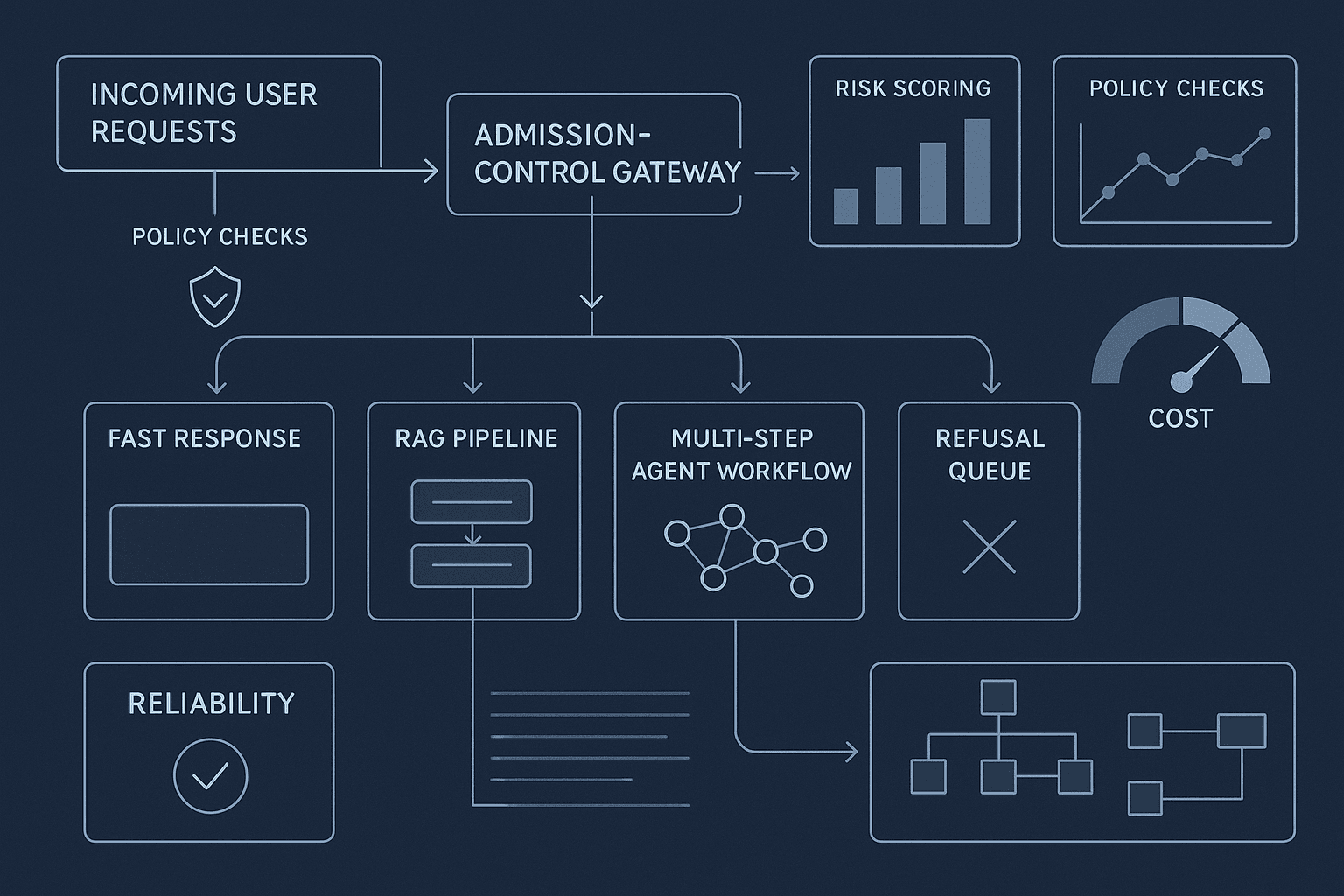
In a production GenAI system, admission control is the layer that decides, before orchestration begins, what class of handling a request deserves. It determines whether a request should get a lightweight direct answer, a constrained retrieval-augmented generation flow, a multi-step agentic workflow, a human-review path, a deferred async job, or a fast refusal. It is not just a safety filter, and it is not just an intent classifier. It is a decision system that balances user value, business cost, operational reliability, policy constraints, and model confidence.
Well-designed admission control changes the economics of GenAI systems. It also changes the shape of engineering work. Instead of endlessly tuning one giant prompt-and-tools stack, you create explicit routes with clear eligibility rules, budgets, and success criteria. That makes systems easier to reason about, easier to evaluate, and easier to operate.
This article lays out a practical design for admission control in production GenAI: how to classify requests, score risk and value, decide among prompt-only vs RAG vs agents, reject or defer requests that should not proceed, integrate policy, and evaluate whether routing is actually improving the system.
The failure mode: one orchestration path for everything
Here is a scenario I have seen in multiple forms.
A team launches an internal operations copilot. Initial scope is modest: answer questions about process documentation, summarize tickets, and help users draft support responses. The first version works surprisingly well in demos, so more capabilities are added. It can search docs, query internal APIs, create tickets, trigger workflows, compare historical incidents, and browse approved knowledge sources. To make all of this possible, the team builds a capable agent runtime with retrieval, a planner, several tools, and a memory layer.
At first, usage is low enough that sending everything through the full runtime seems fine. But over time a few production realities show up.
First, the majority of requests are simple. Many are variants of “what is the escalation policy?” or “summarize this note” or “rewrite this message politely.” These do not need planning, tool use, or retrieval over ten indexes. Yet they incur the same startup overhead and often the same model choice as far more difficult tasks.
Second, some requests are impossible or unsupported. Users ask the system to make approvals it is not authorized to make, provide legal interpretations, or act on data sources the platform does not expose. Without strong admission control, the system burns tokens trying to comply, then fails late.
Third, high-risk requests are mixed into the same queue. A request that touches financial actions or regulated customer data should get stricter policy checks, tighter prompts, stronger evidence requirements, and lower tolerance for uncertain outputs. But if routing happens only after the agent starts acting, those checks are too late.
Fourth, latency tails become brutal. The median user may tolerate a few seconds, but p95 and p99 are what sink trust. Every request now includes retrieval fanout, tool arbitration, and one or more reasoning loops, so transient slowness in any dependency spills into the whole product.
Fifth, costs become detached from value. The platform spends the most on requests that may not merit it and under-invests in requests that actually do. Teams then try blanket optimizations like a cheaper model for everything, fewer retrieval calls for everything, or stricter token limits for everything. These usually hurt quality in the wrong places.
The pattern underneath all of this is a missing pre-orchestration decision layer.
Pattern identification: requests differ in value, risk, complexity, and evidence needs
The core insight behind admission control is simple: requests are not homogeneous. Before you decide how to answer, you should decide what kind of problem this is.
In practice, the dimensions that matter most are:
-
Intent and actionability Is the user asking for a direct text transformation, factual lookup, recommendation, workflow execution, or open-ended analysis? Can the task be completed with the system’s available capabilities?
-
Evidence requirement Can the answer be safely generated from stable instructions and general language competence, or does it require fresh, domain-specific, or user-specific evidence?
-
Risk What is the downside of a wrong answer or wrong action? Does the request touch regulated domains, money movement, account changes, privacy, security, or externally visible commitments?
-
Expected value What is the business or user value of spending more compute and latency here? Is this a high-value task where better groundedness or deeper reasoning materially matters, or a low-stakes task where a fast approximation is enough?
-
Complexity and decomposition need Does the task require planning, iterative tool use, multi-hop retrieval, or stateful interaction across systems? Or is that likely overkill?
-
Confidence and supportability Given available context, policies, and tools, how likely is the system to succeed? Are required entities identified? Are key constraints present? Is the request in a supported domain?
Once you recognize these dimensions, the routing problem becomes clearer. Admission control is a budget allocator and risk manager. It decides where to spend system complexity.
Why the naive approach fails
The naive approach usually looks like one of these:
- A single “best” model and prompt for all requests
- A default RAG pipeline for all requests
- An agent runtime as the front door for all requests
- Safety checks that run only after generation or tool planning
- Handwritten if/else routing based on a tiny set of intents
Each of these fails for predictable reasons.
Single path means the worst-case architecture becomes the default architecture. If an agent loop is needed for 10% of requests, but 100% take that path, cost and latency are structurally inflated.
Default RAG is often cargo cult grounding. Retrieval adds value when the answer depends on external or dynamic knowledge, but many tasks do not. Pulling context into every request can lower answer quality by adding noise, create more prompt variability, and raise token cost.
Agent-first systems are especially vulnerable to reliability problems. The more steps you require before the user gets an answer, the more ways the system can fail: empty retrieval, tool timeouts, planner errors, schema mismatches, rate limits, and runaway loops.
Late safety checks are too expensive and too weak. If the model has already reasoned over sensitive data or prepared tool calls, you have already incurred risk and cost.
Pure intent routing is not enough because the same intent can have very different evidence needs and risk profiles. “Summarize this” could be harmless text rewriting or summarization of privileged, regulated material. “What should I do?” could be a casual suggestion request or an operational instruction with serious consequences.
The better approach is to treat admission control as a first-class subsystem with explicit routes, policies, and budgets.
A better approach: an admission-control architecture for GenAI
A practical architecture has five layers before heavy orchestration kicks in.
-
Request normalization Normalize raw input into a structured representation: user identity, tenant, channel, request text, attached files, referenced objects, session state, feature flags, and product surface. This is also where you enrich the request with metadata such as user role, prior conversation context, account permissions, and environment constraints.
-
Fast gating and policy checks Apply deterministic checks first. Examples:
- Authentication and tenant eligibility
- Product capability availability
- Data access permissions
- Hard policy denials, such as disallowed content or unsupported actions
- Basic schema validation for action requests
These should be cheap, explainable, and auditable.
- Request understanding and scoring Use lightweight models and rules to infer task type and assign scores for risk, value, evidence need, and likely complexity. This can combine:
- Small classification model or fast LLM prompt
- Regex and entity extraction
- Business rules keyed by domain, user role, and target action
- Historical telemetry on similar requests and outcomes
The output is not “the answer.” It is a routing decision object.
- Route selection and budget assignment Choose a route such as:
- Prompt-only direct response
- Prompt + small contextual memory
- Single-shot RAG
- RAG with re-ranking and citation requirements
- Multi-step tool workflow without autonomous planning
- Full agent with bounded planning and execution budget
- Async deferred processing
- Human review
- Fast refusal
This stage also assigns budgets: model tier, max latency, token cap, retrieval depth, tool allowlist, and maximum action scope.
- Route-specific execution with post-checks Only after admission do you run the chosen path. Each route has its own prompts, evidence standards, validators, and fallbacks. A low-risk text rewrite route should not inherit the same machinery as a high-risk action route.
A useful mental model is that admission control sits where API gateways and workflow engines meet. It is the traffic controller for your intelligence stack.
A concrete routing framework
In practice, I recommend defining a small number of execution classes instead of many bespoke flows. Most teams do well with four to seven.
Class 0: Fast refusal or redirect Use when the request is disallowed, unsupported, missing required information, or too risky for autonomous handling.
Examples:
- “Approve this payment over $50,000” when the system lacks authority
- “Give me legal advice on this contract” in a non-legal product
- “Delete all customer records” without authorization
Behavior:
- Refuse clearly or redirect to the correct human/process path
- Explain constraints without over-disclosing policy internals
- Ask for missing info only if completion is realistic and allowed
Class 1: Lightweight response Use for low-risk, low-evidence tasks.
Examples:
- Rewrite, summarize, translate, classify, extract structured fields from provided text
- Answer product-usage questions covered by stable instructions
Architecture:
- Small or mid-size model
- Tight prompt template
- No retrieval unless a tiny local memory lookup is necessary
- Low token budget
Class 2: Grounded answer with constrained RAG Use when the answer depends on domain or tenant knowledge but does not require action execution or planning.
Examples:
- “What is our escalation policy for severity 2 incidents?”
- “Compare these two internal standards”
- “What changed in the benefits policy?”
Architecture:
- Retrieval from approved corpora
- Re-ranking if corpus is broad
- Citation or evidence snippets required
- Mid-size or strong model depending on synthesis complexity
- No autonomous external actions
Class 3: Structured workflow execution Use when the request maps to a known workflow with tool use, but not open-ended planning.
Examples:
- “Create a support ticket with this summary and assign to team X”
- “Generate a weekly incident report from these systems”
- “Pull account status and draft an outreach email”
Architecture:
- Intent-to-workflow mapping
- Parameter extraction and validation
- Deterministic sequence of tool calls
- Model used mainly for extraction, summarization, and user-facing explanation
- Strong guardrails and schema checks
Class 4: Bounded agentic workflow Use only when the task truly needs iterative reasoning, uncertain decomposition, or adaptive tool selection.
Examples:
- “Investigate why this integration has failed across multiple customers and propose likely causes with evidence”
- “Analyze this multi-system outage timeline and identify probable contributing factors”
- “Research approved sources, compare options, and generate a recommendation memo”
Architecture:
- Planner/executor or tool-using model
- Strict tool allowlists
- Max step count and time budget
- Intermediate state logging
- Escalation to human on uncertainty or policy boundaries
Class 5: Deferred or human-in-the-loop Use for long-running, expensive, or high-consequence tasks.
Examples:
- Large document reviews
- Complex compliance analysis
- Batch jobs across many objects
- Requests requiring explicit approval
Architecture:
- Queue-backed async orchestration
- Status updates to user
- Review checkpoints or approval gates
This structure keeps most traffic out of the expensive class while still supporting high-value tasks.
How to score requests
A routing framework is only as good as its scoring. You do not need a perfect classifier; you need a scoring system that is good enough to separate cheap-safe from expensive-risky and supported from unsupported.
I recommend four core scores on a 0–1 or low/medium/high scale.
Risk score This captures harm if the output or action is wrong.
Signals:
- Domain: legal, medical, financial, HR, security, admin
- Action verbs: approve, delete, send, change, terminate, reset
- Sensitive entities: PII, payment details, credentials, customer contracts
- Externality: will the result be sent externally or trigger a system action?
- User role and authority
Value score This estimates whether spending more compute has meaningful payoff.
Signals:
- Business criticality of the workflow
- User segment or role
- Frequency and repeatability
- Downstream time saved or revenue impact
- Whether improved answer quality changes decisions or outcomes
Evidence-need score This estimates how much the answer must be grounded in external or tenant-specific information.
Signals:
- Temporal language: current, latest, changed, today
- Internal references: policy, account, ticket, contract, knowledge base
- Need for citations or provenance
- Likelihood that generic model knowledge is insufficient
Complexity score This estimates whether the task needs decomposition or multiple steps.
Signals:
- Number of distinct subgoals
- Need to compare entities across systems
- Ambiguous target state
- Need for tool use or state changes
- Prior requests in session indicating iterative troubleshooting
From these, you can derive route eligibility. For example:
- Low risk + low evidence need + low complexity -> Class 1
- Medium evidence need + low actionability -> Class 2
- Medium risk + known workflow + required tool action -> Class 3
- High complexity + supported domain + bounded toolset -> Class 4
- High risk + low confidence or unsupported capability -> Class 0 or Class 5
Confidence is the tie-breaker. If the classifier is uncertain, prefer safer or cheaper routes unless business policy says otherwise.
When to use lightweight prompting vs full RAG vs agents
This is where many systems overbuild.
Use lightweight prompting when:
- The task is transformation, extraction, rewriting, summarization of provided content, or generic guidance
- Freshness is not critical
- The model does not need external facts to succeed
- The cost of occasional imperfection is low
Typical stack:
- Fast model
- Short prompt with explicit output schema if needed
- Optional small memory snippet from session
- Output validator for structure and toxicity/policy
Use RAG when:
- Correctness depends on domain or tenant facts
- Users expect citations or provenance
- Policies, docs, or records change frequently
- The answer needs grounding but not autonomous action
Typical stack:
- Query rewrite or expansion only if it improves retrieval measurably
- Hybrid retrieval if corpus is heterogeneous
- Re-ranking for top-k quality
- Context packing under a strict token budget
- Answer constrained to retrieved evidence, with abstention if evidence is weak
Use agentic workflows when:
- The task genuinely requires iterative tool interaction or decomposition
- The system must inspect intermediate results before deciding the next step
- A predefined workflow cannot cover enough variance
- The added value exceeds the extra cost, latency, and failure surface
Typical stack:
- Stronger model or tool-optimized model
- Bounded planning horizon
- Tool allowlists tied to route and user permissions
- Execution budget with hard stop conditions
- Intermediate verification and possible handoff
A useful rule: if you can turn an agent task into a structured workflow for the top 80% of cases, do it. Reserve agents for the long tail where flexibility is genuinely necessary.
Policy integration: don’t bolt it on after the fact
Admission control is one of the best places to integrate policy because it is where intent, authority, and execution scope first become clear.
At minimum, policy should influence:
- Whether the request is allowed at all
- Which route classes are permitted
- Which tools and data sources are available
- Whether citations or stronger evidence are required
- Whether human approval is needed before action
- What model class may be used for the request
- Whether outputs must include disclaimers or confidence indicators
For example, a high-risk HR request may be allowed only in Class 2 with approved HR documents as the sole retrieval corpus, no open web access, mandatory citations, and mandatory abstention on ambiguous policy interpretation. A finance action request may be routed to Class 3 with deterministic workflows and dual authorization, but never to a free-form agent route.
The policy engine should be as deterministic and inspectable as possible. Use models to infer features; use explicit rules to enforce constraints.
Implementation details that matter in production
- Separate classification models from execution models Do not spend your most expensive model deciding whether to use your most expensive model. A small classifier model, compact LLM, or even a hybrid rules-plus-model layer can do most routing work well enough.
In many systems, the admission decision can be made in tens or hundreds of milliseconds with a far cheaper model than the one reserved for harder execution paths.
-
Make routes explicit and versioned Treat routes like product surfaces. Give them names, owners, prompts, budgets, tools, policies, and evaluation suites. Version them. When incidents happen, you want to know whether “Class 2 v3 for HR policy answers” degraded, not just that “the assistant felt worse.”
-
Budget every route Each route should have hard limits:
- Max prompt tokens
- Max completion tokens
- Max retrieval documents
- Max tool calls
- Max elapsed time
- Max retries
Budgeting is a reliability feature as much as a cost feature.
-
Prefer deterministic workflows over open-ended agents where possible If a task corresponds to a business process, encode the process. Use the model for language understanding and generation, not for inventing the process from scratch on every request.
-
Design for abstention A strong admission-control system does not force every request into a “best effort” answer. It creates valid end states like:
- refuse
- ask clarifying question
- defer to async
- request human approval
- answer only from evidence found
- state insufficient evidence
Abstention is often the correct product behavior.
- Log routing decisions and rationale For every request, store:
- extracted features
- assigned scores
- selected route
- policies applied
- budgets assigned
- confidence level
- final outcome and user feedback if available
These logs become your evaluation and optimization backbone.
- Use cheap prechecks before retrieval and tools Common examples:
- Is the request just a rewrite of provided text?
- Is the answer likely in a tiny FAQ cache?
- Is the action unsupported?
- Are required identifiers missing?
Every successful cheap exit avoids downstream complexity.
Model and tool comparisons
There is no universal best model strategy for admission control, but some patterns are durable.
For request classification:
- Small specialized classifiers are cheap, stable, and fast for narrow taxonomies
- Small LLMs are flexible for evolving categories and richer feature extraction
- Rules remain essential for hard constraints and entity-based risk checks
For lightweight responses:
- Fast low-cost models often perform very well on rewriting, extraction, and simple summarization
- Larger models may improve edge-case robustness, but the ROI is often weak for low-risk tasks
For RAG synthesis:
- Mid-tier models are often enough if retrieval quality is strong and prompts enforce evidence use
- If corpus quality is noisy, stronger models may mask retrieval problems temporarily, but you are often better off improving retrieval, chunking, metadata, and re-ranking first
For agentic work:
- Tool-use reliability, function calling quality, and long-context discipline matter more than benchmark hype
- Models that are strong in open-ended reasoning but weak at structured tool use can be poor production choices
For retrieval stack:
- Hybrid search often beats pure vector search in enterprise corpora because keywords, IDs, and exact names matter
- Re-ranking is frequently worth the latency for high-value grounded answers
- Query rewriting helps only if validated; it can also drift intent and retrieve the wrong evidence
Cost and latency tradeoffs
Admission control is fundamentally about shifting the cost-quality frontier.
Imagine a workload where:
- 50% of requests are lightweight transformations
- 30% are grounded questions needing RAG
- 15% are deterministic workflow requests
- 5% truly need agentic behavior
Without admission control, if all requests hit the agent stack, your latency and cost are shaped by the most expensive 5%.
With routing:
- Half your traffic may complete in under one second on a cheaper model
- A large share can use bounded RAG with predictable retrieval cost
- Workflow requests can avoid planning loops entirely
- Only a small minority consume high-end models and repeated tool calls
Even rough routing can create dramatic gains:
- Lower average cost per request
- Better p95 latency because fewer requests depend on many components
- Higher reliability due to smaller failure surfaces on simple tasks
- Better safety because high-risk requests receive stricter handling early
One practical way to think about route economics is expected value per marginal second and per marginal dollar. Do not ask whether an agent gives slightly better answers in aggregate. Ask whether the additional latency and spend improve outcomes enough for the subset of requests that truly need it.
Evaluation design: how to know routing is working
Admission control needs its own evals. If you only evaluate final answer quality across the whole system, you can miss routing failures that waste money or create risk.
I recommend evaluating at three levels.
- Route selection accuracy Build a labeled dataset of requests with ideal routes and unacceptable routes.
Measure:
- Route accuracy
- Precision/recall for high-risk detection
- Precision/recall for “needs grounding” classification
- Precision/recall for “needs agent” classification
- Refusal appropriateness
- Clarification appropriateness
Do not optimize just for overall accuracy. Missing a risky request is very different from over-routing a harmless one.
- Route-specific quality For each route class, evaluate what success means there.
Examples:
- Class 1: format correctness, concise usefulness, low latency
- Class 2: citation accuracy, answer faithfulness to evidence, abstention on missing evidence
- Class 3: parameter extraction accuracy, workflow completion rate, side-effect correctness
- Class 4: task success under budget, tool-call validity, loop rate, escalation appropriateness
- System-level business metrics Measure whether admission control improves production outcomes.
Examples:
- Average cost per resolved request
- p50/p95/p99 latency by route and overall
- Failure rate by route
- Human escalation rate
- Unsafe-action prevention rate
- User satisfaction or task completion
- Percentage of requests handled by each route
- Regret metrics: cases where a cheap route should have gone heavy, or vice versa
Counterfactual evaluation is especially useful. Periodically sample requests and run them through an alternative route offline to estimate whether your router is under- or over-escalating.
A practical eval set should include adversarial and annoying real-world cases:
- Requests with mixed intents
- Ambiguous action requests missing identifiers
- High-risk wording disguised as generic help
- Questions that look factual but need current internal policy
- Open-ended tasks that sound complex but are actually unsupported
- Benign tasks that should definitely not trigger RAG or agents
Common failure patterns to watch for
-
Everything drifts upward into heavier routes Teams get nervous about mistakes and start over-routing. This protects quality in the short term but quietly destroys economics. Track route distribution over time.
-
Retrieval becomes a crutch for poor prompting If simple tasks are frequently routed to RAG, ask whether your lightweight route is under-specified rather than assuming grounding is needed.
-
Agent routes become dumping grounds Once agents exist, product teams may route every hard-looking problem there. Require explicit eligibility criteria and outcome reviews.
-
Policy and routing diverge If policy teams update constraints without corresponding routing logic, requests may reach routes that should never see them. Keep policy changes versioned and integrated with route tests.
-
No feedback loop from execution back to admission If execution repeatedly fails for a route-task combination, the router should learn from that. Admission control is not static.
An implementation pattern that works
A proven implementation pattern looks like this:
Step 1: Build a request schema Define a normalized request object with user metadata, permissions, tenant context, text, attachments, referenced entities, requested action, and session context.
Step 2: Add deterministic gates Implement capability, auth, policy, and schema checks that can refuse early.
Step 3: Add a lightweight scoring layer Start simple. A small LLM or classifier can output:
- intent
- actionability
- evidence need
- complexity
- risk flags
- missing information
- recommended route
- confidence
Step 4: Encode routing policy in rules Do not let the model make the final routing decision alone. Combine model output with deterministic rules like:
- if payment action and no approval scope, refuse
- if internal-policy question and approved corpus exists, RAG
- if transformation-only and no external facts needed, lightweight route
- if open-ended investigation across tools and user has permission, bounded agent
Step 5: Attach budgets and tool scopes by route This is where you operationalize tradeoffs.
Step 6: Instrument everything Log route choice, budgets, execution outcome, user feedback, and overrides.
Step 7: Run shadow evaluations Before changing routes in production, shadow route decisions on live traffic and compare predicted route vs actual best route inferred from outcomes.
Step 8: Create a human override path Operations teams should be able to force a safer route, disable a route, or tighten budgets during incidents.
What this looks like in pseudocode
A simplified decision flow might look like:
- Normalize request
- Apply hard denials and auth checks
- Extract features and scores
- If unsupported or disallowed -> refuse
- If high risk and low confidence -> defer or human review
- If low evidence need and low complexity -> lightweight response
- If high evidence need and no action -> RAG
- If known workflow and valid parameters -> structured workflow
- If high complexity, supported tools, and within policy -> bounded agent
- Else ask clarifying question or refuse
The key point is not the exact tree. The key is that route selection happens before expensive orchestration, not inside it as an afterthought.
Takeaways
Admission control is one of the highest-leverage patterns in production GenAI because it addresses the hidden anti-pattern behind many failing systems: using the same expensive path for every request.
If you remember only a few things, remember these:
First, routing is not just intent classification. It is a decision about risk, evidence need, complexity, value, and confidence.
Second, most requests do not need agents. Many do not even need retrieval. Reserve expensive orchestration for requests where it materially improves outcomes.
Third, refusal, deferral, clarification, and human review are not failures. They are correct product behaviors when confidence is low or risk is high.
Fourth, policy belongs in admission control, not only after generation begins. Deterministic constraints should shape route eligibility, tools, and budgets.
Fifth, evaluate routing as its own subsystem. Measure route accuracy, route-specific quality, and system-level economics and safety.
Finally, keep the architecture explicit. Version routes. Assign budgets. Log rationale. Learn from execution outcomes. The goal is not to build the smartest possible pipeline for every request. The goal is to spend intelligence where it matters and decline, defer, or simplify everywhere else.
That is how GenAI systems become production systems instead of demos with invoices attached.